DRAWING LIFE by fred hatt

2013/12/20

Invitation to an Exhibition

solstice-gradientThe winter solstice is the longest night of the year. Now, in the Northern hemisphere, the days will start to get longer. To all my readers, a Blessed Solstice, a Merry Christmas and a Happy New Year.

My dear friend Claudia, the art model and Museworthy blogger, has posted the 2013 Museworthy Art Show. Claudia invited her readers to submit artwork based on their choice among four of my photographs of her. Click the link and check it out. I’m a big part of this wonderful and diverse gathering of artwork, since I took the source photos and also submitted a drawing for the show. I think this show is a brilliant idea. A blog brings together a great diversity of people around some shared interests, people scattered across the globe, people with different sensibilities and different abilities. Normally it’s all sort of vague, anonymous lurkers and commenters you know little about. Claudia’s show creatively manifests the community she’s growing.

2013/12/09

Vowels

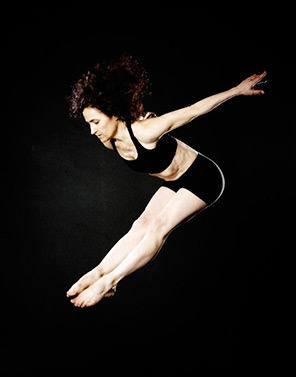
Barefoot, 2013, by Fred Hatt

Barefoot, 2013, by Fred Hatt

This post is an experiment. Some of my recent abstract watercolors, landscape sketches, and doodles have been randomly interspersed between the lines of Arthur Rimbaud’s synesthetic 1872 sonnet “Voyelles”. The original French poem and English translation by Oliver Bernard were copied from this site (where the fourteen-line sonnet is followed by a four-line “envoi” which is not included here below or in most versions of this poem I could find online). Oliver Bernard’s version is a prose translation, striving for the clearest expression of the sense of the original while sacrificing meter and musicality. If this version is too flat for you, check out Canadian poet Christian Bök’s fascinating version of “Voyelles”, translated five different ways.

These paintings were not inspired by this poem, and they have been sequenced randomly to avoid any specific reference to the colors or images mentioned in Rimbaud’s verses. When I draw or paint abstractly, I disengage my mind as much as possible from discursive thought and allow subconscious impulses to express themselves in the movement of the brush and the liquid medium. Imagery never drives the painting – any images are projections of the imagination, like the forms seen in Rorschach blots. I am trying to allow impulses of movement to arise from below the surface of awareness, as in my practice of Authentic Movement, described in this post. Perhaps this way of going fishing in the unconscious has something in common with the methods of a proto-surrealist poet like Rimbaud. Perhaps some accidental resonances may arise from the interleaving of sketches and lines of verse.  If not, please enjoy my humble doodles and Rimbaud’s delirious words separately!

Extinct Animals, 2013, by Fred Hatt

Extinct Animals, 2013, by Fred Hatt

A noir, E blanc, I rouge, U vert, O bleu: voyelles,

A Black, E white, I red, U green, O blue: vowels,

Pastries, 201e, by Fred Hatt

Pastries, 201e, by Fred Hatt

Je dirai quelque jour vos naissances latentes:

I shall tell, one day, of your mysterious origins:

Ego,m 2013, by Fred Hatt

Ego,m 2013, by Fred Hatt

A, noir corset velu des mouches éclatantes

A, black velvety jacket of brilliant flies

fredhatt-2013-autumn-wind

Autumn Wind, 2013, by Fred Hatt

Qui bombinent autour des puanteurs cruelles,

Which buzz around cruel smells,

Plant Spirit, 2013, by Fred Hatt

Plant Spirit, 2013, by Fred Hatt

Golfes d’ombre ; E, candeur des vapeurs et des tentes,

Gulfs of shadow; E, whiteness of vapours and of tents,

Path of Light, 2013, by Fred Hatt

Path of Light, 2013, by Fred Hatt

Lances des glaciers fiers, rois blancs, frissons d’ombelles;

Lances of proud glaciers, white kings, shivers of cow-parsley;

Pink Flowering Tree, 2013, by Fred Hatt

Pink Flowering Tree, 2013, by Fred Hatt

I, pourpres, sang craché, rire des lèvres belles

I, purples, spat blood, smile of beautiful lips

Electrical Storm, 2013, by Fred Hatt

Electrical Storm, 2013, by Fred Hatt

Dans la colère ou les ivresses pénitentes;

In anger or in the raptures of penitence;

Land Forms, 2013, by Fred Hatt

Land Forms, 2013, by Fred Hatt

U, cycles, vibrements divins des mers virides,

U, waves, divine shudderings of viridian seas,

Aromatic Tree, 2013, by Fred Hatt

Aromatic Tree, 2013, by Fred Hatt

Paix des pâtis semés d’animaux, paix des rides

The peace of pastures dotted with animals, the peace of the furrows

Mane, 2013, by Fred Hatt

Mane, 2013, by Fred Hatt

Que l’alchimie imprime aux grands fronts studieux;

Which alchemy prints on broad studious foreheads;

Green and Blue, 2013, by Fred Hatt

Green and Blue, 2013, by Fred Hatt

O, suprême Clairon plein des strideurs étranges,

O, sublime Trumpet full of strange piercing sounds,

Coral, 2013, by Fred Hatt

Coral, 2013, by Fred Hatt

Silence traversés des Mondes et des Anges:

Silences crossed by Worlds and by Angels:

Bosom, 2013, by Fred Hatt

Bosom, 2013, by Fred Hatt

— O l’Oméga, rayon violet de Ses Yeux!

O the Omega, the violet ray of Her Eyes!

Tracks, 2013, by Fred Hatt

Tracks, 2013, by Fred Hatt

I recently discovered the work of the comics artist Julian Peters. One of his specialites is illustrating poetry, including work by Poe, Keats and Eliot. He has a really beautiful comic of Rimbaud’s “Le Bateau Ivre”/”The Drunken Boat” – click on the appropriate title to see it in either English or French.

Color pieces in my post are watercolor paintings except “Green and Blue”, which is drawn with aquarelle crayons and blended with water. Black and white pieces are drawn with Tombow brush markers. “Mane” and “Tracks” are 11″ x 14″ (28 x 35.6 cm), “Ego” is 8.5″ x 11″ (21.6 x 28 cm), and all others are 5.5″ x 8.5″ (14 x 21.6 cm).

2013/08/24

In the Presence of the Watcher

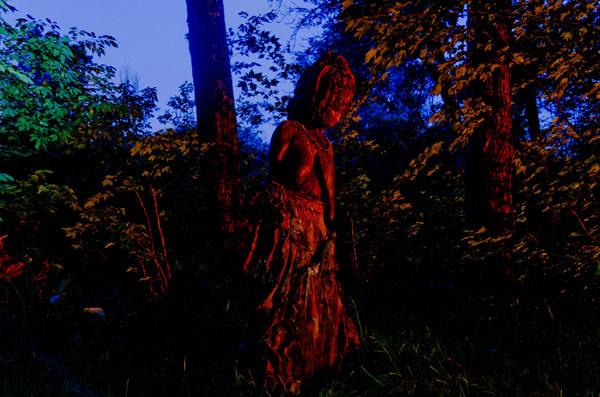
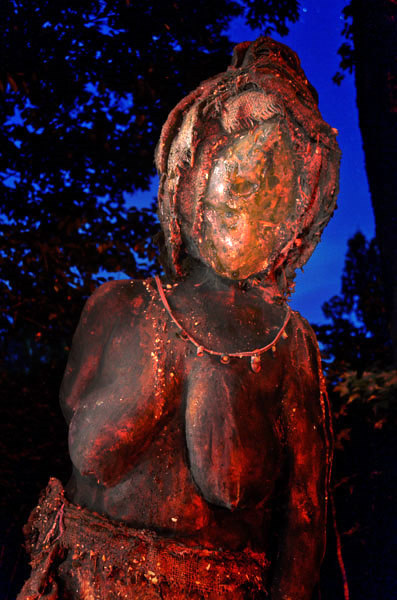
The Watcher at Night, 2013, photo by Fred Hatt

The Watcher at Night, 2013, photo by Fred Hatt

The Watcher is a life-size figurative sculpture that overlooks a quiet path in the woods at the Brushwood Folklore Center in Sherman, New York. It’s been there for six or seven years, but coming upon it, you’d think it had been there for centuries. It seems to grow out of the land, manifesting the spirit of the place.

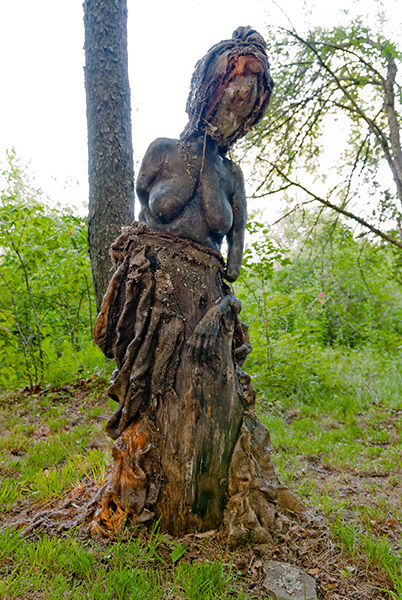
The Watcher, front view, 2009, by Fred Hatt

The Watcher, front view, 2009, by Fred Hatt

If this is a wood nymph, it is no pale, delicate fairy. The Watcher is rough and gnarled like an old tree, an embodiment of life force that survives the lashings of seasons by twisting and toughening and enduring.

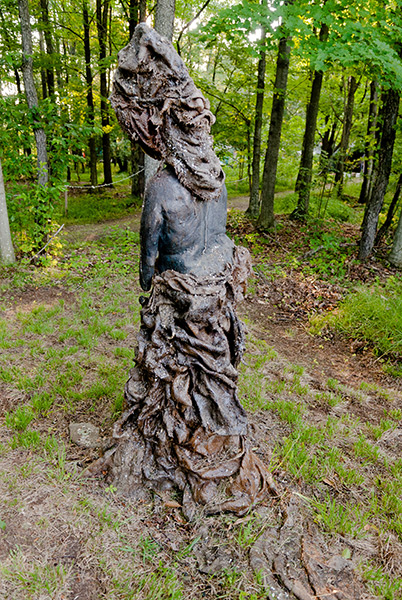
The Watcher (back view), 2009, photo by Fred Hatt

The Watcher, back view, 2009, photo by Fred Hatt

Bellavia is the artist who created The Watcher. For many years she has been a strong presence in the creative community of the festivals at Brushwood. A few years ago she moved from Western New York to New Orleans, but still returns to Brushwood when she can. (Click on her name above to see other artwork by Bellavia.)

Bellavia, 2004, photo and face paint by Fred Hatt

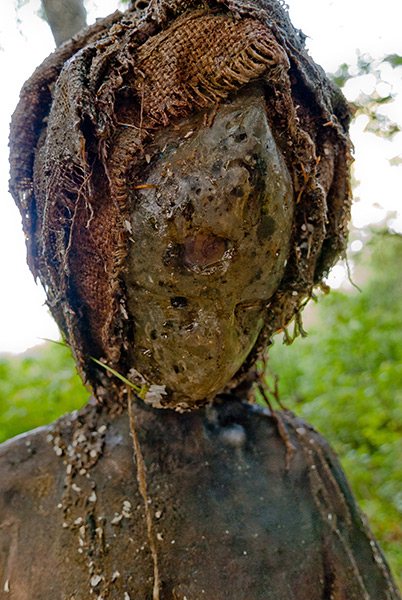
The Watcher is made is made of bronze, pine, burlap, organic matter, fiberglass resin, bone, and cast glass. Parts of it are cast from a live model, Liag, who is a friend of the artist. Liag told me “I have felt an attachment to The Watcher since I first saw Bella’s sketches in 2004.  The process of me becoming part of the sculpture, my torso and arms and hand, was profound.  I feel she is now part of me.  I sense her presence within and around me all the time.  She is alive.”

Head of the Watcher, 2009, photo by Fred Hatt

Head of the Watcher, 2009, photo by Fred Hatt

I asked Bellavia if she designed the work in advance or if it emerged from experimentation. She replied, “I had a rough vision of the piece when I started. It turned out a little like the sketches but so very different at the same time. The piece itself takes over at some point and brings itself to the front and I just become a conduit for it.”

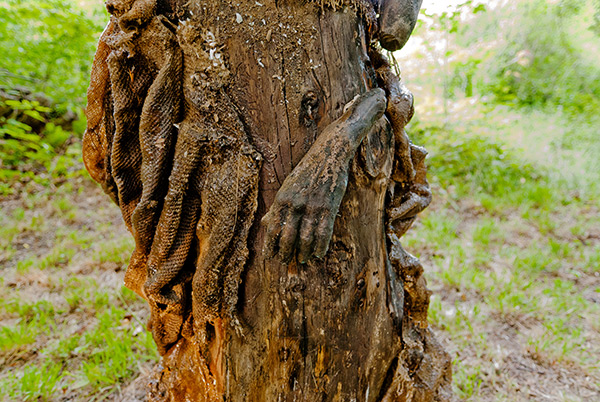
Hand of the Watcher, 2009, photo by Fred Hatt

Hand of the Watcher, 2009, photo by Fred Hatt

She said the Watcher “was not made with brushwood in mind. I don’t work with places in mind for the work. I simply could not move her down south with me and I felt like I really wanted to give something back to the community at Brushwood.”

The Watcher, upper body, 2009, photo by Fred Hatt

The Watcher, upper body, 2009, photo by Fred Hatt

For Bellavia, the work is about female identity and body image. In an artist’s statement, she says:

As a human who happens to be a woman I am all too aware that public opinion and disapproval is something that we are still essentially bound by. Our societal teachings about the many aspects of “self” are generally distorted and inaccurate. I am interested in presenting the viewer with a look into those distortions and offering glimpses of the possibilities in transforming that fear of disapproval or censure. My personal modes of perception towards the meaning and substance of life in all its complexities cause my work to be up close, personal and visceral. My artwork is exploration as a process of defining/redefining an image of the self and body. Oftentimes beautiful, dangerous and disturbing, a palpable presence arises from my work. There is always a hint of darkness underneath the beauty, completing the circle of light and dark. My work is daring, and shows courage, grace and beauty in being willing to challenge normal assumptions about sexuality and boundaries. I am very upfront about the assertion of ones sexuality and exploration of such. I am often my own subject, facing myself, my past and my demons. I endeavor to show the transformation process that starts in the soul towards a new definition of the self. This artistic process brings a freedom from the weight of prejudices, traditions, and custom and the healing from that lies not in distancing myself from it, not in attempting to heal it, but in embracing the experience as part of being alive.

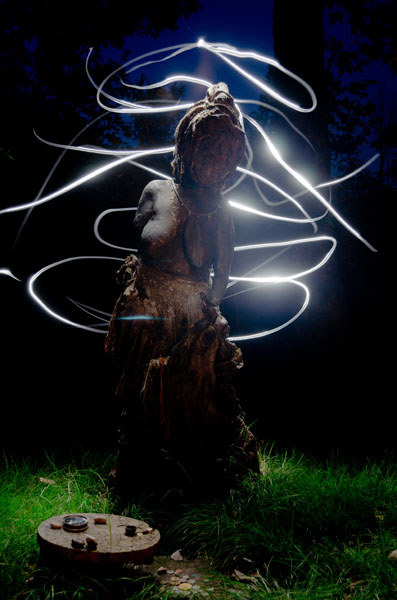
Eye of the Watcher, 2013, photo by Fred Hatt

Eye of the Watcher, 2013, light painting photo by Fred Hatt

Many people are drawn to spend time with The Watcher, and a sort of altar has grown around the base of the sculpture. I feel a power in the work, and I’ve occasionally tried to capture some of its spirit in photographs. This summer, I used The Watcher as a model for light painting. Light painting photographs are taken in the dark with a long exposure time, during which I move around the subject with flashlights or other hand-held lights, applying strokes of light to bring out aspects of the form or to suggest energy within.

The Watcher with Wings, 2013, photo by Fred Hatt

The Watcher with Wings, 2013, light painting photo by Fred Hatt

The video below is made up of some of my light painting images of The Watcher, dissolving one into another so that light seems to move around and animate her earthy form. This is my personal exploration of the palpable presence of The Watcher.

The Watcher from Fred Hatt on Vimeo.

All of the photographs in this video are straight shots, with no digital painting or manipulation.

2013/05/26

Life Drawing at ADaPT


Sample works by visual artists participating in the ADaPT Festival Life Drawing Score, clockwise from left: Michael Alan, Jillian Bernstein, KIMCHIKIM, Masha Braslavsky, Fred Hatt, Susan M. Berkowitz, IURRO.

Sample works by visual artists participating in the ADaPT Festival Life Drawing Score, clockwise from left: Michael Alan, Jillian Bernstein, KIMCHIKIM, Masha Braslavsky, Fred Hatt, Susan M. Berkowitz, IURRO.

ADaPT (A Dance and Physical Theater) Festival, founded in 2011, hosts performances, master classes, and other events in its home base of Santa Barbara, California, and in locations around the world, including one on May 30, 2013 at CPR (Center for Performance Research) in Brooklyn. Festival director Misa Kelly is a dancer and choreographer with her company ArtBark International, and she’s also a life drawing artist and model – please click that last link to see some of Misa’s wonderful drawings.

Adapt Festival Program Orson, May 30 at CPR, features twelve performances by a diverse artists – the link has a full list and descriptions of the pieces. Misa’s a maximalist, surrounding her performance events with installations, projections and opportunities for audience members to express their own creativity. For this program, she asked me to recruit some visual artists and to act as monitor for a special “Life Drawing Score” in conjunction with the performance program.

Art modeling/life drawing is a form of performance, a creative interaction between models (many of whom are also performers in other contexts) and visual artists. This interaction is rarely seen outside of the small community of artists and models. Artwork may be exhibited, but the art audience may be unaware of the collaborative nature of artists’ work with models. Likewise, the dance and theater audience may not know that the performers’ experience modeling for artists is a vital part of their performance practice. Misa decided this special creative relationship deserved a place in a festival of dance and physical theater.

Misa Kelly, photo by Am Wu

Misa Kelly, photo by Am Wu

Here’s what will happen on May 30:

Invited visual artists will be having a private life drawing session in the performance space starting at 6 pm. I’ll be the session monitor. Our models will be Misa Kelly and one other dancer. (There will be no audience for this, until the last 20 minutes of it.)

At 7:15 the audience is invited to the Pre-Show in the lobby. There will be a video installation, sage smudging, and various activities intended to engage audience members to express their own creativity through writing, drawing, and moving.

At 7:35 the audience members will be allowed into the performance space to witness and/or participate in the last 20 minutes of the life drawing session.

At 8:05 there will be a full program of twelve dance and physical theater performances in the performance space. There are descriptions of all of these pieces here: ADaPT Festival Program Orson.

At the intermission (around 9:00) the audience will return to the lobby to see an informal exhibition of work created during the earlier private life drawing session.

Location: CPR (Center for Performance Research), 361 Manhattan Ave, Brooklyn, NY. Tickets $10 in advance or $15 at the door.

Links for participating artists and models:

IURRO

Jillian Bernstein

KIMCHIKIM

Masha Braslavsky

Michael Alan

Misa Kelly

Susan M. Berkowitz

2013/03/27

Exploring Together

Still from "Rocks Remember", 2011, video edited by Yuko Takebe

Still from “Rocks Remember”, 2011, video edited by Yuko Takebe

I’m interested in the moving body and movement in nature, and I’m always trying to capture the spirit of motion in my drawings, but of course I love actual moving pictures too. I like to make simple, non-narrative films, often working with dancers. A couple of years ago I suggested to my friend, dancer Kristin Hatleberg that if she would like to do some kind of dance film, I’d be up for it. She mentioned a curious landscape she wanted to explore, Ringing Rocks State Park, in Pennsylvania.

Still from "Ringing Rocks", 2011, video edited by Fred Hatt

Still from “Ringing Rocks”, 2011, video edited by Fred Hatt

Ringing Rocks Park has a large field of boulders that ring like metal bells when struck with a hammer or with another stone. These boulders are called “lithophonic” or “sonorous rocks”. Geologists believe the tones emitted by these stones are the result of “internal elastic stresses”, but the science isn’t settled. It’s a mysterious and enchanting phenomenon.

Still from "Rocks Remember", 2011, video edited by Yuko Takebe

Still from “Rocks Remember”, 2011, video edited by Yuko Takebe

So one day Kristin rented a Zipcar and we took a day trip to Bucks County, Pennsylvania. With us were Kristin’s friend Jim Smith, a composer and music producer, and my friend Yuko Takebe, a talented dance filmmaker who’d just gotten a new HD camcorder and was eager to put it to use. I had my camera with me too.

Still from "Ringing Rocks", 2011, video edited by Fred Hatt

Still from “Ringing Rocks”, 2011, video edited by Fred Hatt

We had almost no plan about how to film at this site, aside from the idea that Jim was going to go around and hammer on the rocks and record sounds, and Kristin was going to dance in the environment, and Yuko and I were going to film Kristin and the landscape. None of us had ever been to Ringing Rocks before, so we didn’t know exactly what we’d encounter. Together we would explore and collect images and sounds, and then we would see what we could make of them. It was a fairly egalitarian collaboration, and the whole process would be a journey without a map.

Still from "Rocks Remember", 2011, video edited by Yuko Takebe

Still from “Rocks Remember”, 2011, video edited by Yuko Takebe

There was a large clearing covered with big jagged boulders, a forested area, and a small ravine with a waterfall. It was a late autumn day so our daylight hours would be limited, and the angle of the sun would change quickly through the afternoon.

Still from "Ringing Rocks", 2011, video edited by Fred Hatt

Still from “Ringing Rocks”, 2011, video edited by Fred Hatt

Dancing on a jumble of sharp and irregular rocks is nothing like dancing in a studio with open space and a nice smooth hardwood floor. In fact, it’s a bit dangerous. I’m not sure if Kristin imagined doing balletic leaps from stone to stone, but when she actually started moving in the boulder field, she found herself hugging the rocks, rolling over them and in and out of the crevices. It looked a little like contact improvisation with very heavy, very hard dance partners.  Kristin took the same grounded, tactile approach to other elements of the landscape as well.

Still from "Rocks Remember", 2011, video edited by Yuko Takebe

Still from “Rocks Remember”, 2011, video edited by Yuko Takebe

Since there was no script and almost no plan, we all just sort of went about doing our own explorations in whatever way felt appropriate in the moment. Jim rang the rocks until he got the birds to join in the symphony. Yuko and I looked for aesthetically pleasing compositions and dynamic camera angles. Kristin climbed and stroked and became one with the earth.

Still from "Ringing Rocks", 2011, video edited by Fred Hatt

Still from “Ringing Rocks”, 2011, video edited by Fred Hatt

We decided that Yuko and I would share all our footage and sound recordings, but each of us would edit our own version of the material. When I started editing, I found it really challenging. It felt like a random collection of shots that just wouldn’t gel. There was no clear beginning, middle, or end, no unifying design, no choreographic continuity. The color and visual quality of the images from the two cameras was way different, and there were lots of technical problems such as sun glare and noisy tourists who were also at the park that day on the sound track. The rapidly changing light meant a shot made at 2:00 would never match with one made at 3:00.

Still from "Rocks Remember", 2011, video edited by Yuko Takebe

Still from “Rocks Remember”, 2011, video edited by Yuko Takebe

For my first edit, I decided to use just two parts of our footage, the waterfall scene and the field of boulders. I decided to convert everything to black and white, both to eliminate the color differences between the two cameras and to make Kristin, who was dressed in tones of pink and purple, blend in more with the textures of stone and earth. I pulled out what I thought were the best bits of movement and labeled them according to whether the movement was up or down or rotating or whatever, and then basically assembled those movements into an illusion of continuity. It sort of worked, but it had a monotonous rhythm, and after test-screening it for Kristin and my filmmaker friend David Finkelstein, I ended up making it more fragmented and spare, maybe more about the landscape and less about the dance. For my version of the piece, Jim Smith structured some of the sound recordings from the site into a simple composition.

I think my final version captures something beautiful about experiencing oneself as part of the earth by direct contact with it. Human beings are of the earth just as much as are stones or trees, and we should feel it in our bones and in our skin.

A video piece is something different than the experience by which its source material came to be.  In the end it becomes something in itself, something that is experienced as a moving image, by people who have no knowledge of its making. My struggle to structure this material into a piece helped me to find a new sense of how to assemble moving images, and after editing this piece I found I was finally able to complete several other video pieces I had shot that had lingered unfinished for years.

Still from "Ringing Rocks", 2011, video edited by Fred Hatt

Still from “Ringing Rocks”, 2011, video edited by Fred Hatt

I don’t know too much about how Yuko approached the task of editing. Her basic impulse is more narrative and less formal than mine, and she has a knack for making good use of “flaws” like camera shake and lens flare. Her version is in color,and I feel it gives more of a sense of Kristin as a person interacting with the landscape, where mine seems more like some kind of elemental ritual.

Still from "Rocks Remember", 2011, video edited by Yuko Takebe

Still from “Rocks Remember”, 2011, video edited by Yuko Takebe

Here’s what Kristin wrote about the experience:

When Fred asked what I’d like to collaborate on, I thought here’s a rare opportunity to distill a moment. What if every element of this lasting capsule, this film, results completely from its environment? I chose Ringing Rocks State Park because of how literally it could yield all the elements. Our agreement was to focus fully on the park itself, and for me the rocks were a solidity into which I could melt away. I set out to evaporate over them, roll like an ocean wave across their challenging formations. What a metaphorical parallel this act was to dealing with life. I used all my strength to simply be, there.

For me our experience at the Ringing Rocks State Park was a meditative experience, and I think that spills over into the intent of each of the resulting films. It was meditation that arose from necessity, for the sake of harmonious survival. While we were in the park, I was not there to recreate or mimic anything. Instead, my focus was to listen to all the textures. I dove into my senses and I tried to absorb every texture of the place until the most dominant ones seeped back out of me. Because I was approaching it through absorption, I was meditating and accepting. Accepting the jagged contours into my flesh as I rolled over them, softening the harshness of the landscape by joining a wave of air and riding its current over the topography. When each element has its autonomy, it is simpler to find harmony.

All I am doing in my actions is revealing what was revealed to me, simply by being there: there, hanging off the top of that rock upside down; there, perched between three trunks of a tree without a limb on which to sit; there, hearing the beautiful water while feeling the cold, smooth stone slide away from under me. The films that resulted therefore do not give me any answers or pose questions to me. They simply reveal contours, light, textures. Watching them, I can momentarily breathe again a cleaner air.

Still from "Ringing Rocks", 2011, video edited by Fred Hatt

Still from “Ringing Rocks”, 2011, video edited by Fred Hatt

Yuko said this about the experience:

I had never known stone that resonates like a bell until Kristin took me to Ringing Rocks Park. The high-pitched tone, but involving the profound sound as hit by a hammer, brought me to feel time immemorial. Kristin danced as if she were swimming, freely and slowly, between big rough rocks. Her movement looked like just a spirit of the rocks to me. The rock has immanent memories since the earth has existed, and its sound tells us the history of our life. The water flows and wind blows on the surface of the rocks. The beautiful golden strings are spun by a spider and gnats are flying between rocks. That moment fulfilled by stillness and serenity only appeared in an early evening glow. I wanted to capture the eternal flow of time and the spiritual harmony between the perpetuity of nature and a mortal life through Kristin’s dance and my lenses.

So now I have told you my story. My collaborators have offered their beautiful perspectives on this joint exploration of the land in movement and film. There is nothing left but for you to watch the two films, first, “Rocks Remember”, Yuko’s edit, and then “Ringing Rocks”, my version.

Rocks Remember from Yuko Takebe on Vimeo.

Ringing Rocks from Fred Hatt on Vimeo.

Both of these films will be projected outdoors as part of the SB-ADaPT Festival of Dance and Physical Theater in Santa Barbara, California, this summer. I’ll add the dates and more info here when I have it. 

« Newer PostsOlder Posts »

Powered by WordPress

Theme Tweaker by Unreal