DRAWING LIFE by fred hatt

2010/06/20

Exercising Perception

"Innenperspektive", illustration from "Beiträge zur Analyse der Empfindungen", by Ernst Mach, 1886, G. Fischer

 Your ability to draw what you see is limited by your ability to see.  Vision is not simply a mechanical process that is naturally perfect.  Seeing takes place more in the brain than in the eyes, and it can be transformed and expanded by serious practice, just like any other skill that involves the interaction of body and mind. 

The complexities of human visual perception, and techniques for training or honing your vision, are a topic for a whole book.  This post offers a collection of links and ideas as a very basic introduction. 

If you’re up for an experiment, this link describes a “Selective Attention Test” involving counting basketball passes in a video.  Read the description and then take the video test before reading further. 

Part of learning to see is simply learning to notice things.  Most people actually notice very little of what passes before their eyes.  What they do see is what they have been taught or told to pay attention to.  Stage magicians can make you not see something simply by directing your attention to something else.  (Unfortunately marketers and politicians have also mastered such manipulations of attention.) 

Cover of "Pilgrim at Tinker Creek" by Annie Dillard, first edition, 1974, Harper's Magazine Press

 In the classic Pilgrim at Tinker Creek, Annie Dillard writes eloquently about learning to see in the natural world.  Dillard is a poet, philosopher, artist, and keen observer of nature.  Her words helped awaken me to the rich and strange mystery of seeing.  Read chapter 2, titled “Seeing”, or better, get the book and treat yourself to one of the literary masterpieces of our time.  Learning how to see more and better is a primary concern of the whole book. 

Nearly any craft or specialty involves learning to see what most eyes would miss.  For example, the ancient Polynesian navigators, who crossed thousands of miles of ocean in simple boats without any instruments, learned to see land beyond the horizon by observing light reflected on the bottoms of clouds.   Noticing and naming the phenomenon awoke their vision to it. 

Surface Anatomy of the Back, fig. 477 from "Applied Anatomy: The Construction Of The Human Body" by Gwylim G. Davis, 1913, Lippincott

Surface Anatomy of the Back, fig. 477 from "Applied Anatomy: The Construction of the Human Body", by Gwylim G. Davis, 1913, Lippincott

 This is why figurative artists study anatomy.  When you learn the names and locations of bones and muscles, you can see them because you know what they are.  The subtle and sometimes confusing bumps and curves on the surface of the body are more clearly seen because you understand them as manifestations of an underlying structure. 

But there’s a contrary principle.  Sometimes what you know can actually make it hard to see what you see.  For example, you know that the legs, for instance, are long shapes.  But when they are foreshortened, that is, when they face you along their axis, they may not appear long at all.  Thinking of the leg as a long shape may interfere with your ability to see it as a foreshortened, oval form.  So there are cases in which you need to forget what you know in order to draw what you see. 

"The Dead Christ" by Andrea Mantegna, c. 1480

 The illustration at the top of this post is from The Analysis of Sensations and the Relation of the Physical to the Psychical,  by Austrian physicist and philosopher Ernst Mach, whose name has become the scientific term for the speed of sound.  Mach’s philosophy starts from the idea that all we can know, we know via the senses, so understanding how the senses work is fundamental to understanding anything.  In the illustration, he is attempting to represent the view from inside his head, through his left eye.  You can see his nose and mustache to the right of the eye socket. This is a pretty good representation of what you can see with one eye, sitting in one place, keeping the head still, but moving the eye around. 

Everything in the Mach illustration is in sharp focus.  If the eye does not move, only a tiny fraction of what it takes in is actually seen sharply.  The fovea is a dense cluster of light-sensitive cells in the center of the retina, the image-receiving surface in the eye.  The fovea sees in high-resolution and full color, but it only covers a very narrow spot of the complete field of view of the eye.  The eye does take in close to a 180 degree view, but away from center it becomes increasingly lower-resolution and less sensitive to color.  If you could capture a snapshot of sensor output from the retina for a single instant, it would look something like this simulation: 

Rough Simulation of Foveal and Peripheral Vision, illustration by Fred Hatt derived from "Fisheye Domilise's", photo by Editor B

 The eye provides a wide-field view, like a photographer’s fisheye lens, but not very sharp, superimposed with a very sharp narrow-angle view like that of a telephoto lens.  The wide view, or peripheral vision, is useful for noticing movement coming from any direction, and for orientation and aiming of the foveal center of attention.  Of course we’re just describing the raw data coming in from the eye.  The eye scans about and the visual cortex, or image processing center of the brain, knits all of this moving data together into a seemingly sharp view of everything.  But fix your eye on one word on the page of a book and see if you can read a word a few inches away without moving the eye, and you will see that the area of sharp vision is quite small. 

In observational drawing, we’re using these eyes, a sharp foveal scanning element combined with an unsharp peripheral image.  The foveal vision cannot see the whole shape or composition, just one small area at a time.  The peripheral vision can see the whole shape but without much clarity. 

Certain practices and exercises can train you to make better use of this dual data stream.  Artists understand this instinctively.  Often you’ll see artists squinting at their subject or at their work.  Squinting is a way of partially disabling the foveal vision, throwing the whole visual field out-of-focus.  Since foveal input usually dominates the processing functions of the visual cortex, disabling the fovea allows attention to take in more of the peripheral view.  This can help you to see the whole general field at once, understanding it as a simplified and unified shape.  If you are an artist trying to turn vision into a picture, that is just what you need.  It helps you to see compositionally, and to maintain proper proportions and spatial relationships. 

I do many practices to improve my visual perception, not just when I’m drawing but when I’m moving about in the world.  For example, I squint or cross my eyes to bring awareness to my peripheral view when I’m walking down the street.  It is not unsafe, as your peripheral perception, important for navigation and collision avoidance, is actually heightened when you’re doing these things.  Still, I don’t advise doing it while crossing a street as the unfamiliarity of looking at the world this way could be disorienting. 

I also use photography as a tool for honing perception.  If you carry a camera with a single focal-length lens, not a zoom, you will learn to look for images that fit within the angle of view of that lens.  Your brain will be composing your visual world into a rectangular frame as you look at it.  You are learning to see the world in terms of compositions and patterns, another vital skill for an artist. 

Whether you are an artist or not, exercises to improve your ability to perceive the world can open you up to more of the beauty the world has to offer, and can liberate you from some of the marketers’ attempts to manipulate what you notice. 

Illustrations in this post link back to their original online sources.

2010/04/16

Stories in the Round

Randolph Rogers, Nydia, the Blind Flower Girl of Pompeii, 1859, photo #2 by Fred Hatt

Sculpture practice involves working in the round.  A traditional figurative sculpture studio has rotating platforms for the work and for the model, so both can be observed from all angles.  A sculptor must also consider the work from an engineering standpoint, analyzing weight distribution, compression, tension, torque and shear, especially when the work is large.  Looking at a figurative sculpture from different angles helps us understand the expressive qualities of a pose in three dimensions.  The human body is a dynamic structure, achieving stability through adaptive movement.  A sculptor gives the illusion of life by suggesting movement in a stable structure.

In this post I’ll look at two neoclassical works, both made in the middle of the 19th century, when the art of sculpture was still defined by the combination of technical excellence and emotional connection, before modernist innovation took the art in a thousand different directions.  Both of these pieces are based on literary sources.  Randolph Rogers’ Nydia illustrates a scene from Edward Bulwer-Lytton‘s best-selling 1834 historical novel The Last Days of Pompeii.  Carpeaux’ Ugolino is based on an episode from Dante’s Inferno.  Like Bulwer-Lytton’s turgid Victorian prose, this kind of artwork is completely out of fashion today, and from a modern perspective, both of these works are pure kitsch, but taken in their own context they’re beautiful and complex.  Both are on permanent display at the Metropolitan Museum of Art, where I took these photographs.

Randolph Rogers, Nydia, the Blind Flower Girl of Pompeii, 1859, photo #3 by Fred Hatt

Randolph Rogers was an american sculptor based in Rome.  This particular work was extremely popular in its time, and Rogers’ atelier made many commissioned copies of it.  It depicts a scene in which the blind girl Nydia has been separated from her friends during the eruption of the volcano that buried the ancient city of Pompeii.  The face shows a great deal of emotion while remaining youthful and innocent.  The side view above shows the forward lean of the pose.  The center of gravity of the body is above the right foot, so this is a pose that a model could hold at least briefly without external support (unlike the leaping poses in some later sculptures also seen in the sculpture court of the American Wing of the Met such as MacMonnies’ Bacchante and Infant Faun or Frishmuth’s The Vine).  But it has a strong forward lunge, with the upper body curving forward even more, giving a sense of urgency.

Randolph Rogers, Nydia, the Blind Flower Girl of Pompeii, 1859, photo #4 by Fred Hatt

Much of the impression of movement is imparted by the swirling folds of Nydia’s dress.  Real fabric would not hold this form in a state of repose, so this makes the body appear to be in motion even though it is in a stable position.  The drapery creates a helical swirl around the body that makes Nydia appear to be turning towards the sound she hears in the distance.  The crossing of the arm to the ear and the drapery whipping around the walking stick reinforce this overall sense of twisting.

Randolph Rogers, Nydia, the Blind Flower Girl of Pompeii, 1859, photo #5 by Fred Hatt

Randolph Rogers, Nydia, the Blind Flower Girl of Pompeii, 1859, photo #1 by Fred Hatt

You might know Jean-Baptiste Carpeaux‘ famous group La Danse, which adorns the Paris Opera, a work whose exuberant orgiastic nudes caused scandal in their time.  His other famous work is Ugolino and His Sons, which imagines a story told in Dante’s Inferno.  Count Ugolino is imprisoned in a tower with his children and starving to death.  The sons beg the father to devour their bodies.  Even more than Nydia, this work exemplifies the 19th century style of marrying classical technique to emotionally extreme subject matter.  This can be partly attributed to the influence of the ancient Greek sculpture Laocoön and His Sons, with which Carpeaux’ piece bears many similarities.

Jean-Baptiste Carpeaux, Ugolino and His Sons, 1860, photo #1 by Fred Hatt

The pose of Ugolino is similar to Rodin’s iconic Thinker, a piece that embodies stillness and concentration.  Here, though, the pose is full of anguish and tension.

Jean-Baptiste Carpeaux, Ugolino and His Sons, 1860, photo #2 by Fred Hatt

The central figure of Ugolino is surrounded by four children.  Oddly, these figures all look to me like young adult male figures, varying in size but not proportion or development.  Even the youngest figure, lying at the left side of Ugolino’s feet, appears to be a boy’s head grafted onto a man’s torso.

Jean-Baptiste Carpeaux, Ugolino and His Sons, 1860, photo #3 by Fred Hatt

In the view above, note how the hands of the son wrapped around the father’s knee echo the form of Ugolino’s own large hands as he chews his fingers.  The hands and feet of the five figures, limp or tense, carry much of the emotional stress of the composition.  The toes gripping the toes, shown below, is particularly masterful, a gesture that creates an instinctive gripping within the viewer.

Jean-Baptiste Carpeaux, Ugolino and His Sons, 1860, photo #4 by Fred Hatt

Many sculptors have discovered the possibilities of enlarged, gnarled hands and feet to convey anguish.  Here it’s combined with a tormented facial expression.  Because the figure of Ugolino is larger than life size and elevated on a pedestal, his face is seen from a lower angle when approaching closer to the sculpture.  The expression is greatly intensified by viewing from below.

Jean-Baptiste Carpeaux, Ugolino and His Sons, 1860, photo #5 by Fred Hatt

Many compositions of this type, that have such a clear front and back, are displayed near a wall so it’s hard to see the back side.  At the Met, Ugolino is not against a wall, so one can get the very different view of the piece shown below.  From this side, spared the overbearing emotionalism, we can appreciate Carpeaux’ obsessive attention to anatomical detail and the way the differently sized figures are clustered.

Jean-Baptiste Carpeaux, Ugolino and His Sons, 1860, photo #6 by Fred Hatt

2010/03/23

Drawing as Theater / Presence as Provocation: Kentridge and Abramovic at MoMA

Rest Energy, photo of a 1980 performance by Marina Abramovic and Ulay, photo from Galleria Lia Rumma

The Museum of Modern Art in New York currently hosts retrospectives of two idiosyncratic and uncompromising living artists, Yugoslavian born Marina Abramovic and South African William Kentridge.  The two artists could hardly be more different from each other, but each has followed the path of art as something deeply personal and necessary.

Marina Abramovic emerged as a performance artist in the 1970’s.  Using her own body as her medium, she explored the power of living presence in ritual acts of vulnerability and endurance.  Her earliest works were so raw and risky they still shock – for example, in Rhythm 2 (1974), she took drugs that caused seizures, convulsions and catatonia.  But then in the 70’s everyone was experimenting with drugs – she just did it in front of an audience.

In 1976 she began a twelve year collaboration with Ulay (Uwe Laysiepen).  The work they did together achieved a kind of spiritual and aesthetic clarity that has not been surpassed, even as this kind of work has entered the mainstream with David Blaine‘s well-publicized acts of endurance.  In “Rest Energy”, pictured at the top of the post, Abramovic and Ulay lean apart, their weight suspended by the tension of a bowstring with an arrow aimed at Abramovic’s heart.

Abramovic and Ulay traveled continuously, living in an old Citroen van (the van is in the MoMA exhibit), fully devoting their lives to their artistic experiment.  A statement they wrote at the time (1975) reads:

ART VITAL

no fixed living-place
permanent movement
direct contact
local relation
self-selection
passing limitations
taking risks
mobile energy
no rehearsals
no predicted end
no repetition
extended vulnerability
exposure to chance
primary reactions

Abramovic and Ulay parted ways in 1988.  Much of Abramovic’s solo work from the 90’s looks to me more strident and more self-conscious about making “statements”, but in her most recent work she seems to be rediscovering the power of simplicity.

The Abramovic retrospective at MoMA includes documentation of a great many of these performances that tested the limits of the mind and body and the relationship between artist and audience.  It also includes living “reperformers”, re-enacting several of the most well-known actions.  The one that has been most widely discussed is Imponderabilia, originally performed by Abramovic and Ulay in 1977.  A naked male and female stand impassively facing each other in a narrow doorway, through which museumgoers may pass only by squeezing sideways between the pair.

Abramovic has long argued that performance art must be kept alive by reperformance, and in her 2005 show at the Guggenheim Museum she herself reperformed a number of seminal performance works originally done decades ago by such artists as Joseph Beuys and Valie Export.  It is undeniable that the MoMA show is more interesting with live bodies interspersed among the old documentation, but the change of context has surely altered the effect of the pieces.  It is not just that what were once radical experiments are now enshrined in the most institutional of museums.  The original pieces were radically minimalist – highly clarified simple happenings in isolation, usually presented in blank gallery spaces.  The MoMA exhibit is like a crowded menagerie of acts and images, with a steady flow of tourists trying to see it all before their feet give out or the kids start crying or they have to meet someone for dinner.

The title of the Abramovic show at MoMA is The Artist Is Present, and it is with her own simple presence that she makes the strongest statement and the deepest impression in this show.  In the great atrium of the Museum, throughout the public hours while her exhibit is open, the 63-year-old artist sits silently at a table, while museumgoers are invited to sit directly across from her.  She sits all day, and will do so for 77 days.  This is about as radically minimal as performance can get.  She is not doing anything sensational, really not doing anything at all.  But if you’ve tried to sit still for even an hour you know it becomes incredibly grueling.  You can often see the pain in her face as she holds steady eye contact with an endless stream of museum visitors, some of whom sit for moments, and some for hours.  It is an act of extreme endurance, but also, in a way, an act of extreme generosity, giving herself to her audience in direct human presence.  Observe for a while and you’ll see suffering, defiance, confrontation, resignation, engagement, boredom and bliss – the full range of the human condition living and breathing there before us.  Amazingly, her simple presence fills up the gigantic atrium space more than any of the monumental pieces of art I’ve seen there over the years.

On the opening day, her former collaborator, Ulay, showed up at the table for an unexpected tearful reunion:

Ulay and Marina Abramovic, March, 2010, photo by Scott Rudd for MoMA

Just off the Atrium is the entrance to another immersive exhibit, William Kentridge:  Five Themes.  Timed to coincide with Kentridge’s multimedia staging of Shostakovich’s opera The Nose (based on Nikolai Gogol’s short story) at the Metropolitan Opera, this retrospective shows Kentridge’s drawings, prints, animated films, theatrical designs, optical experiments and even animatronic puppets as a diverse but highly unified body of work that spans media and obliterates the traditional line dividing graphic art and theatrical storytelling.

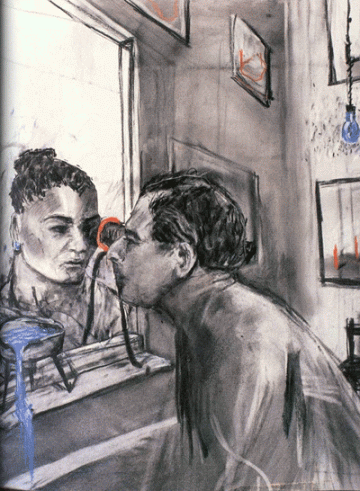
Kentridge became widely known in the 1990’s for his 9 Drawings for Projection (1989-2003), a series of richly evocative short animated films, made by drawing, erasing and redrawing large charcoal sketches on paper.  Originally shown one at a time in galleries in conjuction with exhibits of the final-stage charcoal drawings, the series of films hangs loosely together as a single ongoing story.  They tell of an industrialist, Soho Eckstein, his wife, and her lover, the bohemian Felix Teitlebaum, who is always depicted naked.  Eckstein and Teitlebaum are opposites in a way, but both recognizably resemble Kentridge.  The story in 9 Drawings plays out across the backdrop of the upheavals of South Africa in the late apartheid and early post-apartheid eras, but the films aren’t straightforwardly political.  Instead they’re personal and poetic.  The erasures and redrawing of the filmmaking technique, the transformations of the elemental and mechanical imagery, the ebb and flow of the lives of the characters, and the shifting sands of cultural change are all of a piece, an era of life experience distilled into a cinematic dream.  I get the impression that the transformations of the drawings are not preconceived, but exploratory.

Drawing from “Felix in Exile”, 1994, one of “9 Drawings for Projection” by William Kentridge

The museum show is arranged not chronologically or by media, but thematically.  The 9 Drawings and other films are projected at monumental size, with the real drawings, also quite large, nearby, allowing one to experience the images in both their forms, as mutable projections and as the tactile reality of smudgy charcoal on heavily worked paper.

Kentridge is an obsessive drawer and mark-maker.  One room in the MoMA show surrounds us with multiple projections showing him drawing, tearing paper, pouring ink, etc., often in reverse.  Other rooms are filled with projections, drawings and objects based around designs for his recent operatic productions, Mozart’s Magic Flute and Shostakovich’s The Nose.  There is almost too much to take in, a barrage of images and ideas, nearly all in bold black and white, with a rough, handmade texture.  Throughout the exhibit there are many recurring images, including water and bathing, mechanically walking figures, birds and  rhinoceroses, the industrialized landscape, Alfred Jarry’s corrupt king Ubu, and especially Kentridge’s own heavyset self-image.

Kentridge’s work is not colorful, and while it is bold, it is not simplistic.  It is gray and ambiguous and conflicted.   It draws upon the angular dynamism of early-20th-century avant-garde design, but the boldness is more than anything else the magnified theatrical gesture of the human form.  This is the closest contemporary work I know to the great etchings of Goya, the Caprichos and the Disasters of War.  For Kentridge the act of drawing is theatrical, improvisational and demonstrative, and theater is a graphic art where shadows and lines convey ideas and feelings.

Drawing for II Sole 24 Ore (World Walking), 2007, by William Kentridge; Charcoal, gouache, pastel, and colored pencil on paper, Marion Goodman Gallery

I’ll close with a quote from the Phaidon Monograph, William Kentridge, by Carolyn Christov-Bakargiev et al, that reveals something about his open-ended creative process:

“Drawing for me is about fluidity.  There may be a vague sense of what you’re going to draw but things occur during the process that may modify, consolidate or shed doubts on what you know.  So drawing is a testing of ideas; a slow-motion version of thought.  It does not arrive instantly like a photograph. The uncertain and imprecise way of constructing a drawing is sometimes a model of how to construct meaning.  What ends in clarity does not begin that way.”

Marina Abramovic:  The Artist Is Present, organized by Klaus Biesenbach, Chief Curator at Large, The Museum of Modern Art, and Director, P.S.1 Contemporary Art Center, is on view through May 31, 2010, at the Museum of Modern Art, New York.

William Kentridge:  Five Themes, originally organized for the San Francisco Museum of Modern Art and the Norton Museum of Art by Mark Rosenthal, is on view through May 17, 2010 at the Museum of Modern Art, New York.

Images in this post link back to the sites where I found them.

2010/02/18

Womb of Art: Paleolithic Masterpieces

Detail of the Lion Panel of Chauvet Cave, France, fig. 84 from "Dawn of Art: The Chauvet Cave" by Chauvet, Deschamps & Hillaire

These lions look so full of life they might at any moment pounce on their prey.  This is a small detail from the “Lion Panel”, an expansive composition featuring dozens of animals, discovered in 1994 in a cave in southeastern France.  Across a huge cave wall with a niche in the center, the lions appear to be stalking herds of rhinos, mammoths and bulls.  The realism is classical, the scale and energy modern, yet radiocarbon dating has proven this magnificent work is approximately thirty thousand years old!  The mastery displayed here makes a mockery of the concept of “primitive” art.

It has been barely a hundred years since scientists have agreed that the paintings in certain caves are the work of artists of the paleolithic or old stone age, the end of the last glacial period, when homo sapiens coexisted with Neanderthal people and the kind of herds we associate with the African veldt roamed Europe.  In 1879 the nine year old daughter of amateur Spanish archaeologist Sautuola discovered the magnificent murals of Altamira cave, but it took over twenty years before the scholarly establishment accepted the prehistoric origin of the paintings.

Since then, academics have disputed about the meaning and motivation of these works.  In The Mind in the Cave:  Consciousness and the Origins of Art, David Lewis-Williams, a scholar specializing in ancient rock art, argues that the paintings in the paleolithic caves are the product of shamanic vision quests.  These are not the kind of caves some people lived in, but deep caverns requiring significant effort to penetrate.  Inside these spaces there is no external light or sound.  The paintings may record visions arising from ordeal and sensory deprivation.  Ancient footprints found in the caves show that children accompanied adults into the caves, so the exhibition of the artwork by dim and flickering lamplight may have been a kind of initiation.

Most visual art associated with present-day hunting and gathering cultures is highly stylized, relying on abstract conventions that represent things conceptually rather than accurately following their appearance.  In contrast, the paleolithic art is remarkable for its realism.  Obviously those animals were not posing for the artists inside the caves, but the confident rendering of lifelike animal contours convinces me that these artists were well practiced in observational drawing.  The caves may be significant not as the place of origin of art, but as the place of its preservation, as there must have been an abundance of art outside the caves that did not survive.

I’ll refrain from engaging the scholarly arguments here, and just share a few samples of visual art of the European Paleolithic that speak to me across the millennia, revealing the timeless qualities of great work.  These images come from books in my personal library, and I hope the copyright holders will not mind my sharing them with you.  Altamira, mentioned above, is the source of this exuberant galloping horse:

Galloping Horse, original painting in red, copied by Abbé Henri Breuil, fig. 130 from "Art in the Ice Age" by Maringer and Bandi

This painting has the lightness and simplicity of the loose brushwork of Asian painters grounded in calligraphy and taoism or zen.

This back-biting bison carving, from Trois-Frères Cave in France could be mistaken for a Picasso:

Bison sculpture in reindeer antler, from La Madeleine, France, fig. 44 from "Art in the Ice Age" by Maringer and Bandi

The Cave of Trois-Frères in France is famous for a human-animal hybrid image known as “The Sorcerer“.  It also has a magnificent complex herd scene with at least forty-five animals, densely overlapping, all of them individually expressed in different lifelike positions.  Is the figure on the right in the detail shown below a hunter disguised in a bison’s skin, a shamanic summoner of animal spirits, or a bison god?

Detail from a mural engraving at the Cave of Trois-Frères, France, copied by Abbé Henri Breuil, p. 135 from "La Peinture Prehistorique: Lascaux ou la Naissance de l'Art" by Georges Bataille

Here’s another detail from the same cave:

Bison, engraving at the Cave of Trois-Frères, France, copied by Abbé Henri Breuil, fig. 121a from "The Roots of Civilization" by Alexander Marshack

These vigorous drawings burst with vitality, conveying the power of the looming beasts and the fury of the hunt.

You may notice that I’ve chosen to show many of these works in copies made by the Abbé Breuil, one of the early 20th century’s foremost specialists in European cave art.  His beautifully rendered copies clarify images that are often hard to read in photographs, painted or engraved on rough and mottled stone surfaces.  It’s difficult for photographs to capture the qualities of cave art, which is not flat and not intended to be seen in harsh bright light.  Many of the original paintings incorporate the bulges of the stone walls as the bulges of the animal bodies.  In other places, paintings continue from walls up to vaulted ceilings, as in this image from the most famous painted cave of all, Lascaux:

Ceiling of the Axial Gallery, Lascaux Cave, p. 111 from "The Cave of Lascaux: The Final Photographs" by Mario Ruspoli

Depictions of animals are far more numerous, and usually more detailed, than depictions of the human form in paleolithic art, but the human figures can be strikingly sensual:

Reclining female figures from Cave of La Madeleine, France, relief carvings above with copy drawings below, fig. 111 from "The Way of the Animal Powers" by Joseph Campbell

Those remind me of Matisse.  The carved “Venus” figurines, a selection of which are shown below, prefigure the styles of Brancusi and Gaudier-Brzeska:

Small paleolithic figurines, from left to right, vitreous rock from the Riviera, hematite from Moravia, mammoth ivory from Ukraine, and mammoth bone from Russia, figs. 121 thru 124 from "The Way of the Animal Powers" by Joseph Campbell

From a slightly later period, after the invention of the bow and arrow, we have silhouetted figures like this one, similar in style to South African rock art, but this is from Spain:

Archer with compound bow, rock painting in black from the Spanish Levant, fig. 177 from "Art in the Ice Age" by Maringer and Bandi

This is just a small sampling from an incredible wealth of prehistoric masterpieces.

New note added April 21, 2010:  Get a great feeling for the art in context with the navigable CGI reproduction of the art in context in the cave of Lascaux.

2009/07/29

Meanings of the Nude

"Venus of Lespugue", c. 23,000 BCE

“Venus of Lespugue”, c. 23,000 BCE

Why is the naked human body such an enduring focus of art?  Of course the image of the human form excites our mirror neurons, and can express all aspects of the human experience, but it could usually do that just as well in clothes.  Art students study nude models in order to see the structure and movement of the body unobstructed, but the nude figure in art clearly has an importance beyond its function in learning anatomy.  The naked body is an object of desire, but the nude in art can evoke a far more complex response than can pornographic imagery.

The nude evokes many contradictory things.  Historically, the nude figure has been seen as representing innocence and purity as well as sensuality and sexuality.  The artistic nude can be Apollonian, showing the harmonies of sacred geometry as embodied in the human form, or it can be Dionysian, expressing unconstrained energy or emotion.  Power and weakness, pride and shame, pleasure and pain:  all of these are the experiences of being in the flesh, and all can be shown in the image of the flesh.

William Blake, "Glad Day"
William Blake, “Glad Day”, 1794

In the formal experimentation of the moderns, the nude as a subject maintained a connection to artistic conventions and provided a vital link of identification, humanizing abstraction.

Matisse, "Blue Nude"

Matisse, “Blue Nude”, 1952

In contemporary art since Bacon, the nude is often a mirror reflecting the darkest aspects of society through fragmentation, commodification, dehumanization, dissociation and repulsion.

Jenny Saville, "Hybrid", 1997

Jenny Saville, “Hybrid”, 1997

For the practicing artist, scopophilia, the erotics of seeing, can be an important motivating factor, stimulating the considerable focus of energy that is required in producing art.  Despite the popular image of the artist as lubricious libertine, no real art is produced unless the erotic impulse is sublimated into the creative drive.  Thus the artist of the nude may also represent both sensuality and chastity through her or his practice.

Boucher, "Nude on a Sofa", 1752

Boucher, “Miss O’Murphy”, 1752

Anthropologist Ian Gilligan, who studies the prehistory of clothing, says “Clothing is the thing that separates us from nature, literally and symbolically . . . It actually affects us in the way we perceive ourselves and our environment.”  Clothing is a barrier between us and the world, and between us and our own physical selves, with “implications for how we think about ourselves in relation to other things, but also in how our bodies interact with the world. . . We’ve fabricated a whole artificial environment, which is a kind of externalised clothing. Many aspects of modern existence insulate us from the outside natural world.”

This separation from Nature has become an unhealed split, a division of the self expressed in the root myths of human culture.  In the story of Adam and Eve we are told that the initial manifestation of self-awareness is shame at nakedness, and God’s punishment for it is suffering and death.  Thus our very bodies are seen as the source of evil and sin and must be hidden.

Masaccio, "Expulsion of Adam and Eve from the Garden of Eden"

Masaccio, “Expulsion of Adam and Eve from the Garden of Eden”, 1423

Observing death we see that the living person or soul becomes separated from the body, and so we imagine that these things are inherently separate, forced together by a cruel deity to test us.  The mind or spirit is heavenly, angelic and pure, while the physical body binds us to death, destructive urges and suffering.

The body is identified with the Earth, whose odorous solidity it shares.  Body and Nature, and all the living things of Earth, are then reduced to objects, to be tamed and exploited without mercy for the advancement of the supposedly pure spirit.  The Earth has suffered from this division within Man, but as creatures of Earth we do not escape the pain.

Michelangelo, "Awakening Slave", 1519

Michelangelo, “Awakening Slave”, 1519

The West or the Abrahamic religions hold no monopoly on this hatred of the body.  The way of Yoga would seem opposed to the split, a practice of fully embodied spirituality, and yet the Yogasutras, the most revered ancient source of Yoga philosophy, clearly state the aim of the practice of Yoga is to “transcend the qualities of nature”, to purify ourselves of all physical desires and to “disentangle ourselves from involvement in even the subtlest manifestations of the phenomenal world,” as quoted from B. K. S. Iyengar, Light on the Yoga Sutras of Patanjali.

Scientific humanists might rail against religious ideas of the soul or the afterlife, but still long to upload the mind into a computer as a way of escaping the fallibility and mortality of the flesh.   (As long as computers don’t last even one tenth as long as the human body, this would hardly seem to solve the problem!)

For the fundamentalists in all cultures that fear individual freedom and the open mind, the image of the human body is a threat to order, as it reminds people of pure animal joy.  The free body terrifies authoritarians.  If the people experience freedom at the level of the body, there will be no controlling them!  Thus “modesty” must be strictly enforced.

Gustav Vigeland, figure from Vigeland Park, Oslo, c. 1930

Gustav Vigeland, figure from Vigeland Park, Oslo, c. 1930, photo by Simon Davey

The image of the nude reminds us that we are our bodies, that sexuality and appetites and mortality are our very nature, and that the beauty of our animality cannot be separated from the beauty of our spirituality.

Perhaps death separates body and spirit, but if we separate them in life we are like a house divided against itself, that cannot stand.  We cannot, like Oscar Wilde’s Dorian Gray, deny and conceal the part of us that decays.  I believe mind and matter are two surfaces of a single membrane, and neither can exist in isolation from the other.

Fred Hatt, "Pregnant Couple", 2008

Fred Hatt, “Pregnant Couple”, 2008

For me, the nude is an image of unity, of spirit incarnate and matter imbued with life.  A work of art is in itself an attempt to put living energy into a physical form, so the subject matter perfectly fits the activity.  The nude hides neither its eroticism nor its mortality, but shows the human as a cell of the body of Earth.  The nude is a talisman to heal the ancient division afflicting humanity, and an assertion of freedom and joy against fundamentalism and fear.

I would like to hear readers’ responses to this post.  Please comment.

Fair use claimed for all photos of artwork.  Click on images for links to sources.

« Newer Posts

Powered by WordPress

Theme Tweaker by Unreal