DRAWING LIFE by fred hatt

2012/07/15

Framing Absence

Filed under: Photography: Framing — Tags: , , , — fred @ 21:13

Window Wall, 2003, photo by Fred Hatt

A frame makes a picture.  A frame that is around nothing makes something of that nothing.  Most people probably never look out a window with no view, but if you take the frame’s cue and view this brick wall as a view, it is a rather intense study in texture and light.

I’ve always found something compelling in “empty” frames.  Here are a few of them.

Now Showing, 2002, photo by Fred Hatt

An empty frame is a memento mori, a reminder of mortality, a window on nothingness that tells us there was once something where now there is nothing.

Red on Blue, 2009, photo by Fred Hatt

A big red box frames something – maybe a keyhole? – and, combined with shadows from a scaffold, makes an abstract painting of a blank blue wall.

Dots, 2010, photo by Fred Hatt

Here was once a fine locking glass poster case.  Then it became a community bulletin board.  Then someone pulled down the bulletins, leaving behind scraps of tape.  Now it is a sad cabinet of glass, empty inside and marred outside.  Or you can look at it as a jaunty composition of colored dots and tape on a transparent surface.

Boutique, 2004, photo by Fred Hatt

This storefront once attracted window shoppers with provocatively posed mannequins in garish urban fashions.  A sagging tarp, blue and dusty, hangs there as the flag of failure.

Billboard Support, 2003, photo by Fred Hatt

A vivid golden sculpture rising into the gray sky is so much more appealing than would be another commercial message.

Caution No Floor, 2004, photo by Fred Hatt

Everything has been done to make this once inviting store entrance forbidding:  paint splattered on the inside of the glass, a steel gate, caution tape, and a spray-painted sign that says “Caution No Floor”.  Here is the gate to hell, it would appear.

Exit ACE. 2010, photo by Fred Hatt

Peel, scrape, erase – all but a remnant of a baby’s face.

Glass Frame, 2010, photo by Fred Hatt

This is a little vitrine on a Subway platform where the Transit Authority posts notifications to commuters.  Someone tagged the glass with some clearish substance, creating a piece of abstract expressionism in subtle tones of translucency on transparency, casting faint shadows on a dully reflective aluminum back plate.

Now Serving Soup!, 2005, photo by Fred Hatt

This frame was not an empty frame until the clumping snow made it so.  You can still read the message “Now Serving Soup!” – just what you’d want on a blizzardy day.

Chalked Plates, 2011, photo by Fred Hatt

Some kids with street chalk clearly saw this textured steel access plate as a frame, and decided to fill it in with colors.

Wet Cardboard, 2011, photo by Fred Hatt

Here’s a double frame made of an upside-down box spring and a piece of blue-edged cardboard that maybe used to be behind a mirror or a picture.  In its demise, this piece of cardboard has finally become a picture itself, as the moisture has stained it with something that looks like a misty watercolor painting of mountains.  The hard-edged multiple framing really emphasizes the pictorial quality of the cardboard, as a fancy inset double mat might enhance a soft picture.

Triptych, 2005, photo by Fred Hatt

A triple window of water-stained board becomes a holy triptych.  “And God said, Let there be a firmament in the midst of the waters, and let it divide the waters from the waters.  And God made the firmament, and divided the waters which were under the firmament from the waters which were above the firmament: and it was so.   And God called the firmament Heaven.  And the evening and the morning were the second day.  And God said, Let the waters under the heaven be gathered together unto one place, and let the dry land appear: and it was so.   And God called the dry land Earth; and the gathering together of the waters called he Seas: and God saw that it was good.  And God said, Let the earth bring forth grass, the herb yielding seed, and the fruit tree yielding fruit after his kind, whose seed is in itself, upon the earth: and it was so.  And the earth brought forth grass, and herb yielding seed after his kind, and the tree yielding fruit, whose seed was in itself, after his kind: and God saw that it was good.  And the evening and the morning were the third day.”

Red Rectangle, 2003, photo by Fred Hatt

Will humanity one day emulate and extend the act of creation, seeding life on Mars or other planets?  Or will we destroy ourselves in the fire of our own consumptiveness?

Blinds, 2002, photo by Fred Hatt

Someone who likes to hide in shadows got a building made for putting things on display, and so they put their depression and decay on display.

Rectangles and Diagonals, 2001, photo by Fred Hatt

The paper in these windows, raked with shadows from an awning frame, looks like a silken kimono decorated with delicate diagonal stripes.

You Us We Now, 2010, photo by Fred Hatt

This scraped poster has remnants that suggest a landscape, with brown below and blue above.  The black shapes in the lower left seem to be figures sitting in the landscape.

Blue Rectangle, 2001, photo by Fred Hatt

Here on a plywood fence the artistic battle between figuration and abstraction is being waged.

White on Black, 2003, photo by Fred Hatt

I almost think I can read a message in this remnant in poster paste, but it’s illegible, a distorted echo, a white shadow.

Stone, 2006, photo by Fred Hatt

An artificial texture reminiscent of coral, surrounded in a bold rectilinear frame, marks this stone.  From a distance, it’s just a random pattern, like camouflage, but looked at closely it has a great writhing energy.
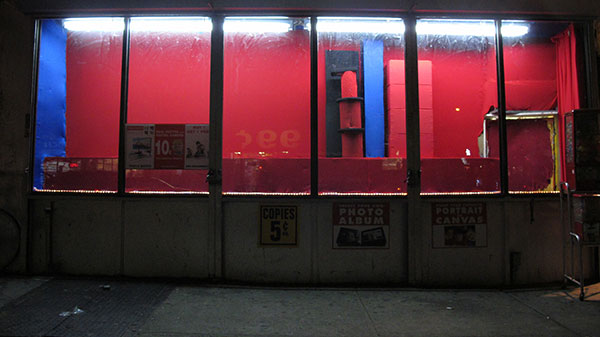
Empty Display, 2010, photo by Fred Hatt

This storefront window between displays is the stage of a shabby rundown theater in an entertainment district the cool people no longer frequent.

Antidepressant, 2010, photo by Fred Hatt

I think maybe this window is supposed to be a conceptual art installation, but it doesn’t look much different from the definitely unintentional depressing empty windows elsewhere in this post.  I like how the neon sign casts its shadow on the plywood – the shadow of light.  This was a storefront window in Williamsburg, Brooklyn.  The artist is unknown to me – let me know if you know.

Dusty Window with Rubber Cement, 2008, photo by Fred Hatt

This dusty window depicts an encounter between a rather rigid character whose plaid slacks are seen in the lower left pane, and an angel of anunciation, descending from heaven in the middle upper frame.

Restaurant, 2001, photo by Fred Hatt

Paper is often used to block the windows of defunct businesses.  Fallen paper, rumpled and stained behind the glass, is an emblem of fragility and collapse, but the rest of the world goes on, and that outside beauty is also seen in the glass, in reflection.

Van Windows, 2002, photo by Fred Hatt

Some kind of film has been applied inside these van windows to block the interior from outside peering.  The sun (?) has caused this fascinating pattern of cracks, both dark and light, to appear in the film.  It reminds me of the tessellation of a dried lake bed.

Pink Window, 2012, photo by Fred Hatt

Notice how much more cheerful satiny pink fabric is in a covered display window, compared with the dusty blinds, tarps, or collapsing paper seen in other images of this post.  But it doesn’t completely overcome the depressing aspect of a shrouded display case.  If the window showed us a colorful piñata donkey, or a tin man made of stovepipe, with the pink fabric behind, that would liven it up nicely.

Window, 2010, photo by Fred Hatt

I think this one may be a bathroom window.  The glass is frosted and there seem to be little shelves and a towel up against the window.  The frames always make me see these empty windows as abstract or minimalist compositions.

Governors Island Window, 2009, photo by Fred Hatt

This is a view looking out from a window by the waterfront on New York’s Governors Island.  The simplicity of this view, with tree branches in front of silvery water, is another lovely minimalist composition, made so by its frame.

Niche, 2011, photo by Fred Hatt

Something – a bust or a plaque, perhaps, surely once occupied this niche flanked by cornucopias and wreathed with ornate floral decorations.  Now it is a beautiful monument to the mystery of the void.  The gaps are where imagination comes to life, where memory and potential coexist.  Sometimes our world is overfilled with stuff and messages and sensations.  I value the absences, the empty spaces, the shells left behind by things that are gone.  The frame around emptiness says here is art, contemplate this.  And nothing rewards contemplation as much as does no thing.
2012/07/10

You Are Invited

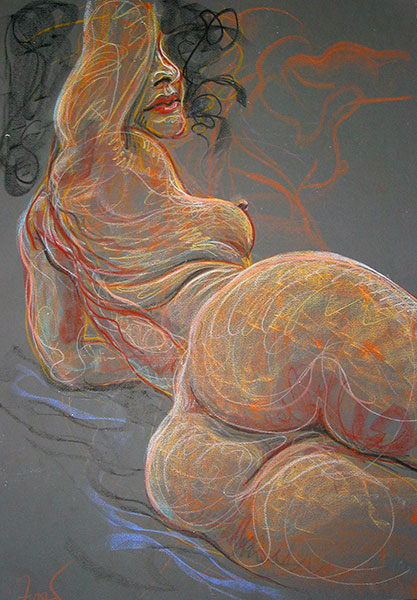
Callipyge, 2002, by Fred Hatt

“Life Drawing”, a group exhibition at Brooklyn’s Figureworks gallery celebrating twelve years of weekly figure drawing sessions at the gallery continues through July 29.  I have been a regular at Figureworks’ sessions since their inception, and two drawings I made there are in the show.  I posted an announcement of the show before it opened, but I’m posting again because the gallery is having a mid-show reception this Friday, so you have a second chance to meet the artists and check out the beautiful home-like space where we draw and where proprietor Randall Harris features a strong and diverse selection of figurative art.  Here are the details from Figureworks’ official ann0uncement of this week’s reception:

Come to Williamsburg this Friday the 13thOur current exhibition has gained great attention with many drawings sold since the opening reception in June.
New drawings have replaced the sold ones so a mid-show reception is in order.

Our reception is being held to coincide with Williamsburg Every 2nd Friday, a monthly gallery crawl when galleries stay open until 9pm with special events.

Life Drawing
12 Year Celebration
artists include:
Raina Bajpai
Susan Berkowitz
Rodney Dickson
Howard Eisman
Susan Hamburger
Randall Harris
Fred Hatt
Elliot Lloyd
Karen Miles
Doug Safranek
K. Saito
Samantha Smith

June 8 – July 29, 2012
Mid-Show Reception: Friday, July 13th from 6-9PM

at FIGUREWORKS

fine art of the human form

168 North 6th St. (1 block from Bedford Avenue “L” train)
Williamsburg, Brooklyn, NY 11211
www.figureworks.com

hours: Saturday and Sunday from 1-6PM

Since 2000, Figureworks has hosted a weekly life drawing session every Saturday morning before the gallery opens. Over the years we have showcased the drawings from those artists who have faithfully supported these sessions.

This year, taking advantage of this longevity, we have created a timeline using artist’s earlier works with their current endeavors. It is exciting to see this history. Some artists have retained their signature style with more confidence while others have chosen to explore new techniques and various mediums. The diversity of this group is remarkable, especially in medium, which includes Ink, magic marker, oil pastel, watercolor, graphite, and colored pencil.

It is worth noting that these exquisite figure studies were executed from 2 minute to 20 minute poses. They are fresh, spontaneous, and many times unfinished. Foremost, all of these drawings are explorations into form and the study of human anatomy, many never intended to be formally shown.

Figureworks is located at 168 N. 6th St., Williamsburg, Brooklyn, NY 11211, one block from the Bedford Avenue “L” train. The gallery is open to the public Friday, Saturday, and Sunday from 1-6 PM and is dedicated to exhibiting contemporary and 20th century fine art of the human form.
For more information please call 718-486-7021 or visit us online at www.figureworks.com


2012/07/04

Different Strokes

Porcupine, 1951, woodcut by Leonard Baskin


The magic of drawing or printmaking is in the strokes.  By strokes I mean the particular and idiosyncratic quality of the lines or other marks the artist makes.  Some lines jab while others meander.  Some markings are cloudy while others are crisp.  The strokes convey in a tactile way the essence of how the artist comes to grips with the challenge of capturing a thing seen or actualizing an inner vision.  Making a drawing is a journey of exploration, and these markings are the spoor of the trek.  When we look at a drawing, we can feel the energy that went into it in the particular flavor of its lineaments.

In this post I present a goodly selection of mostly monochrome sketches and prints by a wide diversity of masterly mark-makers.  I’ll let the works speak for themselves and leave it to you to contemplate the contrasts among them.  I have generally chosen pieces with a direct, spontaneous quality, avoiding highly finished styles where the quality of line may be more a matter of design than of the energy of the mind and the hand.  I often tried to find unfamiliar examples of the work of well-known artists, and sometimes individual works that are not representative of the artists’ familiar styles.  I think you’ll be particularly surprised by the early De Kooning sketch!

Man Walking in a Field, 1883, conte crayon drawing by Georges Seurat


Portrait, title, date and medium unknown, by Paul Cadmus


Composition, 1916, medium unknown, by Wassily Kandinsky


Edward Scissorhands, 1990, pen and pencil drawing by Tim Burton


Autumn, 1970, engraving by Salvador Dalí


Self Portrait, 1946, by David Alfaro Siqueiros


Musician portrait, date, title, and medium unknown, by Edgar Degas


Drawings, 1939, title and medium unknown, by Jackson Pollock


Saturn, 1516, engraving(?) by Hans Baldung Grien


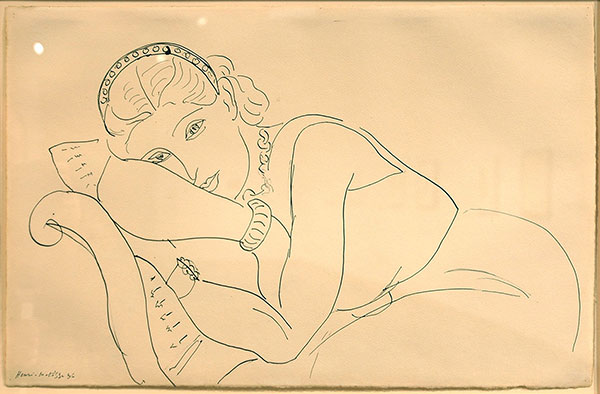
Resting Woman Wearing Tiara, 1936, pen and ink drawing by Henri Matisse


Sketchbook pages, date unknown, drawings by R. Crumb


Reproduction Drawing III (after the Leonardo cartoon), 2010, media unknown, by Jenny Saville


Self Portrait at the Age of Eighty-Three, 1843, ink brush drawing by Hokusai


Untitled, 1981, drawing by Jean-Michel Basquiat


Study for the Head of Leda, 1506, ink and chalk drawing by Leonardo da Vinci


Gregory Hines, date and medium unknown, sketch by Jules Feiffer


Study of the Head of Elizabeth Siddal for “Ophelia”, 1852, medium unknown, by John Everett Millais


Femme nue couchée, 1932, charcoal drawing by Pablo Picasso


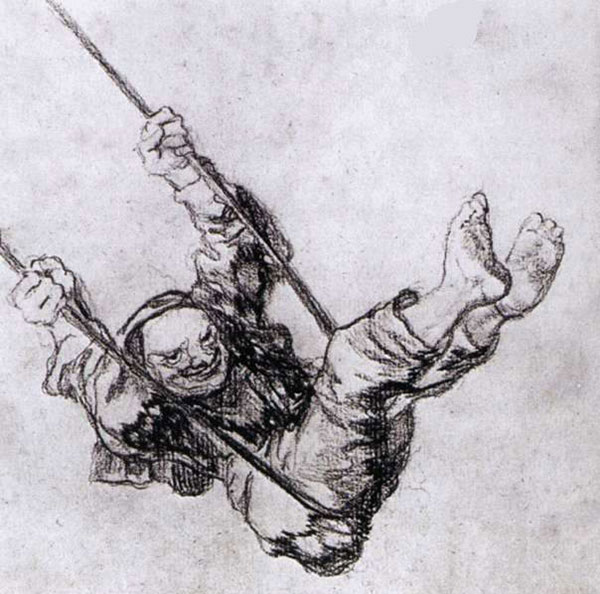
Old Man on a Swing, 1826, medium unknown, by Francisco Goya


Untitled, 1950, ink drawing on parchment by Philip Guston


Europa, 1953, lithograph by Hans Erni


Portrait of the Artist’s Mother, 1514, by Albrecht Dürer


Love Forever (TAOW), 2004, marker drawing on canvas by Yayoi Kusama


Bird Personage, date and medium unknown, by Remedios Varo


Court Room Scene, date and medium unknown, by Honoré Daumier


Beekeepers, 1568, etching(?) by Pieter Bruegel the Elder


Drawings, dates, titles and media unknown, by Alberto Giacometti


Self Portrait, date and medium unknown, by Henry Fuseli


Tree with Trunk, 1998, etching by Louise Bourgeois


Drawing, 1944, title and medium unknown, by Pavel Tchelitchew


Nude Study, 1908, etching by Georges Braque


The Sower, 1888, pencil and pen and ink drawing by Vincent van Gogh


Portrait of Elaine De Kooning, 1940, pencil drawing by Willem De Kooning


Some Can Fly and Some Can’t, 1939, medium unknown, by Rico Lebrun


Le Chapeau-Main, 1947, lithograph by Hans Bellmer


Sketch for “Apollo Slays Python”, 1850, medium unknown, drawing by Eugène Delacroix


Madame Louis-Francois Godinot, 1829, medium unknown, drawing by Jean Auguste Dominique Ingres, with detail


Corps de Dame, 1950, medium unknown, by Jean Dubuffet


Cape Lion, 1650, medium unknown, drawing by Rembrandt van Rijn


The Man who Taught Blake Painting in his Dreams, 1820, print(?) by William Blake


Five Swearing, 1912, oil sketch by Ferdinand Hodler


Madame Sohn, 1918, charcoal sketch by Egon Schiele


Seated Bodhidharma, 18th century, ink brush drawing by Suio Genro


All the images used in this post were found on the web, and clicking on an image will take you to the page where I found it.  Any information about the artwork that is listed as “unknown” is information I was not able to find at the time of making the post.  If you can provide additional or corrected information I will incorporate it.

Readers are invited to nominate some of their favorite drawings for an eventual sequel to this post!

2012/06/21

Partners in Art

Andrea, 2012, by Fred Hatt

I try to put up at least one post a month based around my ongoing practice of drawing the human figure from life, and this is one of those posts.  But instead of discussing drawing techniques or formal concerns, or relevant knowledge about anatomy or visual perception, I want to speak, as an artist, about our often unsung partners in this practice, the models.  Beyond a statement of appreciation, I want to raise some questions that I hope will start a discussion, and I urge both models and artists to offer their thoughts.  (The pictures are in random order and not directly related to the adjacent discussions.  I’ll let the pictures speak for themselves.)

Kneeling Over, 2012, by Fred Hatt

Drawing the human figure from observation of the live nude model has been a staple of art schooling for centuries, and today open life drawing sessions are available in many places, so that a sort of subculture of the art world has arisen among artists who make a study of the human body the focus of their relaxation or their struggle.   It’s a world beautifully described by naturalist and author Peter Steinhart in “The Undressed Art“, and it’s the world I fell into back in the mid-1990’s when I decided my creativity needed to be anchored to a regular discipline – a discipline I found at New York’s Spring Studio, which offered twenty open figure drawing sessions a week.

The human body and face contain as much depth as any creative subject one could choose.  Studying the human animal, we are seeing ourselves, and all the wonderful variations Nature can work on a form.  We are seeing energy and structure, power and vulnerability, character and emotion.  In trying to depict what we see, we can challenge ourselves in the direction of spontaneity or refinement, speed or endurance, realism or abstraction, knowledge or pure impulse.

Bench, 2012, by Fred Hatt

While some artists think of the model as an object of study, fundamentally no different than a plaster cast or a bowl of fruit, I think most artists that devote themselves to the life drawing practice value it as an interactive experience.  The model offers not only their body, but their attitude and their aliveness.

Pedro, 2012, by Fred Hatt

An artist’s style reflects her experience.  The understanding of things like light and anatomy show her knowledge and her innate way of seeing.  The quality of the marks show her energy and the particular quality of her movement.  The model also shows his life experience.  His body may be trained by dance or athletics, or it may show the marks of age or experience.  His face and the poses he choose reveal something about his attitude and adaptation to the world.

Anguish, 2012, by Fred Hatt

Many of the professional artist’s models that work in the studios of New York are creative people in their own right.  Some are dancers or actors, and they may approach the task of modeling as a performance.  Others are writers or musicians, people with a rich interior life who appreciate a job where they can be still and quiet, composing in the mind.  Others are lovers of art who find their own creative spark manifests most strongly in inspiring others with their presence and openness.

Double Back, 2012, by Fred Hatt

When I work with models privately in my own studio, I think of it as a kind of collaboration.  I choose models that have an energy or style that I find exciting, and I try to allow them to manifest that style in a way that enters into my artwork.  But even when drawing models in an open session with multiple artists, where the model chooses her own poses without any input from me (as is the case for all of the works pictured in this post), my drawings clearly draw a great deal from the model’s contribution to the experience.

Lie Down on Black, 2012, by Fred Hatt

Historically, artists have usually been of a relatively privileged class, while models were often prostitutes or laborers, exploited or objectified by the artists, and certainly never accorded any respect or credit by the art world arbiters who could elevate the artists to positions of fame and honor.  The great model and writer Claudia (pictured below) has written many stories of historical artist/model relationships on her blog, Museworthy, and most of them are tragic tales.

Claudia, 2012, by Fred Hatt

I truly respect the models I work with.  My work depends upon them completely.  I have only been able to do what I do because these men and women have offered me the opportunity to “draw from” their bodies and their spirits.  All of them have fed me, and the greatest of them have inspired me and prodded me to exceed my own limitations.  In the best moments, I have gazed upon some of these models and felt what I can only describe as love, a rapture of being connected to another through the gaze.

Conversation, 2012, by Fred Hatt

In my intellectually formative years, feminists and cultural critics were offering a strong critique of the “male gaze” of figurative art, particularly the art of “the nude” as an act of objectification, an attempt by the male ruling class to claim ownership of the female, the cultural “other”, the working class.  The sad history of the way so many artists treated their models certainly makes this more than just an abstract theoretical argument.

Vassilea, 2012, by Fred Hatt

I always felt, though, that there was something prudish in the condemnation of nude art.  I loved the body and the tradition of the nude in art, which often expressed both eroticism and spirituality – a combination I found particularly compelling.  So I was drawn to devote myself to the art of the nude.  But as a white male, I felt I could not just ignore the critique of the “male gaze”.  My solution was to attempt to depict the body not as an object, but as a pattern of living energy, and to treat my subjects not as ideals, but as individuals, with unique characters and authentic personhood.  I would not look down upon my models from a position of power, I would look up at them with an attitude of adoration and wonder.

Sidewise, 2012, by Fred Hatt

When I work with models, privately or as the monitor (supervisor) of public sessions at Spring Studio, I try to treat them with respect and compassion.  I’ve worked as an art model myself, so I know the pain and discomfort it can often involve, and the vulnerability that is inherent to getting naked before others and keeping still.

Head on Hand, 2012, by Fred Hatt

Many of the models I have drawn love to see my depictions of them, and I”ve always been willing to send images and even sometimes give drawings to models.  I feel the models are my greatest fans – I’ve certainly received more praise and appreciation from models than I ever have from art world figures like dealers and critics.  There is nothing sentimental or idealizing in my approach to drawing them.  People who specialize in portrait commissions will complain of the vanity of their clients, but artists’ models don’t seem to have that kind of insecurity.  The nature of the job pretty much requires you to give that up.  Sometimes I feel I am doing the work for the models.  I so appreciate the opportunity to look at them that I want to show them all the wonderfulness that I see in them.

Plans, 2012, by Fred Hatt

Still, they remain mostly anonymous.  When I have a show, or even when I put drawings up here on the blog, I don’t individually credit the model for each work.  Sometimes I talk about individual models, but often I don’t.  I keep the models all mixed up, which keeps the focus on the artist.  I’ve done that even in this post.  I write the model’s name on the back of every drawing, but if it’s framed, no one sees it.  Since I see work with models as essentially collaborative work, should I credit the models individually?

I also work as a photographer and have often attended the Photo Plus Expo, a trade show at the Javits Center in NYC, so I can check out all the amazing gear I can’t afford.  The booths for major manufacturers like Fuji, Canon and Epson always feature big beautiful photographic prints, and I recall once, maybe a decade ago, seeing there a huge shot of my friend, performance artist Amy Shapiro.  In the photo, Amy was wearing a fantastic costume she created, including a hat with live grass growing on it, and her face was decorated with a grassy paint motif by me.  The picture was taken at one of the Earth Celebrations pageants, public celebrations with revelers costumed as nature spirits, that sought to save the endangered community gardens of Manhattan’s Lower East Side.  The label of the photograph proudly credited the photographer, but there was no mention of Amy, me, Earth Celebrations, Felicia Young (Earth Celebrations’ director) or anything else.  This photographer had just attended an event (one that attracted lots of photographers) and took a shot.  Everything that made the shot interesting depended on others’ creativity, but they weren’t given their due.  Seeing that made me conscious of how much photography really is about “taking”.  There’s a bit of that in drawing, too.

Side Curve, 2012, by Fred Hatt

My friend Kristin, a dancer/choreographer, who has also been a creative collaborator of mine on video projects and has worked with me as an art model, recently sent me a link to this very interesting blog post (by Sarah Maxfield) with extensive discussion in the comments section.  The beginning of the discussion here is about choreographers and photographers failing to credit dancers, but questions about artists’ models also arise in the discussion, as many dancers have done such work.  The author and commenters really raise a lot of issues that are important, and rarely considered, and the level of the conversation will surely disabuse you of any notion that dancers are airhead bunheads.

James, 2012, by Fred Hatt

The currently prevailing convention in the subculture of life drawing sessions and classes, at least here in New York, seems to be that artists’ models go by first names only.  They are generally listed that way on the model schedules, and if you ask a model’s name, you’re generally given just a first name.  Many artists make recognizable portraits of professional artists’ models, and often title them with the model’s (first) name.  I usually do that myself when the works are basically portraits – calling a portrait something else would seem an unwarranted judgment or definition of the person.  But Minerva Durham, the director of Spring Studio, once criticized that practice.  As I recall, her point was that the model is paid to let you use their body, not their identity.

Undresser, 2012, by Fred Hatt

I once worked with a female model who had been born in modesty-obsessed Afghanistan but grew up in body-positive Western Europe, who was upset that another artist from Spring Studio had posted online a portrait (not nude) of her tagged with her real name.  She was afraid her Afghan relatives would find it and be upset.  I suggested she should come up with a “nom de muse”.  I suppose there are many reasons nude artists’ models (who often also have other careers) might want to remain anonymous, and if I don’t know, I hesitate to credit them all with full names.

A few years ago when I put up my current portfolio website, I emailed all the models I could to let them know I was putting drawings of them on my site, to thank them, and to ask them if they wished to be credited as model.  I think only one model actually asked to be credited.

Lying Awake, 2012, by Fred Hatt

Here on Drawing Life, my usual practice has been to title drawings with the model’s professional first name when it’s a portrait, and to give drawings that are less specifically portraits descriptive or poetic titles.  In this post, I’m crediting all the models with first names at the foot of the post.

I want to honor and thank the models that contribute so much to my work.  I’m not sure how best to do that.  I would love to get comments from artists or models about this issue.  Let me know what you think and how you feel!

All the drawings above were done at open figure drawing sessions at Spring Studio in Manhattan or Figureworks Gallery in Brooklyn (where there is a current show drawn from 12 years of life drawing classes there, with two of my drawings included).  All are in the size range between 18″ x 24″ and 19.5″ x 27.5″.  Models and media for the above drawings are as follows.  “Crayon” means Caran d’Ache aquarelle crayons.  In case of mixed media, first listed is predominant.

Andrea,  crayon and watercolor/gouache

Kneeling Over (Eric), crayon

Bench (Claudia), watercolor/gouache

Pedro, watercolor/gouache and crayon

Anguish (Eric), crayon

Double Back (Claire), watercolor

Lie Down (Amy), crayon

Claudia, watercolor

Conversation (Eric), watercolor/gouache

Vassilea, watercolor/gouache

Sidewise (Adam), watercolor/gouache

Head on Hand (Amy), watercolor

Plans (Adam), crayon

Side Curve (Amy), crayon

James, watercolor/gouache and crayon

Undresser (Adam), watercolor

Lying Awake (Claudia), crayon


2012/06/08

Mastering Life: Zhuangzi’s Parables of Craft

Zhuangzi is a collection of parables and philosophical dialogues on Daoist themes, dating to the third or fourth century BCE, and attributed to a writer named Zhuang or Zhuangzi or Chuang Tzu.  Much of the material is satirical or fantastical, using wild imagery, odd turns of phrase, and absurdity to crack conventional and complacent ways of thinking.  It mocks the Confucian impulse to reform the world as well as the logician’s claims to pure reason (even though it often puts its arguments in the mouth of Confucius and other traditional sages).  It argues for radical acceptance of the world, suggesting that we should give up complaining and striving, and instead seek to discover our oneness with the mysterious forces that make and move the world.

Zhuangzi likes to find transcendent principles in humble places, and many of the stories talk about the special skills of servants and artisans.  I find these passages particularly relevant to the creative practice, though of course they are metaphors that can lend their meaning to many aspects of life.  In this post, I’ve selected four parables of craft from the Zhuangzi.  These excerpts are from Chuang Tzu: Basic Writings, Columbia University Press, 1964, translated by Burton Watson, a version both scholarly and literary, rollicking and lucid.

Bell Stand, 2012, by Fred Hatt

1.

Woodworker Ch’ing carved a piece of wood and made a bell stand, and when it was finished, everyone who saw it marveled, for it seemed to be the work of gods or spirits.  When the marquis of Lu saw it, he asked, “What art is it you have?”

Ch’ing replied, “I am only a craftsman – how would I have any art?  There is one thing, however.  When I am going to make a bell stand, I never let it wear out my energy.  I always fast in order to still my mind.  When I have fasted for three days, I no longer have any thought of congratulations or rewards, of titles or stipends.  When I have fasted for five days, I no longer have any thought of praise or blame, of skill or clumsiness.  And when I have fasted for seven days, I am so still that I forget I have four limbs and a form and body.  By that time, the ruler and his court no longer exist for me.  My skill is concentrated and all outside distractions fade away.  After that, I go into the mountain forest and examine the Heavenly nature of the trees.  If I find one of superlative form, and I can see a bell stand there, I put my hand to the job of carving; if not, I let it go.  This way I am simply matching up ‘Heaven’ with ‘Heaven.’  That’s probably the reason that people wonder if the results were not made by spirits.”

Ferryman, 2012, by Fred Hatt

2.

Yen Yüan said to Confucius, “I once crossed the gulf at Goblet Deeps and the ferryman handled the boat with supernatural skill.  I asked him, ‘Can a person learn how to handle a boat?’ and he replied, ‘Certainly.  A good swimmer has acquired his ability through repeated practice.  And, if a man can swim under water, he may never have seen a boat before and still he’ll know how to handle it!’  I asked him what he meant by that, but he wouldn’t tell me.  May I venture to ask you what it means?”

Confucius said, “A good swimmer has acquired his ability through repeated practice – that means he’s forgotten the water.  If a man can swim under water, he may never have seen a boat before and still he’ll know how to handle it – that’s because he sees the water as so much dry land, and regards the capsizing of a boat as he would the overturning of a cart.  The ten thousand things may all be capsizing and turning over at the same time right in front of him and it can’t get at him and affect what’s inside – so where could he go and not be at ease?

“When you’re betting for tiles in an archery contest, you shoot with skill.  When you’re betting for fancy belt buckles, you worry about your aim.  And when you’re betting for real gold, you’re a nervous wreck.  Your skill is the same in all three cases – but because one prize means more to you than another, you let outside considerations weigh on your mind.  He who looks too hard at the outside gets clumsy on the inside.”

Herder of Sheep, 2012, by Fred Hatt

3.

T’ien K’ai-chih said, “I have heard the Master say, ‘He who is good at nourishing life is like a herder of sheep – he watches for stragglers and whips them up.’ ”

“What does that mean?” asked Duke Wei.

T’ien K’ai-chih said, “In Lu there was Shan Pao – he lived among the cliffs, drank only water, and didn’t go after gain like other people.  He went along like that for seventy years and still had the complexion of a little child.  Unfortunately, he met a hungry tiger who killed him and ate him up.  Then there was Chang Yi – there wasn’t one of the great families and fancy mansions that he didn’t rush off to visit.  He went along like that for forty years, and then he developed an internal fever, fell ill, and died.  Shan Pao looked after what was on the inside and the tiger ate up his outside.  Chang Yi looked after what was on the outside and the sickness attacked him from the inside.  Both these men failed to give a lash to the stragglers.”

Confucius has said, “Don’t go in and hide; don’t come out and shine; stand stock-still in the middle.”  He who can follow these three rules is sure to be called the finest.  When people are worried about the safety of the roads, if they hear that one traveler in a party of ten has been murdered, then fathers and sons, elder and younger brothers will warn each other to be careful and will not venture out until they have a large escort of armed men. That’s wise of them, isn’t it?  But when it comes to what people really ought to be worried about – the time when they are lying in bed or sitting around eating and drinking – then they don’t have sense enough to take warning.  That’s a mistake!”

An Ox, 2012, by Fred Hatt

4.

Cook Ting was cutting up an ox for Lord Wen-hui.  At every touch of his hand, every heave of his shoulder, every move of his feet, every thrust of his knee – zip! zoop!  He slithered the knife along with a zing, and all was in perfect rhythm, as though he were performing the dance of the Mulberry Grove or keeping time to the Ching-shou music.

“Ah, this is marvelous!” said Lord Wen-hui.  “Imagine skill reaching such heights!”

Cook Ting laid down his knife and replied, “What I care about is the Way, which goes beyond skill.  When I first began cutting up oxen, all I could see was the ox itself.  After three years I no longer saw the whole ox.  And now – now I go at it by spirit and don’t look with my eyes.  Perception and understanding have come to a stop and spirit moves where it wants.  I go along with the natural makeup, strike in the big hollows, guide the knife through the big openings, and follow things as they are.  So I never touch the smallest ligament or tendon, much less a main joint.

“A good cook changes his knife once a year – because he cuts.  A mediocre cook changes his knife once a month – because he hacks.  I’ve had this knife of mine for nineteen years and I’ve cut up thousands of oxen with it, and yet the blade is as good as though it had just come from the grindstone.  There are spaces between the joints, and the blade of the knife really has no thickness.  If you insert what has no thickness into such spaces, then there’s plenty of room – more than enough for the blade to play about in.  That’s why after nineteen years the blade of my knife is still as good as when it first came from the grindstone.

“However, whenever I come to a complicated place, I size up the difficulties, tell myself to watch out and be careful, keep my eyes on what I’m doing, work very slowly, and move the knife with the greatest subtlety, until – flop! the whole thing comes apart like a clod of earth crumbling to the ground.  I stand there holding the knife and look all around me, completely satisfied and reluctant to move on, and then I wipe off the knife and put it away.”

“Excellent!” said Lord Wen-hui.  “I have heard the words of Cook Ting and learned how to care for life!”


Illustrations for this post are all ink brush on paper, 18” x 24” (46 x 61 cm).

An earlier Drawing Life post, “A Useless Tree”, is based on another tale from Zhuangzi.

Note:  There are several editions of Burton Watson’s Complete Works of Chuang Tzu and Chuang Tzu: Basic Writings.  The latter is basically a selection of chapters from the former.  A newer edition of Basic Writings has been amended to use the pinyin transliteration of the Chinese names (i.e. Zhuangzi replaces Chuang Tzu) in the title as well as in the text.  Zhuang has inspired many writers, and besides the various academic translations there are selections of his stories retold by Christian mystic Thomas Merton and Jewish philosopher Martin Buber.

« Newer PostsOlder Posts »

Powered by WordPress

Theme Tweaker by Unreal