DRAWING LIFE by fred hatt

2012/09/09

The Doodle Abides

Nature Boy, 2012, by Fred Hatt

I drew this this morning after a session of Authentic Movement.  It’s a kind of moving meditation, a group practice of discovering the impulses to movement within your body, following them wherever they lead you, and responding in the moment.  The practice called Authentic Movement was developed in the 1950’s by Mary Starks Whitehouse, a student of choreographers Mary Wigman and Martha Graham, and developed in later decades by Janet Adler, Joan Chodorow, and others.  My friend Peter Honchaurk, who studied the form with Adler,  introduced me to it twenty years ago, and ever since then it’s been one of my essential practices.  Nowadays I’m part of a peer group of Authentic Movers, and we meet once a month in Prospect Park in Brooklyn to move and witness together.  Many people treat the practice as a form of somatic therapy, but for me it’s always been most essentially a way to stay in touch with the creative spirit that resides in the body and in the relationship between the inner world and the world outside.

The drawing above is an expression of the connection with elemental energies that I felt moving in the park.  The remainder of the pictures in this post will consist of a collection of my doodles, most of which are done while at work, riding transportation, or talking on the phone, not in connection with Authentic Movement practice.  Illustrations are in random order, so the relation of text to images is mostly coincidental.  (Earlier posts on the art of doodling are here and here.)

Score for Solo Dance, 2011, by Fred Hatt

In Authentic Movement we usually move with eyes closed.  For a person like me, extremely visually oriented and, if not quite intellectual, at least mental, consciousness tends to reside mainly in the head, with the body serving as the vehicle to move the head around in the world.  When the eyes are closed, awareness naturally shifts downward into the body.  Eyes-closed orientation relies not on visual cues, but on contact with the ground or floor.   Proprioception and tactility supplant visual/intentional navigation.

Analysis, 2011. by Fred Hatt

If you’ve followed this blog for a while you may have gleaned a central theme, that I treat visual art as an art of movement, like music or dance.

Curandero, 2011, by Fred Hatt

All organic forms, the bodies of plants, animals, and people, the shapes of clouds and of the land, emerge from dynamic processes of movement and growth.

Generative S;iral, 2012, by Fred Hatt

To draw is to feel form back into the movement from which it arises.

Forest Runner, 2011, by Fred Hatt

You can get to know a landscape by roaming about it, feeling its texture with the soles of your feet and its contours as gravity reveals them to you.

Floor Plan for a Happy Drunk, 2012, by Fred Hatt

A blank piece of paper is a fairly homogenous landscape, so roaming about it with a brush or pen or pencil is an exploration of the hills and valleys of your mind more than of the paper.

Cogitation/Constipation, 2012, by Fred Hatt

Authentic Movement takes place within a space defined by the “witnesses” who observe the “movers”, and with their attention create a protected circle where the magic can happen.  A doodle happens in a space defined by the edges of the paper provided for it.

Mountain Mouth, 2012, by Fred Hatt

The doodle grows into the two-dimensional space of the paper as a growing houseplant expands within the space contained by its pot.

Bacterium, 2011, by Fred Hatt

If you’re dancing in a space, of course you can keep going back and forth over the same little patch.  When you’re making marks, you have to keep moving into territory that hasn’t been marked yet, as a plant’s roots must penetrate the as-yet unoccupied dirt.

Wreckage, 2011, by Fred Hatt

In movement or in drawing or doodling, you are always responsive to sensory input.  Marks or gestures may arise from internal impulses of nerves or emotions or imagination, or they may come from hearing a bird or feeling the wind.

French Curves, 2012, by Fred Hatt

This approach eschews concepts and plans.  There is no preconceived idea one is trying to portray.  There is simply a flow of moments, shapes that flow into other shapes, images and impulses arising in the mind, in the body, or in the world.

Treasure Map, 2012, by Fred Hatt

Of course, shapes are seen as things, and the imagination picks up images and runs with them, so free improvisatory doodling or moving is not necessarily strictly nonobjective, but I try to keep representational elements ambiguous, so that I retain the freedom to reinterpret them.

Old King Lear, 2011, by Fred Hatt

Most of these doodles are made without any particular idea in mind, but once they’re done it is much easier to come up with descriptive titles than it is for my figurative drawings.  There is nothing like mindless abstract movement to inspire the imagination!

Stiff Salute, 2011, by Fred Hatt

Organic movement is all about curves and spirals, meanders and branches, echoes and fractals.

Fleurs du Mal, 2012, by Fred Hatt

How does electricity move?  How does blood flow?

Tesla, 2012, by Fred Hatt

How do a flower’s petals unfold?  How do a tree’s limbs reach out and out, penetrating a space of air?

Pagoda of the Hairy Eyeball, 2011, by Fred Hatt

How do you slip on the ice?  How does water carve a canyon?

Man on Wire, 2011, by Fred Hatt

How does the wind wriggle through a gap?  How does a weed expand a crack in concrete?

Bird Lizard Blizzard, 2011, by Fred Hatt

How do dividing cells accrete into a spine?  How does heat make light ripple in air?

Water Cycle, 2011, by Fred Hatt

Why do arteries look like trees?  Why do trees look like lightning?  Why does a river delta look like a tree?

Jazz Hands, 2012, by Fred Hatt

Why does the large scale structure of the universe look like neurons?

The Devil Toupée, 2012, by Fred Hatt

I want the movement of the hand to reflect the natural movement of  growing things.

Writhing T-square, 2012, by Fred Hatt

I want the movement of the hand to reflect the movement of the mind.

Cul-de-Sac Subdivision, 2012, by Fred Hatt

I want a drawing to grow like a plant grows.

Indomitable Weed, 2012, by Fred Hatt

I want random things to come into the drawing just as random things enter into any experience, any environment in the world.

Museum of Maladaptive Mutations, 2012, by Fred Hatt

I want to create not by fiat, but by adaptation.

Shaft, 2012, by Fred Hatt

The movement of the mind does not stand apart from the world.  Like the movement of the body, it happens only within a world that has forces and pressures and countercurrents and resistance.  To make is to engage.

Thorny Vessels and Tricky Steps, 2012, by Fred Hatt

2012/08/29

Playing with Color

Filed under: Color — Tags: , , , , — fred @ 01:15

“Butterflies & Flowers”, performance by Cilla Vee, 2004, photo by Fred Hatt, grid of various color manipulations

The technological capture and reproduction of images dethroned the artist as magical image maker and robbed all pictures of their aura of rarity and preciousness, leaving us drawers and painters with the same status as those oddballs who insist on writing novels in longhand or doing all calculations with a slide rule.  On the other hand, analog and digital imaging technology is a most amazing box of educational toys for learning about aspects of perception and light.  I’ve had a long-running obsession to understand as much as I can about how these technologies work, from chemical color film to digital image processing, and studying and playing with these things has deeply informed the way I approach observational drawing and painting.  In this post I’ll share some samples of such play and how I learn from it.  I will try to make this both fun and informative – if I’m explaining stuff you already know, feel free to skim through.

As you probably recall from science class, Isaac Newton demonstrated that white light is a combination of all colors of light, and that the individual wavelengths of light appear to the eye as the different colors of the spectrum or rainbow.  Red is at the long-wavelength end of the spectrum, and as the wavelengths get shorter, the color transitions to orange, yellow, green, cyan, blue and violet.  Later experimenters discovered that a wide range of colors could be reproduced by combining just three colors of light, one representing the long (red) wavelengths, one the middle (green) wavelengths, and one the short (blue) wavelengths.  The illustration below represents the overlapping beams from spotlights of these three colors.  Where all three overlap, the light is white.  Where red and green overlap, we get yellow.  Blue and green make cyan (which you might call turquoise, aqua, or teal), and red and blue make magenta (or fuschia, reddish purple).  With red plus green, but more red than green, you have orange, and so on.  This kind of color process is called RGB, for the red, green and blue lights that are used.

Additive (RGB) Color Mixing, digital illustration by Fred Hatt

This way of making colors by combining three colors of light in varying ratios is called additive color mixing.  It’s the basis of color television, cathode ray tube screens, liquid crystal displays, video projectors, and the monitor on your smartphone.  Here’s a close-up of an LCD computer monitor.  A screen has thousands or millions of pixels (short for picture elements), and each pixel has a red, a green, and a blue element.  A digital picture is nothing but a series of numbers representing the brightness levels of each of the three colors for every one of these pixels in a grid.

LCD monitor, magnified to show red, green and blue pixel array, photo by Daniel Rutter

The photo below contains 305, 400 pixels, each one defined by levels of red, green and blue light specified by numbers from zero to sixty-four.  This is a small version – the original camera photo had over ten million pixels.

Photographic self-portrait, 2008, photo by Fred Hatt

With a digital picture it is easy to separate the three component colors as “channels”.  If we take just the levels for the red component of each pixel and render those as a monochrome image, we get the result below.  The skin looks light, almost luminous.  Taking a photo with black and white film through a red filter would give a very similar effect.  Most of the variations in skin tone are variations of redness, so when red is all you can see the differences are minimized.

Photographic self-portrait, 2008, photo by Fred Hatt, red channel

Doing the same with the green channel gives a pretty objective black-and-white rendering of the original photograph.  Because the green wavelengths are in the middle, or average, of the spectrum, they’re pretty close to the average lightness levels, without distortions in tone.  The red channel made me look youthful and glowing, but the green channel shows my age a bit more objectively.

Photographic self-portrait, 2008, photo by Fred Hatt, green channel

The blue channel is similar but the effect is even harsher.  The skin looks darker and blemishes and discolorations of the skin are more pronounced.  Some of the early black-and-white photography processes, including the film used for early silent movies, were sensitive only to the blue end of the spectrum, so they tended to render skin as dark and blotchy, necessitating the use of white make-up on the actors.

With this portrait photo, the red channel is strikingly different from the green and blue channels, which are more like each other.  If I had used a landscape photograph for the demonstration, the blue channel would be the one that stood out, with black foliage and a stark white sky, while the red and green channels would be more alike.

Photographic self-portrait, 2008, photo by Fred Hatt, blue channel

There’s another kind of color reproduction, called subtractive color mixing.  This is used in printing and in photographic prints or slides, where you start with a white ground (all wavelengths) and filter or absorb wavelengths selectively using dyes or pigments.  Transparent paint, such as watercolor, is essentially a subtractive color mixing technique.  The standard colors used in subtractive color processes are cyan (slightly greenish blue), magenta (purplish red) and yellow.  As you can see from the illustration below, mixing all three colors doesn’t give a perfect black, so a fourth layer of black ink is added in four color process printing.  This kind of color process is called CMYK, for cyan, magenta, yellow, and “key” (black).  Note that the subtractive process uses as its basic colors the same colors that are the combined colors in the additive process, and that the combined colors in the subtractive process (the overlapping areas below) are very similar to the basic colors in the additive process.

Subtractive (CMY) Color Mixing, digital illustration by Fred Hatt

Here’s an enlarged illustration of an image printed in a CMYK process.  Where the RGB process varies the brightness of the colored elements, the subtractive process varies the size of the colored dots.  In both types of image, you’re only seeing three colors, but they blend in the eye to create the illusion of a full range of colors.

Image printed in four-color process, with detail showing halftone dots

The image below is from “Butterflies and Flowers”, a performance by Claire Elizabeth Barratt and her Cilla Vee Life Arts company (with whom I have occasionally collaborated) at the New York Botanical Garden in the Bronx in 2004.  I chose this image to play with because it has such a range of vivid colors.

“Butterflies & Flowers”, performance by Cilla Vee, 2004, photo by Fred Hatt

To prepare this photo for color printing we would make “color separations“, the cyan, magenta, yellow, and black layers that would be successively superimposed to make the full color image.  Here is the cyan layer, followed by a version of the image with the other three layers (magenta, yellow, and black, without the cyan.  Notice how the red and yellow colors both look white in the cyan image, and how different the faces look in the different colors.

The subtractive process uses inks to absorb certain colors of light.  Cyan ink absorbs red light, and reflects blue and green light, so the cyan layer of the CMYK image is equivalent to the red channel of the RGB image, and shows a similar smoothing of skin tones.  The magenta layer in CMYK corresponds to the green channel in RGB, and yellow in CMYK corresponds to blue in RGB.

“Butterflies & Flowers”, performance by Cilla Vee, 2004, photo by Fred Hatt, cyan channel

“Butterflies & Flowers”, performance by Cilla Vee, 2004, photo by Fred Hatt, minus cyan channel

I’ll do the same thing with the other layers, showing each single-ink layer followed by the full image minus that color.  Here’s magenta and minus-magenta.

“Butterflies & Flowers”, performance by Cilla Vee, 2004, photo by Fred Hatt, magenta channel

“Butterflies & Flowers”, performance by Cilla Vee, 2004, photo by Fred Hatt, minus magenta channel

You’ll notice that the “minus one color versions” look like different types of faded images.  Old motion picture film often loses its cyan layer, giving a reddish image like the “minus cyan” example three images up.  Color inkjet prints that have been displayed in the sun often lose their magenta layer, leaving a greenish image like the one immediately above.  Next, yellow and minus-yellow:

“Butterflies & Flowers”, performance by Cilla Vee, 2004, photo by Fred Hatt, yellow channel

“Butterflies & Flowers”, performance by Cilla Vee, 2004, photo by Fred Hatt, minus yellow channel

The black layer of a CMYK print is like a very light black and white version of the image.  The lighter values will be distinguished by the colored inks, so the only place the black ink is needed is where the color mix doesn’t give enough contrast, in the darkest areas.

“Butterflies & Flowers”, performance by Cilla Vee, 2004, photo by Fred Hatt, black channel

“Butterflies & Flowers”, performance by Cilla Vee, 2004, photo by Fred Hatt, minus black channel

The CMY image without the black has the full range of colors but lacks contrast.  It lacks a full range of lightness or luminance.

Aside from additive (RGB) and subtractive (CMYK) processes, there’s another way of digitally specifying the values of pixels using a different combination of variables.  “Lab” color does not define color by the levels of light or pigment used to reproduce the color, though it still uses three dimensions.  “Lab” isn’t short for “laboratory” – L (lightness), a, and b are the names of those three dimensions. The three scales are actually based on the way human color perception works in the brain.

The human eye has three different kinds of cones, or color-sensitive receptors, but interestingly, the peak spectral sensitivities of the cones do not correspond to red, green, and blue, but to something more like yellow-orange, yellow-green and blue.  The visual cortex of the brain takes the input from these three sets of cones, and from the low-light sensitive rod cells, and, by comparing and contrasting, analyzes colors according to their variable positions on three scales: dark to light, reddish to greenish, and yellowish to bluish.  That’s the basis of the Lab color model.  It uses the numbers to define colors along these three polarities.  In practice, the Lab color model is mostly used as an intermediary, to translate between additive and subtractive modes, but it’s a fascinating system to explore because it is such a good simulation of how the human visual system processes color.

When we translate our experimental image into the Lab color space, we can selectively “flatten” the channels, showing the image with one variable removed.  Here’s the image with all variations in the lightness channel eliminated.  All the color differences are here, but without differences in dark and light.  It’s like the low-contrast CMY minus K version of the image (above), but instead of low-contrast, here we have absolutely no contrast in values, only in hue.

“Butterflies & Flowers”, performance by Cilla Vee, 2004, photo by Fred Hatt, “L “channel flat

Now let’s restore the lightness channel to its full range and flatten the “a” (red/green) channel.  The resulting image  is very similar to simulations of the vision of people with complete red/green color-blindness.  Deuteranopia or Protanopia are the most common forms of color-blindness, and also similar to the way dogs and cats see color.  They have only two types of color-sensitive cones, so they can distinguish blue colors, but red and green colors all look more or less the same.  Note that the red flowers here completely blend in with the green foliage background.  There is speculation that the ability to distinguish red from green was evolutionarily advantageous because it helped locate fruit!

“Butterflies & Flowers”, performance by Cilla Vee, 2004, photo by Fred Hatt, “a” channel flat

If we flatten the “b” (yellow/blue) channel, we can see the contrast between reds and greens but not between yellows and blues.  Tritanopia, another, very rare, form of color-blindness, looks like this (below).  For the person with normal color perception, the version below showing red/green distinctions is probably more pleasing than the version above that shows yellow-blue distinctions.  The lightness scale can often stand in for the yellow/blue scale because we see yellow as light and blue as dark.  The red/green scale is more equal in terms of values, but it is better at separating animals (usually reddish) from plants (usually greenish).  The yellow/blue scale can be seen as separating land (yellowish) from sky and water (bluish).

“Butterflies & Flowers”, performance by Cilla Vee, 2004, photo by Fred Hatt, “b” channel flat

In looking at the colors of subjects I am drawing or painting, I often try to understand them according to the Lab scales.  Lightness/darkness is by far the most important scale to define form.  Seeing colors on the relative “a/b” scales, as bluish vs yellowish and reddish vs greenish, is simple and clarifying.  This model helps in observing subtle differences within color areas and help an artist avoid the “flatness” that often results when painters think of colors as duplicating surface colors of objects, rather than relative qualities of light.

Let’s try some other variations on this image, just for fun.  Here is an “inverted” version of the full color image, essentially a color negative.  Light becomes dark and dark light.  Every color becomes its complement: blue becomes yellow and red becomes green.

“Butterflies & Flowers”, performance by Cilla Vee, 2004, photo by Fred Hatt, all RGB channels inverted

Here’s a version with the Lab lightness channel inverted, and the “a” and “b” channels not inverted.  Here the lights and darks are switched, but the hues of things remain the same as they are in the original image.

“Butterflies & Flowers”, performance by Cilla Vee, 2004, photo by Fred Hatt, “L” channel inverted

We can restore the L (lightness) channel to its correct orientation and instead invert the color channels.  Here’s a version with the “a” (red/green) channel reversed.  The dancers are green and the foliage is brown.

“Butterflies & Flowers”, performance by Cilla Vee, 2004, photo by Fred Hatt, “a” channel inverted

Here’s the “b” (yellow/blue) channel reversed.  This makes the dancers’ skin look rather purple, and the foliage becomes blue.  I find both of these variations psychedelically beautiful.

“Butterflies & Flowers”, performance by Cilla Vee, 2004, photo by Fred Hatt, “b” channel inverted

Finally, the image with both “a” and “b” channels inverted.  In essence, this converts all hues to complementary hues while leaving values unchanged.

“Butterflies & Flowers”, performance by Cilla Vee, 2004, photo by Fred Hatt, both “a” and “b” channels inverted

Let’s go back to the photographic self portrait and do some other digital manipulations on it.  Here I have increased the contrast to separate only the brightest highlights of the image.

Photographic self-portrait, 2008, photo by Fred Hatt, brightest highlights only

And next, I’ve increased the contrast to bring out only the darkest parts of the image.

Photographic self-portrait, 2008, photo by Fred Hatt, darkest darks only

Here I have combined the darks and the brights against a mid-toned background.  This is essentially how I’m looking at my subject when I’m drawing with lights and darks on gray paper.  The paper provides a mid-tone, and I draw highlights with white and shadows with black, getting a wide range of values much more quickly than would be possible by drawing with only darks on a white paper.

Photographic self-portrait, 2008, photo by Fred Hatt, highlights, darks and midtone

As I often do in drawing, here I’ve superimposed the colors over the simplified black/gray/white values to make a color portrait.  As in the “Lab” model, the face is a little reddish, a little yellowish.  Some of the background colors are a little bluish or greenish.  Seeing color according to just three polarities simplifies it for the purposes of time-limited drawing.  What I have done here with a digital deconstruction of a photograph is very similar to what I do mentally during the process of observational drawing or painting.

Photographic self-portrait, 2008, photo by Fred Hatt, highlights, darks and midtone with color


2012/08/16

Visages

Edwin (profile), 2012, by Fred Hatt

To draw a face by observation, I start out by touching.  Of course I can’t literally touch, so I watch how the light strikes the prominences, falls into the hollows, and flows across the flats, furrows, and swells.  My brush strokes the paper just as though it is stroking the model’s face, following in the path of the light.

This post is a series of my recent portrait drawings.  The first three are relatively quick sketches, twenty minutes of rough freehand rendering using this tactile approach with mostly white gouache and black watercolor.

Tanya (blue), 2012, by Fred Hatt

If you are old enough, you may remember the old Polaroid instant photos, the kind that would eject from the camera in a state of blankness, and then, as you watched, an indistinct image would appear and gradually sharpen, like the world coming back into the vision of someone awakening from a swoon.  This kind of drawing emerges that way, clarifying in stages.  If I keep on going over and over it with the darks and the lights, eventually it starts looking rather continuous-toned and realistic.  But twenty minutes is just a short enough time that the tactile quality still shows nicely in the strokes.

Tin (profile), 2012, by Fred Hatt

The next three drawings are nude portraits from the long pose sessions I run at Spring Studio.  These are done with a combination   of aquarelle crayons, watercolor and gouache, and the total drawing time for each is about two hours, or six times as long as the sketches above.

Crolie, 2012, by Fred Hatt

Even with the longer drawing time, I don’t want the images to become too smooth.  In the past, I used to make them smoother, but I think they’re more interesting when you can see the gesture in them, so when they get to a certain level of pictorial development, I switch from blending the gradients to sharpening the geometry and indicating subtle perceptions using bold gestures.

Crolie (detail), 2012, by Fred Hatt

In my nude portraits, I’m trying to integrate the face and the body.  Culturally, the portrait and the figure are separate artistic genres, but I like to merge them, to show the face as part of the body.  An actor will tell you that a character resides as much in the body, in energy and movement and posture, as it does in the face.  An artist’s model projects his essence with all of it together.

Julio, 2012, by Fred Hatt

Julio (detail), 2012, by Fred Hatt

Touching the model is not allowed, and usually in these open sessions there is not much opportunity to talk with the model either.  But I want my drawing to convey to the viewer that they could touch this person in the drawing, that they have an idea of her personality and her way of being in the world, that she could speak to them and they could come to know her.  I have to try to communicate all that just by looking and drawing.  It needs a wide open kind of looking, and the maximum possible energy channeled into the drawing.

Robyn, 2012, by Fred Hatt

Robyn (detail), 2012, by Fred Hatt

I will conclude with drawings I made of the one-year-old fraternal twin daughters of some close friends of mine.  I prefer to draw portraits directly from life, and nearly all the drawings I have published in this blog are done that way, but it’s hard to get babies to sit still enough for anything other than a very rough sketch, so I did refer to photographs in making these.  I wanted to try to capture the distinctive personalities and looks of these twin sisters.  Babies haven’t had time to develop some of the hard features and cultivated attitudes that individualize adults, but they are all born different, and their particularity is absolutely authentic.

Anya, 2012, by Fred Hatt

Katya, 2012, by Fred Hatt

All the drawings in this post are done on gray Canson paper, mostly with a combination of aquarelle crayons, watercolor, and white gouache.  They are 18″ x 24″ (41 x 61 cm) except for the baby portraits, which are 12″ x 18″ (30.5 x 41 cm).

2012/08/07

Forms of Fire

Filed under: Photography: Elemental Forces,Poetry — Tags: , , , , — fred @ 22:05

Dancing Fire Man, 2012, photo by Fred Hatt

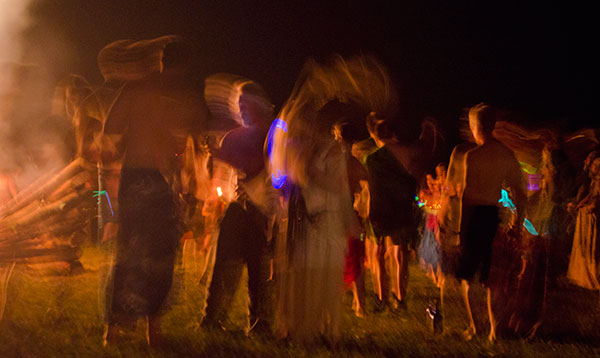
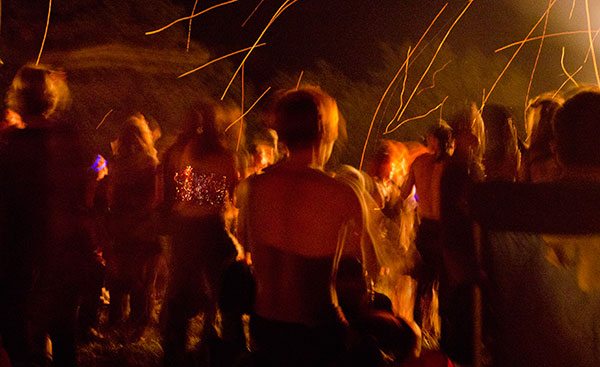
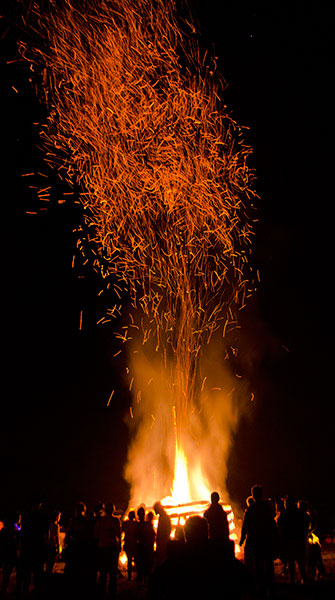
I recently returned from a week teaching art workshops at the Sirius Rising festival at Brushwood Folklore Center in Chautauqua County, New York.  I’ve been going to festivals at Brushwood since 1999, and it’s one of the special places in my world.  The climactic celebration at every festival is a huge community bonfire.   Here are some pictures from this year’s fire, with a few comments and two poems (written by others).

Circling the Bonfire, 2012, photo by Fred Hatt

Flames engulf the wood-stack, wriggling and leaping skyward.  This year’s pyre bore a carved blue dragon.  You can see the dragon’s trumpet-like shout and curled horns in the next two shots.  Salts of copper in the dragon color the flames blue and green.

Bonfire Nebula, 2012, photo by Fred Hatt

Horned Dragon, 2012, photo by Fred Hatt

 TO THE GOD OF FIRE AS A HORSE

A hymn from the Rig Veda (1500-1200 BC) in an English version by Robert Kelly

Your eyes do not make mistakes.

Your eyes have the sun’s seeing.

Your thought marches terribly in the night

blazing with light & the fire

breaks from your throat as you whinny in battle.

Blue Ghost, 2012, photo by Fred Hatt

This fire was born in a pleasant forest

This fire lives in ecstasy somewhere in the night.

Arising Goddess, 2012, photo by Fred Hatt

His march is a dagger of fire

His body is enormous

His mouth opens & closes as he champs on the world

He swings the axe-edge of his tongue

            smelting & refining the raw wood he chops down.

Lady Liberty, 2012, photo by Fred Hatt

He gets ready to shoot & fits arrow to bowstring

He hones his light to a fine edge on the steel

He travels through night with rapid & various movements

His thighs are rich with movement.

            He is a bird that settles on a tree.

(from Technicians of the Sacred:  A Range of Poetries from Africa, America, Asia, Europe & Oceania edited with commentaries by Jerome Rothenberg)

Launch, 2012, photo by Fred Hatt

Gazing into the fire is simultaneously exciting and calming.  The movement is too rapid to fully comprehend, but we know that this energy is within us, in the pulse of our arteries and the impulse of our nerves, the heat of our passions and the controlled combustion that is a life.

Firewatchers, 2012, photo by Fred Hatt

Firelight and Glowsticks, 2012, photo by Fred Hatt

Revelers in the Ember Field, 2012, photo by Fred Hatt

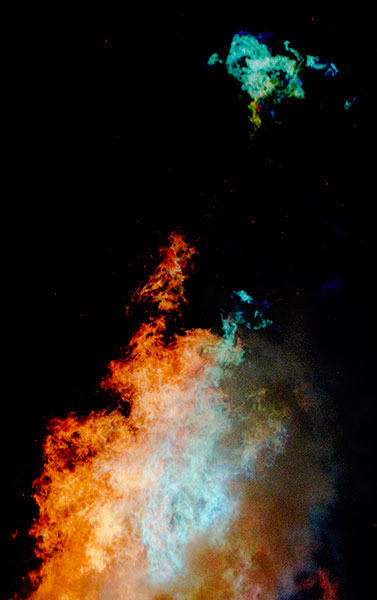
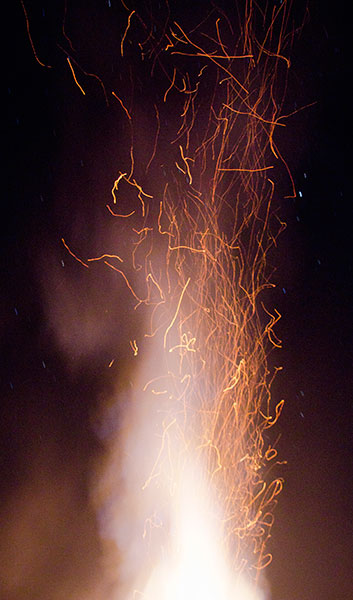
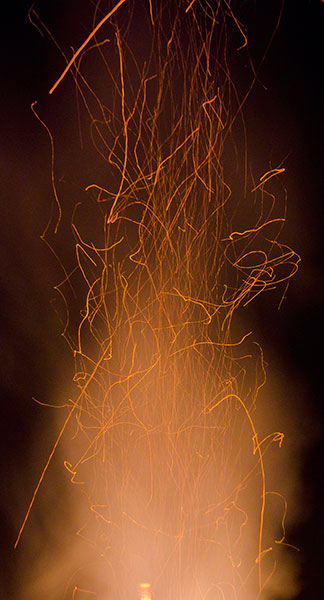
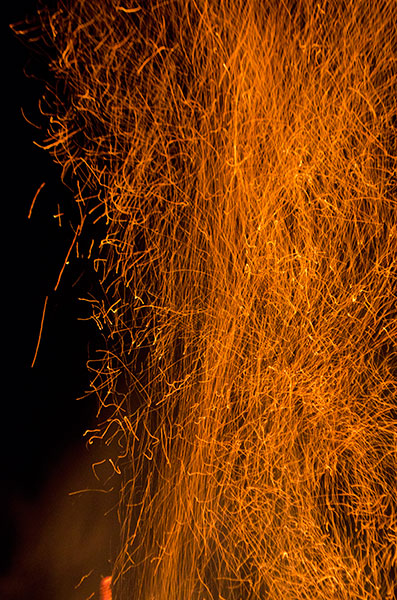
I try to understand the essence of fiery energy by studying the forms of flame.  Combustion is all movement, so it’s really an abstraction to look at it as a still picture, but my slow draftsman’s brain likes to freeze the motion so I can trace its contours.  Photography is my tool for stopping time.  For the raging flames at the top of this post, a fast shutter speed (a thousandth of a second) shows the turbulence of shredded incandescent gas.  The images below use slow shutter speeds (half a second or more) to trace the movement of glowing embers as they rise through the column of heated air above the flames.

Bonfire Centerpost, 2012, photo by Fred Hatt

These scribbles on the sky remind me of the tracings of fermions and bosons recorded in the cloud chamber of a nuclear partical accelerator.  They drift and loop and zag unpredictably.  This is the kind of energy I try to bring to my own drawings.

Incandescent Flux, 2012, photo by Fred Hatt

Dance of Hephaestos, 2012, photo by Fred Hatt

THIS IS THE TIME OF FIRE

a poem by Elaine Maria Upton

There is a time of Water and a time of Wind.
This is the time of Fire, and Fire eats time.
The sands of the desert are uncountable!
Let go of the reckoning! Let go of time!
Let go of rain! Let go of forgiving!

Fountain of Sparks, 2012, photo by Fred Hatt

Cloud Chamber, 2012, photo by Fred Hatt

Fire eats rain and Fire eats trees. Fire eats
The leaves of corn. Fire is the grain and the husk
Of corn. Fire is the raging of Water. Fire is the roar,
the hum, the sting of Wind. Fire is the pepper pulsing
from the flower. Fire is the frenzied volcano dancing.
It is the lightning’s blitz, the drumming, the singing,
The beat of tribes, telling their story all night,
Piercing the bottom of dark, birthing the light.

Pyre, 2012, photo by Fred Hatt

Fire is the Earth exhausted, folding, sleeping
from days and nights of love, til there is no counting.
When flowers bleed, when lions sleep, when angels sigh, oh bleed, oh
sleep, oh sigh then! Oh, burn with mountains!
When leaves flame and fall to the ground,
When grass grows brown then gray, grieve not.
Grieve not, but follow the eagle and follow the grass.

Bottle Brush, 2012, photo by Fred Hatt

River of Embers, 2012, photo by Fred Hatt

Weep not for the Earth. Weep not for the corn.
The Earth is the lover who gives all to love.
The Earth makes a bed of Love and the Sun knows.
The Earth makes a table of Love and the Fire knows.
The Earth feeds Fire. The Earth gives all to Love.
Follow the Earth. Look beyond your eyes as you go!
Follow the Earth to the beat of the Fire!
Open your thighs. Give all to Love!

From the website Poet Seers

Fiery Tresses, 2012, photo by Fred Hatt

For more photos of fire, check this earlier post.

2012/07/27

Cut to the Quick

Julio Quick Poses, 2012, by Fred Hatt

As the 2012 Olympic Games get underway in London, we’ll have an opportunity to observe the elegance and power of the human body in action, diverse kinds of bodies honed through intensive training for different skills.  Here I salute the occasion with my own studies of the body from figure drawing sessions at Figureworks Gallery in Brooklyn and Spring Studio in Manhattan.   All of these sketches are made with watercolor and brush during sequences of two-minute poses.  The illustrations are presented in random order, and the interspersed text is not specifically related to the adjacent images, but generally to the whole collection.

Alley Quick Poses, 2012, by Fred Hatt

A sequence of quick poses is a kind of dance, as the model moves from one position to another to reveal the anatomical structure and the expressive range of the body.  The artist has only a moment to capture whatever can be captured.  I am fascinated by the variety and dynamism of quick poses – the models can do all sorts of things that would be impossible or painful to hold for even a five or ten minute pose.  Knowing that the timer is relentlessly counting down, I enter into a mode of hyperfocused flow, my eyes and my brush both in constant and coordinated motion.  The only way to get anything interesting is to work with swift efficiency.

Gwen Quick Poses, 2012, by Fred Hatt

Here I’m posting complete sequences, so you’ll see some awkward passages as well as some lovely bits of brushwork that reveal something true of the model’s aliveness or individuality.  Every real brushstroke is a rough approximation of the ideal brushstroke into which the visual cortex is translating the forms it perceives.  I’ve been practicing this for many years, so my approximations are pretty good when my focus is on.  It’s more important that the lines be confident and expressive than that they be accurate.  If I were to stop to measure or take a moment to step back and look critically at the sketch, I would hardly be able to get anything at all in two minutes.  I have to go unhesitatingly with the flow, and trust the flow.

Pedro Quick Poses, 2012, by Fred Hatt

I look for curves – the curve of the spine, of the hip, of the neck, of the knee, and make each curve a stroke of the brush.  I try to emphasize what makes each individual body unique, not to genericize the anatomy.  That uniqueness is in the curves.  The curve of one person’s hip is quite different from that of another’s hip.  I always look for the physical idiosyncracies.

Crolie Quick Poses, 2012, by Fred Hatt

I generally omit or radically simplify faces, hair, hands and feet.  Those parts of the body are detail traps, best saved for more leisurely studies.  But they are also often key to the particular expression of a pose or model, so I try to get some indication of their angles.  The direction of a gaze, the splay or curl of the fingers, the twist of an instep can be the detail that makes the pose come alive in the sketch.  For me, angles and curves are practically the whole of quick drawing.

Eric Quick Poses, 2012, by Fred Hatt

Quick poses are a special exchange of energy between model and artist.  A set of quick poses gives the model an opportunity to perform, to stretch out, to test their limits, to offer contrasts of feeling or form.  As the artist, I cannot let such a gift go unappreciated.  When a model is really giving the energy, drawing is like dancing with a fantastically graceful or dynamic partner – complete abandon is the only appropriate response.

Claudia Quick Poses, 2012, by Fred Hatt

A kind of time dilation can occur during quick poses.  From my own experience as a model, I can tell you that holding a challenging pose can make two minutes seem like an eon.  For the artist, a pose that’s complicated to draw can make two minutes feel like a few seconds.

James Quick Poses, 2012, by Fred Hatt

Observing angles is a quick way to see how one thing relates to another thing in space.  When I’m doing quick sketches, I’m making lots of lines that I don’t draw.  In my mind, I make lines between points to see how they relate in space.  I check the angle going from nipple to nose, or from fold of elbow to bulge of heel, or from where the arm meets the leg to the pubic ridge.  When all of those parts are in the right angular relations to each other in space, proportions will be a fair approximation of the reality.

Robyn Quick Poses, 2012, by Fred Hatt

Sometimes it’s easier to see curves and shapes and angles by looking at the negative spaces, the places where the body is not, and how those places relate to each other.  Or the angles of the body may become clearer by seeing them in relation to straight lines such as a wall or surface, the pole the model holds or the wall on which he leans.

Adam Quick Poses, 2012, by Fred Hatt

I’ve pored over anatomy books, assimilating as much structural understanding of the body as I can, but I depict only details I can see.  The knowledge helps me to grasp these features of the body, but I can’t get lost in an analytical breakdown of the body.  I try to get as many anatomical details into the sketches as I can, because these details individualize the body.

Tin Quick Poses, 2012, by Fred Hatt

Curves and angles, negative spaces, spatial relationships, anatomical details, flow and rhythm – it’s a lot to see and a lot to try to depict in two minutes.  The only way to do it is to merge perceiving and drawing into a unified process.  This is achieved by trying and trying and refining through hundreds of hours of practice.

When you watch an Olympic gymnast, you are seeing someone who has developed a perfect unity of perception and action through relentless practice.  Drawing is more subjective, but the learning process is similar.  All the details have to come together, to become one act.

Claire Quick Poses, 2012, by Fred Hatt

All of the original sketches in this post are made with watercolor and a brush in 18″ x 24″ sketchbooks.  Multiple pages have been stacked vertically in the illustrations so a whole series of quick poses appear in a single image, as though the drawings were made on a scroll.  Action sketches actually made on scrolls, drawn by me more than a decade ago, can be seen in this post.  I have also written previously about the similarities between life drawing practice and athletic practice, here.


« Newer PostsOlder Posts »

Powered by WordPress

Theme Tweaker by Unreal