DRAWING LIFE by fred hatt

2012/06/21

Partners in Art

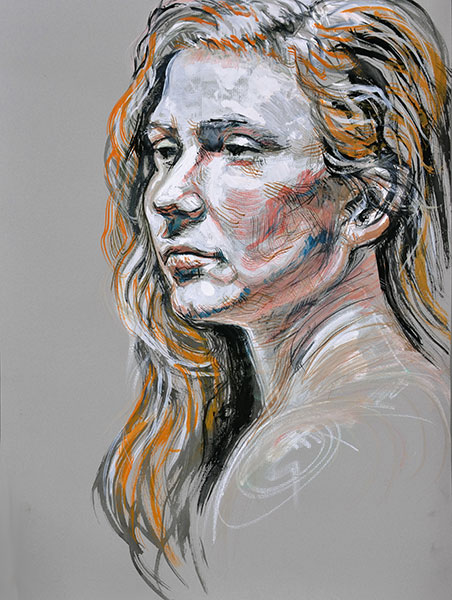
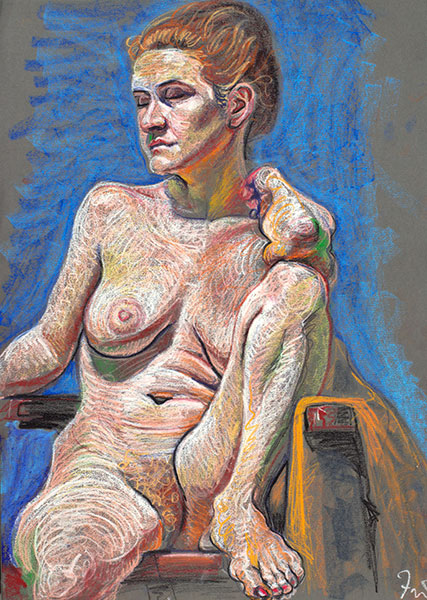
Andrea, 2012, by Fred Hatt

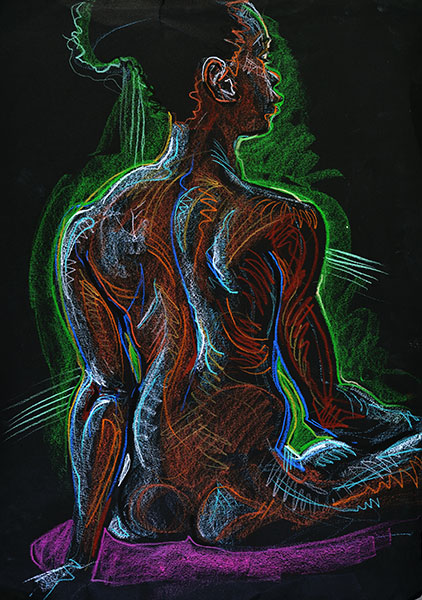
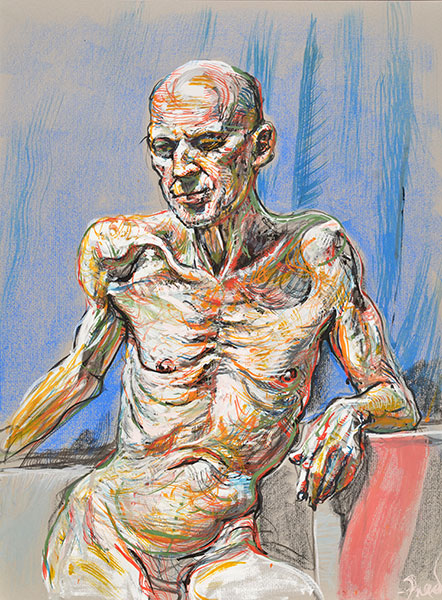
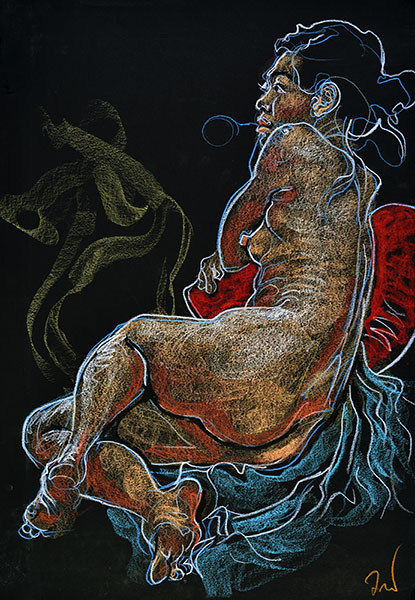
I try to put up at least one post a month based around my ongoing practice of drawing the human figure from life, and this is one of those posts.  But instead of discussing drawing techniques or formal concerns, or relevant knowledge about anatomy or visual perception, I want to speak, as an artist, about our often unsung partners in this practice, the models.  Beyond a statement of appreciation, I want to raise some questions that I hope will start a discussion, and I urge both models and artists to offer their thoughts.  (The pictures are in random order and not directly related to the adjacent discussions.  I’ll let the pictures speak for themselves.)

Kneeling Over, 2012, by Fred Hatt

Drawing the human figure from observation of the live nude model has been a staple of art schooling for centuries, and today open life drawing sessions are available in many places, so that a sort of subculture of the art world has arisen among artists who make a study of the human body the focus of their relaxation or their struggle.   It’s a world beautifully described by naturalist and author Peter Steinhart in “The Undressed Art“, and it’s the world I fell into back in the mid-1990’s when I decided my creativity needed to be anchored to a regular discipline – a discipline I found at New York’s Spring Studio, which offered twenty open figure drawing sessions a week.

The human body and face contain as much depth as any creative subject one could choose.  Studying the human animal, we are seeing ourselves, and all the wonderful variations Nature can work on a form.  We are seeing energy and structure, power and vulnerability, character and emotion.  In trying to depict what we see, we can challenge ourselves in the direction of spontaneity or refinement, speed or endurance, realism or abstraction, knowledge or pure impulse.

Bench, 2012, by Fred Hatt

While some artists think of the model as an object of study, fundamentally no different than a plaster cast or a bowl of fruit, I think most artists that devote themselves to the life drawing practice value it as an interactive experience.  The model offers not only their body, but their attitude and their aliveness.

Pedro, 2012, by Fred Hatt

An artist’s style reflects her experience.  The understanding of things like light and anatomy show her knowledge and her innate way of seeing.  The quality of the marks show her energy and the particular quality of her movement.  The model also shows his life experience.  His body may be trained by dance or athletics, or it may show the marks of age or experience.  His face and the poses he choose reveal something about his attitude and adaptation to the world.

Anguish, 2012, by Fred Hatt

Many of the professional artist’s models that work in the studios of New York are creative people in their own right.  Some are dancers or actors, and they may approach the task of modeling as a performance.  Others are writers or musicians, people with a rich interior life who appreciate a job where they can be still and quiet, composing in the mind.  Others are lovers of art who find their own creative spark manifests most strongly in inspiring others with their presence and openness.

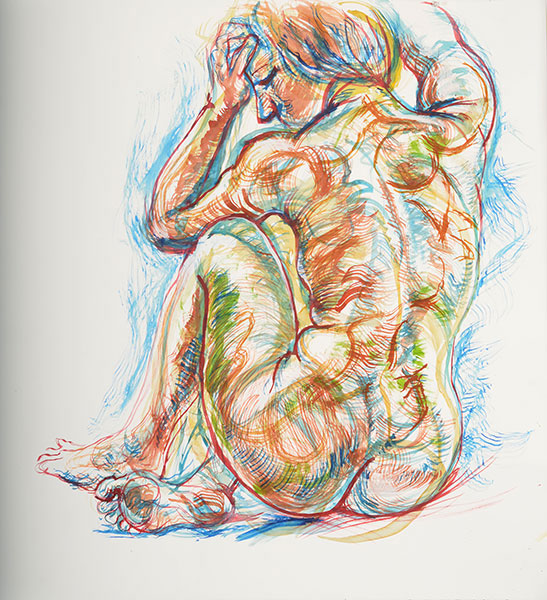
Double Back, 2012, by Fred Hatt

When I work with models privately in my own studio, I think of it as a kind of collaboration.  I choose models that have an energy or style that I find exciting, and I try to allow them to manifest that style in a way that enters into my artwork.  But even when drawing models in an open session with multiple artists, where the model chooses her own poses without any input from me (as is the case for all of the works pictured in this post), my drawings clearly draw a great deal from the model’s contribution to the experience.

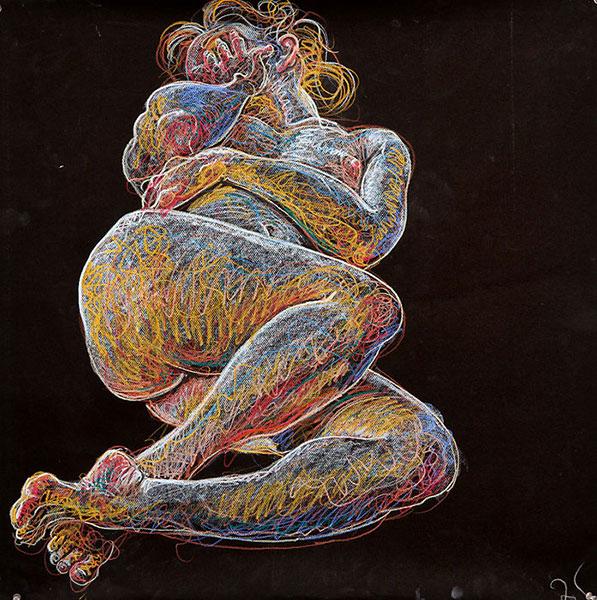
Lie Down on Black, 2012, by Fred Hatt

Historically, artists have usually been of a relatively privileged class, while models were often prostitutes or laborers, exploited or objectified by the artists, and certainly never accorded any respect or credit by the art world arbiters who could elevate the artists to positions of fame and honor.  The great model and writer Claudia (pictured below) has written many stories of historical artist/model relationships on her blog, Museworthy, and most of them are tragic tales.

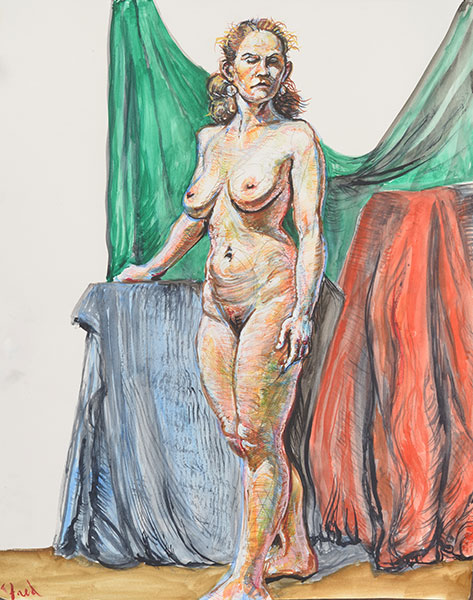
Claudia, 2012, by Fred Hatt

I truly respect the models I work with.  My work depends upon them completely.  I have only been able to do what I do because these men and women have offered me the opportunity to “draw from” their bodies and their spirits.  All of them have fed me, and the greatest of them have inspired me and prodded me to exceed my own limitations.  In the best moments, I have gazed upon some of these models and felt what I can only describe as love, a rapture of being connected to another through the gaze.

Conversation, 2012, by Fred Hatt

In my intellectually formative years, feminists and cultural critics were offering a strong critique of the “male gaze” of figurative art, particularly the art of “the nude” as an act of objectification, an attempt by the male ruling class to claim ownership of the female, the cultural “other”, the working class.  The sad history of the way so many artists treated their models certainly makes this more than just an abstract theoretical argument.

Vassilea, 2012, by Fred Hatt

I always felt, though, that there was something prudish in the condemnation of nude art.  I loved the body and the tradition of the nude in art, which often expressed both eroticism and spirituality – a combination I found particularly compelling.  So I was drawn to devote myself to the art of the nude.  But as a white male, I felt I could not just ignore the critique of the “male gaze”.  My solution was to attempt to depict the body not as an object, but as a pattern of living energy, and to treat my subjects not as ideals, but as individuals, with unique characters and authentic personhood.  I would not look down upon my models from a position of power, I would look up at them with an attitude of adoration and wonder.

Sidewise, 2012, by Fred Hatt

When I work with models, privately or as the monitor (supervisor) of public sessions at Spring Studio, I try to treat them with respect and compassion.  I’ve worked as an art model myself, so I know the pain and discomfort it can often involve, and the vulnerability that is inherent to getting naked before others and keeping still.

Head on Hand, 2012, by Fred Hatt

Many of the models I have drawn love to see my depictions of them, and I”ve always been willing to send images and even sometimes give drawings to models.  I feel the models are my greatest fans – I’ve certainly received more praise and appreciation from models than I ever have from art world figures like dealers and critics.  There is nothing sentimental or idealizing in my approach to drawing them.  People who specialize in portrait commissions will complain of the vanity of their clients, but artists’ models don’t seem to have that kind of insecurity.  The nature of the job pretty much requires you to give that up.  Sometimes I feel I am doing the work for the models.  I so appreciate the opportunity to look at them that I want to show them all the wonderfulness that I see in them.

Plans, 2012, by Fred Hatt

Still, they remain mostly anonymous.  When I have a show, or even when I put drawings up here on the blog, I don’t individually credit the model for each work.  Sometimes I talk about individual models, but often I don’t.  I keep the models all mixed up, which keeps the focus on the artist.  I’ve done that even in this post.  I write the model’s name on the back of every drawing, but if it’s framed, no one sees it.  Since I see work with models as essentially collaborative work, should I credit the models individually?

I also work as a photographer and have often attended the Photo Plus Expo, a trade show at the Javits Center in NYC, so I can check out all the amazing gear I can’t afford.  The booths for major manufacturers like Fuji, Canon and Epson always feature big beautiful photographic prints, and I recall once, maybe a decade ago, seeing there a huge shot of my friend, performance artist Amy Shapiro.  In the photo, Amy was wearing a fantastic costume she created, including a hat with live grass growing on it, and her face was decorated with a grassy paint motif by me.  The picture was taken at one of the Earth Celebrations pageants, public celebrations with revelers costumed as nature spirits, that sought to save the endangered community gardens of Manhattan’s Lower East Side.  The label of the photograph proudly credited the photographer, but there was no mention of Amy, me, Earth Celebrations, Felicia Young (Earth Celebrations’ director) or anything else.  This photographer had just attended an event (one that attracted lots of photographers) and took a shot.  Everything that made the shot interesting depended on others’ creativity, but they weren’t given their due.  Seeing that made me conscious of how much photography really is about “taking”.  There’s a bit of that in drawing, too.

Side Curve, 2012, by Fred Hatt

My friend Kristin, a dancer/choreographer, who has also been a creative collaborator of mine on video projects and has worked with me as an art model, recently sent me a link to this very interesting blog post (by Sarah Maxfield) with extensive discussion in the comments section.  The beginning of the discussion here is about choreographers and photographers failing to credit dancers, but questions about artists’ models also arise in the discussion, as many dancers have done such work.  The author and commenters really raise a lot of issues that are important, and rarely considered, and the level of the conversation will surely disabuse you of any notion that dancers are airhead bunheads.

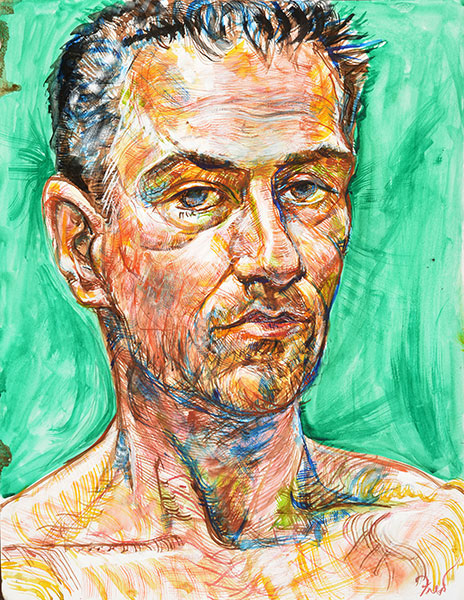
James, 2012, by Fred Hatt

The currently prevailing convention in the subculture of life drawing sessions and classes, at least here in New York, seems to be that artists’ models go by first names only.  They are generally listed that way on the model schedules, and if you ask a model’s name, you’re generally given just a first name.  Many artists make recognizable portraits of professional artists’ models, and often title them with the model’s (first) name.  I usually do that myself when the works are basically portraits – calling a portrait something else would seem an unwarranted judgment or definition of the person.  But Minerva Durham, the director of Spring Studio, once criticized that practice.  As I recall, her point was that the model is paid to let you use their body, not their identity.

Undresser, 2012, by Fred Hatt

I once worked with a female model who had been born in modesty-obsessed Afghanistan but grew up in body-positive Western Europe, who was upset that another artist from Spring Studio had posted online a portrait (not nude) of her tagged with her real name.  She was afraid her Afghan relatives would find it and be upset.  I suggested she should come up with a “nom de muse”.  I suppose there are many reasons nude artists’ models (who often also have other careers) might want to remain anonymous, and if I don’t know, I hesitate to credit them all with full names.

A few years ago when I put up my current portfolio website, I emailed all the models I could to let them know I was putting drawings of them on my site, to thank them, and to ask them if they wished to be credited as model.  I think only one model actually asked to be credited.

Lying Awake, 2012, by Fred Hatt

Here on Drawing Life, my usual practice has been to title drawings with the model’s professional first name when it’s a portrait, and to give drawings that are less specifically portraits descriptive or poetic titles.  In this post, I’m crediting all the models with first names at the foot of the post.

I want to honor and thank the models that contribute so much to my work.  I’m not sure how best to do that.  I would love to get comments from artists or models about this issue.  Let me know what you think and how you feel!

All the drawings above were done at open figure drawing sessions at Spring Studio in Manhattan or Figureworks Gallery in Brooklyn (where there is a current show drawn from 12 years of life drawing classes there, with two of my drawings included).  All are in the size range between 18″ x 24″ and 19.5″ x 27.5″.  Models and media for the above drawings are as follows.  “Crayon” means Caran d’Ache aquarelle crayons.  In case of mixed media, first listed is predominant.

Andrea,  crayon and watercolor/gouache

Kneeling Over (Eric), crayon

Bench (Claudia), watercolor/gouache

Pedro, watercolor/gouache and crayon

Anguish (Eric), crayon

Double Back (Claire), watercolor

Lie Down (Amy), crayon

Claudia, watercolor

Conversation (Eric), watercolor/gouache

Vassilea, watercolor/gouache

Sidewise (Adam), watercolor/gouache

Head on Hand (Amy), watercolor

Plans (Adam), crayon

Side Curve (Amy), crayon

James, watercolor/gouache and crayon

Undresser (Adam), watercolor

Lying Awake (Claudia), crayon


2012/05/13

Back in Gray

Leaning Ahead, 2012, by Fred Hatt

For any artist, I think, regularity of work is essential.  For an artist like me who does other work to make a living, it can be very difficult to keep the creative practice vital and central.  I hold my life drawing practice as a constant.  Sometimes in my life I’m working on special creative projects, and sometimes I’m not.  Sometimes I’m spending huge amounts of time doing jobs to pay the bills, or dealing with family responsibilities, or whatever.  No matter what, I get to my life drawing sessions faithfully.  There are two three-hour classes I attend nearly every week, one a long pose class and another one featuring shorter poses.  I may miss the occasional session due to work schedule, travel, or other unavoidable disruptions, but I will not miss a session because I’m tired or not in the mood or not feeling confident.  The structure of the session solves all my potential “blocks”.  The model gives me a focus that takes me out of my own head.  The model is an active stimulus to which I can respond, without having to come up with any ideas.  The timed poses give me a sense of urgency – there is never quite enough time, so I have to get right into it, no dithering.  The critical eye can only be indulged fleetingly – it can’t be allowed to take over from the direct action of drawing.

I don’t allow the practice to become just a hobby, doing the same things over and over again because they please me.  It must be a constant struggle, a quest to see more, understand more, capture more.  There is no end to the study.  There is always something new I can understand about the structure or the expressiveness of the body, something new I can learn about light or about how eye and mind interact, some new bit of technique or material I can explore, some new challenge of spontaneity or carefulness that I can undertake as I draw.

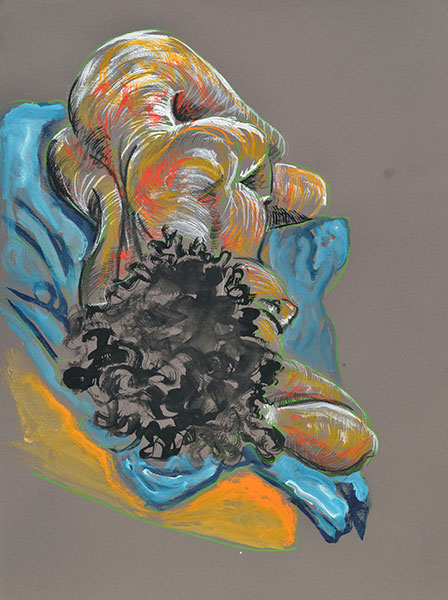
Last year I had begun to feel that I was getting a bit too comfortable in my technique of drawing with aquarelle crayons on gray or black paper, and I decided to start working with watercolors at my life drawing sessions.  If you have been following Drawing Life over the last several months you’ve seen my struggles with the unforgiving medium.  In recent weeks I’ve been trying different papers, including gray paper, and returning sometimes to crayons or using the crayons in conjunction with the paints.  In this post I’ll share some of that work.  All of these pieces were made in the past month.  If you’re not a painter the discussion may be a bit technical, so feel free to just enjoy the pictures.

Knee L, 2012, by Fred Hatt

The wet brush makes more expressive strokes than dry media.  In part this is because it is less controllable, or to be more precise it is controlled more by physics and less by the artist’s hand.  An oil painter may use as much underdrawing and overpainting as necessary to master the painted image, but watercolors are transparent, so all the work shows through.  The unruly nature of the brush is understood in East Asian calligraphy as a virtue.  To make a spontaneous stroke that conveys energy, movement and feeling, using a big floppy wet brush, is a taoist exercise par excellence – going with the flow, dancing on the wind, trusting the chaos of nature to impart its ineffable beauty to your human gesture.

Iridescence of Skin, 2012, by Fred Hatt

The sketches above and below are done with the aquarelle crayons I’ve used for so much of my work over the years.  The crayons have several special qualities.  They can easily be used either sideways, to smear out areas of color, or on point, to make lines.  Hues can be blended by layering on the paper, without mixing and muddying the pigments, perfect for an additive approach to color.  On dark paper, the lighter crayons have a special luminosity, effectively rendering subtle effects of light.  I like to draw by looking at light before anything else, and usually this means drawing highlights before shadows and edges of things – an approach that is impossible when using transparent paints on a white ground.

Touch of Light, 2012, by Fred Hatt

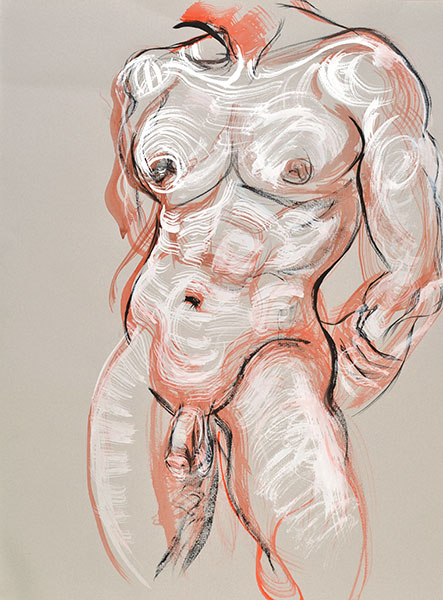
Recently I’ve been using white gouache (opaque watercolor) combined with transparent colors on gray paper, trying for those glowing highlights.  At this point I’m not good enough with the paint to get anything like the color complexity I can get with the crayons.  The crayon drawing above and the gouache/watercolor sketch below are both twenty-minute studies.  With paint, it takes longer to get the light and dark, so there’s less time for color, and since the white gouache is the only paint lighter than the gray background, color in the highlights is a two-stage process, not a one-stage process as with the crayons.

Torso, 2012, by Fred Hatt

The long-pose class gives a longer time to work at subtleties of color and tone.  It’s a three-hour class, and when the warm-up poses and the breaks are subtracted, there’s about two solid hours of studying a single pose.

Akimbo, 2012, by Fred Hatt

The long pose studies above and below are painted in watercolor on white bristol vellum, with some white gouache used for highlight detailing and corrections.  The white gouache never cleanly covers anything.  Any color that is underneath bleeds into it, and it can quickly become dull and dirty-looking.  I’m still trying to use my additive color approach, not mixing paints on the palette, but using straight colors in proximity to each other, so they mix in the eye to give the impression of smooth transitions.  It’s very hard to get this to work as well as it does with the crayons.  The crayons can be applied lightly on the side, introducing a subtle tone to an area.  My best approximation of that with the paint is to use a fan brush with a rather dry load of paint to put down some thin subtle lines of color.  Wherever the white paper shows through, though, it dominates, as it is obviously the brightest and strongest color of them all.

Inward Look, 2012, by Fred Hatt

I finally found a kind of gray paper that takes the watercolor and gouache paints well, without too much friction and without sucking all the water out of the brush or puckering at the wetness.  As you can see in the long-pose example below, this allows me to use white as a highlight, so I can work with paint both lighter and darker than the ground, but it doesn’t do much to make the color mixing easier.  In the background of this one, I’ve used crayons on edge to get soft area coloration, but the colors in the figure are all paint.

Reader of Proust, 2012, by Fred Hatt

Below is a crayon drawing on black paper, 20-minute pose.  Working on black paper offers its own special challenges – as with white paper, I can only go in one direction with the values.  But I think in twenty minutes with crayons I’ve been able to get as much color variance as I was able to do in six times the time in those long pose studies with paint.

Side and Back, 2012, by Fred Hatt

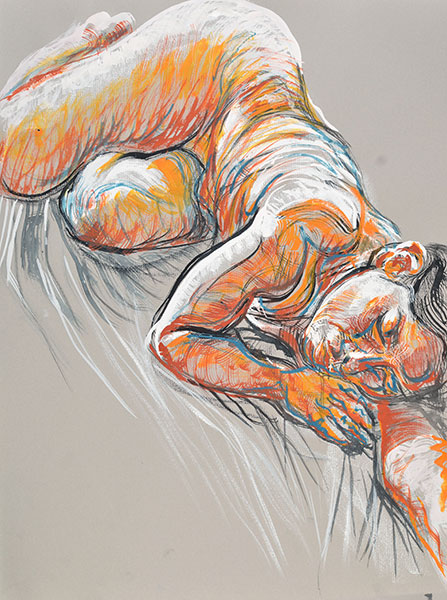
The next three pictures are all 20-minute foreshortened reclining poses.  The first one is done with watercolor and gouache, on a medium gray paper that works well with the crayons.  With the paint, it’s resistant.  The paint doesn’t flow smoothly on this paper, and you may be able to see the scratchy quality of the brushstrokes.  But the middle gray is perfect for bringing out the bold contrast between the black and white paint, and the vividness of the colors against the neutral ground.

Head End Reclining Figure, 2012, by Fred Hatt

Below is a similar pose, painted on the lighter gray paper that handles the wet media more smoothly.  Here I was able to abstract the strokes in a more deliberate way, especially in the face.

Dune, 2012, by Fred Hatt

I used the same paper for the one below.  I used a red crayon to sketch out the figure, then used white gouache and black watercolor to render highlights, edges, and shadows in a relatively realistic style.  The odd angle nevertheless gives this figure a mildly cubist aspect.

Sleeping Weightlifter, 2012, by Fred Hatt

Portraits are the most challenging mode of all, and I’ll conclude this post with four paintings of faces.  The first one is a quick watercolor sketch on bristol vellum, with rough, brushy color.

Knee Kiss, 2012, by Fred Hatt

This one’s on the brush-resistant medium gray paper.  I love the way the gouache-painted highlights look on this darker ground.  The paint becomes light itself.

Heavenward, 2012, by Fred Hatt

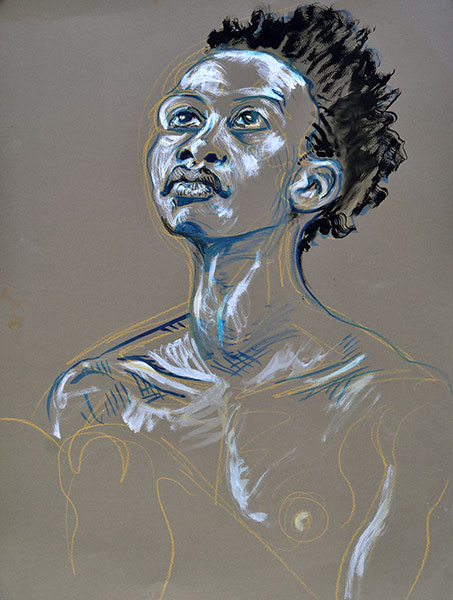
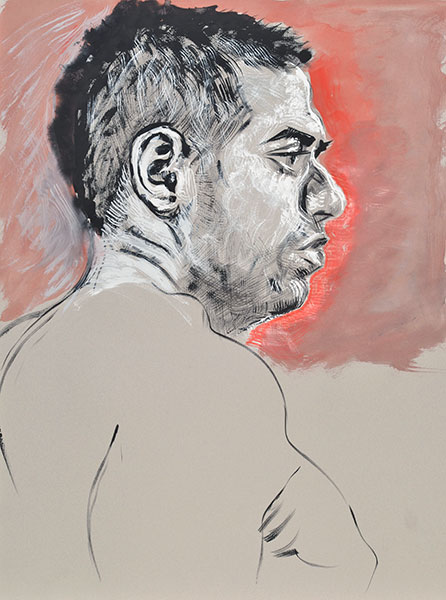
These last two are both painted on the lighter gray paper (though the photographs make the background color look quite different.  It’s a little too warm in the first one and definitely too cool in the second one).  I have to say I’ve always loved working on gray paper.  I can paint the highlights and the shadows, and let the paper provide the tones in between.

Mike in Profile, 2012, by Fred Hatt

The neutrality of the gray ground also has the effect of calming the mind.  For the purposes of drawing, it is a perfect nothingness.  White shines all over and all you can do is try to knock it down a bit.  Black always stays in the background, making anything that  is lighter than itself glow, but its main quality is to suck up and extinguish as much light as it can.  Gray is the synthesis of black and white.  It is serene and unassertive.  It glows, but gently.  It absorbs, but just a bit.  Gray contains all the colors, dark and light, somber and wild, in balance.  Put a red next to it, and you will see the coolness of the gray.  Put a blue next to it, and evoke gray’s warmth.  Gray possesses the underappreciated magic of moderation!

Alley, 2012, 2012, by Fred Hatt

Sizes of the works shown in this post are as follows:

On white paper:  19″ x 24″ (48.3 x 61 cm)

On black paper:  27.5″ x 19.75″ (50 x 70 cm)

On medium gray paper:  18.5″ x 24.5″ (47 x 62 cm)

On light gray paper:  18″ x 24″ (46 x 60 cm)

2012/01/08

Wax and Water

Weathermap, 2011, watercolor on paper, 38" x 34", by Fred Hatt

A few months ago, I made a change in my regular life drawing practice.  My primary drawing medium for over fifteen years had been Caran d’Ache Neocolor II aquarelle crayons.  Aquarelle means watercolor, and the pigments laid down by these crayons can be thinned or blended with water, but I always used them as a dry medium.  Caran d’Ache crayons are similar in size and feel to the familiar Crayola crayons, but they have a much higher pigment density, so they just glow on a background of black or gray paper. One day I decided to change over to a very different medium, to give myself new challenges.  I feel it’s important to keep any creative practice expansive by changing things up in small ways constantly, and in big ways occasionally.  So when I went to the life drawing sessions I began leaving my crayon box at home and bringing instead my watercolor paints and brushes.

There’s a repetition factor in the life drawing practice anyway, as you’ll often see the same models in similar poses to ones you’ve drawn before, and in such a case it’s always more interesting if you can come up with a slightly different approach than the one you used the last time.  Working with a very different medium, one you haven’t yet mastered, is certainly enough of a change to keep it fresh.  I’ve begun to amass a collection of similar pieces in the two media, and in this post I’ll be sharing pairs of images.  Each one of these pairs is of the same model, in similar poses, drawn at similar sizes and over roughly the same amount of working time, but one of each pair is a watercolor painting while the other is a crayon drawing.

The painting at the top of this post and the crayon drawing just below are both studies of model, actor and artist Alley, rendered in free, expressive strokes in their respective media.  I’ve always liked the linear aspect of drawing, as the movement of the line captures a feeling of energy.  Interestingly, in comparing these two, the painting has more linear energy than the drawing does, but the crayons on a black ground give more of an impression of light.

Rotation, 2006, aquarelle crayon on paper, 30" x 30", by Fred Hatt

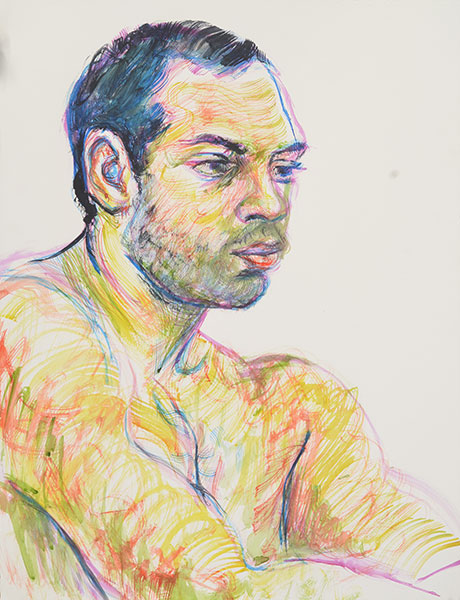
Next, here are two larger-than-life-size heads of Michael, the first a crayon drawing and the second a watercolor painting.

Michael W., 2009, aquarelle crayon on paper, 28" x 20", by Fred Hatt

Michael W, 2011, watercolor on paper, 19" x 24", by Fred Hatt

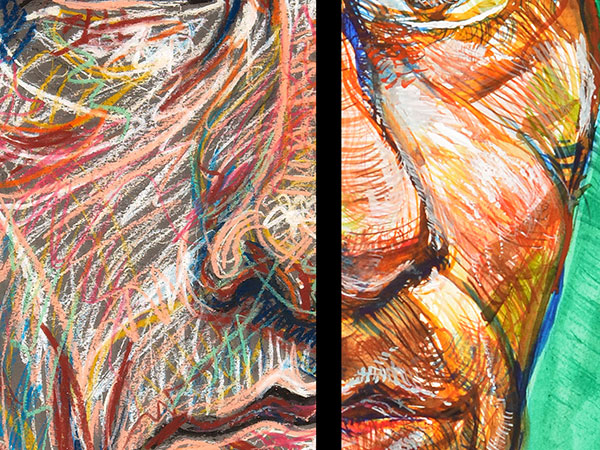
Initially the crayon drawing may appear more linear, but a closer inspection shows that both versions are built up from linear strokes following the contours of the face.  My painting style is becoming quite similar to my drawing style.  The biggest difference is that the crayon drawings start with a dark surface and add light, while the paintings start from white paper and build shadows.  The crayon drawings are an additive process, like modeling a sculpture from clay, while the watercolor paintings are a subtractive process, like carving a sculpture from a block of stone or wood.

Details of two portraits of Michael W, 2009 crayon (left) and 2011 watercolor (right)

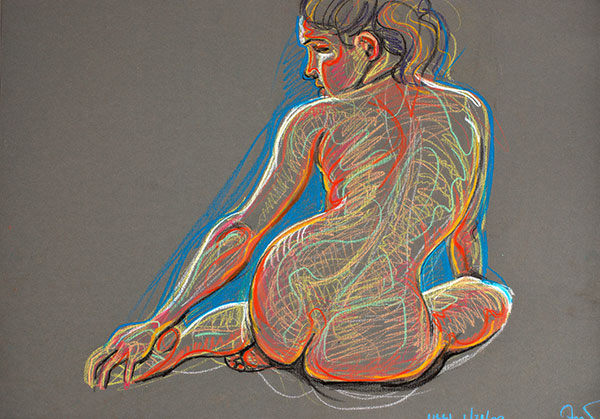
Here are two 20-minute sketches of Lilli’s back.  Notice how free is the movement of the hand in the lighter colors of the crayon drawing.  I can add higher-value colors little by little in this scribbly fashion until it’s light enough.

Sidesit, 2009, aquarelle crayon on paper, 20" x 28", by Fred Hatt

In watercolor painting, the white paper is dominant and blinding, but a single wrong touch can destroy it.  The sculptural analogy holds here – in watercolor painting, as in stone carving, a misplaced stroke can ruin it all.  The hand must be confident and sure.

Seated Contrapposto, 2011, watercolor on paper, 15" x 20", by Fred Hatt

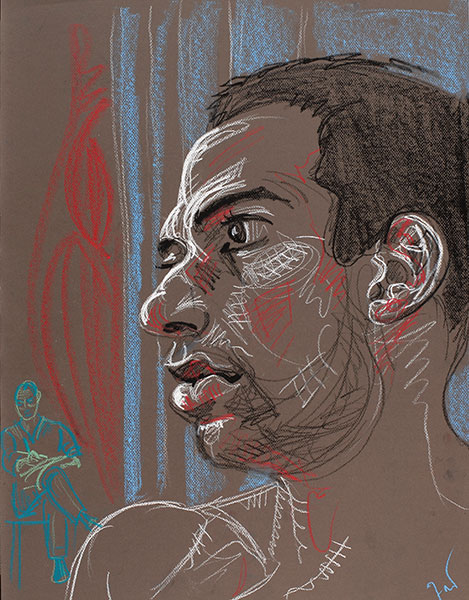
These two 20-minute portrait sketches of Mike (not the same Mike as in the third and fourth pictures in this post) show me trying to go against the tendencies of the media mentioned in the notes on the Lilli back sketches.  In the crayon drawing I’m trying to give the lines great clarity and confidence.

Sketcher and Poser, 2011, aquarelle crayon on paper, 20" x 25", by Fred Hatt

In the watercolor painting below I’m trying to be as loose and sketchy as the cloudiest crayon drawing.  This is mostly painted with a fan brush or comb brush, the paint kept fairly dry.

Michael H, 2011, watercolor on paper, 19" x 24", by Fred Hatt

I’ll conclude with another pair of more developed drawings of Lilli, in both of which she closes her eyes.  (Lest this pairing give the wrong impression, I assure you that Lilli is always alert and focused as a model, eyes closed or not!)  Both of these pieces are worked in many layers, to approach a realistic impression of color and solidity.  A closer look at either one, though, will show the construction of cross contour lines, with colors mixed on the paper, not on the palette.

Reverie, 2008, aquarelle crayon on paper, 28" x 20", by Fred Hatt

Standing, Eyes Closed, 2011, watercolor on paper, 19" x 24", by Fred Hatt

Readers, I invite you to comment on these pairs – what strikes you about the difference between a crayon drawing and a watercolor painting of the same subject?

2011/12/03

Form as Energy

Attraction, Healing Hands series, 2010, by Fred Hatt

The Center for Remembering and Sharing, or CRS, is an organization devoted to supporting and teaching healing arts and creative arts.  Their studios near Union Square in Manhattan host dance and yoga classes, bodywork sessions, film screenings, performances (music, dance and theater), and meditation and energy healing circles.  I got involved with CRS several years ago because their excellent performing arts program, directed by Christopher Pelham, is one of a handful of organizations (along with Cave and the Japan Society) regularly presenting  butoh dance, the experimental Japanese performance art that grows out of the work of Tatsumi Hijikata and Kazuo Ohno.  I first studied butoh in 1992 (in a workshop at La MaMa Experimental Theatre with Yoko Ashikawa), and have performed and collaborated with many butoh artists since then.  On several occasions I was involved in events at CRS, as a performer, video or light artist, or performance videographer.  Through those events I got to know Chris Pelham and CRS’s founder Yasuko Kasaki, and in 2010 they invited me to exhibit my artwork at CRS.  Last year I blogged about it as an upcoming show and posted a transcript of the interview Yasuko conducted with me at the opening.  In this post I’ll share all the drawings I made specifically for the CRS show, and talk a little about my experience making them.

Healing Circle 1, 2010, by Fred Hatt

Aside from the creative arts programs, CRS is a center for spiritual healing.  Practitioners use visualizations, focused breathing, and meditative mental states to channel and direct energy, much as yogis or martial artists do.  I thought this would be an interesting subject to approach as an artist, so I observed and sketched at some of the healing circles at CRS.  These large ink-brush drawings are based on rough sketches I made on-site.

Healing Circle 2, 2010, by Fred Hatt

It’s been a while since I attended these sessions, and some of the sessions were conducted in Japanese, which I don’t understand, so my memory could be wrong in some details, but I think all the healing sessions began with guided and silent meditation.  I believe there was some private speaking between each healer and his or her receiver.  The person receiving healing would sit meditating in a chair, while the healer would move around them, not touching them, but directing the hands towards various parts of the person’s body as though beaming heat waves at them.  Often the healer would raise one hand towards the sky, connecting to universal energy or Holy Spirit, and face the other hand towards the receiver.

Healing Circle 3, 2010, by Fred Hatt

At other times, a healer would move their hands several inches above the receiver’s body, as though smoothing fabric or combing hair in the air around the receiver.  In this drawing, instead of depicting the healers, I drew the paths of the movements of their hands around the receivers, giving, perhaps, an impression of the patterns of energy the healers perceive or conceive surrounding the body.

Healing Circle 4, 2010, by Fred Hatt

If you know my portraits and figure drawings, you’ll know that I often show “energy lines” or “auras” like this, in work that has nothing to do with spiritual healing.  People sometimes ask me if I can perceive energy, if I really see all the colors I put into my drawings.  I’ll try to answer those questions in this post, the remainder of which is illustrated with my drawings of the hands of various CRS healing practitioners, sketched from life as they sat in meditation.

Blessing, Healing Hands series, 2010, by Fred Hatt

I have no sixth sense.  Like anyone else, my eyes perceive only light, and it is through seeing patterns of light that I can discern physical forms and movements.  Through many years of practice in observational drawing, I have trained myself to look with sustained attention, and to notice very subtle variations in form and color.  Through the practice of photography and filmmaking, I have learned a lot about how light works.

Connection, Healing Hands series, 2010, by Fred Hatt

Science tells us that solid matter is essentially an illusion, that all the diverse substances and objects in the world are just different arrangements of the same fundamental stuff, essentially patterns of energy.  The fundamental particles and forces that make up a blade of grass are the same as those that make a blade of steel, and fire and water are different patterns, not different elements.  We living creatures grow out of chemicals forged in stars, and every breath we breathe contains atoms that have been part of countless other things and beings.

Focus, Healing Hands series, 2010, by Fred Hatt

Our perception has evolved to show us a world of solid matter and separate objects.  For basic animal functioning, it’s a highly effective way of understanding what is around us, but it is an illusion.  I have made it a project of my life to try to train myself to see through that illusion, to make the unified field of reality not just an intellectual understanding, but a lived experience.  It seemed to me that our default mode of interpreting sensory input is the most powerful impediment to getting the deeper reality of what we know, and that a practice of honing perception might be a fruitful path.  My visual art practices are about learning to see the world in a way that I believe is truer than the default way, and about communicating that vision to others.  To put it simply, I try to perceive physical things, especially the human form, as patterns of energy, rather than as objects.

Heart, Healing Hands series, 2010, by Fred Hatt

Perhaps some people really can perceive invisible energies directly through the eyes.  Synesthesia is a well-known phenomenon in which sensory pathways get crossed, so that a synesthete might perceive particular musical notes as having colors, for example.  There are many variations of synesthesia, and perhaps seeing auras is a synesthetic phenomenon.  Alternatively, it could be a matter of intuition heightened by imagination – that’s what some who claim to teach clairvoyance seem to be describing.  I don’t know, because I don’t perceive that way, though intuitive imagination is a fundamental aspect of art, mine as much as anyone else’s, and you can see that in these examples especially in the backgrounds, which are essentially imaginative developments around the form of the hands (more on backgrounds later).

Insight, Healing Hands series, 2010, by Fred Hatt

Instead, my practice is to try to link the actual mark-making as closely as possible to the act of perceiving.  Ideally, every saccadic glance should be a stroke of the crayon or brush or whatever.  Every mark should move as though it is flowing over the surface it is describing.  The curves and rhythms of the movements of my drawing hand should reflect the patterns of organic growth that create the forms of the body, or whatever else I am drawing.  My aim is to work in the most direct and dynamic way possible, and in that way to achieve an image in which flow IS form.

Light, Healing Hands series, 2010, by Fred Hatt

This approach can be steered more toward classical realism, by working to make contours and gradations as accurate as possible to what I see, or it can be steered more toward expressionism, by allowing the marks to be freer and looser – by letting the hand dance on the paper.  It’s like the musical distinction between playing it straight and swinging.  Generally the looser style creates a more immediate impression of energy in the viewer of the drawing.  I find that accuracy of proportion is rather unimportant – if the lines have the flow of life, the drawing has life.

Receiving, Healing Hands series, 2010, by Fred Hatt

The colors are just exaggerated from what I see.  In the drawing below, for example, I could see in looking at these hands that the knuckles were slightly more reddish than the rest of the skin, and the area around the veins slightly more bluish.  Color perception is highly relativistic anyway – our way of perceiving color is to compare adjacent areas to see how different they are.   In drawing, I often exaggerate these differences.  If I’m going for the more realistic style, I work at neutralizing the extreme colors by layering them with opposing colors, and the end product can look fairly convincing, when the colors combine in the eye.  If I’m being more expressionistic, I like to keep the more extreme color contrasts.

Rest, Healing Hands series, 2010, by Fred Hatt

In these drawings, the backgrounds are fanciful abstractions.  Sometimes elements of the real background come into it.  In the drawing above, the river of color underneath the hands contains some forms derived from the wrinkles in the pants of the model, whose hands were resting on her thighs.  More often in these drawings, the backgrounds are made by echoing and extending curves in the subject, making a pattern that derives from the hands but also tries to express something of the intuitive feeling I get from the individual who is posing for me.  This aspect of these drawings really is the imaginative projection I discussed above, but it takes place strictly on the paper – it’s not something I could see without drawing.

Strength, Healing Hands series, 2010, by Fred Hatt

I suppose it could be objected that my practice of working as closely as possible to direct perception of the subject, while treating the pictorial background as a projected abstraction, remains a form of separating objects, and therefore does not achieve the vision of unity I described as my ideal.  Alas, my practice doesn’t quite meet my goal.  It’s just the best I’ve been able to do so far in depicting the body as a pattern of energy, and it’s still a work in progress.

Warmth, Healing Hands series, 2010, by Fred Hatt

The “Healing Circle” ink brush drawings are 22.25″ x 30″ (56.5 cm x 76.2 cm).  The “Healing Hands” aquarelle crayon drawings are 18.4″ x 24.5″ (46.7 cm x 62.2 cm).

2011/08/30

A Torso Even More So

Filed under: Figure Drawing: Anatomy — Tags: , , , , , — fred @ 15:08

Face of the Body, 2011, by Fred Hatt

“Torso” is the art term for a depiction of the human form focused primarily on the trunk of the body rather than the head or limbs.  The word derives from a Greek/Latin word meaning stalk.  It’s a botanical analogy, like its synonym, “trunk”, the core out of which the branches grow.  The Greek root word, thyrsos, denotes the magic wand of the followers of Dionysos, a god of fertility, ecstasy, ritual madness, and theater.  The thyrsos, a fennel rod with a pine cone head, twined with ivy vines, embodies the unruly and indomitable life force.

Nautilus, 2011, by Fred Hatt

The torso often expresses this life force in its ability to twist, though as far as I can determine it is a coincidence that the word torso resembles the word torsion.  Torsion means twisting, and that word is related to the terms torque, torture, and torment.  The torso can express coursing vital energy but also vulnerability, leaping joy and convulsive anguish.

Mesh Fem, 2010, by Fred Hatt

The torso includes the heart and lungs and the organs of digestion and sex.  It is the seat of gut feelings, and of the swellings of erotic desire, hunger, and pride.

Supine Lotus, 2010, by Fred Hatt

We all grow in the womb and find our first nourishment at the breast.  Humans and other mammals crave the feeling of warmth and acceptance that is only felt in an embrace with full body closeness.

Arranged Around the Knee, 2011, by Fred Hatt

The torso is a rich subject for the artist because of its complexity of form, revealing different aspects at different angles of view and in varying relationships to the limbs and head.

Oxbow Hip Curve, 2010, by Fred Hatt

In drawing the body, I always imagine that my hands are feeling it, clasping the waist, holding the ribcage, following the underlying structure of bones and the fibers of muscle, sensitive to the warmth of the body, the expansive tide of the breath and the buzzing of nerves and blood vessels.

Inverted Rest, 2011, by Fred Hatt

The arms and legs thrust or relax outward in various directions, and their long forms create expressive angles, but the origin of the energy expressed by the limbs is always found in the core of the body.

Iliac Power, 2010, by Fred Hatt

My friend Mana Hashimoto, a dancer who is blind, teaches workshops on “Dance Without Sight“.  Part of her workshop involves observing the movement of another person by touch alone.  When I took Mana’s workshop I was struck by how clearly I could  understand all the movements of another person with hands placed gently on the back.  It was impossible to follow a dance by touching the head or extremities, but a hand on the back could feel the movements of all parts of the body, including the head, arms, and legs.

Back and Bottle, 2011, by Fred Hatt

The classic standing pose in figurative sculpture and painting is “contrapposto“.  This generally means the weight of the body is primarily on one leg, causing the pelvis to be tilted, and usually the shoulders are tilted in the opposite direction.  The slight asymmetry that is introduced in this way gives an appearance of liveliness to a still figure.  In practice, there are countless variations on the basic principle of contrapposto, as the ribcage/shoulder girdle and the pelvis can each be shifted or tilted in many directions, and the spine can be arched forward or back, bent to the side, twisted, extended or compressed.

Curved Torso Straight Arm, 2011, by Fred Hatt

Symmetrical poses, however, do not need to appear rigid.  In fact, symmetrical poses can be very relaxed because of their balanced weight. Looking at such a pose from an angle is all it takes to give assymmetry to a drawing, and if the artist’s calm hand follows the calmness of the model, the picture will have a certain serenity.

Balasana, 2011, by Fred Hatt

In a drawing, the body reveals its structure in the form of curves and angles going in various directions.  In the drawing below, note the forward thrust of the shoulder softened by the curling hair, and the rearward angle of the elbow balanced by the point of the breast.

Chair Back, 2010, by Fred Hatt

The outside contours of the body, the curve of the spine, and the shadows and highlights make the drawing below a study of sinuous flow.

Sheen, 2010, by Fred Hatt

The contrapposto principles can be seen even in an unusual seated pose seen from the side, as below.  A line drawn across the nipples and one drawn across the crests of the pelvis would create an angle pointing to the right.  The head turns away from the viewer while the far knee and hand come toward us, giving the pose that dynamic twist, while the near arm reaching out of frame to the left acts compositionally like an unresolved chord in music, keeping things a bit off balance.

Hoop Earring, 2011, by Fred Hatt

The spine is really the core of the body, and its movement is a key to the energetic expression of the pose.  Notice the difference in the next two drawings.  Here the spine seems to be lengthening, rising up.

Uplifting, 2011, by Fred Hatt

In the one below, by contrast, there’s a feeling of weight, of the spine relaxing downward.  Unlike most of the other drawings in this post, these two show facial expressions, which surely contribute to the contrasting moods, but even if you cover the faces you can see the difference in the energy.

Leaning on Wall, 2011, by Fred Hatt

In the two drawings above, the abstract treatment of the light around the figures suggests a kind of energetic aura.  In the drawing below a similar effect is achieved by using colored lines to indicate the complex ways that various light sources, both direct and reflected, flow over the curves of the body.

Mesh Masc, 2010, by Fred Hatt

All the parts of the torso are formed around a center line.  I try to locate this center line and then to develop the forms to either side, sketching with cross-contours, or strokes that follow the three-dimensional shapes of the body.

Terrestrial Body, 2010, by Fred Hatt

Here’s another contrapposto from behind, with the angles of the legs echoing the angles of hips and shoulders.

Helical Zigzag, 2011, by Fred Hatt

The energy of the pose below emerges powerfully from the stable center of the sacrum, the base of the spine.  The cross contours show the structure of muscles and bones of the back as a kind of swirling energy.

Sacral Center, 2010, by Fred Hatt

Here’s an unusual pose supported on one hip and forearm.  All four limbs are bent at more or less right angles, all pointing in different directions.

Lateral Bridge, 2011, by Fred Hatt

The features of the frontal torso are arranged similarly to the features of the face.  The face is the window of the soul, showing emotion, intelligence, engagement.  The torso is the face of the life force, showing energy and balance and movement.

Hand on Hip, Forearm on Doorknob, 2011, by Fred Hatt

The torso can embody vigor, sensuality, boldness, timidity, and so on.  The quality of spirit resides in the body as well as in the mind or brain.  Entering into a contemplative state requires releasing and balancing and stabilizing the energy of the body as well as the mind.

Grounded Sitting, 2011, by Fred Hatt


All the drawings in this post are about 50 x 65 cm, or 19 1/2″ x 25 1/2″, aquarelle crayon on paper.  All of these were drawn during 20-minute poses at Figureworks Gallery in Brooklyn.

(The title of this post is a line from the song “Lydia the Tattooed Lady”, by Harold Arlen and Yip Harburg, made famous by Groucho Marx in the 1939 film “At the Circus”.)

« Newer PostsOlder Posts »

Powered by WordPress

Theme Tweaker by Unreal