
Leaning Ahead, 2012, by Fred Hatt
For any artist, I think, regularity of work is essential. For an artist like me who does other work to make a living, it can be very difficult to keep the creative practice vital and central. I hold my life drawing practice as a constant. Sometimes in my life I’m working on special creative projects, and sometimes I’m not. Sometimes I’m spending huge amounts of time doing jobs to pay the bills, or dealing with family responsibilities, or whatever. No matter what, I get to my life drawing sessions faithfully. There are two three-hour classes I attend nearly every week, one a long pose class and another one featuring shorter poses. I may miss the occasional session due to work schedule, travel, or other unavoidable disruptions, but I will not miss a session because I’m tired or not in the mood or not feeling confident. The structure of the session solves all my potential “blocks”. The model gives me a focus that takes me out of my own head. The model is an active stimulus to which I can respond, without having to come up with any ideas. The timed poses give me a sense of urgency – there is never quite enough time, so I have to get right into it, no dithering. The critical eye can only be indulged fleetingly – it can’t be allowed to take over from the direct action of drawing.
I don’t allow the practice to become just a hobby, doing the same things over and over again because they please me. It must be a constant struggle, a quest to see more, understand more, capture more. There is no end to the study. There is always something new I can understand about the structure or the expressiveness of the body, something new I can learn about light or about how eye and mind interact, some new bit of technique or material I can explore, some new challenge of spontaneity or carefulness that I can undertake as I draw.
Last year I had begun to feel that I was getting a bit too comfortable in my technique of drawing with aquarelle crayons on gray or black paper, and I decided to start working with watercolors at my life drawing sessions. If you have been following Drawing Life over the last several months you’ve seen my struggles with the unforgiving medium. In recent weeks I’ve been trying different papers, including gray paper, and returning sometimes to crayons or using the crayons in conjunction with the paints. In this post I’ll share some of that work. All of these pieces were made in the past month. If you’re not a painter the discussion may be a bit technical, so feel free to just enjoy the pictures.

Knee L, 2012, by Fred Hatt
The wet brush makes more expressive strokes than dry media. In part this is because it is less controllable, or to be more precise it is controlled more by physics and less by the artist’s hand. An oil painter may use as much underdrawing and overpainting as necessary to master the painted image, but watercolors are transparent, so all the work shows through. The unruly nature of the brush is understood in East Asian calligraphy as a virtue. To make a spontaneous stroke that conveys energy, movement and feeling, using a big floppy wet brush, is a taoist exercise par excellence – going with the flow, dancing on the wind, trusting the chaos of nature to impart its ineffable beauty to your human gesture.

Iridescence of Skin, 2012, by Fred Hatt
The sketches above and below are done with the aquarelle crayons I’ve used for so much of my work over the years. The crayons have several special qualities. They can easily be used either sideways, to smear out areas of color, or on point, to make lines. Hues can be blended by layering on the paper, without mixing and muddying the pigments, perfect for an additive approach to color. On dark paper, the lighter crayons have a special luminosity, effectively rendering subtle effects of light. I like to draw by looking at light before anything else, and usually this means drawing highlights before shadows and edges of things – an approach that is impossible when using transparent paints on a white ground.
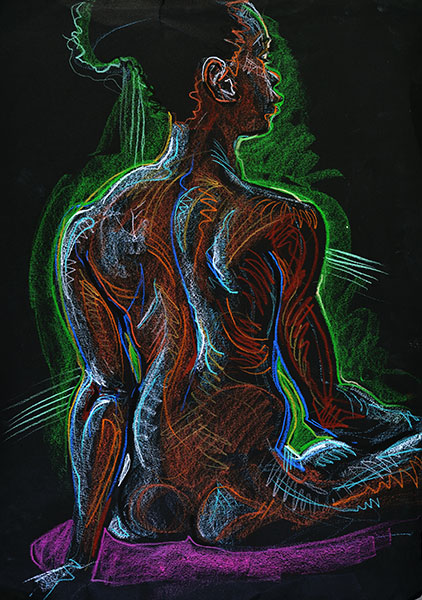
Touch of Light, 2012, by Fred Hatt
Recently I’ve been using white gouache (opaque watercolor) combined with transparent colors on gray paper, trying for those glowing highlights. At this point I’m not good enough with the paint to get anything like the color complexity I can get with the crayons. The crayon drawing above and the gouache/watercolor sketch below are both twenty-minute studies. With paint, it takes longer to get the light and dark, so there’s less time for color, and since the white gouache is the only paint lighter than the gray background, color in the highlights is a two-stage process, not a one-stage process as with the crayons.
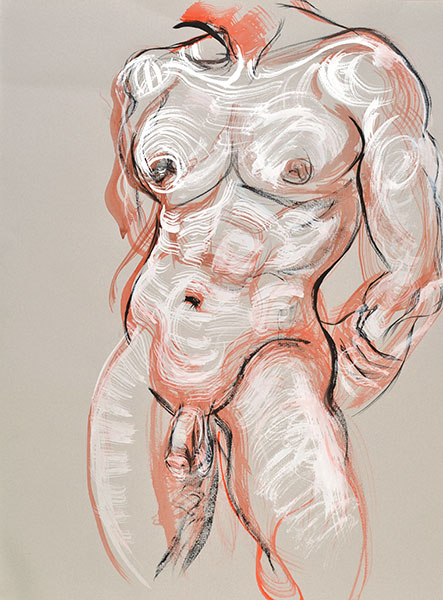
Torso, 2012, by Fred Hatt
The long-pose class gives a longer time to work at subtleties of color and tone. It’s a three-hour class, and when the warm-up poses and the breaks are subtracted, there’s about two solid hours of studying a single pose.

Akimbo, 2012, by Fred Hatt
The long pose studies above and below are painted in watercolor on white bristol vellum, with some white gouache used for highlight detailing and corrections. The white gouache never cleanly covers anything. Any color that is underneath bleeds into it, and it can quickly become dull and dirty-looking. I’m still trying to use my additive color approach, not mixing paints on the palette, but using straight colors in proximity to each other, so they mix in the eye to give the impression of smooth transitions. It’s very hard to get this to work as well as it does with the crayons. The crayons can be applied lightly on the side, introducing a subtle tone to an area. My best approximation of that with the paint is to use a fan brush with a rather dry load of paint to put down some thin subtle lines of color. Wherever the white paper shows through, though, it dominates, as it is obviously the brightest and strongest color of them all.

Inward Look, 2012, by Fred Hatt
I finally found a kind of gray paper that takes the watercolor and gouache paints well, without too much friction and without sucking all the water out of the brush or puckering at the wetness. As you can see in the long-pose example below, this allows me to use white as a highlight, so I can work with paint both lighter and darker than the ground, but it doesn’t do much to make the color mixing easier. In the background of this one, I’ve used crayons on edge to get soft area coloration, but the colors in the figure are all paint.
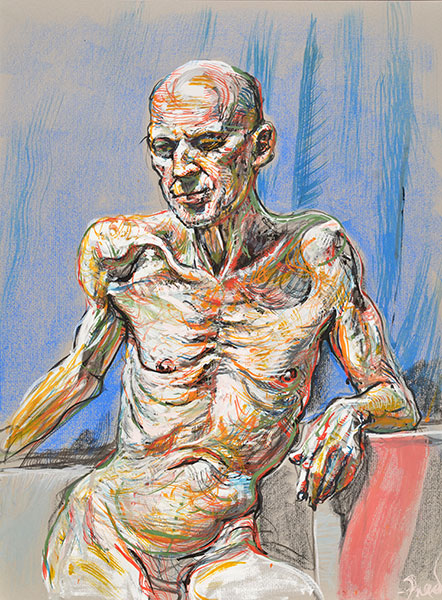
Reader of Proust, 2012, by Fred Hatt
Below is a crayon drawing on black paper, 20-minute pose. Working on black paper offers its own special challenges – as with white paper, I can only go in one direction with the values. But I think in twenty minutes with crayons I’ve been able to get as much color variance as I was able to do in six times the time in those long pose studies with paint.
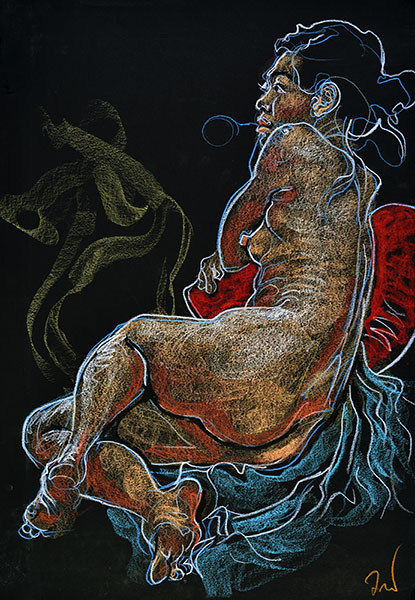
Side and Back, 2012, by Fred Hatt
The next three pictures are all 20-minute foreshortened reclining poses. The first one is done with watercolor and gouache, on a medium gray paper that works well with the crayons. With the paint, it’s resistant. The paint doesn’t flow smoothly on this paper, and you may be able to see the scratchy quality of the brushstrokes. But the middle gray is perfect for bringing out the bold contrast between the black and white paint, and the vividness of the colors against the neutral ground.
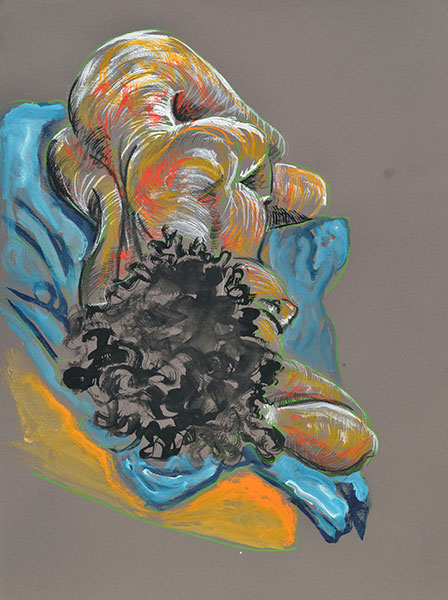
Head End Reclining Figure, 2012, by Fred Hatt
Below is a similar pose, painted on the lighter gray paper that handles the wet media more smoothly. Here I was able to abstract the strokes in a more deliberate way, especially in the face.
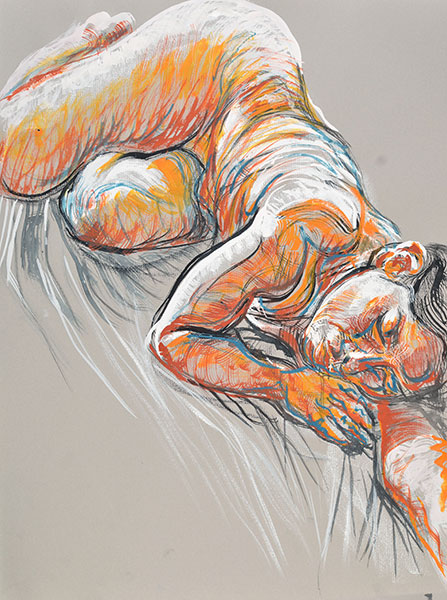
Dune, 2012, by Fred Hatt
I used the same paper for the one below. I used a red crayon to sketch out the figure, then used white gouache and black watercolor to render highlights, edges, and shadows in a relatively realistic style. The odd angle nevertheless gives this figure a mildly cubist aspect.

Sleeping Weightlifter, 2012, by Fred Hatt
Portraits are the most challenging mode of all, and I’ll conclude this post with four paintings of faces. The first one is a quick watercolor sketch on bristol vellum, with rough, brushy color.

Knee Kiss, 2012, by Fred Hatt
This one’s on the brush-resistant medium gray paper. I love the way the gouache-painted highlights look on this darker ground. The paint becomes light itself.
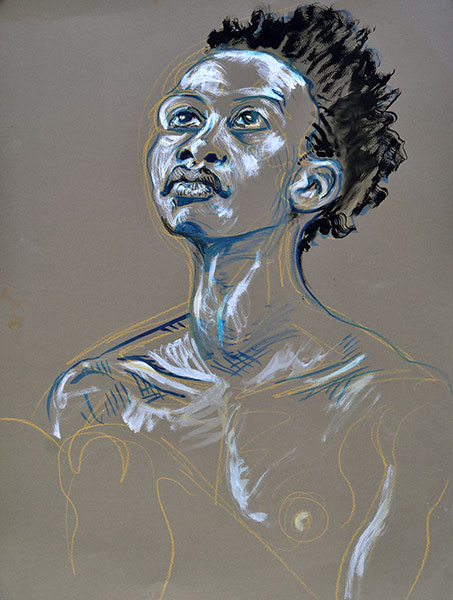
Heavenward, 2012, by Fred Hatt
These last two are both painted on the lighter gray paper (though the photographs make the background color look quite different. It’s a little too warm in the first one and definitely too cool in the second one). I have to say I’ve always loved working on gray paper. I can paint the highlights and the shadows, and let the paper provide the tones in between.
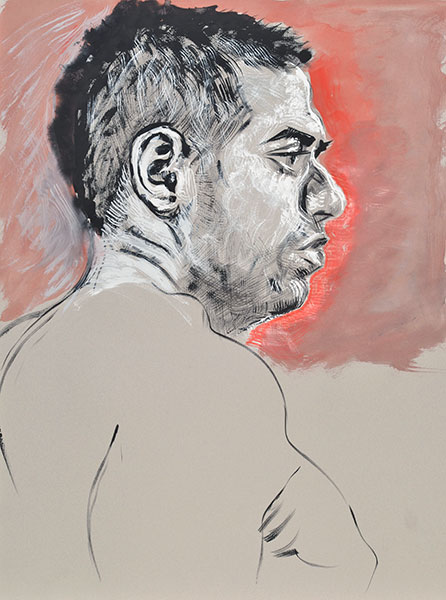
Mike in Profile, 2012, by Fred Hatt
The neutrality of the gray ground also has the effect of calming the mind. For the purposes of drawing, it is a perfect nothingness. White shines all over and all you can do is try to knock it down a bit. Black always stays in the background, making anything that is lighter than itself glow, but its main quality is to suck up and extinguish as much light as it can. Gray is the synthesis of black and white. It is serene and unassertive. It glows, but gently. It absorbs, but just a bit. Gray contains all the colors, dark and light, somber and wild, in balance. Put a red next to it, and you will see the coolness of the gray. Put a blue next to it, and evoke gray’s warmth. Gray possesses the underappreciated magic of moderation!
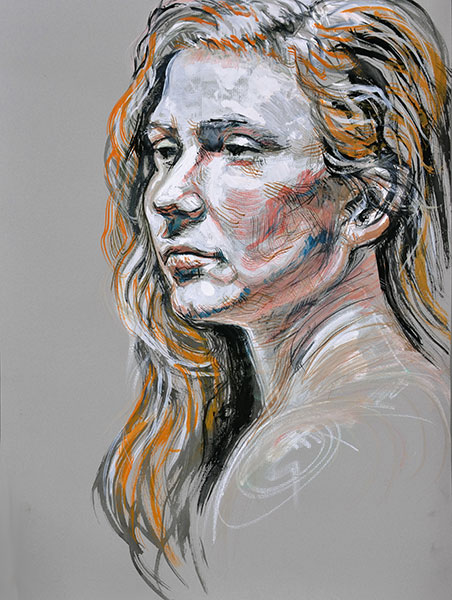
Alley, 2012, 2012, by Fred Hatt
Sizes of the works shown in this post are as follows:
On white paper: 19″ x 24″ (48.3 x 61 cm)
On black paper: 27.5″ x 19.75″ (50 x 70 cm)
On medium gray paper: 18.5″ x 24.5″ (47 x 62 cm)
On light gray paper: 18″ x 24″ (46 x 60 cm)
