DRAWING LIFE by fred hatt

2011/12/03

Form as Energy

Attraction, Healing Hands series, 2010, by Fred Hatt

The Center for Remembering and Sharing, or CRS, is an organization devoted to supporting and teaching healing arts and creative arts.  Their studios near Union Square in Manhattan host dance and yoga classes, bodywork sessions, film screenings, performances (music, dance and theater), and meditation and energy healing circles.  I got involved with CRS several years ago because their excellent performing arts program, directed by Christopher Pelham, is one of a handful of organizations (along with Cave and the Japan Society) regularly presenting  butoh dance, the experimental Japanese performance art that grows out of the work of Tatsumi Hijikata and Kazuo Ohno.  I first studied butoh in 1992 (in a workshop at La MaMa Experimental Theatre with Yoko Ashikawa), and have performed and collaborated with many butoh artists since then.  On several occasions I was involved in events at CRS, as a performer, video or light artist, or performance videographer.  Through those events I got to know Chris Pelham and CRS’s founder Yasuko Kasaki, and in 2010 they invited me to exhibit my artwork at CRS.  Last year I blogged about it as an upcoming show and posted a transcript of the interview Yasuko conducted with me at the opening.  In this post I’ll share all the drawings I made specifically for the CRS show, and talk a little about my experience making them.

Healing Circle 1, 2010, by Fred Hatt

Aside from the creative arts programs, CRS is a center for spiritual healing.  Practitioners use visualizations, focused breathing, and meditative mental states to channel and direct energy, much as yogis or martial artists do.  I thought this would be an interesting subject to approach as an artist, so I observed and sketched at some of the healing circles at CRS.  These large ink-brush drawings are based on rough sketches I made on-site.

Healing Circle 2, 2010, by Fred Hatt

It’s been a while since I attended these sessions, and some of the sessions were conducted in Japanese, which I don’t understand, so my memory could be wrong in some details, but I think all the healing sessions began with guided and silent meditation.  I believe there was some private speaking between each healer and his or her receiver.  The person receiving healing would sit meditating in a chair, while the healer would move around them, not touching them, but directing the hands towards various parts of the person’s body as though beaming heat waves at them.  Often the healer would raise one hand towards the sky, connecting to universal energy or Holy Spirit, and face the other hand towards the receiver.

Healing Circle 3, 2010, by Fred Hatt

At other times, a healer would move their hands several inches above the receiver’s body, as though smoothing fabric or combing hair in the air around the receiver.  In this drawing, instead of depicting the healers, I drew the paths of the movements of their hands around the receivers, giving, perhaps, an impression of the patterns of energy the healers perceive or conceive surrounding the body.

Healing Circle 4, 2010, by Fred Hatt

If you know my portraits and figure drawings, you’ll know that I often show “energy lines” or “auras” like this, in work that has nothing to do with spiritual healing.  People sometimes ask me if I can perceive energy, if I really see all the colors I put into my drawings.  I’ll try to answer those questions in this post, the remainder of which is illustrated with my drawings of the hands of various CRS healing practitioners, sketched from life as they sat in meditation.

Blessing, Healing Hands series, 2010, by Fred Hatt

I have no sixth sense.  Like anyone else, my eyes perceive only light, and it is through seeing patterns of light that I can discern physical forms and movements.  Through many years of practice in observational drawing, I have trained myself to look with sustained attention, and to notice very subtle variations in form and color.  Through the practice of photography and filmmaking, I have learned a lot about how light works.

Connection, Healing Hands series, 2010, by Fred Hatt

Science tells us that solid matter is essentially an illusion, that all the diverse substances and objects in the world are just different arrangements of the same fundamental stuff, essentially patterns of energy.  The fundamental particles and forces that make up a blade of grass are the same as those that make a blade of steel, and fire and water are different patterns, not different elements.  We living creatures grow out of chemicals forged in stars, and every breath we breathe contains atoms that have been part of countless other things and beings.

Focus, Healing Hands series, 2010, by Fred Hatt

Our perception has evolved to show us a world of solid matter and separate objects.  For basic animal functioning, it’s a highly effective way of understanding what is around us, but it is an illusion.  I have made it a project of my life to try to train myself to see through that illusion, to make the unified field of reality not just an intellectual understanding, but a lived experience.  It seemed to me that our default mode of interpreting sensory input is the most powerful impediment to getting the deeper reality of what we know, and that a practice of honing perception might be a fruitful path.  My visual art practices are about learning to see the world in a way that I believe is truer than the default way, and about communicating that vision to others.  To put it simply, I try to perceive physical things, especially the human form, as patterns of energy, rather than as objects.

Heart, Healing Hands series, 2010, by Fred Hatt

Perhaps some people really can perceive invisible energies directly through the eyes.  Synesthesia is a well-known phenomenon in which sensory pathways get crossed, so that a synesthete might perceive particular musical notes as having colors, for example.  There are many variations of synesthesia, and perhaps seeing auras is a synesthetic phenomenon.  Alternatively, it could be a matter of intuition heightened by imagination – that’s what some who claim to teach clairvoyance seem to be describing.  I don’t know, because I don’t perceive that way, though intuitive imagination is a fundamental aspect of art, mine as much as anyone else’s, and you can see that in these examples especially in the backgrounds, which are essentially imaginative developments around the form of the hands (more on backgrounds later).

Insight, Healing Hands series, 2010, by Fred Hatt

Instead, my practice is to try to link the actual mark-making as closely as possible to the act of perceiving.  Ideally, every saccadic glance should be a stroke of the crayon or brush or whatever.  Every mark should move as though it is flowing over the surface it is describing.  The curves and rhythms of the movements of my drawing hand should reflect the patterns of organic growth that create the forms of the body, or whatever else I am drawing.  My aim is to work in the most direct and dynamic way possible, and in that way to achieve an image in which flow IS form.

Light, Healing Hands series, 2010, by Fred Hatt

This approach can be steered more toward classical realism, by working to make contours and gradations as accurate as possible to what I see, or it can be steered more toward expressionism, by allowing the marks to be freer and looser – by letting the hand dance on the paper.  It’s like the musical distinction between playing it straight and swinging.  Generally the looser style creates a more immediate impression of energy in the viewer of the drawing.  I find that accuracy of proportion is rather unimportant – if the lines have the flow of life, the drawing has life.

Receiving, Healing Hands series, 2010, by Fred Hatt

The colors are just exaggerated from what I see.  In the drawing below, for example, I could see in looking at these hands that the knuckles were slightly more reddish than the rest of the skin, and the area around the veins slightly more bluish.  Color perception is highly relativistic anyway – our way of perceiving color is to compare adjacent areas to see how different they are.   In drawing, I often exaggerate these differences.  If I’m going for the more realistic style, I work at neutralizing the extreme colors by layering them with opposing colors, and the end product can look fairly convincing, when the colors combine in the eye.  If I’m being more expressionistic, I like to keep the more extreme color contrasts.

Rest, Healing Hands series, 2010, by Fred Hatt

In these drawings, the backgrounds are fanciful abstractions.  Sometimes elements of the real background come into it.  In the drawing above, the river of color underneath the hands contains some forms derived from the wrinkles in the pants of the model, whose hands were resting on her thighs.  More often in these drawings, the backgrounds are made by echoing and extending curves in the subject, making a pattern that derives from the hands but also tries to express something of the intuitive feeling I get from the individual who is posing for me.  This aspect of these drawings really is the imaginative projection I discussed above, but it takes place strictly on the paper – it’s not something I could see without drawing.

Strength, Healing Hands series, 2010, by Fred Hatt

I suppose it could be objected that my practice of working as closely as possible to direct perception of the subject, while treating the pictorial background as a projected abstraction, remains a form of separating objects, and therefore does not achieve the vision of unity I described as my ideal.  Alas, my practice doesn’t quite meet my goal.  It’s just the best I’ve been able to do so far in depicting the body as a pattern of energy, and it’s still a work in progress.

Warmth, Healing Hands series, 2010, by Fred Hatt

The “Healing Circle” ink brush drawings are 22.25″ x 30″ (56.5 cm x 76.2 cm).  The “Healing Hands” aquarelle crayon drawings are 18.4″ x 24.5″ (46.7 cm x 62.2 cm).

2011/11/22

Abstraction by Shadows

Filed under: Photography: Light — Tags: , , , , , — fred @ 00:12

Texture in Gray and Tan, 2010, photo by Fred Hatt

I don’t usually think of my urban landscape photos as Fine Art Photography.  They’re just visual impressions, casually collected by technological means.  Unless it’s a job, I rarely go out specifically to make photographs.  If I’m going to the kind of event I think will attract a lot of shutterbugs, I’ll deliberately leave my camera at home.  But when I’m going about my business around town, provided I’m not too rushed or carrying too much other stuff, I often carry a camera with me.  Looking for pictures in the world around me is an exercise in seeing the world abstractly.  I like patterns and geometry, randomness (chaos) and design (order), elemental and optical phenomena.

Sometimes the patterns of shadows and light, when framed in the viewfinder, look like abstract expressionist paintings, especially when organic scatterings come together with rectilinear structures, as in the above image of mottled tree shadows falling across subtle bands of colored stucco and concrete.  In the picture below, the mottled pattern is light reflected from the windows of another building, a towering projection of fire in the middle of a monolithic shadow.

Light Within Shadow, 2010, photo by Fred Hatt

Decorative ironwork makes the stark necessity of security an occasion for creative design, and the visual layering of the black iron and the dark shadows in afternoon sunlight make a complex tessellation.

Cracquelure, 2006, photo by Fred Hatt

At night, multiple light sources, of different colors, come from different directions, creating subtle patterns.

Stair Shadows, 2011, photo by Fred Hatt

Here, the sun shines through windows of beveled glass onto a tile floor perhaps inspired by Piet Mondrian.

Sunlight Through Leaded Glass, 2011, photo by Fred Hatt

A geometrical arrangement in red, beige, and dark gray frames an adumbral totem of modernity.

Cobra, 2007, photo by Fred Hatt

Another signpost is the figure on a ground of stippled gold and teal.

Park and Adelphi, 2005, photo by Fred Hatt

In a shadowy corridor, a beam of light shining through a skylight gives this brass number a soft aura.

Three, 2006, photo by Fred Hatt

In early morning sunlight, shadows and reflections from chrome architectural fixtures play like wild luminous graffiti across this stodgy corporate structure.

Plaza, 2004, photo by Fred Hatt

I think of this one as a study in polyrhythms, as the different repeating intervals of light and dark, thick and thin, angled and perpendicular, come together.

Interval Variations, 2005, photo by Fred Hatt

This composition of perspective and piebald is held together by the patch of bright orange netting in the corner.

Under a Scaffold, 2011, photo by Fred Hatt

Here, shadows of trees cast directly by the sun overlap shadows cast by the sun bouncing off of greenish glass, a vision worthy of a great abstract colorist like Joan Mitchell.

Shadows in Green and Gray, 2009, photo by Fred Hatt

Two lamps cast cones of light like sentries guarding this Romanesque arch.

Lamps and Arch, 2010, photo by Fred Hatt

This porch light in the late day sun projects a robotic face on the wall.

Daytime Nightlight, 2010, photo by Fred Hatt

Someone tried to relieve the ennui-producing rigidity of this building façade by putting the vinyl siding on at a 45 degree angle, but the venous shadows of bare trees are what finally do the trick.

Winter Composition, 2006, photo by Fred Hatt

Don’t rectangles and organic branching patterns complement each other wonderfully?

Storefront, 2011, photo by Fred Hatt

In this nighttime shot, the shadow of a cluster of signs and the crosswalk markings add their jagged geometry to a well-worn street corner.

Bold Stripes, 2008, photo by Fred Hatt

On this wall beneath an iron grating, two white lights and one yellow one create a network of stripes over the masonry.

White and Yellow Light, 2010, photo by Fred Hatt

Light reflecting from (I think)  a bowl of water in the sun throws this ghost on an old tin ceiling, with a bit of a rainbow forming about the lower left edge.

Refractive Projection, 2004, photo by Fred Hatt

The cable installers never seem much concerned about neatness, and the angled sun turns their tangle into an art brut scrawl.

Coaxial Cluster, 2010, photo by Fred Hatt

The columns in this neoclassical temple are cast concrete, but sunlight and bare trees give them the veined patterns of Carrara marble.

Fluted Columns, 2010, photo by Fred Hatt

Here the crepuscular rays of a car’s headlights cross the sidewalk slabs from one angle, while the elongated shadow of a bicycle, cast by a sodium-vapor streetlight, cross at another angle.

Crossing Light and Dark, 2011, photo by Fred Hatt

Here the shadows of decorative ironwork dance across the treads and risers of a New York brownstone stoop.

Filigreed Steps, 2008, photo by Fred Hatt

White stripes, orange splotches, dark windows, a looming presence.

Night House, 2010, photo by Fred Hatt

A tree’s narrow leaves make the shadows on this security gate, but it looks like the work of a berserk calligrapher.  The sky blue and pink paint on the wall are the colors of baby announcements, but what kind of world are they being born into?

Shadow Gate, 2010, photo by Fred Hatt

The shadow of an ornate carved wooden cross at a Lithuanian church breaks as it falls across a stepped wall.

Segmented Cross, 2010, photo by Fred Hatt

When multiple light sources of different colors cast shadows of a single object, the colors neutralize in the bright areas but intensify in the shadows, especially where light of only one color falls.

Tinted Lines, 2011, photo by Fred Hatt

The city is designed and constructed of plane surfaces, but without the organic forms of trees and people in motion, it would be nothing.

Sidewalk Shadows, 2011, photo by Fred Hatt


2011/11/12

Fierce Fire


Still from "Inner Heat", video by Fred Hatt with Corinna Brown

If you emerge from a hot tub or shower into the cold night, you may see rivulets of steam rising from your skin.  If the environment is dark and a light source illuminates the steam from behind, you can see it clearly.  A runner on a chilly morning may also generate steam from the body, but it’s usually difficult to see in daylight.

Still from "Inner Heat", video by Fred Hatt with Corinna Brown

My longtime friend and collaborator, Corinna Hiller Brown, a butoh dancer and movement therapist, had the idea of trying to capture this effect on video, combined with trancelike butoh dance.  On a snowy winter night in 2005, in my studio in Brooklyn, we turned off the heat, opened all the windows and doors, and pulled a box fan out of off-season storage, trying to get the room as cold as possible.  Corinna repeatedly got in and out of a hot shower, so when she entered the chilly studio her skin would steam for a couple of minutes – just enough to get a quick take.  Later that same night, I filmed the snowflakes eddying under the street lamps outside.

There was no way to assemble the fragments of dance into a connected choreography, but the slow downward drift of the snow through shifting currents of air worked well as a transitional element, echoing in reverse the movement of the glowing steam curling up from the warm skin.  The first, simple edit of this material was used as a projection element with “My Love Bleeds Fire”, a choreographed piece that Corinna premiered at the Cool New York Dance Festival at White Wave.

Still from "Inner Heat", video by Fred Hatt with Corinna Brown

Seven years later, I’ve finally completed a version of the video that I feel stands alone as a piece of poetic cinema.  For the soundtrack, multi-instrumentalist Gregory Reynolds created a jangly droning sound with swelling bass notes, which I mixed with recordings I’d made of ocean surf and rain.

Still from "Inner Heat", video by Fred Hatt with Corinna Brown

For me, the film is a vision of the warmth of life in the cold world.  I described it thus:  “The body is a slow flame, a campfire in the snow, a star in the vastness of space, a pulsing heart in the ocean.”  Every living being is a kind of fire.  Metabolism is combustion.  Life force is like a flame, cohering as long as it consumes experience, adhering to the body as a candle flame clings to its wick.  The heart and mind of a sentient being give warmth and light into the world.

Still from "Inner Heat", video by Fred Hatt with Corinna Brown

The title, “Inner Heat”, refers to a traditional Tibetan meditation practice called tummo.  A combination of breathing exercises and highly focused visualizations can produce enough heat in the body to survive in the snows of the Himalayas.  This is more than just legendary tantric magic, as Harvard researchers have documented the ability of experienced tummo practitioners to produce striking changes in body heat and other supposedly autonomic bodily functions.

Still from "Inner Heat", video by Fred Hatt with Corinna Brown

I suggest viewing this video as a meditation.  Give yourself over to the waves of slow movement and feel the warmth generating within your own belly and heart, and be a source of light in the darkness.  The video is embedded below (except in the email subscription version of the blog), or click the link to see “Inner Heat” on my Vimeo page.

2011/11/08

Claudia’s Collection

Claudia, the Museworthy blogger, has posted “The Museworthy Art Show”, a collection of artwork by her regular readers and commenters.  One of my large-scale multi-figure drawings is included, a piece that hasn’t yet been seen on Drawing Life.

This is a kind of group show I like.  The artists are diverse in media, style, approach, and level of training.  Simple sketches appear alongside elaborate compositions.  The virtues of spontaneity and simplicity shine, as do the accomplishments of refined craft.  And Claudia has fostered a feeling of community among her far-flung readers, since now we’ve all been in a group show together.  Museworthy tribe, represent!

Click to visit The Museworthy Art Show.

2011/11/02

Liquid and Linear

Seated Contrapposto, 2011, by Fred Hatt

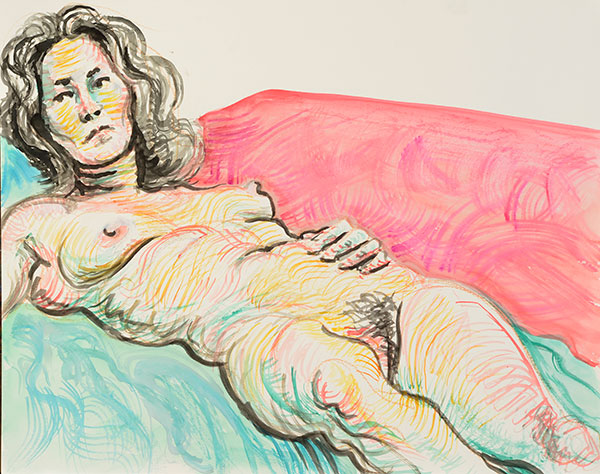
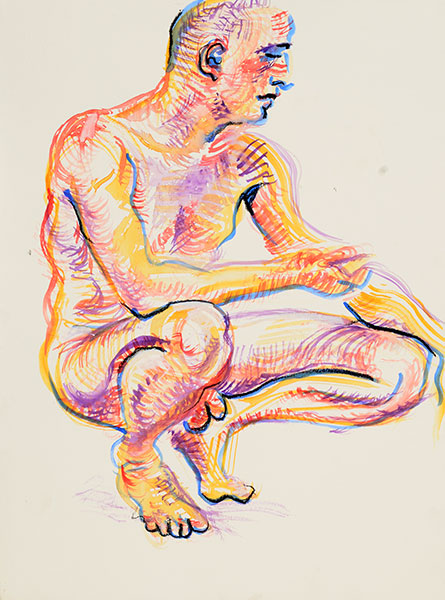
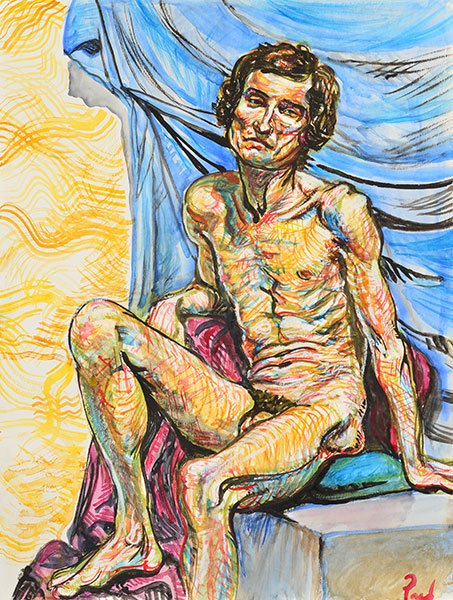
Several weeks ago I posted about beginning to experiment with watercolor painting in the life drawing sessions I attend as a regular practice.  Now I have a batch of new watercolor paintings to share.  I’ll write about my experiences with the new (to me) medium, interspersing illustrations more or less randomly.

Yisroel Quick Poses 2, 2011, by Fred Hatt

The classic watercolor approach to the figure is to focus on clear areas of light and dark, infusing color into the shadows using wet-on-wet techniques to achieve luminous softness.  I don’t know of anyone that does that style better than my friend Jacqui Morgan.  I love the way she achieves the look of light reflecting into the shadow areas – click the link on Jacqui’s name to see several examples of what I’m talking about.  But I’m more interested in finding my own style than in imitating something someone else has already mastered.

Think Back, 2011, by Fred Hatt

Over the seventeen years I’ve been attending life drawing sessions, I’ve drawn with pencils, pens, pastels, conté crayons, graphite blocks, markers, and ink and brush.  The medium I really developed was aquarelle crayons.  (Aquarelle is the French word for watercolor, so these crayons contain watercolor pigments and are water-blendable.)  I generally worked on gray or black paper, so I focused primarily on drawing the highlights, letting the ground of the paper represent the shadows.  Watercolor painting essentially demands an opposite approach!

Chin on Knee, 2011, by Fred Hatt

Through the use of dry media I discovered the expressive power of the linear stroke.  These gestural marks are the traces of movement, the movement of my hands as well as the movement of my perception.  I’ve found that the scribbly thicket of lines communicates my way of seeing my subjects as patterns of energy.  The strokes also capture a particular quality of the moment, a mood that may be tranquil, dynamic, sensual, or whatever.  The lines also follow the three-dimensionality of the form, and convey its roundness even in the absence of chiaroscuro lighting.  The expressive line technique should work well with the brush.

Squat, 2011, by Fred Hatt

Dry media such as the aquarelle crayons cannot be mixed on a palette, but must be combined directly on the paper.  Essentially, the pigments remain separate but are close enough together that they blend in the eye.  It should be possible to do that in paint, too, though so far I haven’t yet figured out how to get the highly saturated watercolor hues to blend into really convincing realistic colors.

James, 2011, by Fred Hatt

Over the years I have done a lot of drawing with ink and a brush, and I had certainly noticed that brushstrokes are more expressive than the strokes of a pencil or crayon.  Crayons are simple – relatively easy to control, dumb, but direct.  I barely think about them when I’m using them.  The relationship of brush to paper and brush to liquid is complex, with small variations in pressure, angle, and wetness making a huge difference in the quality of the marks.  I find I must place more of my mental awareness in the brush itself, because the subtleties of its caress are so magnified on the paper.

Seize, 2011, by Fred Hatt

As you can see, I’ve been trying to adapt my scribbly linear style to watercolor painting.  I still consider these paintings a beginner’s attempts in this direction.  It’s exciting for me to challenge myself with an unfamiliar medium, and interesting to see how techniques with which I’d achieved a certain facility become crude or experimental when transposed to watercolors.

Lumbar Hands, 2011, by Fred Hatt

In sketching quick two-minute poses with watercolor, the technique of focusing on the light/dark divisions works well, and actually seems to capture the quality of the pose more efficiently than the contour-based approach I tend to use when drawing with pencils or pens.

James Qucik Poses 1, 2011, by Fred Hatt

James Quick Poses 2, 2011, by Fred Hatt

Watercolor paints are transparent.  Highlights are achieved by leaving the paper unpainted, and light values of colors by using very thin washes of color, or, in my linear style, thin meshes of colored lines with a lot of white in between.  For me, this has been the most challenging aspect of the medium.  Occasionally I’ve cheated by using white aquarelle crayons to open up highlights or to “erase” errors or washes that become too dark.

Gathered, 2011, by Fred Hatt

I’ve also sometimes used light-colored crayons to make a rough sketch on the paper before beginning to apply paint.  This allows me to use my accustomed loose-handed way of establishing overall proportions and spatial relationships before laying down paint that may be difficult or impossible to correct.

Upward Recline, 2011, by Fred Hatt

Sometimes a very simple approach is most effective.  I think I have a tendency to overwork things.  Watercolor seems to shine with a minimalist style.

Bow & Kneel, 2011, by Fred Hatt

The portrait below may be the closest I’ve gotten to duplicating my crayon style in paint.

Donna, 2011, by Fred Hatt

The colors of the watercolor paintings look a bit more intense in these photos than they do in the originals.  Even photographing these requires a different approach than photographing the crayon drawings!  But since I switched from cheap watercolors to higher-end paints, the colors are highly saturated.  I think I need to figure out how to neutralize them.

Torso on Folded Legs, 2011, by Fred Hatt

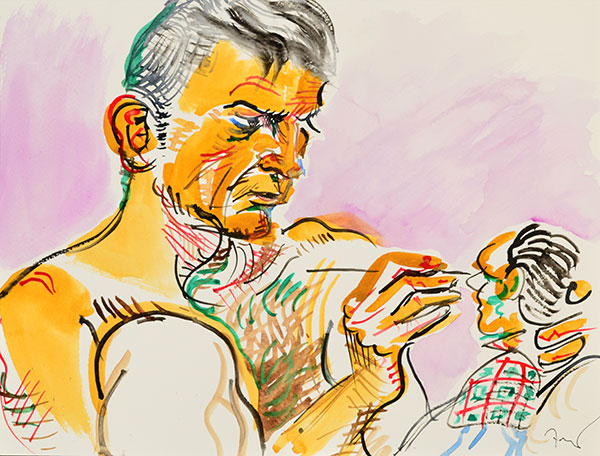
Sometimes I’ve tried a more expressionistic approach to both the colors and the strokes.  That seems to work to give a feeling for emotion and character.

Puppet Maker, 2011, by Fred Hatt

Melancholy, 2011, by Fred Hatt

The model for the drawing above is Claudia, the Museworthy blogger.  She’s got a post coming soon that features artwork by the many talented artists that know her through her blog or through her work as a model.  I’ll have a piece in it, and I’ll add a link here as soon as it’s up.  I’ll close this post with another watercolor of Claudia.

Claudia, 2011, by Fred Hatt

All the paintings in this post are watercolor on paper, either 15″ x 20″ (38 x 51 cm) or 11″ x 14″ (28 x 36 cm).

« Newer PostsOlder Posts »

Powered by WordPress

Theme Tweaker by Unreal