DRAWING LIFE by fred hatt

2011/10/23

The Full Gamut

Filed under: Collections of Images,Color — Tags: , , , , — fred @ 00:07

Munsell principal and intermediate hues, digital illustration by Fred Hatt

I am a person of serial obsessions.  Every few years I feel compelled to learn everything I can about some topic, usually something esoteric or scientific.  Around 2003-2005, my obsession was color:  the science of light and spectra, the biology and psychology of color perception, the technology of color reproduction, ways of naming colors and dividing color space, and philosophical ideas about color.  When I had the idea of writing a blog post about color, I started looking through my notes and collections of digital images, making a list of interesting things I’d learned.  There was enough there for a book or a semester course!  Perhaps in the future there will be more posts on color.  For now, I’ve selected a few interesting or lovely images from my collection, and here present them with interesting related factoids.  Even if you don’t share my hunger for knowledge about color, I hope you’ll appreciate the beauty of these diagrams.

I’m titling this post “The Full Gamut” – we’ve all heard that phrase meaning the complete range of something that has varieties.  The word gamut originally meant a range of musical notes.  It’s used in color science to indicate the limited range of colors that can be described or reproduced given a certain technological context.  A computer monitor, for example, can simulate many colors by combining various intensities of red, green, and blue “primary” colors.  The surface colors of most naturally occurring objects can be reproduced, but there remain many colors outside the gamut of the monitor.  You can see pure spectral colors by looking at the reflections on a CD or DVD.  The colors in the image at the top of this post approach the limits of saturation achievable on a monitor, but compared to pure spectral colors they’re surprisingly dull.  Even Newton’s prismatic spectrum does not contain the full range of vivid colors – magentas and purples cannot be represented by single wavelengths, but only exist as the blending of the opposite ends of the spectrum.

Color is a three-dimensional phenomenon.  Every model for describing colors requires three variables: three primaries, or three polarities.  For a general understanding of color independent of any particular medium or technology, the clearest dimensions are hue, value (lightness or luminance), and chroma (saturation or intensity).  Albert Munsell’s model of color space is one of the most illuminating systems, based on rigorous study of human color perceptions rather than on physical or technological variables.  In Munsell’s system, value is the vertical dimension, hue is the angular dimension, and chroma is shown as the distance from the center.  The resulting arrangement of colors is called a color solid, or a color tree.

The Munsell colors are produced in rigorously accurate sets as books and charts to be used to describe colors by visual reference to standard samples.  They come very close to representing the full range (gamut) of colors that can exist in the form of physical objects.

Munsell Color Tree, illustration by limaorian@hotmail.com

The “color wheel” most people are taught in basic art classes is a rigid and simplistic model compared to Munsell’s color solid.  The color wheel doesn’t account for the fact that different hues have different ranges of chroma or intensity, and that some hues (e.g. yellow) achieve their highest chroma at high values, while other colors (e.g. bluish purple) are more intense at a darker value.  Munsell’s system defines the hues by letters and numbers, starting with five fundamental hues (red, yellow, green, blue, and purple), and five secondary or intermediate hues (yellow-red, green-yellow, blue-green, purple-blue, and red-purple).  The diagram below shows five cross-sections of the Munsell color solid, with the principal hues on the right and the complementary intermediate hues on the left.

Five cross sections of Munsell Color Solid, digital illustration by Fred Hatt

Here are the most saturated colors around the perimeter of the Munsell Solid.  Here, the hue circle is repeated twice along the horizontal axis with the values arranged on the vertical axis.

Munsell hues at maximum chroma, digital illustration by Fred Hatt

If we consider the color solid as a kind of globe, with the neutral grays as the axis, we can look at the irregular shape from a point of view centered above the north (white) pole or the south (black) pole.  The colors with maximum chroma are at the outer bound of these polar views, whether they are on the “equator” (middle value perimeter) or not.  Please note that the gamut of the computer monitor is considerably smaller than the gamut of the physical samples included in the Munsell standard, so the colors closer to the outside edge of the figures below are not really accurate.  You can see that the colors yellow and green achieve high chroma at the higher values, while deep blues and purples are most intense at low values.

Light and dark hemispheres of the Munsell color solid, digital illustration by Fred Hatt

Some of the transitions between adjacent colors in the illustration above may seem abrupt, but that’s because of variations in the maximum achievable value or chroma.  If we look at the full range of hues at a uniform value and chroma level, as in the circle below, the transitions are very smooth.

40 Munsell hues at value 7, chroma 8, digital illustration by Fred Hatt

This circle is at value 7 and chroma 8, the maximum chroma level achievable all the way around the hue circle at any value in the Munsell solid.  We probably all learned in school that Newton proved that light is a waveform, and that different colors are different wavelengths of light.  The diagram below charts the level at which the Munsell samples, at the same chroma and value seen in the above illustration, reflect various wavelengths of the spectrum.  The horizontal axis goes from short wavelengths (violet blue) at the left, to long wavelengths (red) at the right.  You will notice that even these samples, which appear quite vividly colored, are all reflecting almost half the spectrum at over half their average reflectivity.  These colors are not “pure”, but they do look intense!

Spectral reflection curves for five principal Munsell hues at value 7, chroma 8, illustration from article by A. Kimball Romney and Tarow Indow

Munsell’s model arranges colors by measures of equal perceptual distance, but what does that have to do with how we learn to identify and name colors?  One of the most cited academic papers of all time is Berlin and Kay’s cross-cultural survey of color names.  Berlin and Kay used a study of color terms to address the question of linguistic relativity, that is, whether linguistic categories define perceptions, or vice versa.  They used the highest-chroma Munsell samples of colors at the full range of hues and values, asking participants of various linguistic and cultural backgrounds to choose the “best examples” of their basic color words, and the range these words would cover.  The “best examples” were called “focal colors”.  In the diagram below, the focal colors are marked as chosen by speakers of American English.

American English focal colors in a Munsell grid, based on data from Basic Color Terms: Their Universality and Evolution, 1969, by Brent Berlin and Paul Kay, digital illustration by Fred Hatt

Berlin and Kay found a high degree of uniformity in the specific colors chosen as focal colors between speakers of different languages.  They also found evidence that color terms evolve in a given language in a predictable order.  First, a distinction is made between dark/cool and light/warm.  Red is the first individual color to be given a name.  Next, green or yellow are distinguished, followed by blue.  More complex languages separate brown, purple, pink, orange, and gray.  Berlin and Kay’s findings have been challenged and reproduced by many subsequent researchers, using the same Munsell grid.  The chart below shows interesting variations on how the color range can be divided, with eight divisions in English and five in a language called Berinmo.

Distribution of English and Berinmo color names, illustration from the article "Colour categories in a stone-age tribe", by Jules Davidoff, Ian Davies and Debi Roberson, Nature 398, 1999

Below are pretty close representations of the “focal colors” chosen by English speakers.  There are eleven basic color terms in English, the eight easily identifiable ones shown below, plus black, gray, and white.  Chosen samples of focal colors would be very similar for nearly every language in the industrial world.  Why are these colors seen as basic?  They are not evenly distributed on the grid of colors, and no one, as far as I know, has been able to show any fundamental relation between these specific colors and any measurable aspect of color vision or color physics.

Focal colors, digital illustration by Fred Hatt

You’ll notice that people make finer distinctions in the colors around the red/yellow portion of the range.  Human skin color and the colors of most animals are in this area, so perhaps we are more attuned to fine differences there than we are in the blue and green areas associated with the landscape.

Randall Munroe, author of the classic geek webcomic XKCD, conducted an online color-naming experiment, with a random color generator that asks random web participants to name the colors they see.  His report on the results of the survey is hilarious as well as interesting.  Here’s his map of how thousands of participants intuitively divided up the color space.

Dominant color names mapped to RGB cube, illustration from XKCD Color Survey Results, from Randall Munroe's XKCD blog

Color naming experiments are usually done by showing subjects one color at a time.  When the colors are shown together, as in the chart above, or in the Munsell grid illustrating the Berlin and Kay survey, we notice the arbitrariness of the lines we draw to distinguish colors.

Color perception is a relativistic phenomenon.  The book Interaction of Color, by the painter and teacher Josef Albers, shows by example how colors are seen differently according to their surroundings.  In the illustration below, the double-x line looks very different depending on its background, but where the line joins we can see its continutiy.

Illustration from Interaction of Color, 1975, by Josef Albers

As an artist, I find it most useful to look at colors as polarities tending one way or another.  Many real-life colors are very muted and subtle, but if you can look at a shadow and see, for example, that it has a bluer tone compared to the adjacent highlight’s yellower tone, you can begin to capture those subtleties.

In photography, it is common to analyze and correct colors using such polarities.  The most important one is the color temperature axis, what most painters would describe as the warm/cool distinction.  In the study of light, it was observed that the temperature of any incandescent substance, such as a heated piece of metal, could be determined by the color of its glow.  White hot is hotter than red hot, and blue hot is hotter still.  Color temperature is a scientifically defined scale for describing the color of light on a red/orange/white/blue scale.  Typical incandescent lights glow at 2500-3200 degrees kelvin, while daylight is 5000-7500 degrees.  The temperature-color correspondence is exactly the opposite of what is taught to artists as warm and cool colors.

Color temperature illustration, from a webpage by W. A. Steer, PhD

Of course, fluorescent lights, neon lights, high-intensity discharge lamps, LEDs, and other non-incandescent sources aren’t defined by the color-temperature scale, so correcting colors from those lights involves a second scale, which photographers call “tint” or “plus green” and “minus green”.  Minus green is magenta or pink.  A minus green filter, for example, can overcome the tendency of fluorescent lights to photograph as greenish.  These two axes, orange-blue and green-magenta, are used in filtering for lenses or light sources while shooting, and in digital post-processing of photographs and video recordings.

In figurative art, I’m always looking at the variations in flesh tones.  I find it useful to look at these very subtle differences as tendencies along axes of complementary colors:  orange/blue, magenta/green, red/green blue, yellow/deep blue.

Eight part color arrangement, digital illustration by Fred Hatt

Some of the illustrations in this post are my own, and others are found on the web.  Clicking on found images links to the site where I found them. For the Munsell colors used in some of the digital illustrations I am indebted to Wallkill Color for their Munsell Conversion Software.

2011/10/11

Sowing Seeds

Filed under: Abstract Art,Art and Philosophy — Tags: , , , — fred @ 22:41

Twixt, 2011, by Fred Hatt

How do you make change in the world?  Even I, who love finding beauty amid the world’s insanity and squalor, yearn for a kinder and juster culture.  Does art have any part in that, or is it just entertainment, an idle pastime of the privileged?  You surely see a lot of contemporary art that addresses injustice, stigma, corruption, exploitation, and violence.  But doesn’t much of that kind of art seem exploitive itself?  During a recent museum visit I saw mural-sized photos of homeless people in humiliating positions, and installations that made real footage of war and prison killings look like video games.  Do you suppose these works will change the minds of the powerful or offer any solace to the souls with whose real suffering they toy?  Do the artists who do this work or the curators who put it on display imagine that they are displaying a social conscience?  Ah, the abject of the world, the war-scarred, the enslaved – let them eat critical theory!

Perhaps it is pretentious for an artist even to pretend to care.  Social change is a complex phenomenon involving myriad conflicting and interacting forces.  The power that an artist has to influence the process of change in society would seem like the power of a mosquito to change the course of an ocean liner.  Even the mass-produced forms of entertainment such as movies and pop music no longer reach the vast audiences they once did.  The kind of art that shows in galleries or alternative performance venues, reaching a minuscule audience, must surely have no impact at all.

Ovum, 2011, by Fred Hatt

People think that the kind of power that produces change must be a direct push.  Huge advertising campaigns, political activism, legal crusades, large-scale economic offenses such as boycotts and buyouts, military or revolutionary attacks are all attempts to leverage monetary, demographic, or violent power to change things in a direct way.  History shows us that such efforts tend to produce unintended consequences such as political backlash movements or power vacuums that allow ruthless people to seize control.  There is a physical law that states that every action produces an equal and opposite reaction, and this often seems to apply to clashing cultural forces as well.

There is a different way of producing change, which may be described by the metaphor of planting seeds.  A seed is a tiny thing which contains the potential for the development of a tree or plant.  In nature, plants have various ways of scattering their seeds widely.  Most seeds will not find the conditions necessary to become a mature plant, but enough may grow to perpetuate and even increase the range of the plant that produced them.  Each seed begins to develop in darkness and obscurity and there is no way to see that it is growing until it is emerging into the world as a fresh new manifestation of life.  The very obscurity and indirectness of this process may make change that overcomes the reactionary recoil effect.

Radia, 2011, by Fred Hatt

The metaphor of the seed appears in a famous parable of Jesus, quoted here from the Gospel of Thomas, translated by Patterson and Robinson:

Look, a sower went out. He filled his hands (with seeds), (and) he scattered (them).
Some fell on the path, and the birds came and pecked them up.
Others fell on the rock, and did not take root in the soil, and they did not put forth ears.
And others fell among the thorns, they choked the seeds, and worms ate them.
And others fell on good soil, and it produced good fruit.
It yielded sixty per measure and one hundred twenty per measure.

In the canonical gospels, the seed is interpreted as representing the word of Christ, which may or may not take root in the hearts of those who hear it, but I think it works well as a wider metaphor of how the world works.  It even describes the evolution of species, in which mutations are scattered haphazardly like seeds, most fail, but a few find the conditions to flourish.  A process that might seem random and wasteful is the process that produces our world with all its wondrous variety.

Umbilicus, 2011, by Fred Hatt

Culture, too, is a seeding process.  In the internet era, an idea or style that sprouts and spreads in the culture is called a meme, and its explosive growth is called “going viral” (reminding us that a virus is also a kind of seed, and that the effects of a seed are not necessarily positive).  But viral memes are not all lolcats – Steve Jobs’ vision of friendly technology and Gandhi’s vision of nonviolent resistance are also powerful viral memes.

In a human life, anything that one does or says, demonstrates or communicates to others, may become a seed.  An artist plays with perception, expression, ideas, experience, and desires, and shares the products of this play with others.  An image, an idea, or a feeling thus communicated may connect with the receiver on a deep level.  Whether it stays in the memory or in the unconscious, it may later affect the receiver’s actions or thinking in some way.  At this point the seed is sprouting.

Elaborating on the metaphor, we could say that we are always scattering seeds.  Anything we say or do could be a seed.  Most of our deeds will amount to nothing, but occasionally something will take root.  We can’t know which of our actions or words will sprout, but we should be aware that some will.  We can’t check to see what is growing – the process of development begins in obscurity, and digging up a seed to check on its development may halt that development.  We should act as though everything we do is a seed of goodness, and we should let go of everything we do, trusting that the unpredictable process of the world will nourish and grow some of them.

Vortex, 2011, by Fred Hatt

Real change takes root over long periods of time, cumulatively growing from innumerable such seemingly insignificant experiences and actions of vast numbers of people.  This way of producing change through seeds requires faith.  One doesn’t seem to be changing or moving anything, and often doesn’t even perceive the invisible reactions that may show that the seeds are sprouting.  The power of this way of producing change lies in its invisibility, because since it seems to be nothing it provokes no reactionary counterpunch.

While artists may often engage in direct efforts to change people’s minds, even art which has no outwardly apparent political or intellectual content may be planting seeds.  Some art which does not seem to be making any statement may be an exploration of pure perception.  Since the way people perceive the world alters the way they experience and interact with it, something which expands or alters someone’s way of perceiving something even in a subtle way may be a powerful seed for change.

The illustrations for this post are watercolor on paper,  11″ x 14″ or 28 x 35.6 cm.

2011/09/29

Pluvial Polyrhythms

Filed under: Video: Natural Phenomena — Tags: , , , — fred @ 13:15

Still from "Driving Rain", 2008, video by Fred Hatt

Before I get into this week’s material, I’d like to urge my readers to click over to Museworthy, where my friend, model, and blogging mentor Claudia is celebrating four years of her entertaining, inspiring, and enlightening blog about artists, models, and her life as an artists’ model.  Every Museworthy blogaversary post has featured a photo of Claudia by me.  Check out this year’s shot at the link!  And here are the shots for years one, two, and three.

Still from "Driving Rain", 2008, video by Fred Hatt

I’m continuing to develop my own approach to watercolor painting, but I’ll wait to post on that again until I have a wider selection of examples to share.  Today’s post, though, does feature colors running in water, as well as optical phenomena of distortion and reflection, so you could see it as a continuation of themes.

Still from "Driving Rain", 2008, video by Fred Hatt

The stills here are from “Driving Rain”, a video made in the spring of 2008.  This is one of my experiments in minimal cinema, using the video camera to capture fleeting phenomena of light and motion.  We are used to seeing moving image media used to present narrative, to entertain, educate, persuade, or manipulate.  I’m interested in stripping all of that away, to see the moving image as simply an image of movement.  We appreciate still pictures for their aesthetic and formal qualities, for their ability to show us the world through another’s awakened eye.  I believe video can do the same, separate from its rhetorical dimensions.  (For other “minimal cinema” efforts, see here and here.)

Still from "Driving Rain", 2008, video by Fred Hatt

The video is nothing but a shot through the windshield of a vehicle during a pelting downpour, driving across the Williamsburg Bridge between Brooklyn and Manhattan, through the streets of the Lower East Side, and up the FDR Drive along the East River waterfront of Manhattan.  There is no music, there are no voices, and there are no edits until nine minutes into the total eleven-minute running time.  Sounds boring as hell, you say?  It is, unless you give in to the film’s narrative blankness and start appreciating the peculiar complexities of the images and sounds.

Still from "Driving Rain", 2008, video by Fred Hatt

There is the mechanical beating of the windshield wipers, the deluge’s waves of white noise, and the roar of the engine.  There’s the stop-and-go flow of traffic and the relentless flow of water from the sky.  The world is seen through a refractive surface of water droplets and rivulets.  Droplets are drawn downward by gravity, shoved aside by the wiper, and blown upward by the wind.

Still from "Driving Rain", 2008, video by Fred Hatt

Because you aren’t actually driving in this monsoon, you are free to enjoy the musical phases of its various rhythmic elements, to marvel at the complexity of the movements of water on glass, to appreciate the impressionist scattering of light and color that the wet windshield introduces to the world beyond it.

Still from "Driving Rain", 2008, video by Fred Hatt

The video is embedded below (unless you receive the blog by email), but I suggest following this link to see the video in full screen and HD resolution.  If your computer or connection isn’t up to that, or if you’re reading this blog on your phone, don’t bother – just enjoy the stills.  This video was conceived with the idea of projecting it in high definition on a large screen, and it works best that way.

If you appreciate the beauty of rain as I do, you might also enjoy this earlier post, featuring still pictures of rain in the city.

2011/09/20

A Toe in the Water

Sketch with watercolors and brush, 2011, by Fred Hatt

I’ve been doing art sessions with a good friend’s seven year old daughter.  She wanted to learn about painting and I thought pan watercolors would be a good medium to start with – vivid colors, cheap, and not too messy.  Sharing her beginner’s joy with watercolors inspired me to try working with pan watercolors in the life drawing sessions I attend regularly, and in this post I’ll share some of the results from my first two weeks of struggling with this medium, which I have never before attempted to master.

Many of my readers are art students, so this blog is my platform to be a teacher.  I supervise an uninstructed weekly life drawing session at Spring Studio in New York.  A lot of older, experienced artists attend the session regularly.  Many of them have done life drawing or painting practice for decades.  I’ve noticed that while nearly all of them have a pretty good style and technique, most long ago settled into a comfortable rut.  They stopped when they got good, kept doing what worked for them, and haven’t learned anything new in a long time.  There’s nothing wrong with that, of course, but the magic of art as a practice is that it is possible to keep it growing and expanding for a lifetime, and they’re missing out on that.

In this blog I always urge pushing the envelope, going out of your comfort zone, being willing to fail.  I often try different drawing materials and techniques for quick drawings, work on varying scale, and experiment in various ways.  But in my developed drawings I too could be accused of working the comfortable rut.  I developed my technique of drawing with aquarelle crayons on gray or black paper a long time ago.  It’s a great way of working, perfectly suited to my strengths and tendencies, and difficult for other people to copy.  I can easily vary the technique to make it more impressionistic or expressionistic or stylized or classical.  I’ve made the medium my own.

But once you’ve mastered something it may be time to move on to something that remains a challenge, to get back to the Zen ideal of “beginner’s mind”.  Watercolor struck me as an ideal challenge, because it goes against almost everything I love about the crayon technique.

With the crayons, I start with a dark ground and build from the highlights first.  With watercolors, the paper is white and paint can only make it darker.  With crayons, my focus is bold, linear, gestural.  Watercolors are soft by nature, and intensity is only achieved by incremental washing.  With crayons, I use additive, optical mixing of colors.  With watercolors, colors blend subtractively.  My style of drawing is to dive in spontaneously and then to work towards correcting mistakes in subsequent layers.  Watercolors are transparent, making it nearly impossible to correct things by going over them.

Companheiros, 2011, by Fred Hatt

In quick drawings, one minute to five minutes, I’m still drawing with my flowy linear style.  The watercolor brush is far more responsive to touch than a pencil or pen.  Speed and pressure affect line thickness, but density also varies according to the ratio of water and pigment in the brush, and whether the brush dashes quickly or lingers as it moves.

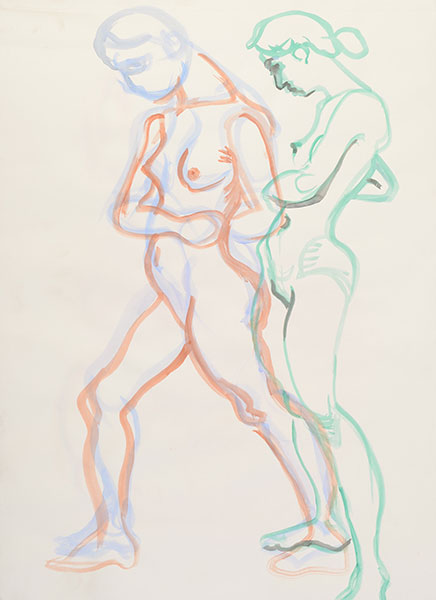
Stepping Forward, 2011, by Fred Hatt

Here are two beautifully expressive quick poses from my great friend Claudia, the Museworthy blogger.

Onde, 2011, by Fred Hatt

Compared to a pen, pencil, or crayon, the brush is hard to control.  There’s almost no friction – it’s like walking on wet ice.

Réveil, 2011, by Fred Hatt

Here are some ten and twenty minute watercolor sketches from the sessions at Brooklyn’s Figureworks Gallery, with the wonderfully idiosyncratic models Taylor and Jillian.

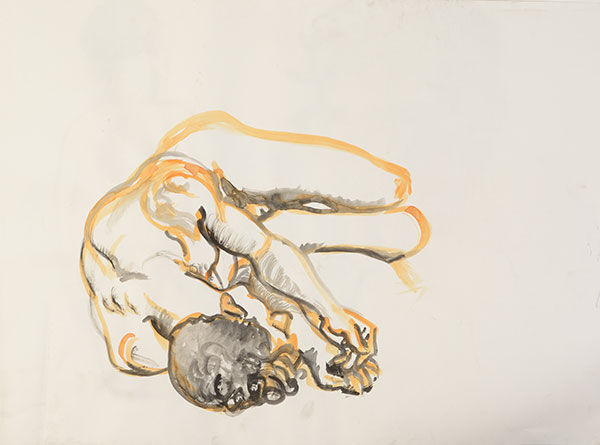
Lying on Side, 2011, by Fred Hatt

I’m still more or less drawing with the brush.  Some watercolor painters use watercolor-specific techniques like letting the paint infuse into pre-wetted paper.  So far, I’m using regular inexpensive sketch paper and painting “wet on dry”.

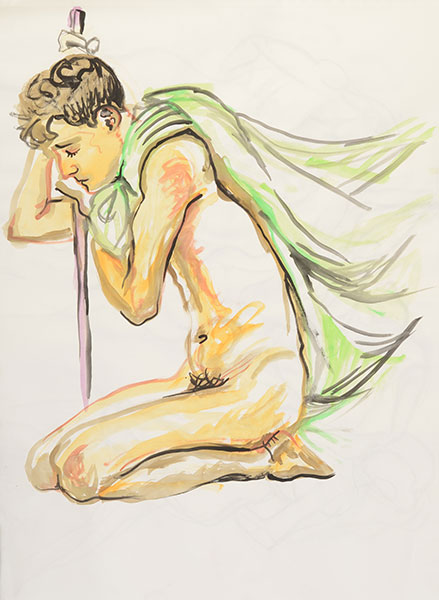
Supplicant, 2011, by Fred Hatt

Maybe with tube watercolors you can get deep colors right out of the tube.  With these pan watercolors every color goes on pretty thin, and then gets even lighter as it dries.  You have to paint multiple layers to get any density.  This may be a good thing, since there’s no erasing.

Rayon Vert, 2011, by Fred Hatt

The dryer I can keep the brush, the more controllable the line is.  By combining wet and dry application I can use some of my pencil drawing techniques but also blended shading.

Tea Drinker, 2011, by Fred Hatt

Little touches of color can suggest area color without filling it in.

Vanquished, 2011, by Fred Hatt

On the one below, I lightly sketched in the figure with crayons, then used watercolor for the shading and colors.  The foreshortening of the right leg at the bottom of the page is a bit awkward here, but the torso is wonderfully present.

Rêverie, 2011, by Fred Hatt

Just this week I tried for the first time using watercolors for a long pose at the three-hour session I supervise at Spring Studio on Monday mornings.  I allowed myself to use crayons for the initial rough sketch, and to sharpen highlights and shadows at the end of the session, but besides those small touches, this is all watercolor.

Športnik, 2011, by Fred Hatt

I was getting a little too adept at crayon drawing.  Working with watercolors, I’m struggling again, and it feels good.  I think I’ll keep working with this medium for a while, so expect to see more here, perhaps mixed in with crayon drawings.

All the pieces in this post are 18″ x 24″, pan watercolors (sometimes with aquarelle crayon) on paper.

2011/09/08

Distorted Reflections

Filed under: Photography: Light — Tags: , , , , — fred @ 23:20

Glass Bricks, 2004, photo by Fred Hatt

I’m feeling a bit oversaturated these days, both by the incessant rain we’ve been having in the Northeastern states, and by the relentless media focus on the tenth anniversary of September 11, 2001.  If you’re interested in a long-time New Yorker’s look back at that event and its cascading effects over the past decade, look at my post from last year, “Signs in the Aftermath.”  For now, I’d rather distract myself and my readers with shiny things.

Insistent Squares, 2003, photo by Fred Hatt

I live in a city of glass and steel and plastic, colored electric lights and glittering curves and facets.  The quadrangular grid is the fundamental pattern of the city, rigid, regular, and inhuman.  But the grid is only the substructure for a culture of remarkable frenzy and chaos.  Chaos manifests in the pure optics of grids of reflective materials, as the inevitable imperfection of flat surfaces introduces dazzling distortions.  Sometimes the details of a reflected view are fragmented and repeated, something like what an insect supposedly sees with its compound eye.

Emergent Image, 2008, photo by Fred Hatt

There are layers of reflections, as when an object of stainless steel, with cylindrical curves, is viewed through a window, whose transparent and reflective qualities superimpose the space in front of the viewer over the space behind the viewer.

Modern Lamp, 2005, photo by Fred Hatt

At night, metallic walls turn the various sources of light into swirling patterns like the methane turbulences of the planet Jupiter.

Steel Clouds, 2004, photo by Fred Hatt

Or like the op-art paintings of Victor Vasarely.

Diner Rays, 2005, photo by Fred Hatt

Or like the tormented patterns of Arshile Gorky.

Plexi Deli, 2002, photo by Fred Hatt

Frenetic jabs of neon and fluorescent light put a figure in an environment of cold fire.

Silvery Gate, 2003, photo by Fred Hatt

Stainless steel facets turn architecture into abstract expressionism.

Deco Shatter, 2010, photo by Fred Hatt

Perhaps this view of reality, faceted, multiply reflected, distorted, layered, shows a reality that the classical image, with its hard-edged clear divisions, misses.  Objects are not separate, but exist only in a complex web of relationships.

Patchwork, 2010, photo by Fred Hatt

A person exists only as a reflection of all that is around them.

Chrome Mannequin, 2005, photo by Fred Hatt

Our love of order and regularity makes us build an environment of reflective planes.  The imperfection of our planes reveals the contortions we like to think we’ve transcended.

Drunken Building, 2001, photo by Fred Hatt

Our grids are ragged and jagged.

Spasmodic Geometry, 2004, photo by Fred Hatt

The more we try to order our world, the more it asserts its unwillingness to be ordered.

Amoebic Grid, 2011, photo by Fred Hatt

The taillight of a car in the sunset becomes a scarlet thread in the steel quilt of a vendor’s cart.

Red Infusion, 2005, photo by Fred Hatt

A new monument near Union Square depicts Andy Warhol as the artist who reflected his surroundings, mirrorlike.

Silver Andy ("The Andy Monument", by sculptor Rob Pruitt, 2011), photo by Fred Hatt

Regularity and symmetry are an illusion.  The world we move in is dynamically unbalanced.

Red Distortion, 2001, photo by Fred Hatt

Our reality is a membrane that seems to have an inside and an outside, but those two worlds are both implicit in the membrane, and their separateness is an illusion.

Winter Fruit, 2001, photo by Fred Hatt

An image like this exists only because of the conjunction of the car and the building reflected in its surface.  Light makes them one thing.

Pathfinder, 2004, photo by Fred Hatt

A red printed number is on fire with orange and blue-green light.

$9, 2007, photo by Fred Hatt

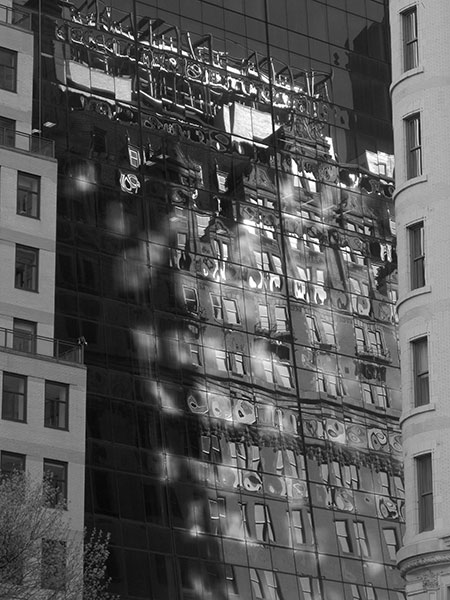
New shiny, curvy, minimalist architecture exists visually only as a distorted reflection of  old, opaque, classical, decorated architecture.

Fragmentation, 2010, photo by Fred Hatt

In many Asian businesses, the beckoning cat invites prosperity.  This silvery one also captures the colors and light of its surroundings.

Beckoning Cat, 2005, photo by Fred Hatt

Water is also used as a decorative element in the city of glass and steel.  Its light distortions are dynamic, always in motion.

Plaza Pool, 2010, photo by Fred Hatt

Here mirror reflection, reflected light and shadow, and a sloped glass wall are framed by flat and rounded opaque geometric structures.

Recursion, 2011, photo by Fred Hatt

This combination of gridlike patterns and irregularly reflective surfaces is the visual essence of the twentieth century city.

Glass Loom, 2010, photo by Fred Hatt


« Newer PostsOlder Posts »

Powered by WordPress

Theme Tweaker by Unreal