DRAWING LIFE by fred hatt

2012/01/19

Oddities of the Anatomium

Filed under: Collections of Images,Figure Drawing: Anatomy — Tags: , , — fred @ 22:14

"Vegetables Are All Your Body Needs", advertisement for the International Vegetarian Union

Most figurative artists spend some time studying human anatomy – basic musculoskeletal structure, often just enough that your Spider-Man doesn’t come out looking like Popeye.  But of course the study of anatomy is a vast edifice, with wings and annexes, great halls and obscure corridors, constructed by physicians and yogis, gymnasts and psychiatrists, animators and masseurs, mystics and coroners.  Let’s call this imposing monument the Anatomium.

For an artist, the body is more than just a physical structure.  It is an instrument for experiencing and portraying realities beyond the physical plane:  emotions, energy, spirituality.  We need to understand structure, but we also need to go beyond structure.  Your teacher may have urged you to spend most of your time studying in the great hall of bones and the gallery of muscles, but there is much to discover in the more obscure rooms of the Anatomium.  Let’s look at some curious specimens found in many different parts of the labyrinthine palace, from the viewpoint of the artist.  (All of these images were found on the web, and clicking on an image will take you to the page where I found it, and where, usually, more pictures and information will be found.)

The brilliant ad that leads this post tells us that if we are what we eat, we can construct a healthy body from a vegetable diet.  In folk wisdom, it’s often been thought that various plants and other substances support the functioning of the body parts they resemble, so for instance walnuts are supposed to be good for the brain, and tomatoes for the heart.  This way of seeing the anatomy arises from a metaphorical understanding of the body as a garden or landscape, a popular image since the time of Arcimboldo, at least.  Here’s Aurel Schmidt’s beautiful contemporary rendition of body as garden, a teeming but unsettling garden full of insects, snakes, birds, and cigarette butts.

Super Natural, 2006, mixed media on paper by Aurel Schmidt

Since the industrial revolution, the metaphor of the body as a factory or machine has been common in the culture.  A lot of medical practice, especially orthopedics, is essentially based in this mechanical metaphor.  Perhaps the ultimate realization of the industrial view of the body is Woody Allen’s depiction of the internal sexual functions as a military-industrial deployment in Everything You Always Wanted to Know About Sex * But Were Afraid to Ask.

Der Mensch als Industriepalast (Man as Industrial Palace), 1926, by Fritz Kahn

The technology of the industrial and digital era has given us countlesss new ways of seeing and studying the human body.  X-rays, MRIs, and endoscopes have become essential tools in medicine.  The National Institutes of Health and the National Medical Library collaborated on the “Visible Human Project”, high-resolution 3D scans of real bodies for anatomical study.  The bodies were sliced in razor-thin layers and scanned, the data assembled into a 3D image that can be viewed in any cross-section or in the round, or even “flown through” in a digital animation.

Coronal cross-section from the Visible Human Project of the National Library of Medicine and the National Institutes of Health

Controversial physician and showman Dr. Gunther von Hagens invented a technique for preserving human tissue by replacing the water  with plastics, which enabled him to prepare real cadavers for public display in his “Body Worlds” exhibits.  Von Hagens’ figures follow the renaissance convention in anatomical illustrations of posing flayed figures as though alive and active.  These exhibits are educational, fascinating, and more than a little creepy.

The Walker, plastinated from Body Worlds exhibit, from Gunther von Hagens' Institute for Plastination

Therapists, athletes, dancers, and others who study movement, posture, and fitnesss experiment with the living body, which can reveal dynamic aspects of the structure that may be missed when you’re cutting up cadavers.  This illustration from Thomas Myers’ Anatomy Trains, a study of the fascia and connective tissue in bodily movement, looks like a bit of couture in the outré style of an Alexander McQueen.

The Back Functional Line, illustration from "Anatomy Trains", by Thomas W. Myers

The illustration below shows the dermatomes.  Most of the nerves of the body are wired to the spinal cord, and the dermatomes are the areas of the skin divided according to the particular vertebra where each area has its nerve connection to the spinal cord.  The different areas of the spine are color-coded, cervical (neck) nerves in white, thoracic in yellow/black, lumbar in blue/black, and sacral nerves in red/black.  This too looks like a bit of latex fetishwear or a high-tech superhero costume.

Dermatomes (Spinal Innervation Map), artist unknown, from the website of New York School of Regional Anesthesia

Within the field of anatomical studies, there are many ways of dividing the body into regions.  Here’s a diagram for doctors with named regions on the surface of the body, for the purposes of clinical description.

Anatomical Regions of the Body, illustration from David Darling's online "Encyclopedia of Science"

“Surface Anatomy” is an interesting field for the artist who works with live models, as it’s all about learning to identify underlying structures based on what can be seen or felt at the level of the skin.

Surface Anatomy of the Abdomen, from "The Anatomy Lesson", a website by Wesley Norman, PhD, DSc, professor at Georgetown University

Seeing beneath the surface shows that the beautiful reality of the body conceals even more beautiful hidden realities.

Pregnant Anatomy, illustration found on Ed Merritt's Flickr photostream (may not be original source)

These back muscles look like the head of a goat – cool.

The Back,iIllustration by Phrenzy84

The illustration below shows a method of analyzing the structure of the face by geometrical analysis of a series of identifiable points.  This kind of analysis was invented for forensic use, but it’s also the basis of computer face recognition and other forms of digital biometrics.

Illustration from "Geometric Morphometric Analyses of Facial Shape in Twins", a paper by Demayo, et al.

This kind of geometrical analysis of faces and bodies is also important to artists working with digitally generated 3D graphics.  Some of the most interesting anatomy illustrations, from an artist’s point of view, are found in CGI tutorials.

Illustration from Phung Dinh Dzung's "Realistic Human Face Modeling", a guide for 3D computer graphic artists

Here’s a look at the different typical patterns of fat distribution on the male and female body.  It’s a fine illustration, although that male figure looks disconcertingly like me!  These sketches derive from works by Prud’hon and Rubens.

Fat Distribution in Women and Men, illustration from an online anatomy and figure drawing tutorial by Nocte

This one compares the basic skeletal structure of a person with that of a four-legged animal such as a dog.  I think the best way to grasp anatomical realities is to see how the same basic structure manifests with variations in different individuals and even different species.  You can learn a lot about anatomy just petting an animal!

Comparison of Human and Quadruped Skeletons, source unknown

In this illustration, an artist shows how different arrangements of the shoulder girdle express different emotions.

Shoulder Movements of Psychological Description, source unknown

The brain contains its own models of the body.  The sensory cortex and the motor cortex are bands of the human brain devoted to the senses and to movment, respectively.  When the image of the body is projected to correspond with the appropriate parts of the brain, the resulting distorted figure is called a “homunculus” (latin for “little human”).  The homunculus, the body in the brain, has huge lips and hands, since those areas are so important for sensation and action.  Note that the hand area is right next to the eye area – perhaps this facilitates the connections a visual artist makes.  And the genitalia area is right next to the feet – an explanation for foot fetishism?

Somatosensory Homunculus, artist unknown

Many forms of traditional therapy use this kind of mapping of the whole body onto a part of the body.  Auricular acupuncture, for example, is a form of acupuncture in which the ear stands in for the whole body, and practitioners believe that any part of the body can be treated by needling the corresponding parts of the ear.  Reflexology massage of the feet and hands is another treatment that uses similar charts.

Indian Hand Reflexology Illustration, original source unknown

Of course these aren’t anatomical studies in the scientific sense, but the ancient energy arts, including qigong and tantric yoga and many kinds of martial and healing arts, are based on extensive experiential study of energy flow in the body.  Understanding the immaterial but dynamic aspects of the body should interest any artist who strives to capture the feeling of aliveness.  Here’s an unknown artist’s attempt to represent the human aura, the field of energy clairvoyants say they can perceive around the body.

Human Aura, artist unknown

Chinese Traditional Medicine, martial arts and practices of “internal alchemy” aimed at physical or spiritual self-transformation, use a highly developed system of subtle anatomy to understand the movement of many different kinds of energy within and around the body.  For a visual artist, but even more for a performing artist, this way of visualizing and projecting emotions and forces can be a powerful tool.

Psycho-Emotional Aspects of the Liver Channel, from a website on the energy channels of acupuncture theory, by Lieske

Going back to scientific medical imaging, but keeping the emphasis on energy flow, we have thermographic imaging, which shows patterns of heat radiating from the body.   (Check out a brief excerpt from a dance film made with high-resolution thermographic cameras.)

Thermogram of the Breast, original source unknown

For an artist, the most subtle part of the human form, the most difficult thing to capture, is the spark, the life force, the flow of energy.  It’s important to understand structure, but it’s also important to see the dynamism and tension within that structure.  Anatomical studies of all kinds can open our eyes to the amazing tornado of different forces that is the human body.

I’ll conclude this post with a traditional medical anatomical illustration, but one of great beauty.   This is an abstraction, not a visual transcription of reality.  Of course the veins aren’t really blue and the arteries red and the nerves yellow – this is just a convention to aid in a functional understanding of what is going on.  But the life force in all its explosivenesss expresses itself here.

Thoracic Anatomy, 2006, illustration by Patrick J. Lynch

In researching on the web and my own archives for this post, I found such a wealth of incredible anatomical images that I think there will be many posts to come on the general subject of human anatomy.

Nearly all of these images link back, if you click on them, to where I found them on the web.  If any of my readers has further information about the sources or artists behind these images, please let me know.  It is often frustrating to me that so many great images on the web are published without attribution.
2012/01/08

Wax and Water

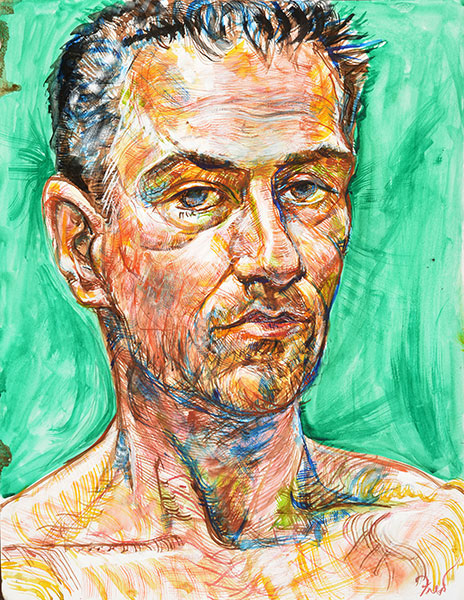
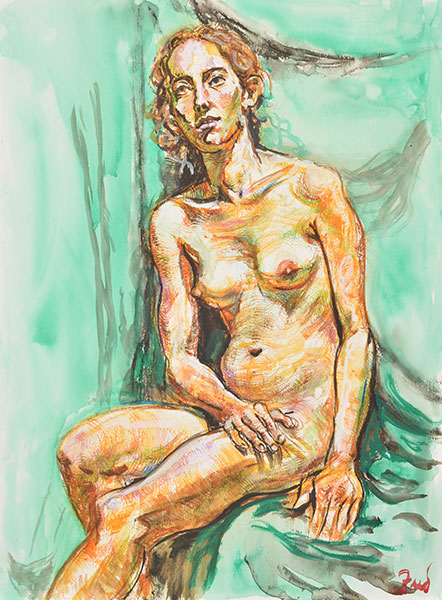
Weathermap, 2011, watercolor on paper, 38" x 34", by Fred Hatt

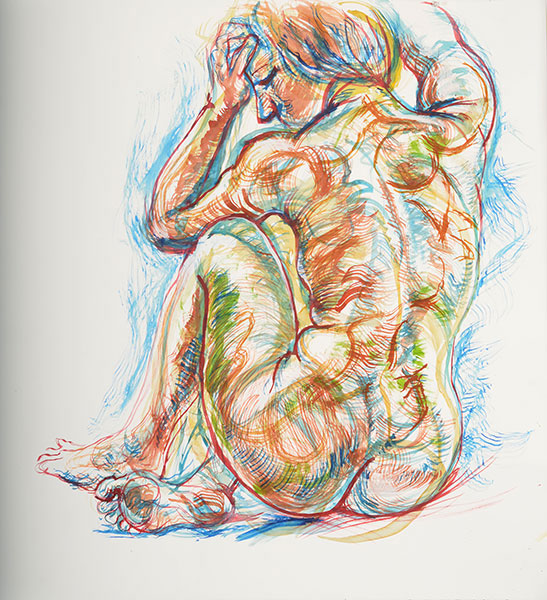
A few months ago, I made a change in my regular life drawing practice.  My primary drawing medium for over fifteen years had been Caran d’Ache Neocolor II aquarelle crayons.  Aquarelle means watercolor, and the pigments laid down by these crayons can be thinned or blended with water, but I always used them as a dry medium.  Caran d’Ache crayons are similar in size and feel to the familiar Crayola crayons, but they have a much higher pigment density, so they just glow on a background of black or gray paper. One day I decided to change over to a very different medium, to give myself new challenges.  I feel it’s important to keep any creative practice expansive by changing things up in small ways constantly, and in big ways occasionally.  So when I went to the life drawing sessions I began leaving my crayon box at home and bringing instead my watercolor paints and brushes.

There’s a repetition factor in the life drawing practice anyway, as you’ll often see the same models in similar poses to ones you’ve drawn before, and in such a case it’s always more interesting if you can come up with a slightly different approach than the one you used the last time.  Working with a very different medium, one you haven’t yet mastered, is certainly enough of a change to keep it fresh.  I’ve begun to amass a collection of similar pieces in the two media, and in this post I’ll be sharing pairs of images.  Each one of these pairs is of the same model, in similar poses, drawn at similar sizes and over roughly the same amount of working time, but one of each pair is a watercolor painting while the other is a crayon drawing.

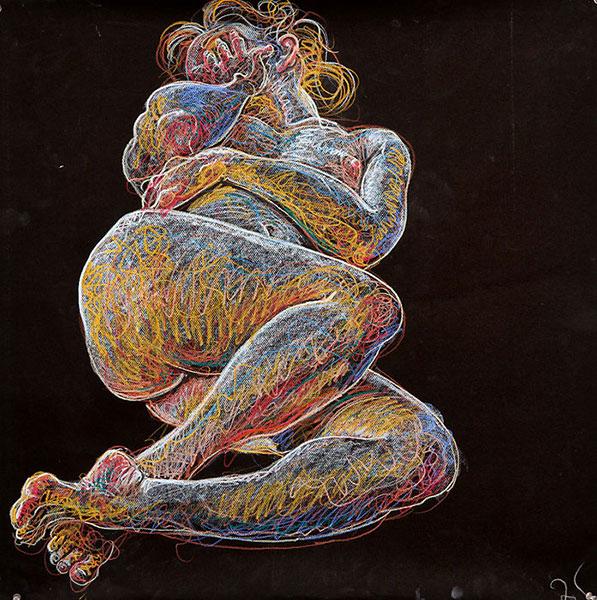
The painting at the top of this post and the crayon drawing just below are both studies of model, actor and artist Alley, rendered in free, expressive strokes in their respective media.  I’ve always liked the linear aspect of drawing, as the movement of the line captures a feeling of energy.  Interestingly, in comparing these two, the painting has more linear energy than the drawing does, but the crayons on a black ground give more of an impression of light.

Rotation, 2006, aquarelle crayon on paper, 30" x 30", by Fred Hatt

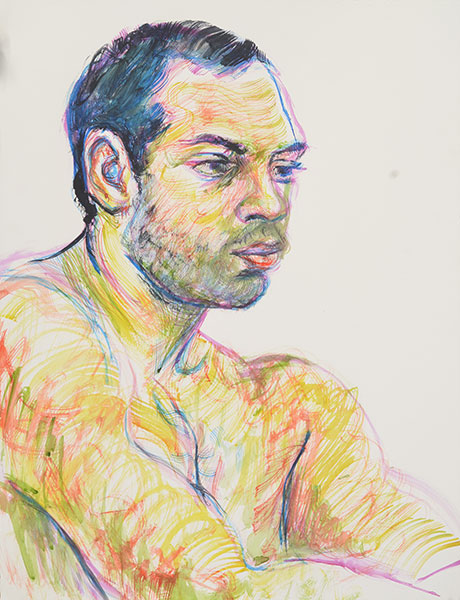
Next, here are two larger-than-life-size heads of Michael, the first a crayon drawing and the second a watercolor painting.

Michael W., 2009, aquarelle crayon on paper, 28" x 20", by Fred Hatt

Michael W, 2011, watercolor on paper, 19" x 24", by Fred Hatt

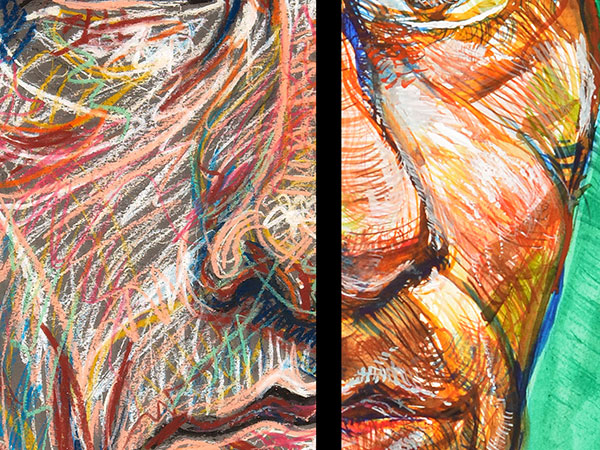
Initially the crayon drawing may appear more linear, but a closer inspection shows that both versions are built up from linear strokes following the contours of the face.  My painting style is becoming quite similar to my drawing style.  The biggest difference is that the crayon drawings start with a dark surface and add light, while the paintings start from white paper and build shadows.  The crayon drawings are an additive process, like modeling a sculpture from clay, while the watercolor paintings are a subtractive process, like carving a sculpture from a block of stone or wood.

Details of two portraits of Michael W, 2009 crayon (left) and 2011 watercolor (right)

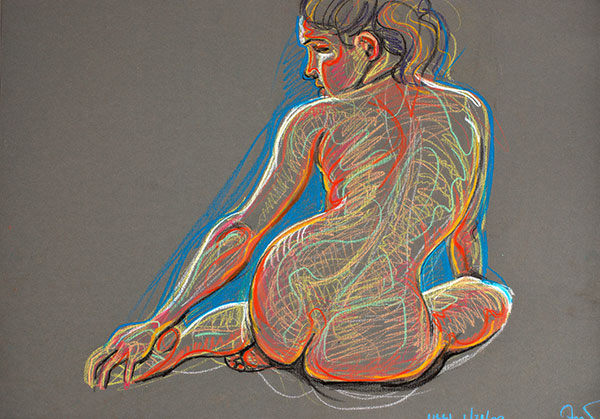
Here are two 20-minute sketches of Lilli’s back.  Notice how free is the movement of the hand in the lighter colors of the crayon drawing.  I can add higher-value colors little by little in this scribbly fashion until it’s light enough.

Sidesit, 2009, aquarelle crayon on paper, 20" x 28", by Fred Hatt

In watercolor painting, the white paper is dominant and blinding, but a single wrong touch can destroy it.  The sculptural analogy holds here – in watercolor painting, as in stone carving, a misplaced stroke can ruin it all.  The hand must be confident and sure.

Seated Contrapposto, 2011, watercolor on paper, 15" x 20", by Fred Hatt

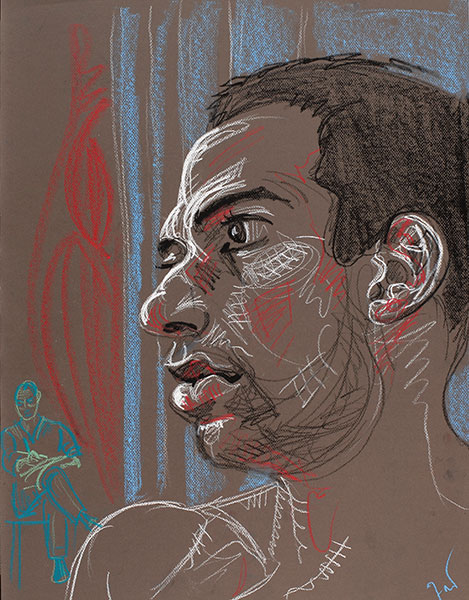
These two 20-minute portrait sketches of Mike (not the same Mike as in the third and fourth pictures in this post) show me trying to go against the tendencies of the media mentioned in the notes on the Lilli back sketches.  In the crayon drawing I’m trying to give the lines great clarity and confidence.

Sketcher and Poser, 2011, aquarelle crayon on paper, 20" x 25", by Fred Hatt

In the watercolor painting below I’m trying to be as loose and sketchy as the cloudiest crayon drawing.  This is mostly painted with a fan brush or comb brush, the paint kept fairly dry.

Michael H, 2011, watercolor on paper, 19" x 24", by Fred Hatt

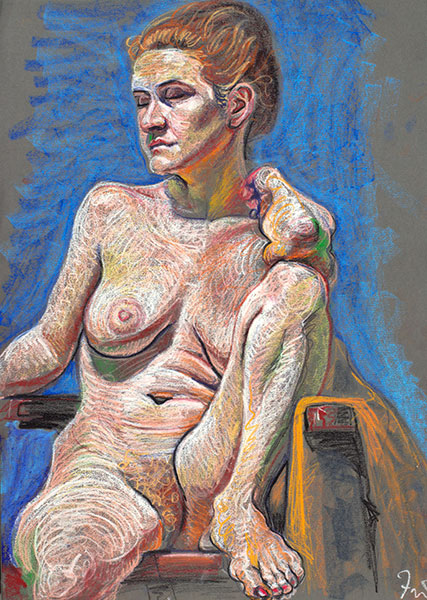
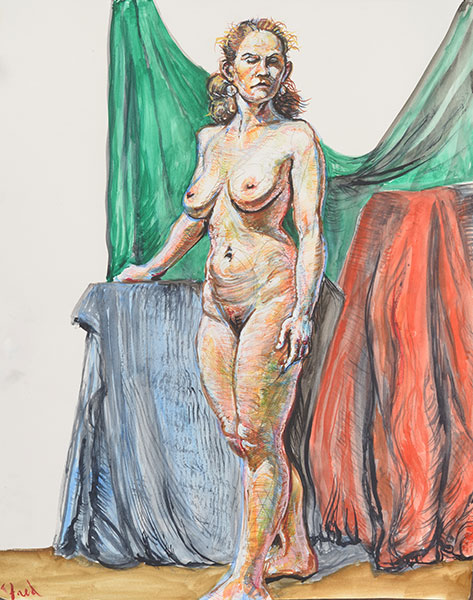
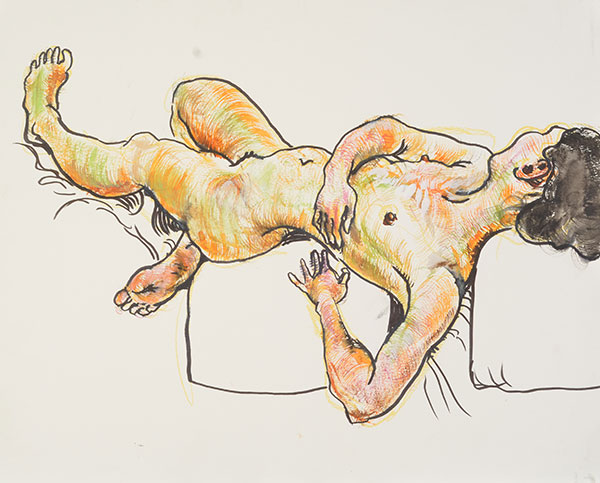
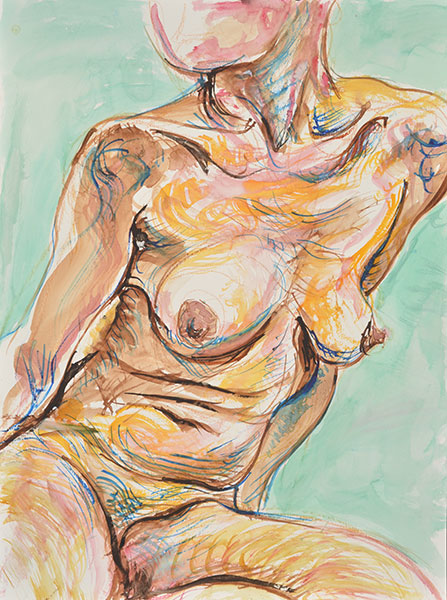
I’ll conclude with another pair of more developed drawings of Lilli, in both of which she closes her eyes.  (Lest this pairing give the wrong impression, I assure you that Lilli is always alert and focused as a model, eyes closed or not!)  Both of these pieces are worked in many layers, to approach a realistic impression of color and solidity.  A closer look at either one, though, will show the construction of cross contour lines, with colors mixed on the paper, not on the palette.

Reverie, 2008, aquarelle crayon on paper, 28" x 20", by Fred Hatt

Standing, Eyes Closed, 2011, watercolor on paper, 19" x 24", by Fred Hatt

Readers, I invite you to comment on these pairs – what strikes you about the difference between a crayon drawing and a watercolor painting of the same subject?

2011/12/28

Mother Nature, Abstract Expressionist: Photography by Dan Fen

Fohoco, 2011, photo by Dan Fen

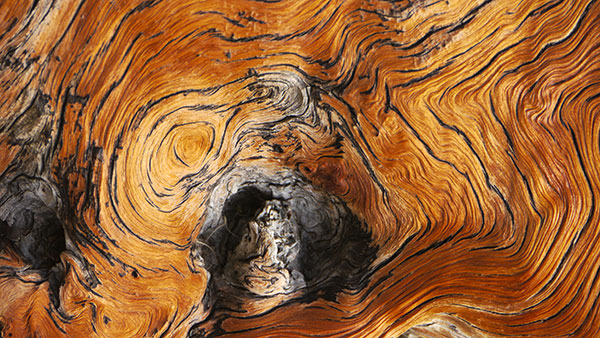
One of the gifts I received this holiday season was a collection of hundreds (thousands, actually!) of digital photographs by my youngest brother, Dan.  Dan lives in the Mojave Desert area, and regularly goes hiking in the canyons, hills, and valleys of Nevada, Utah, Arizona and California, with his partner Jill, their dogs, and his camera.  All of the photos seen here were taken within 90 minutes drive from his house.  Dan has a great eye for the abstract patterns of nature.  I’m devoting this last post of 2011 to sharing Dan’s vision with the readers of Drawing Life.  The vortex of color below is a close-up detail of a living tree.
Votr, 2011, photo by Dan Fen

Dan rarely prints his photos, and prefers that they be viewed as digital slide shows, full screen on a large monitor in a dark room, as sequences.  The more abstract series are quite hypnotic seen in that way, and I hope Dan will soon put some of his photos on line for full-screen slide show viewing.  For the format of this blog, I’ve selected a few of my favorites, reduced them in size, and mixed them up.  (Apologies, Dan!)  The originals have extremely fine textural details that are lost in the smaller images here, but the smaller size seems to emphasize the compositional qualities of the images.

Sheep Mountains, 2011, photo by Dan Fen

Some of these close-up studies of rocks, trees and metal remind me of some of the images of the planet Mars that we have seen recently from the HiRISE camera launched by NASA and the University of Arizona.

Fohoco, 2011, photo by Dan Fen

You can also look at these pictures as though they were abstract expressionist paintings.  To my eye, the subtlety of the colors and the variety and complexity of the patterns surpass the masters of the New York School.

Sheep Mountains, 2011, photo by Dan Fen

The desert mountains and canyons are famous for their grand vistas, but Dan looks closely at details one might easily overlook, seeing the beauty of all phases of the cycles of nature, including erosion and decay.

Tree, 2011, photo by Dan Fen

These markings remind me of petroglyphs.  This is another close textural examination of a tree.

Noba, 2011, photo by Dan Fen

The landscape in Dan’s area is arid and much of it is dominated by bare stone.  That doesn’t mean it isn’t wildly colorful.  Look at these rocks streaked in white and red.

Buffington Pockets, 2011, photo by Dan Fen

In the picture below, the sun shines through the grass from behind, making the clumps shine like Fourth of July sparklers all around the jagged branches of a dead tree.

Sheep Mountains, 2011, photo by Dan Fen

This is another detail of the tree seen in the second picture in this post.  I wonder how it gets all these colors!

Votr, 2011, photo by Dan Fen

The landscape in wet places tends to have a lot of soft shapes and vivid greens.  The landscape in the desert leans more towards the spiky and the reddish.

Buffington Pockets, 2011, photo by Dan Fen

Time is an artist!

Fohoco, 2011, photo by Dan Fen

Sometimes the long view is just as much an abstract pattern as the close view.

Spring Mountains, 2011, photo by Dan Fen

Organic growth, the cycles of the seasons, and the ravages of time all go into creating these expressions of vitality and struggle.  Dan’s art is to find and isolate them, and to share them with those who can’t be there, or wouldn’t notice these details if they were.

Cluptr, 2011, photo by Dan Fen

Who says death is not a creative force?

Buffington Pockets, 2011, photo by Dan Fen

Growth and destruction, all of it is part of the eternal process of change, and it all coexists as layers settle upon layers and surfaces scratch and peel.

Sheep Mountains, 2011, photo by Dan Fen

Noba, 2011, photo by Dan Fen

Fohoco, 2011, photo by Dan Fen

No architect’s dream of clean lines and noble geometry can compare to the fractal magic of living chaos!

Spring Mountains, 2011, photo by Dan Fen

Thanks, Dan, for sharing your photos with me and for allowing me to share them with my readers.

2011/12/23

The Light Returns

Filed under: Season's Greetings — fred @ 23:46

Blessed Solstice, Happy Hanukkah, Io Saturnalia, Merry Christmas, Winter Greetings, Tolerable Festivus, New Moon, Epiphany, Kwanzaa, Yule!

To all my readers, a wish for the season:  As the longest night finally awakes in ultramarine glow, may the sun without and the sun within commence to wax!

(Digital illustration by Fred Hatt.  Tree silhouette from here.)

2011/12/15

Painting as Drawing

Persona, 2011, by Fred Hatt

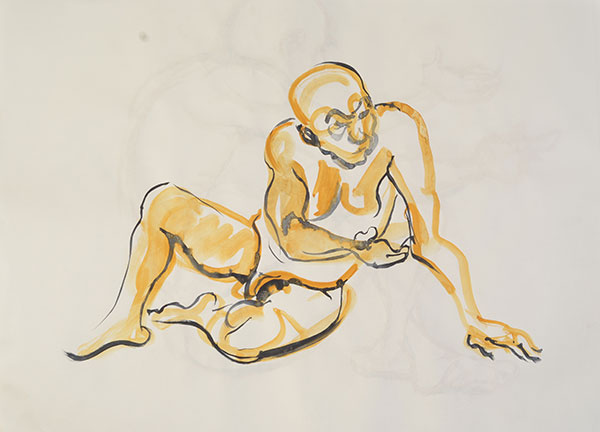
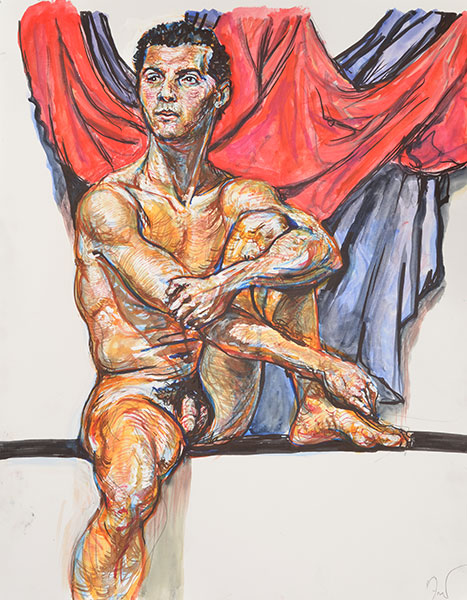
I am by my essential nature more drawer than painter.  In taking on painting as a challenge, I have approached it as a form of drawing.  I seek spontaneity, linear expressiveness and energy, and a direct connection between perception and mark-making.  I’m not particularly concerned with sophisticated composition or illusionistic realism.  In drawing, perceptions are traced as lines, and drawn figures remain transparent, because they’re not all filled in.  This allows multiple images to coexist, as they often do in the mind, or as they do in the painting above.  Even when a drawing or painting isn’t explicitly layered in this way, I like it to have that kind of openness.

In quick sketches, I use the brush in much the same way as I use a pencil or pen, freely tracing the contours.  The brush is even more sensitive to the motions of the hand, and indicates shadowed areas more efficiently than the pencil can.

Claudia Three Poses, 2011, by Fred Hatt

To draw with the brush is to dance the contours of your subject.

Ridge, 2011, by Fred Hatt

I always start with this kind of rhythmic following of the movement of the figure.  The body is an expression of vitality, and even in stillness it expresses motion and projects energy with its curves and angles.

Robyn Poses, 2011, by Fred Hatt

In this post I share a selection of recent watercolor paintings of the figure, both raw and essential quick sketches and longer, more layered studies like the portrait below.  In painting, as in drawing, I try to let the strokes follow the three-dimensional form of the subject.

Claudia, 2011, by Fred Hatt

I’m using transparent watercolors, but I’ve also sometimes introduced white gouache (opaque watercolor).  In drawing, I usually preferred to use gray or black paper because I could draw highlights.  Watercolor needs a white paper base, but the white gouache lets me paint highlights.

Crouch, 2011, by Fred Hatt

The simplest figures convey emotion very directly.

Mendicant, 2011, by Fred Hatt

When I have more time, I give more attention to the subtleties of color and form and light, and the relation of the subject to its setting.

Knee Clasp, 2011, by Fred Hatt

That kind of development gives solidity to the image.  Maintaining transparency preserves the potential of movement.

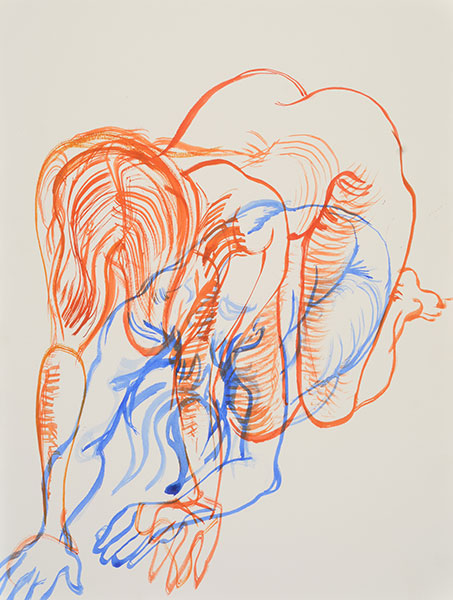
Expand, 2011, by Fred Hatt

In the developed drawings, I’m working on a painting technique that is similar to my scribbly, optical color mixing style of drawing.  I use fan brushes and comb brushes to sketch with cross-contour lines.

Male, 2011, by Fred Hatt

Does developing the color and solidity actually obscure some of the emotional expressiveness?  Or are the quick sketches more expressive just because the shorter time allows the model to hold a more extreme position?

Anguish, 2011, by Fred Hatt

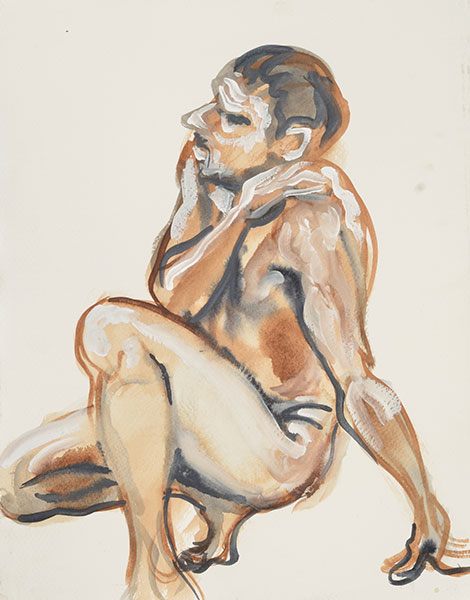
In a medium-length pose, like the two 20-minute drawings below, I combine a contour-based linear sketch with a relatively simple development of color and solidity.

Angle of Repose, 2011, by Fred Hatt

Chin on Palm, 2011, by Fred Hatt

Some artists don’t like quick poses because the limited time isn’t enough to go through the multi-stage process of creating an illusion of reality.  I like quick poses because models can explore everything the human body can do.  The range of poses that can be held for a minute or two is vastly larger than the range of poses that can be held for hours.  That fact was enough to motivate me to learn to draw fast!

Headstand, 2011, by Fred Hatt

There’s something inherently contradictory about painting or drawing.  I’m trying to be as loose and expressive as possible, and at the same time, as accurate as possible.

Angled Torso, 2011, by Fred Hatt

The lines need to carry the rhythm.  Color is more expressive the more approximate it is!  More layers make it more realistic, but sometimes fewer layers is more interesting.

Knees and Elbows, 2011, by Fred Hatt

Here’s one way of starting:  blobs (yellow), followed by hard contours (blue).

Stepping, 2011, by Fred Hatt

Everything is built out of gestures.

Omega, 2011, by Fred Hatt

In a more developed portrait, layers of color tendencies approximate perceptual colors.  Every stroke is made as though the brush is touching the body.

Traveler Returned, 2011, by Fred Hatt

When the brush touches the paper, it must be fully charged with the energy of life.

Black Hair, 2011, by Fred Hatt

The original watercolor paintings pictured in this post range in size from 11″ x 14″ (28 x 35.5 cm) to 18″ x 24″ (45.75 x 61 cm).

« Newer PostsOlder Posts »

Powered by WordPress

Theme Tweaker by Unreal