DRAWING LIFE by fred hatt

2012/03/20

Givens and Options

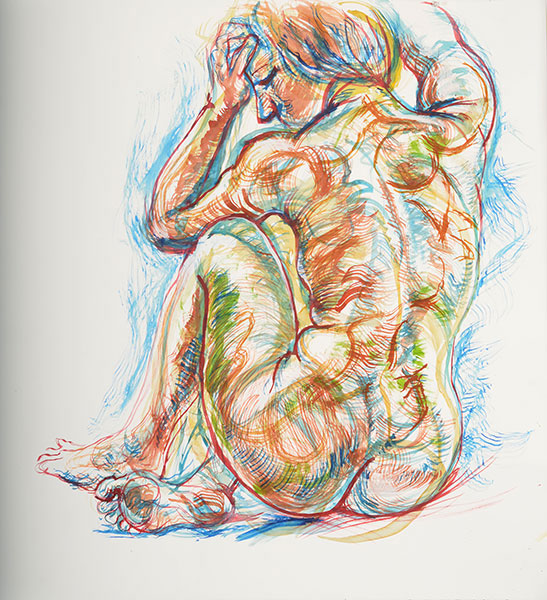
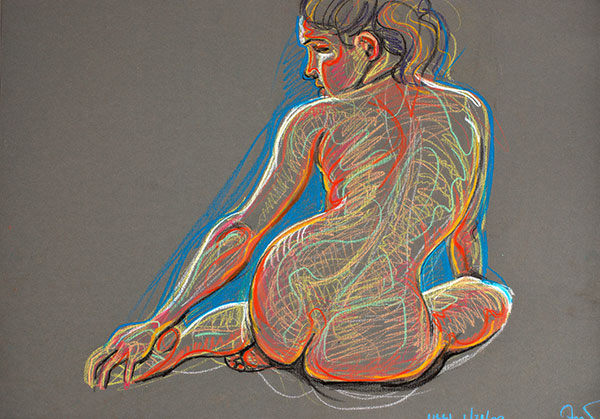
Shoulderblade Contact, 2012, by Fred Hatt

In an open life drawing session, the givens are simple:  There is a live nude model, who will take a pose and hold still for a designated period of time.  Using the materials of visual art, we must draw what we can from the model during the interval allowed.  Over a series of sessions, we can expect to see a great variety of models, and if we want to, we can try out many different materials and techniques, but for a given class, we take the model we get and use the materials we’ve brought.  If it’s a big class, we will probably have little or no say about the poses, and may not be able to move from the viewing position we have taken up in advance.  But in the moment the model takes the pose and the timer begins counting down, we still have many options, and must make choices instinctively or deliberately.

How shall we scale the figure?  Do we want to include the whole figure, or just part?  Do we focus our energies on trying to capture a likeness, or a feeling of structure, or what?  Do we isolate the figure, or include background elements?  What details should we include, and what can we omit?  Do we start with light and shadows, or with contours?  Shall we try to keep our hand as loose as possible, or as precise as possible?  These choices face us, in a way limited by our skill, even in a one- or two-minute pose.  If the pose is twenty minutes, or three hours, the options proliferate!  In an instructed class, the teacher may make many of these choices for us, but in an open practice session they are up to us, and the richness of the practice is greatly enhanced by not always making the same choices.

That’s a general observation, the sort of thing I’m always harping on, and would perhaps be best illustrated by work from over the years, specifically selected to highlight the various choices involved.  But what I have to share with you now is a few of my recent watercolor paintings and crayon drawings of the figure.  I’ve arranged them to bring out similarities and differences, and the theme of choices will perhaps provide a lens with which to view them.

Slim, 2012, by Fred Hatt

The first three illustrations are all 10- or 20-minute watercolor sketches of figures with crossed arms.  All of these have a loose, casual feel, but the scribbly strokes are anchored by contour lines that are carefully drawn.  The first two are standing poses, with the faces roughly indicated, and framed to include most of the body but not the feet.  The one below is a seated pose, framed closer, with more attention to the facial expression and the hands.

Arms Folded, 2012, by Fred Hatt

Lines of color on the face give a sense of color and shading, but also convey some quality of emotion or energy.  Below I’ve used a similar approach in a longer drawing – I think this one was about an hour.  I had started out sketching a full figure, but as I went on with it I found that what really interested me about this model was her face, and I couldn’t get the details of the face in a full-figure painting.

Thinking Back, 2012, by Fred Hatt

Including the chest as well as the face allows me to get plenty of expressive detail but also show something of how the head is carried upon the body.  In the watercolor sketches above and below, I’m using two of my favorite pigments, cadmium red and ultramarine blue.  The red shows where the blood flows near the surface, and the blue shows where the light is absorbed.

Relief, 2012, by Fred Hatt

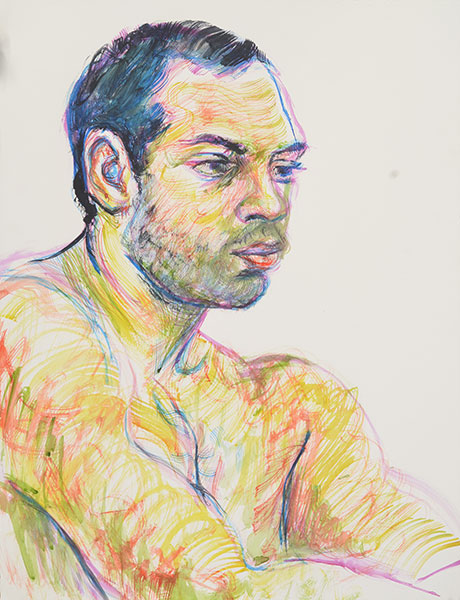
In the long-pose watercolor portrait below, I tried optical color mixing to give a sense of flesh tones.  By cross-hatching using fan brushes with cadmium red and green oxide, with some lamp black and phthalocyanine turquoise, I’m trying to get the glow of life.  Adding bluer tones to the background also emphasizes the warmth of the figure.

Chuck, 2012, by Fred Hatt

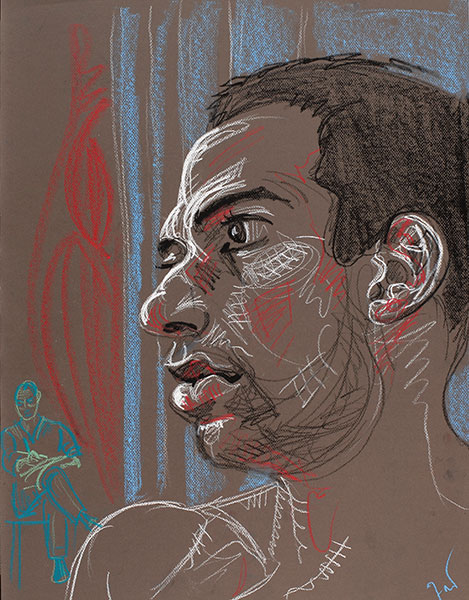
The portrait below is drawn with white and reddish-brown aquarelle crayon on warm gray paper, with the darks filled in with black watercolor.  A wet brush was used to blend some of the white aquarelle crayon.

A.Z., 2012, by Fred Hatt

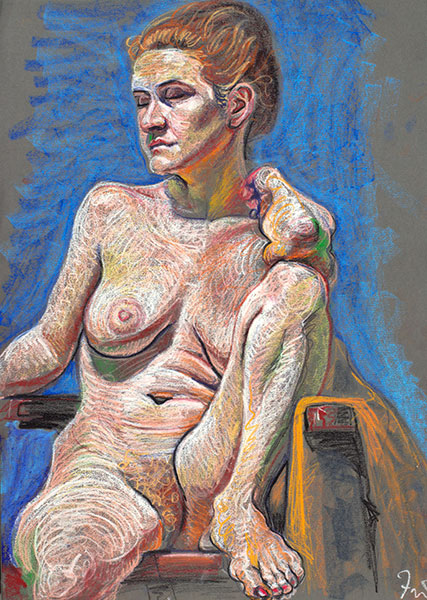
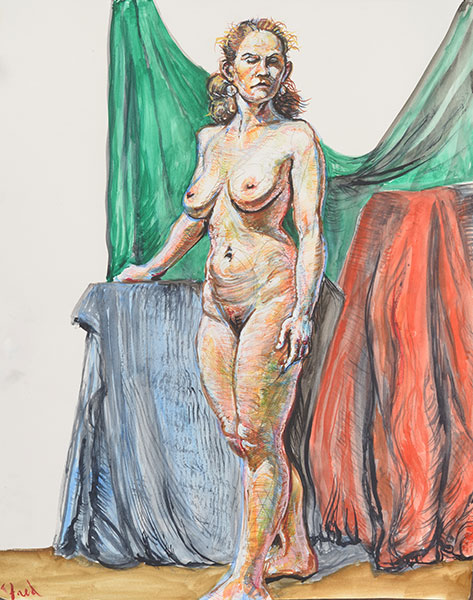
The model below, Julie,  has an inner happiness and confidence that I can’t help but express in my drawings of her.  Plump females may get no respect in the media culture, but they’re very popular as figure drawing models, because their rounded forms are beautiful on paper, and they’re a lot easier to draw than wiry, angular models.  Something about this pose just makes me want to dance, and I had to get the whole figure on the paper, from head to feet, in this 20-minute watercolor sketch.

Coquette, 2012, by Fred Hatt

The body leans to one side, and that violation of balance makes a still pose seem active.  In the long pose watercolor below, I chose to develop rectangular elements in the background to contrast the inclined body.

Piet, 2012, by Fred Hatt

Every Monday morning at Spring Studio I am the monitor for the 3-hour long pose session.  We do a set of 2-minute warm-up poses and then, subtracting the breaks, we have about two hours to study a single pose.  Once in a while, we have two models at once.  Two models isn’t just twice the work, it multiplies the geometrical relationships of elements and reveals every feature of the face and body by contrast to a very different face and body.  The intensity of observation required usually sends me into a more realist mode than I might otherwise pursue.

Two Women, 2012, by Fred Hatt

The realist mode of painting is obsessive, and when I really get into it, every detail of texture or color becomes achingly beautiful – even the way cellulite refracts light.

Center of Power, 2012, by Fred Hatt

Sometimes in a session you get an angle on a pose that, on first glance, doesn’t seem to offer much.  A back view, flat lighting, not much visible anatomical detail – not much to work with, right?  No, this is an opportunity to notice subtleties, and to find how simple details – the arrangement of the fingers, the way a scarf is tied around the head – can make the boring pose dynamic.

Back with Headscarf, 2012, by Fred Hatt

Here’s another example of a pose that at first seemed a bad viewpoint.  But look at how the angular joints stack up!  Look at how the light pulls everything up and to the right, while the shadows and the black hair give the figure gravity.

Listening, 2012, by Fred Hatt

Contrast the skinny body above with the corpulent body below.  The range of variation of the human form is a wondrous thing to contemplate.

An artist working with a model in his or her own studio would be unlikely to choose either of these sideways/backwards views of a pose, but in a class or an open session you get what you get, and what do you know, this is a great angle to reveal the energy of the body!

Column, 2012, by Fred Hatt

When I work with a model in my own studio, I can do experiments with angles and lighting that wouldn’t work in a class or open session.  The next two figures were drawn (in aquarelle crayon) by looking through a mirror set on the floor with the model standing above.  This gives a foreshortened view with a standing pose.  In this way, I’m looking up by looking down, while drawing on the floor.  The figure in the mirror is seen upside-down, and these drawings were made that way, with the head at the bottom of the page.  One of the pleasures of the foreshortened view of the figure is unusual juxtapositions of body parts.  Notice below how one elbow aligns with the head, and another with the cleft between buttock and thigh.  That’s something you will never see with the normal straight-on view of a standing pose.

Atlas 2, 2012, by Fred Hatt

My inspiration for these figures was ceiling frescoes, which often show cherubs and mythological characters as though one is looking up at bodies floating in the sky.  The figure towering above has a godlike quality.  This is how adults are seen by babies!

Atlas 1, 2012, by Fred Hatt

This pose was done lying face down on the floor, but it naturally conveys the feel of flying.  I was sorry to lose that left hand, but just couldn’t shrink the figure down enough to fit the entire thing on the page!

Soar, 2012, by Fred Hatt

Here’s a reclining foreshortened view from the head end of the body, with the light coming from behind.  This is a sketch painted with white gouache on black paper.  I love unusual, foreshortened views of the body.  In drawing them, I find it very helpful to think of the eyes as organs of touch from a distance.  The fingertips that are touching this body are rays of light, and it is that touch that the eyes receive and translate into drawing.

Morning Light, 2012, by Fred Hatt

All the pieces in this post are around 18″ x 24″, in watercolor, sometimes with white gouache, and/or in aquarelle crayon on paper.

EVENT THIS WEEKEND:

On Saturday, at Soundance Studio in Brooklyn, I’m showing an experimental video I made last year with dancer Kristin Hatleberg.  Kristin improvised movement at Ringing Rocks Park in Eastern Pennsylvania, a unique landscape with boulders that ring like steel when struck.  Filmmaker Yuko Takebe and I both shot video of Kristin in this environment, and then each of us made our own edits of the combined footage.  It’s fascinating to see how two different sensibilities transform the same raw material.  We’ll be showing both versions of the Ringing Rocks video at an event also featuring other video and live dance work at Soundance Studio in Williamsburg, Broooklyn, this Saturday.  Here are details:

    • Saturday
    • 8:00pm
  • 281 N. 7th Street in Williamsburg, Brooklyn
  • Free Admission! Reservation required!
    2 Excerpts From Generations: A Dance and Film Collaboration Conceived and Directed by Janet Aisawa with choreography by Emily Winkler-Morey and Judith Grodowitz
    Ringing Rocks Remember: Companion Films by Yuko Takebe and Fred Hatt, with dancer Kristin Hatleberg
    Additional Videos by Vanessa Paige & Dalienne Majors’ Video of Sarah Skaggs’ 9/11

2012/02/08

The Body Contemplated

Ray, 2012, by Fred Hatt

a person is a bit of this and a bit of that

fuzzy tendencies overlapping, interacting

forged and scourged in the kiln of embodied life


Earrings, 2012, by Fred Hatt

eyes ions, black magnetic pools


A la plage, 2012, by Fred Hatt

zone in on tones

undertone, overtone, midtone

let the parts fall where they may


Elbows & Knees, 2012, by Fred Hatt

body takes a beating just doing the day by day


Brooder, 2012, by Fred Hatt

why are things so

what do things mean

how do things work


Curvature, 2012, by Fred Hatt

a serpent grows limbs

a head aloft partakes of the clouds of heaven

as well as the dirt of the ground


Sleep Tight, 2012, by Fred Hatt

a stack of bones

opal tones


Halt, 2011, by Fred Hatt

expand, contract

concentrate, dissipate


Defeat, 2012, by Fred Hatt

hands ground down while forces face forward


Muscles of the Back, 2012, by Fred Hatt

the bones are the slowest river

the flesh, the nerves, the blood grow to flow, each in its way

life is a convulsion of matter


Gray, 2012, by Fred Hatt

eyes tomorrow

seated present


Outward & Inward, 2012, by Fred Hatt

sentry and slave

guard the grave


Defiant, 2012, by Fred Hatt

the body of light harbors a shade

the body of shadow contains a glow


Graces, 2011, by Fred Hatt

Luna Triune: wax and full and wane and new

the new of course unseen

every cycle has its way, its period, its mystery

each single season’s unique, any noise has its timbre

all is oscillation, orbs in orbit

go down long, draw in and in, only finally open out


Degasian, 2012, by Fred Hatt

bow, bend, lay low

tack and parry, stealthy slow

like grass grows


Retrospect, 2011, by Fred Hatt

space is light

matter is force

time is mind


Rorrim, 2012, by Fred Hatt

feeling with eyes, rove over ridges and marshes and creeks

body is topography and self is weather

sometimes stormy, often calm


Fine Lines, 2012, by Fred Hatt

I am made of moss and ferns

mushrooms and minnows and dim glow worms


Faun, 2012, by Fred Hatt

man is land

containing imagination

soil to till

seed to spill


Heartache, 2012, by Fred Hatt

bereft chest

abject head

trunk bent

tower leant


Brothers, 2012, by Fred Hatt

a man knows a man, nothing said


All the images in this post are watercolor on paper, sometimes with a little white gouache.  I painted all these within the last two months.  Sizes:

Graces and Rorrim:  38″ x 50″ (96.5 x 127 cm).

Ray, Earrings, Elbows & Knees, Sleep Tight, Gray, Defiant, Retrospect, Fine Lines, Faun, Heartache, Brothers:  19″ x 24″ (48.3 x 61 cm).

A la plage, Brooder, Curvature, Halt, Defiant, Muscles of the Back, Outward & Inward, Degasian: 14″ x 17″ (35.6 x 43.2 cm).

2012/01/08

Wax and Water

Weathermap, 2011, watercolor on paper, 38" x 34", by Fred Hatt

A few months ago, I made a change in my regular life drawing practice.  My primary drawing medium for over fifteen years had been Caran d’Ache Neocolor II aquarelle crayons.  Aquarelle means watercolor, and the pigments laid down by these crayons can be thinned or blended with water, but I always used them as a dry medium.  Caran d’Ache crayons are similar in size and feel to the familiar Crayola crayons, but they have a much higher pigment density, so they just glow on a background of black or gray paper. One day I decided to change over to a very different medium, to give myself new challenges.  I feel it’s important to keep any creative practice expansive by changing things up in small ways constantly, and in big ways occasionally.  So when I went to the life drawing sessions I began leaving my crayon box at home and bringing instead my watercolor paints and brushes.

There’s a repetition factor in the life drawing practice anyway, as you’ll often see the same models in similar poses to ones you’ve drawn before, and in such a case it’s always more interesting if you can come up with a slightly different approach than the one you used the last time.  Working with a very different medium, one you haven’t yet mastered, is certainly enough of a change to keep it fresh.  I’ve begun to amass a collection of similar pieces in the two media, and in this post I’ll be sharing pairs of images.  Each one of these pairs is of the same model, in similar poses, drawn at similar sizes and over roughly the same amount of working time, but one of each pair is a watercolor painting while the other is a crayon drawing.

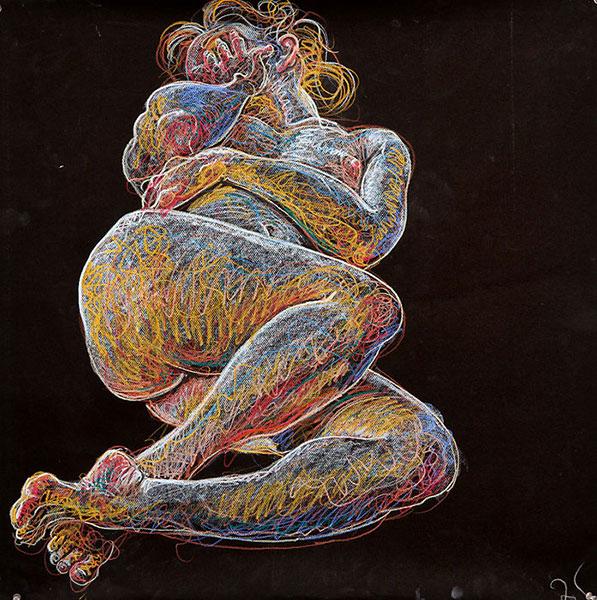
The painting at the top of this post and the crayon drawing just below are both studies of model, actor and artist Alley, rendered in free, expressive strokes in their respective media.  I’ve always liked the linear aspect of drawing, as the movement of the line captures a feeling of energy.  Interestingly, in comparing these two, the painting has more linear energy than the drawing does, but the crayons on a black ground give more of an impression of light.

Rotation, 2006, aquarelle crayon on paper, 30" x 30", by Fred Hatt

Next, here are two larger-than-life-size heads of Michael, the first a crayon drawing and the second a watercolor painting.

Michael W., 2009, aquarelle crayon on paper, 28" x 20", by Fred Hatt

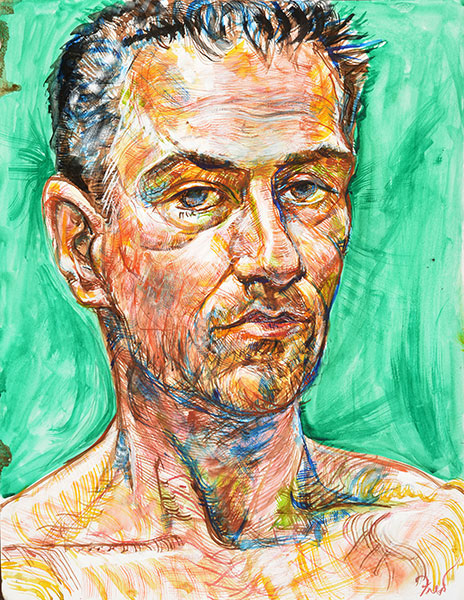
Michael W, 2011, watercolor on paper, 19" x 24", by Fred Hatt

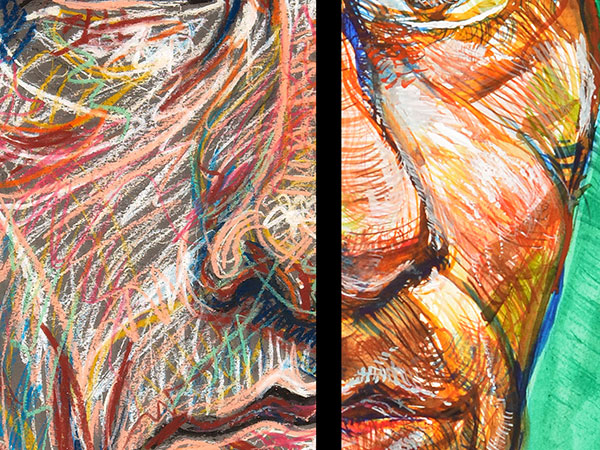
Initially the crayon drawing may appear more linear, but a closer inspection shows that both versions are built up from linear strokes following the contours of the face.  My painting style is becoming quite similar to my drawing style.  The biggest difference is that the crayon drawings start with a dark surface and add light, while the paintings start from white paper and build shadows.  The crayon drawings are an additive process, like modeling a sculpture from clay, while the watercolor paintings are a subtractive process, like carving a sculpture from a block of stone or wood.

Details of two portraits of Michael W, 2009 crayon (left) and 2011 watercolor (right)

Here are two 20-minute sketches of Lilli’s back.  Notice how free is the movement of the hand in the lighter colors of the crayon drawing.  I can add higher-value colors little by little in this scribbly fashion until it’s light enough.

Sidesit, 2009, aquarelle crayon on paper, 20" x 28", by Fred Hatt

In watercolor painting, the white paper is dominant and blinding, but a single wrong touch can destroy it.  The sculptural analogy holds here – in watercolor painting, as in stone carving, a misplaced stroke can ruin it all.  The hand must be confident and sure.

Seated Contrapposto, 2011, watercolor on paper, 15" x 20", by Fred Hatt

These two 20-minute portrait sketches of Mike (not the same Mike as in the third and fourth pictures in this post) show me trying to go against the tendencies of the media mentioned in the notes on the Lilli back sketches.  In the crayon drawing I’m trying to give the lines great clarity and confidence.

Sketcher and Poser, 2011, aquarelle crayon on paper, 20" x 25", by Fred Hatt

In the watercolor painting below I’m trying to be as loose and sketchy as the cloudiest crayon drawing.  This is mostly painted with a fan brush or comb brush, the paint kept fairly dry.

Michael H, 2011, watercolor on paper, 19" x 24", by Fred Hatt

I’ll conclude with another pair of more developed drawings of Lilli, in both of which she closes her eyes.  (Lest this pairing give the wrong impression, I assure you that Lilli is always alert and focused as a model, eyes closed or not!)  Both of these pieces are worked in many layers, to approach a realistic impression of color and solidity.  A closer look at either one, though, will show the construction of cross contour lines, with colors mixed on the paper, not on the palette.

Reverie, 2008, aquarelle crayon on paper, 28" x 20", by Fred Hatt

Standing, Eyes Closed, 2011, watercolor on paper, 19" x 24", by Fred Hatt

Readers, I invite you to comment on these pairs – what strikes you about the difference between a crayon drawing and a watercolor painting of the same subject?

2011/11/08

Claudia’s Collection

Claudia, the Museworthy blogger, has posted “The Museworthy Art Show”, a collection of artwork by her regular readers and commenters.  One of my large-scale multi-figure drawings is included, a piece that hasn’t yet been seen on Drawing Life.

This is a kind of group show I like.  The artists are diverse in media, style, approach, and level of training.  Simple sketches appear alongside elaborate compositions.  The virtues of spontaneity and simplicity shine, as do the accomplishments of refined craft.  And Claudia has fostered a feeling of community among her far-flung readers, since now we’ve all been in a group show together.  Museworthy tribe, represent!

Click to visit The Museworthy Art Show.

2011/08/02

Try, Try Again

Filed under: Figure Drawing: Practice — Tags: , , , , , , — fred @ 23:28

Marilyn 1, June, 2011, by Fred Hatt

Last week I posted about the master of the “naked portrait”, Lucian Freud, who often spent hundreds of hours over a period of many months on a single painting.  Naked portraits are also among my practices, but I lack the patience to spend so much time laboring over a single image.  I feel my best work arises more from spontaneity than from perseverance, and so I just churn ’em out and hope a few are worth saving.

I run a weekly session at New York’s Spring Studio featuring a nude “long pose” – long by sketch standards, not by oil painting standards.  My class lasts three hours and starts with a set of two-minute warm-up poses; subtracting that set and breaks, the amount of time allotted for drawing the pose amounts to two hours.

Most artists work on a single drawing or painting during the session.  So do I, sometimes, but I also frequently decide to start over again one or more times.  In this post I’ll share recent examples of multiple tries at the same pose from the same viewing angle.  I’m sharing some of my failures, work I wouldn’t normally exhibit, because of what they reveal about my process.

The sketch that opens this post shows how I begin analyzing the angles of a pose.  You can see how I use a combination of triangulation and rhythmic curves to find the tension and structural energy of the pose.  In my second attempt, below, I’m building on that analysis, but drawing closer.  I often use lines to indicate the contours between shadows and highlights.

Marilyn 2, June, 2011, by Fred Hatt

Finally, I decide that all the magnificent arches and cantilevers of this pose are distilled in Marilyn’s face, with its pointed eyebrows and lips, and the lovely taut bow of the collarbone.

Marilyn 3, June, 2011, by Fred Hatt

Christophe is a model with an acting background, and his specialty is facial expressions.  Here he gave us anguish, leaning to one side.

Christophe 1, June, 2011, by Fred Hatt

Here I spent most of the session developing the drawing above.  At some point near the end of the session I decided I’d best stop working on it. lest I overwork it and destroy its power, a mistake I still sometimes make.  So I spent the last half hour or so simplifying what  I’d learned from the previous hours of study of Christophe’s expression into a linear abstraction of emotion, below.  Even though this drawing is an afterthought, I think it’s stronger than the one I spent more time on.  I wouldn’t have been able to do something like this from the start – its simplicity only arises from the experience of prolonged looking.

Christophe 2, June, 2011, by Fred Hatt

Here’s one of my favorite models, Betty.  I think I began drawing using the yellow crayon sideways to indicate the highlights of the body, then used white and black lines to delineate details and the contours between highlight and shadow areas.  Proportions are wildly off here, with the head half the size of the torso.

Betty 1, July, 2011, by Fred Hatt

So I started again and developed this figure in relation to the elements around it.  The head may still be a little too big, but that’s my strongest distortive tendency.  The face has so much structural complexity and carries so much expressive power, it needs as much space in the drawing as it needs!

Betty 2, July, 2011, by Fred Hatt

Below is another example where I managed to come up with a representation of the model’s face, body and expression that was pretty satisfactory, overall, but a bit dull, perhaps.

Mitchell 1, July, 2011, by Fred Hatt

So I moved in on the face and tried to summarize its specificity in line.

Mitchell 2, July, 2011, by Fred Hatt

Here’s stage one of a look at Luke’s seated pose.  All the drawings in this post were made during the summer.  In the hot months, the aquarelle crayons I use are softer and lay down a thicker layer of wax than they do in the cooler months.  Once there’s a certain density of wax on the paper, revision is hopeless.

Luke 1, July, 2011, by Fred Hatt

A second attempt shows my understanding of the figure sharpening.  Here I’m using a lot of cross-contours.

Luke 2, July, 2011, by Fred Hatt

Finally, again, I move in closer.  Here the style I”m using is like carving with a chisel.  I’m trying to approximate colors by the method of optical mixing.

Luke 3, July, 2011, by Fred Hatt

The final series of drawings in this post is from this past Monday.  This was my first shot at drawing Leah, a model that has inspired several lovely paintings by Daniel Maidman.  I started out measuring the pose by head-lengths.

Leah 1, August, 2011, by Fred Hatt

In the second attempt, the head was oversized – my usual tendency.  The pose has subtly changed since the first set, with the left knee and arm covering less of the torso.  Most of the artists were clustered to the model’s right side during this pose, and probably didn’t even notice the change in the pose.  I took advantage of it to study the structure of the chest and abdomen.

Leah 2, August, 2011, by Fred Hatt

My third try at this pose finds me moving closer, to allow a more detailed treatment of the face.  Still not quite right, though.

Leah 3, August, 2011, by Fred Hatt

Here’s the final try, developed during the last third of the session.  I still haven’t really captured Leah’s face, but I’m happy with the color and the challenging dangling hand in front of the thigh.  It can be hard to really get the essence of a model in the first session of studying her or him – you get what you can, and then time’s up!

Leah 4, August, 2011, by Fred Hatt

All the drawings in this post are aquarelle crayon on paper, 19 1/2″ x 25 1/2″ (50 cm x 65 cm).  Similar previous posts showing multiple attempts at the same pose include Variations and Redrawing.

« Newer PostsOlder Posts »

Powered by WordPress

Theme Tweaker by Unreal