DRAWING LIFE by fred hatt

2010/04/16

Stories in the Round

Randolph Rogers, Nydia, the Blind Flower Girl of Pompeii, 1859, photo #2 by Fred Hatt

Sculpture practice involves working in the round.  A traditional figurative sculpture studio has rotating platforms for the work and for the model, so both can be observed from all angles.  A sculptor must also consider the work from an engineering standpoint, analyzing weight distribution, compression, tension, torque and shear, especially when the work is large.  Looking at a figurative sculpture from different angles helps us understand the expressive qualities of a pose in three dimensions.  The human body is a dynamic structure, achieving stability through adaptive movement.  A sculptor gives the illusion of life by suggesting movement in a stable structure.

In this post I’ll look at two neoclassical works, both made in the middle of the 19th century, when the art of sculpture was still defined by the combination of technical excellence and emotional connection, before modernist innovation took the art in a thousand different directions.  Both of these pieces are based on literary sources.  Randolph Rogers’ Nydia illustrates a scene from Edward Bulwer-Lytton‘s best-selling 1834 historical novel The Last Days of Pompeii.  Carpeaux’ Ugolino is based on an episode from Dante’s Inferno.  Like Bulwer-Lytton’s turgid Victorian prose, this kind of artwork is completely out of fashion today, and from a modern perspective, both of these works are pure kitsch, but taken in their own context they’re beautiful and complex.  Both are on permanent display at the Metropolitan Museum of Art, where I took these photographs.

Randolph Rogers, Nydia, the Blind Flower Girl of Pompeii, 1859, photo #3 by Fred Hatt

Randolph Rogers was an american sculptor based in Rome.  This particular work was extremely popular in its time, and Rogers’ atelier made many commissioned copies of it.  It depicts a scene in which the blind girl Nydia has been separated from her friends during the eruption of the volcano that buried the ancient city of Pompeii.  The face shows a great deal of emotion while remaining youthful and innocent.  The side view above shows the forward lean of the pose.  The center of gravity of the body is above the right foot, so this is a pose that a model could hold at least briefly without external support (unlike the leaping poses in some later sculptures also seen in the sculpture court of the American Wing of the Met such as MacMonnies’ Bacchante and Infant Faun or Frishmuth’s The Vine).  But it has a strong forward lunge, with the upper body curving forward even more, giving a sense of urgency.

Randolph Rogers, Nydia, the Blind Flower Girl of Pompeii, 1859, photo #4 by Fred Hatt

Much of the impression of movement is imparted by the swirling folds of Nydia’s dress.  Real fabric would not hold this form in a state of repose, so this makes the body appear to be in motion even though it is in a stable position.  The drapery creates a helical swirl around the body that makes Nydia appear to be turning towards the sound she hears in the distance.  The crossing of the arm to the ear and the drapery whipping around the walking stick reinforce this overall sense of twisting.

Randolph Rogers, Nydia, the Blind Flower Girl of Pompeii, 1859, photo #5 by Fred Hatt

Randolph Rogers, Nydia, the Blind Flower Girl of Pompeii, 1859, photo #1 by Fred Hatt

You might know Jean-Baptiste Carpeaux‘ famous group La Danse, which adorns the Paris Opera, a work whose exuberant orgiastic nudes caused scandal in their time.  His other famous work is Ugolino and His Sons, which imagines a story told in Dante’s Inferno.  Count Ugolino is imprisoned in a tower with his children and starving to death.  The sons beg the father to devour their bodies.  Even more than Nydia, this work exemplifies the 19th century style of marrying classical technique to emotionally extreme subject matter.  This can be partly attributed to the influence of the ancient Greek sculpture Laocoön and His Sons, with which Carpeaux’ piece bears many similarities.

Jean-Baptiste Carpeaux, Ugolino and His Sons, 1860, photo #1 by Fred Hatt

The pose of Ugolino is similar to Rodin’s iconic Thinker, a piece that embodies stillness and concentration.  Here, though, the pose is full of anguish and tension.

Jean-Baptiste Carpeaux, Ugolino and His Sons, 1860, photo #2 by Fred Hatt

The central figure of Ugolino is surrounded by four children.  Oddly, these figures all look to me like young adult male figures, varying in size but not proportion or development.  Even the youngest figure, lying at the left side of Ugolino’s feet, appears to be a boy’s head grafted onto a man’s torso.

Jean-Baptiste Carpeaux, Ugolino and His Sons, 1860, photo #3 by Fred Hatt

In the view above, note how the hands of the son wrapped around the father’s knee echo the form of Ugolino’s own large hands as he chews his fingers.  The hands and feet of the five figures, limp or tense, carry much of the emotional stress of the composition.  The toes gripping the toes, shown below, is particularly masterful, a gesture that creates an instinctive gripping within the viewer.

Jean-Baptiste Carpeaux, Ugolino and His Sons, 1860, photo #4 by Fred Hatt

Many sculptors have discovered the possibilities of enlarged, gnarled hands and feet to convey anguish.  Here it’s combined with a tormented facial expression.  Because the figure of Ugolino is larger than life size and elevated on a pedestal, his face is seen from a lower angle when approaching closer to the sculpture.  The expression is greatly intensified by viewing from below.

Jean-Baptiste Carpeaux, Ugolino and His Sons, 1860, photo #5 by Fred Hatt

Many compositions of this type, that have such a clear front and back, are displayed near a wall so it’s hard to see the back side.  At the Met, Ugolino is not against a wall, so one can get the very different view of the piece shown below.  From this side, spared the overbearing emotionalism, we can appreciate Carpeaux’ obsessive attention to anatomical detail and the way the differently sized figures are clustered.

Jean-Baptiste Carpeaux, Ugolino and His Sons, 1860, photo #6 by Fred Hatt

2010/04/09

The Secret of Practice

Marina, December, 1994, by Fred Hatt

Practice itself is no secret. Everybody knows you have to practice to be good at anything athletic or artistic. Talk to anyone who has brilliant skills, whether with a fiddle or a basketball or a theatrical role, and you can bet you’ll hear they spend a lot of time practicing.

Shifra, December, 1995, by Fred Hatt

I’m a big believer in practice. As a young self-taught artist I had no consistent and regular practice, and it soon became clear that the occasional flashes of brilliance I perceived in my own work weren’t going to turn into any steady flame without a more disciplined approach. In 1994 I began a regular practice of attending timed life drawing sessions. I’ve continued to this day and will do so as long as I live.

Arthur, December, 1996, by Fred Hatt

The point about practice that I intend to make in this post can’t really be illustrated.  I thought maybe looking at my sketchbooks over the years would reveal something about the effects of sustained practice on my work, but it’s not perfectly clear.  The drawings show a great deal of variability due to changes of media, different models, or my own energetic state on a given day.  Of course it’s a bit overwhelming to look at thousands of sketchbook pages over sixteen years.  What I have chosen to intersperse with these paragraphs is simply sketchbook pages (or double pages) of quick poses (one or two minutes), one each from the month of December of each year since my practice began in December 1994.  These are all practice drawings.  None were made with the intention to exhibit them.  There’s no direct relation between the images and the adjacent paragraphs.

Bruno, December, 1997, by Fred Hatt

Now when I look back at my work from 1994 and my work from today, I can see a lot of development. The quick sketches have become bolder and surer.  The long drawings have gotten looser and lighter.  The biggest improvement of all came in the first months of regular practice.  The long-term gains are subtler, but deep.

Rae, December, 1998, by Fred Hatt
The life drawing sessions I attend are filled with people who believe in practice. There are a lot of regulars there who have been pursuing the practice much longer than I have. Why, I wondered, do some of these devoted practicers not seem to show any improvement in their skill? (I won’t name names!)

Estella & Rudy, December, 1999, by Fred Hatt

The artists who show no growth aren’t challenging themselves. They tread the same well-worn path over and over again. They started out challenging themselves, but as soon as they found an approach that pleased them or earned praise from others, they stopped right there and went into endless repeat mode.

Daniel, December, 2000, by Fred Hatt

If you are an artist, you may have had the experience of being encouraged to maintain the rut. When a dealer finds work that sells, they want more of the same, not more experimentation.

Nora, December, 2001, by Fred Hatt

Many of the artists at the studio only want to do what they’re good at. A typical class starts with quick poses and increases the length, finishing with longer poses. Artists that excel with long poses but deal awkwardly with quick poses often come late to avoid the quick poses at the beginning of the class. Artists that do well with quick poses and tend to bog down on the long poses often leave early. They may be avoiding the experience of producing “bad drawings”, but they’re not doing their craft any favors.

Maryam, December, 2002, by Fred Hatt

This week I was reading, in the New York Times Sunday Book Review, a review by Annie Murphy Paul of a book I haven’t read, The Genius in All of Us, by David Shenk. I came across this sentence: “Whatever you wish to do well, Shenk writes, you must do over and over again, in a manner involving, as [Anders] Ericsson put it, ‘repeated attempts to reach beyond one’s current level,’ which results in ‘frequent failures.’ This is known as ‘deliberate practice,’ and over time it can actually produce changes in the brain, making new heights of achievement possible.”

Maggie, December, 2003, by Fred Hatt

I couldn’t have put it better. Bodybuilders use the term “training to failure“, and many of them believe pushing the muscles to the point of failure is essential to increasing strength and bulk. I believe an artist should also train to failure.

Christophe, December, 2004, by Fred Hatt

In art, when you start a practice, you’re failing every time. This is why beginner’s practice shows such amazing gains. When you finally reach a level that pleases you, you can easily stay at that level without continuing to experience failure. Of course, you will not experience any further growth either.

Carlos, December, 2005, by Fred Hatt

Artists at the open studio drawing sessions often say they’re having a “good day”, meaning they’re happy with their work, or a “bad day”, meaning they’re unhappy with what they’re getting. But if you want to expand beyond your limitations, you should view every drawing as a failure. After all, there’s no end point of perfection where a work of art is all it can possibly be. If you are trying to depict what you perceive, keep looking – you’re not quite getting it all yet. If you are trying to be as expressive as possible, keep trying – there is still more that you feel, that is not yet making it into your work.

Alley, December, 2006, by Fred Hatt

Once you get pretty good at something, you should be constantly on guard against settling into the comfortable rut. Keep challenging yourself. Try changing your media or the scale of your drawing or your position in relation to the model. Try using your non-dominant hand. Keep varying little things. Whether you have a minute or several hours to capture a pose, always consider that amount of time not quite enough, so that you must work furiously against the relentless clock. These are the small everyday ways of challenging yourself that can hone your craft.

Stephanie, December, 2007, by Fred Hatt

Bigger challenges can actually deepen your art. That’s harder to talk about because those bigger challenges are much more idiosyncratic and uncommon. Often, the great challenges come from outside, rather than being self-imposed. But by constantly challenging your craft in small ways, you are also developing flexibility and an orientation towards responding to problems by growth and adaptation rather than by denial and resistance.

Jaece, December, 2008, by Fred Hatt

In small things, strive beyond your ability. In large things, aspire to the impossible. Welcome failure, as often as possible. Failure is your friend!  That’s the secret!

Betty, December, 2009, by Fred Hatt

2010/04/06

Figureworks is Ten

Filed under: My Events: Exhibitions — Tags: , , , — fred @ 14:25

"10 Years of Figureworks" postcard, illustration: Arlene Morris, "Untitled", oil on wooden box, 16" x 16" x 4"

Friday, April 9, 2010 is the opening reception for an exhibit celebrating ten years of Figureworks, Brooklyn’s premiere gallery specializing in figurative art.  Figureworks hosts an open life drawing session on Saturday mornings, and I’ve been a regular at those sessions for years.  Gallery director Randall Harris has selected work by ten artists from his diverse stable for an exhibit to celebrate the anniversary.  I’ll have two color drawings in the show, and I’ll be there at the opening between 6 and 9 Friday evening.  Full info at this link.

“10 Years of Figureworks” is curated by Randall Harris.  It will be on view through June 6, 2010 at Figureworks, 168 North 6th Street, Williamsburg, Brooklyn, NY.  The gallery is open Friday through Sunday from 1:00 to 6:00 pm.  Open life drawing session is Saturday morning 10:00 am to 1:00 pm.

2010/03/29

Reverse Engineering a Drawing

Twists, 2010 by Fred Hatt

Reverse engineering is taking something apart to find out how it was put together.  The term usually applies to technology or manufactured products, particularly in the case of competitors seeking to discover trade secrets or make knockoffs.  I’ve never heard the phrase applied to an artwork, but a drawing or painting does conceal stages of construction.  In my last post I wrote about artist William Kentridge.  His method of charcoal drawing animation reveals the drawings he exhibits as processes of exploration and development.

Over the last seven years I’ve been making large-scale drawings with multiple overlapping figures.  Each of these is created in close collaboration with a single model.  I call them “chaos compositions” because their process involves drawing over and over on the same page to create a field of chaos, and then working to find a dynamic structure within that chaos.  Many examples, and an explanation of the process, can be found in this gallery on my portfolio site, and others in the blog posts “Time and Line”.  The stages of development of a chaos composition are shown in the post “Composing on the Fly”.

“Twists”, pictured at the top of the post, is a recent chaos composition, 48″ x 60″, or 122 cm x 152 cm, aquarelle crayon on paper, created in collaboration with the great model Madelyn.  Figurative elements are clearly visible, but the overlapping is dense enough that much of it is essentially abstract.  Different colors are used in different figures, making it possible to discern connected parts of individual figures by following lines of certain colors.  I’m trying to create images that require a more active approach to viewing than the traditional straightforward pictorial composition, and finding the starting figures is one way of active looking at these pictures.  It’s a little easier to do this with the original drawings, in which the figures are close to life size, than with a small online reproduction, but here I’m going to do it for you, using cropping and selective digital erasure to separate the component figures.

Figure 1, from Twists, 2010, by Fred Hatt

The lower part of this figure is easy to see in the finished piece, but the upper part has been heavily overdrawn and is difficult to find.  On these re-separated figures, where you see many other colors crossing over some of the contour lines, as in the left arm above, that is an indication of great density in the final piece.  Below, two figures from the left side of the picture.

Figure 2, from Twists, 2010, by Fred Hatt

Figure 3, from Twists, 2010, by Fred Hatt

One of these figures serves to frame the lower left corner of the picture, while the other turns away, to reach out of the frame.  The line of the back has been sketched twice in the one just above, once in pink and then in a light blue, with a slightly altered repeat of the pose.  Toward the middle of the piece, there are several more dramatic poses.

Figure 4, from Twists, 2010, by Fred Hatt

Figure 5, from Twists, 2010, by Fred Hatt

The figure below is particularly hidden.  The hand, in white, really stands out, but the forward-bending figure with the crossed feet is difficult to distinguish in the dense mass of line and color.

Figure 6, from Twists, 2010, by Fred Hatt

The one below is a little easier to see, but it’s an unusual pose that may be hard to figure out, and the drawing is somewhat distorted.  The model was twisting and leaning to her left side, so the angle of view appears to be from below.

Figure 7, from Twists, 2010, by Fred Hatt

The figure below is in the upper right corner and has much less overlapping than the central figures.  This pose is a complex sculptural arrangement of counterbalanced curves.

Figure 8, from Twists, 2010, by Fred Hatt

In the middle of the composition is this standing figure, which is ghostly and hard to see.  Nearly every part of this figure is masked by something more dominant in its vicinity, including the yellow raised hand, which becomes an echo of the bolder white hand above it.

Figure 9, from Twists, 2010, by Fred Hatt

Now that you’ve seen the drawing deconstructed, look again at the final version.  There are things going on here that can’t be seen in the separated figures, juxtapositions like the multiple hands in the upper middle area, organic shapes that appear between or in the overlaps of other shapes.  It is a picture of energy, a sketch of a single figure moving in time and space, an attempt to see in four dimensions.  I hope that the total is more than the sum of its parts.

Twists, 2010, by Fred Hatt

Thanks again to Madelyn, the model for this piece, a fine model and a great creative collaborator.

2010/03/23

Drawing as Theater / Presence as Provocation: Kentridge and Abramovic at MoMA

Rest Energy, photo of a 1980 performance by Marina Abramovic and Ulay, photo from Galleria Lia Rumma

The Museum of Modern Art in New York currently hosts retrospectives of two idiosyncratic and uncompromising living artists, Yugoslavian born Marina Abramovic and South African William Kentridge.  The two artists could hardly be more different from each other, but each has followed the path of art as something deeply personal and necessary.

Marina Abramovic emerged as a performance artist in the 1970’s.  Using her own body as her medium, she explored the power of living presence in ritual acts of vulnerability and endurance.  Her earliest works were so raw and risky they still shock – for example, in Rhythm 2 (1974), she took drugs that caused seizures, convulsions and catatonia.  But then in the 70’s everyone was experimenting with drugs – she just did it in front of an audience.

In 1976 she began a twelve year collaboration with Ulay (Uwe Laysiepen).  The work they did together achieved a kind of spiritual and aesthetic clarity that has not been surpassed, even as this kind of work has entered the mainstream with David Blaine‘s well-publicized acts of endurance.  In “Rest Energy”, pictured at the top of the post, Abramovic and Ulay lean apart, their weight suspended by the tension of a bowstring with an arrow aimed at Abramovic’s heart.

Abramovic and Ulay traveled continuously, living in an old Citroen van (the van is in the MoMA exhibit), fully devoting their lives to their artistic experiment.  A statement they wrote at the time (1975) reads:

ART VITAL

no fixed living-place
permanent movement
direct contact
local relation
self-selection
passing limitations
taking risks
mobile energy
no rehearsals
no predicted end
no repetition
extended vulnerability
exposure to chance
primary reactions

Abramovic and Ulay parted ways in 1988.  Much of Abramovic’s solo work from the 90’s looks to me more strident and more self-conscious about making “statements”, but in her most recent work she seems to be rediscovering the power of simplicity.

The Abramovic retrospective at MoMA includes documentation of a great many of these performances that tested the limits of the mind and body and the relationship between artist and audience.  It also includes living “reperformers”, re-enacting several of the most well-known actions.  The one that has been most widely discussed is Imponderabilia, originally performed by Abramovic and Ulay in 1977.  A naked male and female stand impassively facing each other in a narrow doorway, through which museumgoers may pass only by squeezing sideways between the pair.

Abramovic has long argued that performance art must be kept alive by reperformance, and in her 2005 show at the Guggenheim Museum she herself reperformed a number of seminal performance works originally done decades ago by such artists as Joseph Beuys and Valie Export.  It is undeniable that the MoMA show is more interesting with live bodies interspersed among the old documentation, but the change of context has surely altered the effect of the pieces.  It is not just that what were once radical experiments are now enshrined in the most institutional of museums.  The original pieces were radically minimalist – highly clarified simple happenings in isolation, usually presented in blank gallery spaces.  The MoMA exhibit is like a crowded menagerie of acts and images, with a steady flow of tourists trying to see it all before their feet give out or the kids start crying or they have to meet someone for dinner.

The title of the Abramovic show at MoMA is The Artist Is Present, and it is with her own simple presence that she makes the strongest statement and the deepest impression in this show.  In the great atrium of the Museum, throughout the public hours while her exhibit is open, the 63-year-old artist sits silently at a table, while museumgoers are invited to sit directly across from her.  She sits all day, and will do so for 77 days.  This is about as radically minimal as performance can get.  She is not doing anything sensational, really not doing anything at all.  But if you’ve tried to sit still for even an hour you know it becomes incredibly grueling.  You can often see the pain in her face as she holds steady eye contact with an endless stream of museum visitors, some of whom sit for moments, and some for hours.  It is an act of extreme endurance, but also, in a way, an act of extreme generosity, giving herself to her audience in direct human presence.  Observe for a while and you’ll see suffering, defiance, confrontation, resignation, engagement, boredom and bliss – the full range of the human condition living and breathing there before us.  Amazingly, her simple presence fills up the gigantic atrium space more than any of the monumental pieces of art I’ve seen there over the years.

On the opening day, her former collaborator, Ulay, showed up at the table for an unexpected tearful reunion:

Ulay and Marina Abramovic, March, 2010, photo by Scott Rudd for MoMA

Just off the Atrium is the entrance to another immersive exhibit, William Kentridge:  Five Themes.  Timed to coincide with Kentridge’s multimedia staging of Shostakovich’s opera The Nose (based on Nikolai Gogol’s short story) at the Metropolitan Opera, this retrospective shows Kentridge’s drawings, prints, animated films, theatrical designs, optical experiments and even animatronic puppets as a diverse but highly unified body of work that spans media and obliterates the traditional line dividing graphic art and theatrical storytelling.

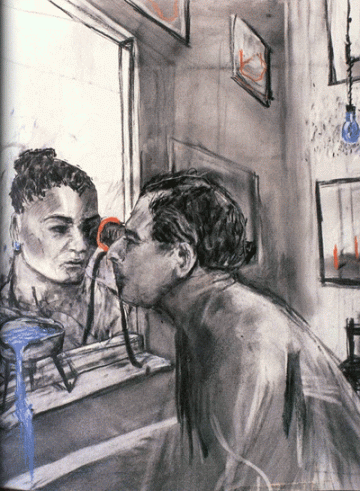
Kentridge became widely known in the 1990’s for his 9 Drawings for Projection (1989-2003), a series of richly evocative short animated films, made by drawing, erasing and redrawing large charcoal sketches on paper.  Originally shown one at a time in galleries in conjuction with exhibits of the final-stage charcoal drawings, the series of films hangs loosely together as a single ongoing story.  They tell of an industrialist, Soho Eckstein, his wife, and her lover, the bohemian Felix Teitlebaum, who is always depicted naked.  Eckstein and Teitlebaum are opposites in a way, but both recognizably resemble Kentridge.  The story in 9 Drawings plays out across the backdrop of the upheavals of South Africa in the late apartheid and early post-apartheid eras, but the films aren’t straightforwardly political.  Instead they’re personal and poetic.  The erasures and redrawing of the filmmaking technique, the transformations of the elemental and mechanical imagery, the ebb and flow of the lives of the characters, and the shifting sands of cultural change are all of a piece, an era of life experience distilled into a cinematic dream.  I get the impression that the transformations of the drawings are not preconceived, but exploratory.

Drawing from “Felix in Exile”, 1994, one of “9 Drawings for Projection” by William Kentridge

The museum show is arranged not chronologically or by media, but thematically.  The 9 Drawings and other films are projected at monumental size, with the real drawings, also quite large, nearby, allowing one to experience the images in both their forms, as mutable projections and as the tactile reality of smudgy charcoal on heavily worked paper.

Kentridge is an obsessive drawer and mark-maker.  One room in the MoMA show surrounds us with multiple projections showing him drawing, tearing paper, pouring ink, etc., often in reverse.  Other rooms are filled with projections, drawings and objects based around designs for his recent operatic productions, Mozart’s Magic Flute and Shostakovich’s The Nose.  There is almost too much to take in, a barrage of images and ideas, nearly all in bold black and white, with a rough, handmade texture.  Throughout the exhibit there are many recurring images, including water and bathing, mechanically walking figures, birds and  rhinoceroses, the industrialized landscape, Alfred Jarry’s corrupt king Ubu, and especially Kentridge’s own heavyset self-image.

Kentridge’s work is not colorful, and while it is bold, it is not simplistic.  It is gray and ambiguous and conflicted.   It draws upon the angular dynamism of early-20th-century avant-garde design, but the boldness is more than anything else the magnified theatrical gesture of the human form.  This is the closest contemporary work I know to the great etchings of Goya, the Caprichos and the Disasters of War.  For Kentridge the act of drawing is theatrical, improvisational and demonstrative, and theater is a graphic art where shadows and lines convey ideas and feelings.

Drawing for II Sole 24 Ore (World Walking), 2007, by William Kentridge; Charcoal, gouache, pastel, and colored pencil on paper, Marion Goodman Gallery

I’ll close with a quote from the Phaidon Monograph, William Kentridge, by Carolyn Christov-Bakargiev et al, that reveals something about his open-ended creative process:

“Drawing for me is about fluidity.  There may be a vague sense of what you’re going to draw but things occur during the process that may modify, consolidate or shed doubts on what you know.  So drawing is a testing of ideas; a slow-motion version of thought.  It does not arrive instantly like a photograph. The uncertain and imprecise way of constructing a drawing is sometimes a model of how to construct meaning.  What ends in clarity does not begin that way.”

Marina Abramovic:  The Artist Is Present, organized by Klaus Biesenbach, Chief Curator at Large, The Museum of Modern Art, and Director, P.S.1 Contemporary Art Center, is on view through May 31, 2010, at the Museum of Modern Art, New York.

William Kentridge:  Five Themes, originally organized for the San Francisco Museum of Modern Art and the Norton Museum of Art by Mark Rosenthal, is on view through May 17, 2010 at the Museum of Modern Art, New York.

Images in this post link back to the sites where I found them.

« Newer PostsOlder Posts »

Powered by WordPress

Theme Tweaker by Unreal