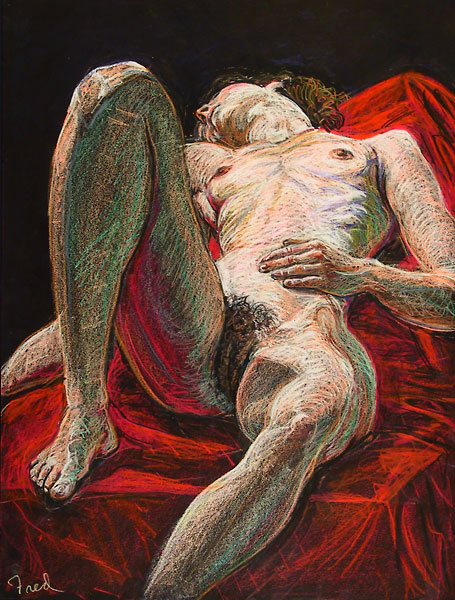
DRAWING LIFE by fred hatt

2011/01/12

Mixing in the Eye

Alley, 2009, by Fred Hatt

Most contemporary technologies of color image reproduction use optical mixing to obtain a full range of colors.  Four-color process printing, CRT, LCD and plasma displays, all reproduce a wide gamut of hues and values using tiny dots of ink or luminous pixels in just three or four colors.  The colors remain discrete in the image, and are only blended in the eye.  The illustration below shows a detail of a printed color picture, with inks of cyan, magenta, yellow and black in dots of variable size.  A color monitor performs a similar trick with glowing red, green and blue dots of variable brightness.

Image printed in four-color process, with detail showing halftone dots

The old masters who developed the craft of pictorial oil painting did not, as far as I know, ever consciously use the phenomenon of optical color mixing.  Most of them used some variation of the technique of grisaille, or painting in black and white (or sometimes in greens or earth tones), then adding color by applying thin transparent glazes over this monochrome foundation.  Jan Van Eyck is often considered the first master of this technique, and it’s still commonly used by painters who follow the classical methods.  Here are two versions of a painting by Jean Auguste Dominique Ingres, the first version in grisaille, and the second with color glazes applied.

Odalisque in Grisaille, 1824-34, by Jean Auguste Dominique Ingres

Grande Odalisque, 1814, by Jean Auguste Dominique Ingres

The great virtue of this method is to achieve a feeling of solidity and luminosity.  The grisaille painting allows for a sculptural rendition of values, and the white of the grisaille reflects all wavelengths of light, which are then subtly filtered by the glazes.  Light penetrates the transparent surface layer of the painting and reflects back to us from a deeper level, tinged as the setting sun or the distant mountain are tinged by the intervening atmosphere.

Directly mixing pigments on the palette or on the canvas, on the other hand, tends to give dull and flat colors.  Every opaque blend of two pigments has less brightness and less intensity of color than either of its components.  The natural mineral pigments available to painters before the industrial revolution were extremely limited, so the glazing technique was often the only way to achieve color that was both vivid and subtle in its gradations.

In the nineteenth century, several technological innovations led to a completely new approach to color in painting.  Photography quickly surpassed the painters in its ability to render monochromatic values.  This made painters strive to reproduce the more vibrant effects of color that photography still could not capture.  Modern industrial chemistry discovered new synthetic pigments that were both permanent and far more vivid than the classical artists’ pigments.  All those paints with chemical sounding names like alizarin and phthalocyanine are products of the new chemistry.  Pre-mixed paints in squeezable metal tubes were yet another nineteenth century development that made it much easier for an artist to leave the studio and study the colors of nature and the effects of light outdoors, or en plein air.

French Impressionism was the product of all these changes.  The old methods started to seem stodgy and lacking in spontaneity, and in any case were unsuited to plein air painting.  You can observe optical color mixing effects starting from the beginnings of the impressionist movement, as in this Renoir painting.

Bal au Moulin de la Galette, 1876, by Pierre-Auguste Renoir

In the detail below, you can see that the clothing and shadows on the ground are painted with various bright colors in close proximity, colors that do not correspond with the actual surface colors of the objects being depicted.  The overall impression of the colors in the painting is vibrant but not unnatural.

Bal au Moulin de la Galette, 1876, by Pierre-Auguste Renoir, detail

Monet painted haystacks in a field and the facade of Rouen Cathedral over and over again, trying to capture the ever-changing subtleties of light and air.  [Both links in the preceding sentence are well worth a click!]  Here the haystack contains dabs of red, olive, lavender, violet and black.

Grainstack (Sunset), 1890-91, by Claude Monet

Artists such as Edgar Degas and Mary Cassatt used optical mixes of odd colors like greens and purples to depict flesh tones.

Lydia Leaning on her Arms, Seated in a Loge, 1879, by Mary Cassatt

George Seurat studied the science of color perception, and developed an analytical approach to painting with optically mixing colors.  He called his method chromoluminarism, though it’s better known today as pointillism, a word originally coined by critics.  Here’s one of his mural-scale canvases, followed by a detail of a face in profile, showing the discrete dots of color.

La Parade du Cirque (Invitation to the Sideshow), 1889, by George Seurat

La Parade du Cirque (Invitation to the Sideshow), 1889, by George Seurat, detail

What Seurat does with analytical coolness, Vincent van Gogh does with fiery intensity.

Sower with Setting Sun, 1888, by Vincent van Gogh

Optical mixing of colors also interested abstract expressionists such as Joan Mitchell.

Weeds, 1976, by Joan Mitchell

Chuck Close is the heir to Seurat’s analytical approach, as in this monumental self-portrait.

Self Portrait, 1997, by Chuck Close

Self Portrait, 1997, by Chuck Close, detail

For my own work in color, I usually use aquarelle crayons on toothy charcoal paper.  The crayons deposit bits of pigmented wax on the ridges of the paper.  Going over an area with more than one color leaves the markings separate, and the colors mix optically.  Here’s a detail of the portrait of Alley featured at the top of this post.  You can see that the flesh tones are made up of strokes of blue gray, pink, yellow, light blue, reddish brown and white, on a neutral gray paper.  The technique is particularly effective at depicting reflected light in shadow areas.

Alley, 2009, by Fred Hatt, detail

Here’s a quicker figure sketch, followed by an enlarged detail.  Here the colors making up the flesh tones include turquoise, orange, fuschia, and yellow.

Maira Horizontal, 2010, by Fred Hatt

Maira Horizontal, 2010, by Fred Hatt, detail

Mixing colors in the eye, rather than on the palette, produces color impressions that are bright and shimmery, that suggest not only the effects of light but the slippery nature of flesh tones.  The actual colors of living human skin are subtle to the point of elusiveness.  Skin is translucent, imbued with underlying colors of blood and fat.  Its surface is nearly iridescent, and reflects and refracts the colors of surrounding objects and lights.  Flat colors cannot capture this subtlety.  Grisaille and glazing can, and so can optical mixing, in a very different way.

All the images in this post, besides those of my own work, were found on the web.  Clicking on the pictures will take you to their source pages, and in many cases, to larger versions of the images.

2010/11/22

Flanking Figures

Filed under: Art History,Collections of Images — Tags: , , , , , — fred @ 17:06

Far Side of the Moon with Flanking Figures, 2010, by Fred Hatt

I made these two large reclining nudes, each one 48″ x 30″, with the idea that they would be flanking figures, a human frame for some significant object or image.  They could be on either side of a mirror or a portrait or a proscenium stage.  They could be facing center or away from center.  For me these figures have a lunar quality, so here I have used them to bracket an image of the far side of the moon.

[Tangent:  The far side of the moon was a complete mystery before the era of space flight, as the moon always turns the same face towards Earth, and of course people imagined that it hid alien civilizations or other exotic marvels.  Even now this distant hemisphere is unfamiliar to most of us.  The far side of the moon is mountainous and heavily pocked with craters, and lacks the great “seas” or mare that give the near face the dark patches that we see as the man in the moon, the rabbit, or whatever it is supposed to resemble.  The face that is turned away can be a symbol of the unseen aspect of things.  Here is an interactive map of both sides of the moon, and here’s the source for the moon map used in the illustration at the top of this post.]

Allegorical flanking figures of this sort are a fusty old iconographic tradition.  The ones I had in mind were the figures of Dawn and Dusk on the tomb of Lorenzo de’ Medici, in the Medici Chapel in the Basilica of San Lorenzo in Florence, designed and sculpted by Michelangelo.  The chapel also features a similar idealized portrait of Giuliano de’ Medici, accompanied by figures called Night and Day.  These nudes, named as embodiments of cycles of nature and shown reclining at the feet of the enthroned noblemen, exalt their central figures by portraying them as masters over Nature itself.  Those Medicis were as self-aggrandizing as Trump!

Tomb of Lorenzo de' Medici, c. 1530, by Michelangelo

This kind of arrangement of human images embodying abstract concepts became a standard trope in public art.  Here are the figures over the entrance to the Old Bailey, the Central Criminal Court in London, by sculptor F.W. Pomeroy.  In the middle is the Recording Angel, lurking under a hood and looking far more intimidating than most of the court stenographers I’ve seen.  On the left is Fortitude, with a sword, and on the right, Truth, with a mirror.

Allegorical Figures, Old Bailey Central Criminal Court, London, 1907, sculptures by F. W. Pomeroy

Allegorical flanking figures became such a cliché in the depiction of official power that they are a frequent feature of the engraved headings of stock certificates, such as this one for Shell Oil, Inc.

Shell Oil Company stock certificate engraving, 1975

The tradition probably originates with Medieval Heraldry.  A coat of arms often shows a shield with symbolic emblems or colors, held up on either side by what some cultures would call power animals, such as Great Britain’s lion and unicorn.  Here’s a lovely new variation on the theme, the official coat of arms of Nunavut, the Inuit province of Northern Canada.  The symbolic animals are the caribou and the narwhal.

Coat of Arms of the Province of Nunavut, Canada

Christian religious painting also frequently includes figures flanking a central personage.  The sidekicks may be angels, saints, or the donor who funded the artwork.  It naturally occurs in crucifixions, in which Jesus is often shown between the two crucified thieves, as in this Mantegna painting.

Crucifixion, 1459, by Andrea Mantegna

Raphael omitted the thieves, but framed Jesus between two angels, representations of the sun and moon, and one kneeling and one standing figure on each side.  Clearly the idea here is to convey the centrality of the Christ.

Crucifixion, 1503. by Raphael

I can’t tell you why I was drawn to such a thoroughly old-fashioned figurative motif.  I suppose applying my loose and energetic style to neoclassical subject matter seemed an interesting variation on improvised compositions and experimental process.  Here are some closer looks at these two drawings.  The models are Yuko and Jeremiah.  Let me know if you have anything that needs to be exalted by being displayed in between allegorical figures!

Waning Moon, 2009, by Fred Hatt

Waxing Moon, 2010, by Fred Hatt

My works shown here are aquarelle drawings on black paper, each 48″ high by 30″ wide.  All the other images were found on the web, and clicking on the images will take you to the sites where I found them.

2010/10/28

Finishing Touches

Dreamer, 2010, by Fred Hatt

Here’s one of my recent works of a type I call chaos compositions.  These are large-scale drawings, four by five feet (122 x 152 cm) and up, made with aquarelle crayons on black paper or canvas.  These combine multiple sketches of the same model in different poses, overlapped willy-nilly without preconceived design.  I basically keep adding drawings to the same paper until it starts threatening to be an indecipherable mess, and then struggle to reveal the beauty in the wondrous complexity that results.

Part of what I’m going for here is to create images that demand of their viewers a kind of looking that is completely different from our default response to pictures.  When we look at a picture, we tend to see it all at once.  We immediately recognize its imitation or simulation of our visual experience of the world, and relate to it through the reality or fantasy that it illustrates for us.  Deeper looking may involve noticing telling details or observing how an idiosyncratic style communicates the subjectivity of the visual experience.  But it is the immediate and unified visual experience that captures our attention and imagination.

A piece of pure abstract expressionism deliberately foregoes these illusionistic charms, but still, it tends to hit us all at once.  We take it in as an overall composition of textures and colors and shapes that express something directly through their energy or their physical properties.

With these chaos compositions, the first glance is a hit of the abstract kind.  We see a busy field of colors and lines, and maybe we get a feeling of swirliness or jaggedness.  It is far too jumbled to be interpreted as a picture, though we cannot fail to see that the elements of the composition are human figures.  Some are more developed and others more sketchy, some are clear and bold while others are almost lost in the density.  Abstraction and figuration coexist here in a state of virtual tensegrity.

Most (not all) of the figures in these drawings are complete figures, but to see a figure in its entirety requires starting with its more obvious features and carefully tracing areas of color or line that may be woven in with several other figure drawings occupying the same plane.  If the viewer is sufficiently captured by the drawing to try to unravel it in this way, he or she has been drawn into a way of looking that is far more actively engaged than the receptive mode demanded by most pictures.

Kuan, a dancer/choreographer and model who recently posed for one of these chaos compositions (not shown here because not yet finished), observed that these drawings are like maps of cities.  There are different neighborhoods of varying character, all woven together by lines of movement.  You can look at the map and get a kind of overview, but the only way to really explore the city is to follow the lines, to move about within it, experiencing the distinctive pockets of a particular character and the transitional areas where multiple characters may coexist.

In previous posts on this blog, I’ve shown the progressive building-up of one of these pictures, or I’ve shown how the original figure drawings can be recovered by carefully studying the finished work.  I’ve looked at this work as it relates to my earliest creative impulses to express movement through line.  Many other examples of chaos compositions can be found in this gallery on my portfolio site, and related work can be seen in any of my posts tagged “movement drawing“.

Those posts should give you a good idea of the process behind these works.  Here, I’m going to focus on the final stage of development of three recent chaos compositions, looking at the finishing touches whereby I try to discover the composition residing in the chaos.  Here below is what “Dreamer”, the drawing shown at the top of this post, looked like at the conclusion of my session working with the model, Izaskun, before finishing work:

Dreamer, 2010, by Fred Hatt, early state

The finished version shown at the top of the post has been developed by a couple of hours of work in the studio, without the model present.  If you scroll up and back down to compare the two versions, you can see that the early state immediately above this paragraph contains virtually all of the figurative elements that are in the finished version.  You may be surprised by how little has really been added to the drawing to finish it.  But I think you’ll agree that the final version has a richness, a “snap”, and a dimensional quality that aren’t there yet in the early state.

Unfortunately, these large drawings lose a lot of their impact in such small reproductions.  (I’d love to have a show of these pieces in a gallery large enough to host a collection of them, but I don’t have anything lined up at this time.  Any gallery referrals are welcomed!)  Let’s look at a detail of “Dreamer”, in before and after versions:

Dreamer, 2010, by Fred Hatt, early state, detail

Dreamer, 2010, by Fred Hatt, final version, detail

Part of what I’ve done is simply to color in background areas to help separate the figures from the overall black field.  I’ve also paid particular attention to the faces.  I find the faces work as powerful focal points in these pieces.  The face in the upper right quadrant of this detail has had its warm tones complemented by cool tones.  The distorted face of the foreshortened figure in white, here in the upper center, has been proportionally corrected, which also allowed me to clarify the red-lined face just to the left of it.  The faces in the lower left quadrant have also been sharpened or developed.

Here’s another chaos composition, “Hero”, shown as it was just after my session with model Jeremiah, and then as finished:

Hero, 2010, by Fred Hatt, early state

Hero, 2010, by Fred Hatt

Again, let’s look at a detail view, the better to see some of the finishing touches:

Hero, 2010, by Fred Hatt, early state, detail

Hero, 2010, by Fred Hatt, final version, detail

In this segment of “Hero”, nearly all of the final development is focused on the background.  Color in the background clarifies both the figures and the overall structure while allowing the figures to remain close to their original form as raw, quick line drawings.  The standing figure near the right hand side of this detail has been filled in with yellow, and a figure just above the eyebrows of the large face on the left side of the detail has been restored from almost complete obscurity to just near obscurity, by tracing its lines in a lighter color.

Here’s our third and final example, “Sole”.  The model here is Madelyn.  First, the whole piece in two states:

Sole, 2010, by Fred Hatt, early state

Sole, 2010, by Fred Hatt

This piece started with the large feet, drawn to nearly fill the space of the drawing.  The full figures were then layered over and around the feet.  For me the soles of the feet represent the human connection to the earth, our grounding.  (A similar oversized sketch of feet, without the overlapping figures, can be seen here.)

Compared to the other two chaos compositions featured above, “Sole” has more of the feeling of a landscape.  The figures are, if anything, even more hidden, and the background elements, especially at the top and bottom, have been filled in with more detail and texture.  Here are our before and after detail views:

Sole, 2010, by Fred Hatt, early state, detail

Sole, 2010, by Fred Hatt, final version, detail

The in-between black spaces have been filled in with snaky and leafy patterns.  The arch-backed figure in the lower part of the detail has been made more dimensional by the addition of a network of cross-contour lines.  Both linear faces in the upper half of the detail have been sharpened with black and red and white lines.  The toes of both of the underlying giant feet, which had become obscured beneath the figures drawn over them, have been brought out by the addition of red outlines.

In finishing these drawings, I am cautious not to overdevelop the figures that result from my initial work direct from the live model.  I feel that the drawings made by direct observation have an energy that is rarely enhanced by further finishing, even if the figures are very rough or distorted.  The finishing work is often largely focused on the gaps between the figures.  Developing a background helps to push the figures into the foreground, giving them a feeling of depth and separating pieces that would otherwise be lost in the general tangle.

All three of the drawings featured in this post are 48″ x 60″, aquarelle crayon on paper.

2010/10/07

Nudes with Projections

Nox, 1996, by Fred Hatt

Some readers have expressed an interest in seeing more of my early figurative drawings, and more of my more “finished” work, so here’s a post drawn from the early years of my intensive practice of life drawing.

In 1996 I had been practicing life drawing regularly at New York’s Spring Studio for two years.  Minerva Durham, the artist and teacher who founded the studio, asked me to be the monitor (overseer, proctor, invigilator) of a regular once-a-week three hour long pose figure drawing class.  I had to show up every week at the same time, whether I felt like it or not, and take responsibility for the smooth operation of the session.  There was no pay, but I got to draw for free.

I had been developing a technique of color drawing with crayons on dark-toned paper, trying to get much of the richness of painting with the speed and spontaneity of drawing.  For me, three hours was a long time, and  my greatest challenge was to sustain the focus for such a protracted period.  (I can hear the oil painters laughing!  The egg tempera painters just sigh disdainfully.)

Creating a satisfying composition within three hours soon proved to provide plenty of diversion for my short attention span.  Of course the study of the human body and how to render its form and expression is the first task, but if you spend the whole time on that you end up with a figure floating in a void.  In reality, the body exists in an environment, with gravity and light and spatial relationships.  The actual setting of the model in the studio, though, is cluttered and distracting.

I really had no interest in placing my models into fake nature, mythological forests or imaginary harems.  A more abstract treatment of the background seemed the most promising approach.

I had been attracted to drawing more than to painting partly because I was interested in the direct expressiveness of the artist’s marks.  In a painting, these marks tend to get blended and obscured, whereas in a drawing they remain more visible.  Of course, now that I was developing my figures over several hours, striving towards an illusion of reality, as my drawings were becoming more polished, the process of the drawing was becoming more obscured.  So it struck me that I could use the background to reveal some of the process of abstract analysis that the artist goes through on the way to even the most photographic rendering.

Web, 1996, by Fred Hatt

I always figure out a pose partly by tracing angular relationships between different parts.  There’s a line from the knee to the shoulder, a line from the left nipple to the navel and another from the nipple to the notch of the collarbone, and on and on.  Every landmark of the figure has an angular relationship to every other landmark.  In the figure above the original markings that were made in constructing the figure were darkened and extended, creating a web of relationships in which the figure is suspended.

Pensée, 1997, by Fred Hatt

That approach proved fruitful.  What began as a study of internal relationships vanished from the drawing of the body as its light, shadow and color was developed, but then reappeared in the space surrounding the body.  The internal structure manifested in its spatial container.

Gem, 1997, by Fred Hatt

Sometimes the lines were more delicately indicated by their points of intersection.

Filament, 1998, by Fred Hatt

I tried to show the body itself as close as possible to what I actually saw, and to use the surrounding space to show its hidden geometry.

Throne, 1998, by Fred Hatt

At times the treatment could be more subtle, suggesting not so much hard geometrical structure, but a field of energy.

Space, 1998, by Fred Hatt

The pose below has a particularly clear simple triangular structure, so the projected lines show the sub-triangles that give it facets.

Pyramid, 1998, by Fred Hatt

The body can be projected in curves rather than straight lines.  Shadows, furniture and objects, and folds of fabric also create a linear environment in which the figure is embedded.

Rings, 1998, by Fred Hatt

Miha, 1998, by Fred Hatt

The figure below was perched symmetrically on a stool.  I didn’t bother to draw the stool, but instead traced a stack of horizontal markers that define the proportions of this pose:  ankles, knees, hipbones, breasts, shoulders, eyes and ears.

Pagoda, 1998, by Fred Hatt

The angles of the figure imply a crystalline structure that defines the person’s energetic being in geometrical terms.

Start, 1998, by Fred Hatt

Every being is an organic manifestation of a web of relationships.

Ombre, 1998, by Fred Hatt

Action is structure.

Bagua, 1998, by Fred Hatt

The engagement of a person with their environment is an organic flow, at least as complex as the internal flow that sustains the life of the individual.

Oeil, 1998, by Fred Hatt

All of these drawings are aquarelle on paper, around 18″ x 24″ or a bit bigger.  More selections of my work from this period can be seen at the portfolio I put online in 2000, as well as in several posts on this blog.

2010/09/26

End-On: Extreme Foreshortening

Filed under: Figure Drawing: Poses,Top Ten — Tags: , , , , , — fred @ 23:18

Dynamo, 2010, by Fred Hatt

My friend, model/muse and blogging mentor Claudia likes to post photos of herself to celebrate the anniversaries (first, second, third) of the launching of her great blog, Museworthy, and it has been my honor to be the chosen photographer each year so far.  This year we were seeking a new approach.  Claudia had the idea of getting in low and close with the camera, treating the body as a landscape.  She chose this sensual abstraction for this year’s anniversary post.

I love seeing the body this way.  Unusual angles create perspective effects and unfamiliar juxtapositions, and utterly transform the familiar forms of the body.  Foreshortening is a fundamental concept in drawing, designating the distortion of long shapes when seen end-on.  Often, in figure drawing, this refers only to an arm or leg that appears pointed toward the viewer of the image.  A familiar example would be the pointing finger and arm of Uncle Sam in James Montgomery Flagg’s iconic army recruiting poster of 1917.  Here I post examples of my figure drawings in which not only the extremities but the entire body is seen from a foreshortened perspective.

Looking at the body from an angle close to the central axis is very helpful in understanding it as a three dimensional form.  In these foreshortened torsos, we see the protuberances of the iliac spine of the pelvis rising to either side of the pubic bone.  The abdomen is a saddle-like shape, concave in one direction and convex in the other.  The ribcage is a converging arch.  The pectoral or breast muscles show a continuity with the deltoid muscles of the shoulder.  The upper of these drawings still shows analytical lines I drew to figure out the angular relationships of bodily landmarks.

Surveyed, 2004, by Fred Hatt

Thorax, 2009, by Fred Hatt

Looking at the body from the head end shows a succession of rounded or symmetrically swelling forms:  the top of the skull, then the cheekbones and nose, the jaw, the collarbone, the shoulders, the chest, the ribs, the abdomen and pelvis.  You can see it as a kind of architecture based on a series of differently shaped arches that you pass through or over, or as a landscape of hills and valleys that you can traverse on a meandering trail.  From this angle the legs and feet are often severely forshortened, and are best observed in relation to the cross-sectional contours of the torso.

Lounging, 2000, by Fred Hatt

Head End 2, 2006, by Fred Hatt

Head End, 2006, by Fred Hatt

I try to see organic physical forms as manifestations of patterns of energy.  In looking down the length of the body, you can see each of these levels as manifestations of the elemental forces associated with the chakras, a series of focal points arranged along the central column of the body in a Yogic conception of energy anatomy.  For example, the pelvis, corresponding to the water element, has the form of a basin, while the chest, corresponding with the air element, has the form of a bellows.  Here are a few sketches from a series exploring the energy patterns of the body in this context:

Strata, 2002, by Fred Hatt

Flat, 2002, by Fred Hatt

Zones 1, 2002, by Fred Hatt

To see the body in extreme foreshortening, I find it helpful to look at it not in terms of an understanding of structural relationships and proportions, but cross-sectionally, as a series of transverse contours receding in space.  The National Library of Medicine’s Visible Human Project, a three-dimensional atlas of human anatomy, has a website that offers animated “fly-throughs” of the human body in the various planes of sectioning.  Here’s the transverse section animation, the one most relevant to these end-on views of the human body.

Here are some more of my compositions of the body in extreme foreshortening:

Crossed Ankles, 2004, by Fred Hatt

Nuit, 1999, by Fred Hatt

The examples above are drawn from a distance of at least three meters and so show a sort of compressed perspective.  The feet and head are roughly in the same proportional scale but the angle of view has caused things to be seen in unfamiliar juxtaposition.  The drawing below is drawn from much closer, so it shows more perspectival diminution.  The feet and legs, closer to me, are large in comparison to the upper body and head, which are further away.  The length of the foot, measured on the drawing, is more than twice the width of the skull, but it looks right because it represents the perception of perspective.

Perspective, 2010, by Fred Hatt

In this foot-end view, the angles of the feet and legs are the foreground of the drawing, while the upper body becomes the mountain on the horizon.

Side Drawn Up, 2001, by Fred Hatt

Prone Reach, 2006, by Fred Hatt

Splay, 1999, by Fred Hatt

When the head is the foreground element, it remains abstract as we are looking at the top of the skull, and the face, if seen, is highly abstracted.  The body is even more landscape-like seen from the head end.

Climber, 2006, by Fred Hatt

In the drawing below, the blue line in the background is the “horizon”, or edge of the floor on which the model was lying.  The body formed a tilted rectangular form, so I tilted my drawing board to maximize usage of the page.

Tilted Horizon, 2001, by Fred Hatt

Sometimes these end-on views become visions of pure organic form.

Prone Twist, 2009, by Fred Hatt

The twisting of the body, as seen in the example above, also creates interesting sculptural forms seen from the foot end.

Corner, 2010, by Fred Hatt

Here the legs go one direction and the head the opposite, with the hand and arm reflecting that arc of movement.

Helix, 2001, by Fred Hatt

Here the position of the legs gives a soft curve to one side of the figure and a sharp angle to the other.

Bow and Arrow, 2000, by Fred Hatt

When the body is visually compressed by foreshortening, an upraised knee becomes dramatically long and vertical by contrast.

Wrist to Knee, 2008, by Fred Hatt

Angular Recline, 1998, by Fred Hatt

In the drawing below, the use of a mirror gives a view of the same pose from both the head end and the foot end.

Mira, 1996, by Fred Hatt

I’ll close this collection with a more finished piece, a foreshortened figure of graceful serenity.

Tranquility, 2008, by Fred Hatt

All the drawings in this post are aquarelle crayon on paper, in the size range of 18″ x 24″ to 20″ x 30″.  Other examples of foreshortened figures can be seen in this post and this one, and there are many others scattered through my portfolio site and other figure drawing posts on this blog.  This post features a famous 15th century foreshortened figure painting by Andrea Mantegna.

If you’re a student of drawing, you might be interested in a new series of articles on learning the basics of drawing that has begun appearing in the Opinion pages of the New York Times online edition, under the title “Line by Line” by James McMullan.

« Newer PostsOlder Posts »

Powered by WordPress

Theme Tweaker by Unreal