DRAWING LIFE by fred hatt

2010/05/04

We See Differently

Filed under: My Events: Exhibitions — Tags: , , , , , — fred @ 22:52
Poster for “We See Differently” exhibit at CUNY Lehman

If you’ve attended an open life drawing session, not a class where an instructor is steering everyone down a similar path but a practice session for artists of all levels, you’ve probably had the experience of walking around the room on the breaks and noticing how very differently different artists are responding to the same subject.  Everyone is seeing basically the same thing, but one will have bold hard slashing lines and another gentle clouds of color, in one the model will appear serene while in another he looks angry, one will look like a study of classical sculpture and another like an acid hallucination.  It’s a dramatic demonstration of the power of representational art to reveal not just the subject, but the subjectivity of the artist.

Artist Daniel Galas, currently in a graduate program at CUNY’s Lehman College in the Bronx, has curated an exhibit based on that idea.  He organized a free life drawing session, two days with the same model in the same pose, and invited a variety of artists to come to the session and submit their results for a show.  The participants include Lehman art students and artists Daniel met at Spring Studio in Manhattan – the latter category includes me.

The model, Tedra, took a classic angular seated pose, with lighting from both sides and an Indian batik cloth as a backdrop.  Here’s my first of four sketches from the session:

"We See Differently" #1, 2010, drawing by Fred Hatt

In the following example, Lenward Snead captured Tedra’s strong face in profile:

"We See Differently", 2010, drawing by Lenward Snead

Ray Rosario focused on the angular structure of the arms and shoulders and let the face merge into a cloud of light that defines an inky shadow around the body:

"We See Differently", 2010, by Ray Rosario

I got to know Kimchi Kim back in the 1990’s, when she was a regular at my movement drawing sessions.  She’s a specialist in loose and lively gestural figures.  Kim made multiple studies of the model’s feet, curving in opposite directions like the fishlike forms in the Taegeuk or yin-yang diagram.  Kimchi Kim has a solo show opening this month at Spring Studio.

"We See Differently", 2010, by Kimchi Kim

James Horner is an artist and writes about art for the examiner website and his own blog.  I believe the linear shapes in his abstract painting are derived from the model’s pose, but he certainly didn’t feel constrained to restrict himself to a physical depiction!  Nonetheless, the colors and forms here make me feel happy.

"We See Differently", 2010, by James Horner

Daniel Galas, the organizer of the session and its exhibit, was an abstract painter doing cathartic expressions of inner states until he began to feel the need for an external focus in his work, which led him to take up the classic themes of landscape and portrait.  His portraits all feature a certain controlled distortion, but powerfully capture the individuality of his sitters.  They also show a fascination with the textural specifics of pores and blemishes.  Daniel cites El Greco as an inspiration.  To me, his work also evokes the cockeyed psychological realism of Alice Neel.  Here is Daniel’s very large-scale charcoal portrait of Tedra:

"We See Differently", 2010, by Daniel Galas

I did a big face drawing too.  It’s interesting to compare these two larger-than-life heads.  To my eye, Daniel’s head of Tedra has the stony grandeur of an Easter Island moai, whereas mine has a much softer, maybe sad quality.  Notice the difference in the size of the eyes relative to the head.

"We See Differently" #2, 2010, by Fred Hatt

These and many other visions from the same life drawing session will be on view in “We See Differently” in the basement gallery of the Fine Arts Building at CUNY Lehman, 250 Bedford Park Boulevard West in the Bronx.  The opening reception is on Thursday, May 13, 2010, at 5 pm, and the show will remain on view through the Summer.

2010/03/23

Drawing as Theater / Presence as Provocation: Kentridge and Abramovic at MoMA

Rest Energy, photo of a 1980 performance by Marina Abramovic and Ulay, photo from Galleria Lia Rumma

The Museum of Modern Art in New York currently hosts retrospectives of two idiosyncratic and uncompromising living artists, Yugoslavian born Marina Abramovic and South African William Kentridge.  The two artists could hardly be more different from each other, but each has followed the path of art as something deeply personal and necessary.

Marina Abramovic emerged as a performance artist in the 1970’s.  Using her own body as her medium, she explored the power of living presence in ritual acts of vulnerability and endurance.  Her earliest works were so raw and risky they still shock – for example, in Rhythm 2 (1974), she took drugs that caused seizures, convulsions and catatonia.  But then in the 70’s everyone was experimenting with drugs – she just did it in front of an audience.

In 1976 she began a twelve year collaboration with Ulay (Uwe Laysiepen).  The work they did together achieved a kind of spiritual and aesthetic clarity that has not been surpassed, even as this kind of work has entered the mainstream with David Blaine‘s well-publicized acts of endurance.  In “Rest Energy”, pictured at the top of the post, Abramovic and Ulay lean apart, their weight suspended by the tension of a bowstring with an arrow aimed at Abramovic’s heart.

Abramovic and Ulay traveled continuously, living in an old Citroen van (the van is in the MoMA exhibit), fully devoting their lives to their artistic experiment.  A statement they wrote at the time (1975) reads:

ART VITAL

no fixed living-place
permanent movement
direct contact
local relation
self-selection
passing limitations
taking risks
mobile energy
no rehearsals
no predicted end
no repetition
extended vulnerability
exposure to chance
primary reactions

Abramovic and Ulay parted ways in 1988.  Much of Abramovic’s solo work from the 90’s looks to me more strident and more self-conscious about making “statements”, but in her most recent work she seems to be rediscovering the power of simplicity.

The Abramovic retrospective at MoMA includes documentation of a great many of these performances that tested the limits of the mind and body and the relationship between artist and audience.  It also includes living “reperformers”, re-enacting several of the most well-known actions.  The one that has been most widely discussed is Imponderabilia, originally performed by Abramovic and Ulay in 1977.  A naked male and female stand impassively facing each other in a narrow doorway, through which museumgoers may pass only by squeezing sideways between the pair.

Abramovic has long argued that performance art must be kept alive by reperformance, and in her 2005 show at the Guggenheim Museum she herself reperformed a number of seminal performance works originally done decades ago by such artists as Joseph Beuys and Valie Export.  It is undeniable that the MoMA show is more interesting with live bodies interspersed among the old documentation, but the change of context has surely altered the effect of the pieces.  It is not just that what were once radical experiments are now enshrined in the most institutional of museums.  The original pieces were radically minimalist – highly clarified simple happenings in isolation, usually presented in blank gallery spaces.  The MoMA exhibit is like a crowded menagerie of acts and images, with a steady flow of tourists trying to see it all before their feet give out or the kids start crying or they have to meet someone for dinner.

The title of the Abramovic show at MoMA is The Artist Is Present, and it is with her own simple presence that she makes the strongest statement and the deepest impression in this show.  In the great atrium of the Museum, throughout the public hours while her exhibit is open, the 63-year-old artist sits silently at a table, while museumgoers are invited to sit directly across from her.  She sits all day, and will do so for 77 days.  This is about as radically minimal as performance can get.  She is not doing anything sensational, really not doing anything at all.  But if you’ve tried to sit still for even an hour you know it becomes incredibly grueling.  You can often see the pain in her face as she holds steady eye contact with an endless stream of museum visitors, some of whom sit for moments, and some for hours.  It is an act of extreme endurance, but also, in a way, an act of extreme generosity, giving herself to her audience in direct human presence.  Observe for a while and you’ll see suffering, defiance, confrontation, resignation, engagement, boredom and bliss – the full range of the human condition living and breathing there before us.  Amazingly, her simple presence fills up the gigantic atrium space more than any of the monumental pieces of art I’ve seen there over the years.

On the opening day, her former collaborator, Ulay, showed up at the table for an unexpected tearful reunion:

Ulay and Marina Abramovic, March, 2010, photo by Scott Rudd for MoMA

Just off the Atrium is the entrance to another immersive exhibit, William Kentridge:  Five Themes.  Timed to coincide with Kentridge’s multimedia staging of Shostakovich’s opera The Nose (based on Nikolai Gogol’s short story) at the Metropolitan Opera, this retrospective shows Kentridge’s drawings, prints, animated films, theatrical designs, optical experiments and even animatronic puppets as a diverse but highly unified body of work that spans media and obliterates the traditional line dividing graphic art and theatrical storytelling.

Kentridge became widely known in the 1990’s for his 9 Drawings for Projection (1989-2003), a series of richly evocative short animated films, made by drawing, erasing and redrawing large charcoal sketches on paper.  Originally shown one at a time in galleries in conjuction with exhibits of the final-stage charcoal drawings, the series of films hangs loosely together as a single ongoing story.  They tell of an industrialist, Soho Eckstein, his wife, and her lover, the bohemian Felix Teitlebaum, who is always depicted naked.  Eckstein and Teitlebaum are opposites in a way, but both recognizably resemble Kentridge.  The story in 9 Drawings plays out across the backdrop of the upheavals of South Africa in the late apartheid and early post-apartheid eras, but the films aren’t straightforwardly political.  Instead they’re personal and poetic.  The erasures and redrawing of the filmmaking technique, the transformations of the elemental and mechanical imagery, the ebb and flow of the lives of the characters, and the shifting sands of cultural change are all of a piece, an era of life experience distilled into a cinematic dream.  I get the impression that the transformations of the drawings are not preconceived, but exploratory.
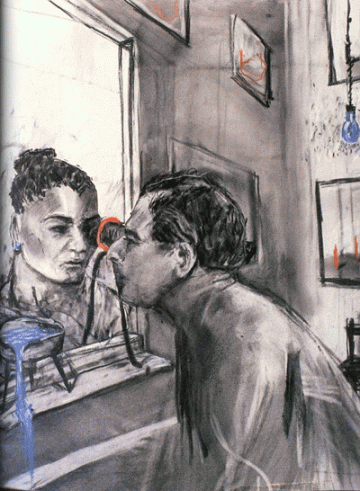
Drawing from “Felix in Exile”, 1994, one of “9 Drawings for Projection” by William Kentridge

The museum show is arranged not chronologically or by media, but thematically.  The 9 Drawings and other films are projected at monumental size, with the real drawings, also quite large, nearby, allowing one to experience the images in both their forms, as mutable projections and as the tactile reality of smudgy charcoal on heavily worked paper.

Kentridge is an obsessive drawer and mark-maker.  One room in the MoMA show surrounds us with multiple projections showing him drawing, tearing paper, pouring ink, etc., often in reverse.  Other rooms are filled with projections, drawings and objects based around designs for his recent operatic productions, Mozart’s Magic Flute and Shostakovich’s The Nose.  There is almost too much to take in, a barrage of images and ideas, nearly all in bold black and white, with a rough, handmade texture.  Throughout the exhibit there are many recurring images, including water and bathing, mechanically walking figures, birds and  rhinoceroses, the industrialized landscape, Alfred Jarry’s corrupt king Ubu, and especially Kentridge’s own heavyset self-image.

Kentridge’s work is not colorful, and while it is bold, it is not simplistic.  It is gray and ambiguous and conflicted.   It draws upon the angular dynamism of early-20th-century avant-garde design, but the boldness is more than anything else the magnified theatrical gesture of the human form.  This is the closest contemporary work I know to the great etchings of Goya, the Caprichos and the Disasters of War.  For Kentridge the act of drawing is theatrical, improvisational and demonstrative, and theater is a graphic art where shadows and lines convey ideas and feelings.

Drawing for II Sole 24 Ore (World Walking), 2007, by William Kentridge; Charcoal, gouache, pastel, and colored pencil on paper, Marion Goodman Gallery

I’ll close with a quote from the Phaidon Monograph, William Kentridge, by Carolyn Christov-Bakargiev et al, that reveals something about his open-ended creative process:

“Drawing for me is about fluidity.  There may be a vague sense of what you’re going to draw but things occur during the process that may modify, consolidate or shed doubts on what you know.  So drawing is a testing of ideas; a slow-motion version of thought.  It does not arrive instantly like a photograph. The uncertain and imprecise way of constructing a drawing is sometimes a model of how to construct meaning.  What ends in clarity does not begin that way.”

Marina Abramovic:  The Artist Is Present, organized by Klaus Biesenbach, Chief Curator at Large, The Museum of Modern Art, and Director, P.S.1 Contemporary Art Center, is on view through May 31, 2010, at the Museum of Modern Art, New York.

William Kentridge:  Five Themes, originally organized for the San Francisco Museum of Modern Art and the Norton Museum of Art by Mark Rosenthal, is on view through May 17, 2010 at the Museum of Modern Art, New York.

Images in this post link back to the sites where I found them.

2010/02/12

Events

Blacklight body art at a party at Collective Unconscious, NYC, 1999, bodypaint and photo by Fred Hatt

I’m involved with several events over the next few days.  Click on “Calendar” for details.

Sunday the 14th:  Opening for Spring Studio 18th Anniversary Show, featuring hundreds of artists.  Spring Studio, NYC, starts 6:30.

Sunday the 14th:  Blacklight Body Painting Dance Party at St. George Healing Arts, Staten Island, 6 pm on, donation suggested.

Tuesday the 16th:  KAMI, live music by Gregory Reynolds and butoh dance by Mariko Endo with video and light by Fred Hatt, part of a multi-media program also featuring Ben Miller and Orin Buck, at the Gershwin Hotel, NYC, 8 pm, $10.

Monday the 22nd:  New choreography by Jung Woong Kim, featuring special light effects by Fred Hatt, at Movement Research at Judson Church, NYC, 8 pm, free.

2009/12/30

Release

Images from "Glossolalia + Katharsis", 1989, multimedia show produced by Fred Hatt

The tradition of the wild party for New Years probably has something to do with the idea of catharsis, an explosive releasing of pent-up emotion through acting out.  We want to exhaust the frustration, regrets and resentments of the ending year by burning off the lingering energy to awaken to a fresh new day.  Of course in real life it doesn’t work, and waking up to a hangover in no way feels like a clean beginning.  But perhaps an artistic experience can give a taste of liberating paroxysm.  In this spirit I present this little two minute primal scream made twenty years ago.

Excerpts from Glossolalia + Katharsis from Fred Hatt on Vimeo.

There’s a good story behind the making of this film.  One of my housemates at the time, Mike Montgomery (now known as the lounge singer Monty Banks) was planning a tour of the Fringe Theater Festivals in Canada with Buck Duke’s Wild Sex Show, a potpourri of dirty jokes, puppets, magic tricks and R&B music with audience participation.  To attract media attention, Mike planned to stage public confrontations between his character, Buck Duke, a profane cowboy mountebank, and a pompous European artiste named Lorean Dauphine, who would be portrayed in the faux showdowns by different actors hired in each Fringe Festival city.

Mike felt Lorean Dauphine needed his own show, and approached me about producing a multimedia extravaganza that could be presented in the festivals as Dauphine’s work.  I would have just two weeks to complete an hour-long show that could be shown without my having to tour with it.  I suppose I should have been offended that Mike thought of presenting my work as the oeuvre of a pretentious twit, but I thought it was an interesting production challenge and decided to take it as an opportunity to make something experimental.  Mike suggested basing the work on themes from Georges Bataille’s Erotism:  Death and Sensuality.

I put together a slide show with 280 images photographed from my own collection of art books:  depictions of heroism, death and horror, eroticism and enlightenment from many cultures.  The slides were ordered according to a classical hindu theory of Rasas, the gamut of moods or flavors in the arts.

To record a sound track we threw a party where we taped musicians improvising, under the direction of my brother Frank.  I still have his notes for the different phases of the improvisation, which read, “Mirthful glee – righteous rage – sexual ecstasy – wailing & bemoaning – military pride – all falsetto – sustained chanting – percussive noises – tribal trance – everybody improvise poetry at the same time.”  Frank and I had been doing what we called Glossolalia – freely improvised group sounding, mostly vocal – for several years by that time, and for the recording Frank led a large and, I’m afraid, unruly group in this.

We threw another party that filmmaker Eve Heller filmed in 16mm, at which “without rehearsal or preconceived structure, vocal and physical taboos were lifted and the resulting chaos became the ground on which the collective unconscious of the performers could realize itself,” as explained in a statement I wrote for a showing of the piece.  One hour of film was shot, to be presented unedited.  Around this time, I had first experienced the shamanic work of California performance artist Frank Moore, and his influence may be seen in the performance party.

That’s me in the film, juggling sheets of silver mylar and carrying a woman in a slip on my back.  Frank is the guy with a mustache making magic hands at the beginning, and Mike is seen in a wheelchair.  Party like it’s 1989!

The film, slide show, and sound track were created separately, to be exhibited simultaneously, with correspondences occurring only by chance.  The show was presented in New York and at the various Canadian Fringe Festivals.  One reviewer wrote, “Definitely in the running as the worst Fringe show of the year, this combines slides and experimental film in a way that goes beyond baffling. . . redefines self indulgence.”  I figure it’s always good when you can redefine something, and if the critic thought it was so awful I suppose it met Mike’s requirement to represent the work of fictional Lorean Dauphine.  April Panzer, director of TuCCA, the Tulsa Center for Contemporary Art, where the show was also presented, described it as “A cloud of chaos out of which periodically drop gems of insight.”

I felt there was a lot of good stuff in the piece, especially the slide show, but it was a bit long at an hour, so the following year I made this much shorter distillation of a few moments from it, and present it to you now as your cathartic New Years’ party.  All the best to you in 2010.

On my Vimeo page you can see the full credits for the film and music.

2009/12/07

Light and Stone

Thomas W. Brown, installation at Art Students' League, 2008, photo by Fred Hatt

Thomas W. Brown, installation at Art Students' League, 2008, photo by Fred Hatt

Thomas William Brown is an art therapist and a stone carver.  Many of his works, like those seen above in a detail from an installation of sculptures shown in an exhibit last year at the gallery of the Art Students’ Leage of New York, are based on architectural motifs.  When he talks about his process, Tom speaks of finding forms through carving that already reside within the stone.  Tom gave me one of his pieces, an abstract shape evocative of a female torso in brown alabaster.  Recently I used this sculpture as a photographic model, to experiment with lighting.

One way of seeing a three dimensional form is to look at it from different angles.  In fact this is the way sculptors work, and observational figurative sculptors even have rotating platforms for their models and for their work in progress.  Artists working in two dimensions, with drawing or painting, rely on light and shadow to perceive and depict the three dimensional form of a figure or object.

I studied filmmaking in college, and we spent considerable time learning about the qualities of light and how to use lighting to reveal form and create moods.  Artists that draw and paint study light by observation, but rarely is it part of their learning practice to place, manipulate, and modify sources of light.  For anyone interested in learning about light from this hands-on perspective, Ross Lowell’s book, Matters of Light and Depth, is an excellent, simple yet thorough, introduction.

To see how changing the lighting changes the appearance of Tom’s sculpture, all these photos are taken from the same angle.  Here is the piece with a strong light from up high and to the right:

Thomas W. Brown, Alabaster, 2004, photo by Fred Hatt, 2009 #1

Thomas W. Brown, Alabaster, 2004, photo by Fred Hatt, 2009 #1

This lighting certainly highlights the sculpture’s resemblance to a female torso with a contrapposto tilt.  The highlights and shadows seem to convey the familiar forms of breasts and a belly.  The light here is from a bare bulb, giving crisp, sharply defined shadows.  In the next version, the light is in the same place, but it is diffused through a large white umbrella:

Thomas W. Brown, Alabaster, 2004, photo by Fred Hatt, 2009 #2

Thomas W. Brown, Alabaster, 2004, photo by Fred Hatt, 2009 #2

The light striking the sculpture is coming not from a small point but from a broad area.  It’s a bit like the difference between the light on a sunny day and the light on an overcast day.  Highlights and shadows are softened, with smooth gradual transitions between light and dark areas.  The softer light seems to bring out the beautiful subtleties in the color of the stone.  Next, a hard light from the right:

Thomas W. Brown, Alabaster, 2004, photo by Fred Hatt, 2009 #3

Thomas W. Brown, Alabaster, 2004, photo by Fred Hatt, 2009 #3

Every change in the angle of the light reveals different aspects of the shape of the sculpture, just as looking at if from different points of view would do.  Here, the protrusions that we saw as belly and hip bone could be seen as the back of a head with longish hair and a shoulder of another figure with its back turned to us.

Thomas W. Brown, Alabaster, 2004, photo by Fred Hatt, 2009 #6

Thomas W. Brown, Alabaster, 2004, photo by Fred Hatt, 2009 #6

The shot above has the light high and to the left side of the sculpture.  In this lighting, what I originally saw as a breast now appears as a rather feline face, while the upper bulge of the belly becomes the feline figure’s shoulder.  The curve on the left, that we initially saw as the transition from ribs to hip, becomes the neck and chest of this newly discovered creature.

Thomas W. Brown, Alabaster, 2004, photo by Fred Hatt, 2009 #7

Thomas W. Brown, Alabaster, 2004, photo by Fred Hatt, 2009 #7

In the version above, the light source is reflected from a white surface on the floor beneath the platform where the sculpture rests.  The diffuse nature of the light, and its unconventional low angle nearly eliminate the kind of form-revealing shadow cues seen in the first photos of the piece.  Here I am struck by the color variations we can see in the stone.  There are veins of deep red, warm pink and cool gray.  With the form flattened, the color can almost be seen as a painting.

Thomas W. Brown, Alabaster, 2004, photo by Fred Hatt, 2009 #9

Thomas W. Brown, Alabaster, 2004, photo by Fred Hatt, 2009 #9

In the final example I’ve chosen to show here, there are two light sources, one on either side of the sculpture and slightly behind it.  This lighting allows the front of the piece, which might naturally dominate our attention, to be shadowy, while the edges are shown with great clarity.

To conclude this post, here’s a Photoshop experiment.  The versions above labeled as #1, #3, and #6 were converted to grayscale, and then each one was used as one of the color channels for a RGB image using Photoshop’s “merge channels” function.  Don’t worry if you don’t understand that.  The effect is essentially the same as if the sculpture were lit by three different colored lights,  a green one from the right, a blue one from the left, and a red one from up high and slightly to the right.

Thomas W. Brown, Alabaster, 2004, photo by Fred Hatt, 2009, merge channels version

Thomas W. Brown, Alabaster, 2004, photo by Fred Hatt, 2009, merge channels version

I thank Tom for letting me experiment with his work this way.  It’s good work that seems initially simple, but reveals hidden aspects when explored in more depth!

« Newer PostsOlder Posts »

Powered by WordPress

Theme Tweaker by Unreal