DRAWING LIFE by fred hatt

2013/10/20

Pointz of Contention

Mural by Dase, 5 Pointz, photo by Fred Hatt

Mural by Dase, 5 Pointz, photo by Fred Hatt

5 Pointz Aerosol Art Center, Inc. is a 200,000 square foot factory building occupying a whole block in Long Island City, the southwesternmost district of the borough of Queens, in New York City. Since 1993 the building’s owner has allowed the building to be used as a fully legal venue for urban graffiti artists from around the world to showcase their artistry.

5 Pointz Loading Dock Area, photo by Fred Hatt

5 Pointz Loading Dock Area, photo by Fred Hatt

Curator Jonathan Cohen, also known as the artist Meres One, selects artists, who must submit work samples and designs to get permission to paint at 5 Pointz. The building is regularly renewed with new murals replacing those that have had a good run.

Mural by Cortes, 5 Pointz, photo by Fred Hatt

Mural by Cortes, 5 Pointz, photo by Fred Hatt

The center is well known to anyone who rides the 7 train, whose elevated tracks pass right by 5 pointz. It’s directly across Jackson Avenue from PS1, MoMA’s satellite museum devoted to contemporary art, and many visitors to that august institution also visit 5 Pointz to see a kind of contemporary art that springs from the streets rather than the academies. If you’ve never heard of 5 Pointz, perhaps you’ve seen it in music videos by Kurtis Blow, Doug E. Fresh, Joss Stone, or Joan Jett.

Mural by Sinxero, 5 Pointz, photo by Fred Hatt

Mural by Sinxero, 5 Pointz, photo by Fred Hatt

Jerry Wolkoff, the long-time owner of the building, has made it available as a painting space for artists over the past twenty years (Back in the ’90’s it was called Phun Factory). The idea was to discourage graffiti vandalism by offering spray paint artists a legal place to exhibit their work. Particularly since Jonathan Cohen’s curatorship began about eleven years ago, the place has become one of New York’s cultural landmarks, a destination for practitioners and appreciators of street art from all over the world.

Mural by Meres One, 5 Pointz, photo by Fred Hatt

Mural by Meres One, 5 Pointz, photo by Fred Hatt

5 Pointz Posted Rules, photo by Fred Hatt

5 Pointz Posted Rules, photo by Fred Hatt

Jerry Wolkoff’s son, David Wolkoff, is a developer. He wants to tear down 5 Pointz to build two luxury high-rise condo towers. Manhattan and the parts of Brooklyn and Queens that are close to Manhattan are already glutted with fancy condos for the ultra-rich. Many of the most expensive apartments are not even used as residences, just held as investments by people who have a lot of excess money they need to park. New York, along with London and other international cities, has been subjected to massive development of this kind in recent years. It’s made it more difficult for artists and other middle class and working class people to live in the city, but money rules over all.

Mural by Joseph Meloy, 5 Pointz, photo by Fred Hatt

Mural by Joseph Meloy, 5 Pointz, photo by Fred Hatt

Long Island City is one of those parts of New York that’s a short train ride to Midtown Manhattan but still has a lot of old, decrepit industrial buildings and warehouses, so it’s a natural spot for development. On the blocks around 5 Pointz you’ll see wholesalers and taxi dispatchers and sidewalk food cart garages, but gourmet restaurants and designer boutiques are nearby, and the blue glass Citicorp Tower looms above the art center.

5 Pointz and Citicorp Tower, Long Island City, Queens, New York, photo by Fred Hatt

5 Pointz and Citicorp Tower, Long Island City, Queens, New York, photo by Fred Hatt

The City Council voted unanimously to allow the bulldozing of 5 Pointz. The developers agreed to feature some aerosol artworks on the facade at the base of the new building, to “preserve the heritage and legacy” of 5 Pointz. It is hard for me to imagine, though, that the managers of a luxury condo building will allow the kind of freewheeling spirit of creative anarchy that the old 5 Pointz has embodied.

Mural by DT, 5 Pointz, photo by Fred Hatt

Mural by DT, 5 Pointz, photo by Fred Hatt

I think destroying 5 Pointz is a crime and a disgrace. It was almost exactly fifty years ago that developers were allowed to raze the old Pennsylvania Station in Manhattan, a true temple of transit and one of the great architectural masterpieces of McKim, Mead & White, to build the uninspired arena of Madison Square Garden with today’s depressing Penn Station in the basement. It was a true act of vandalism that shocked the aesthetic conscience of the city and led to the rise of the historic preservation movement.

Mural by Monsieur Plume, 5 Pointz, photo by Fred Hatt

Mural by Monsieur Plume, 5 Pointz, photo by Fred Hatt

5 Pointz is no masterpiece of architecture like the old Penn Station, and the art on its walls is not all of transcendent quality, but neither is all the art on the walls inside PS1 or other centers for contemporary art. These institutions are valuable because they are vital laboratories of creative ferment, filled with many clashing varieties of contemporary art, not yet culled by time, the ultimate curator. We go to be wowed by some works, bored by others, and angered by others.

Mural by James Cochran, 5 Pointz, photo by Fred Hatt

Mural by James Cochran, 5 Pointz, photo by Fred Hatt

A lot of the contemporary art in PS1 is abstruse and condescending, or crudely and pointlessly transgressive, or gimmicky and commercial, but there’s a great variety and it can be a very exciting museum to visit. I’ve often thought of 5 Pointz as PS1’s outdoor annex, offering work that is grand in scale, with vivid colors given their fullest expression in the bright light of day.

Mural by Nicholai Khan, 5 Pointz, photo by Fred Hatt

Mural by Nicholai Khan, 5 Pointz, photo by Fred Hatt

The City Council would surely never approve the destruction of an established museum such as PS1, with wealthy donors and corporate sponsors and a respectable board of trustees. 5 Pointz, though, has none of those recognized signifiers of legitimacy.

Mural by TooFly, 5 Pointz, photo by Fred Hatt

Mural by TooFly, 5 Pointz, photo by Fred Hatt

Currently the most famous “street artist” in the world, that master of self-promotion Banksy, is in New York, sending his fans on a sort of treasure hunt to find the new pieces of work he’s installing around the city at regular intervals.

Kool Herc mural by Danielle Mastrion, 5 Pointz, photo by Fred Hatt

Kool Herc mural by Danielle Mastrion, 5 Pointz, photo by Fred Hatt

Mayor Bloomberg criticized Banksy, saying “Art is art, and nobody’s a bigger supporter of the arts than I am. I just think there are some places for art and there are some places [not for] art. And you running up to somebody’s property or public property and defacing it is not my definition of art.” And indeed, Banksy is painting graffiti on property he doesn’t own, without permission, but of course he gets away with it because he’s a celebrity and an international art star who also sells work in galleries for serious prices.

Mural by Kram, 5 Pointz, photo by Fred Hatt

Mural by Kram, 5 Pointz, photo by Fred Hatt

The artists of 5 Pointz are nearly anonymous. It took me quite a bit of digging to identify the names of the artists who did the pieces pictured in this post, and still I couldn’t find some of them, and may have made some mistakes. If anyone who is knowledgeable can correct or amend my picture captions, I’d truly appreciate it.

Mural by unidentified artist, 5 Pointz, photo by Fred Hatt

Mural by unidentified artist, 5 Pointz, photo by Fred Hatt

Some of these artists have surely engaged in illegal tagging elsewhere, but all the work at 5 Pointz is completely legal.

Mural by El Nino de las Pinturas, 5 Pointz, photo by Fred Hatt

Mural by El Nino de las Pinturas, 5 Pointz, photo by Fred Hatt

I took all the photos in this post last weekend, and if you can visit 5 Pointz soon you can see the originals. Most of the murals are eight or ten feet tall, and these small photos don’t really do them justice.

Mural by Rimx & Nepo, 5 Pointz, photo by Fred Hatt

Mural by Rimx & Nepo, 5 Pointz, photo by Fred Hatt

You’ll notice the great variety of styles and themes, abstraction and figuration, whimsy and seriousness, pop cultural and art historical references. There is a lot of the wildstyle lettering that came out of the New York school of graffiti art of the original hip hop era, and traditional lowbrow motifs like skulls and monsters, but there are also realistic portraits and some truly sophisticated painting techniques.

Mural by Fumero, 5 Pointz, photo by Fred Hatt

Mural by Fumero, 5 Pointz, photo by Fred Hatt

The city will do nothing to stop the celebrity Banksy’s illegal work, but they will sanction the razing of the outsider artists’ legal work at 5 Pointz. They’ll protect the gallery-anointed contemporary art at PS1 but not the street-culture contemporary art at 5 Pointz. It’s hard not to see this as an example of a class-based double standard.

Mural by True Fame, 5 Pointz, photo by Fred Hatt

Mural by True Fame, 5 Pointz, photo by Fred Hatt

As of the time of this writing, there is a temporary injunction stopping the bulldozers, based on a claim by seventeen of the 5 Pointz artists, invoking the 1990 Visual Artists Rights Act.

Mural by Mr Blob, 5 Pointz, photo by Fred Hatt

Mural by Mr Blob, 5 Pointz, photo by Fred Hatt

To be fair to the Wolkoffs, they do own the building, and we can be grateful to them for having made it available as a place for the creation and exhibition of artwork over the past two decades. But I find it disappointing that someone who owns such a collection of art would decide to destroy it to put up more luxury condos in New York. Surely there are other options available to billionaire developers.

Mural by Meres One, 5 Pointz, photo by Fred Hatt

Mural by Meres One, 5 Pointz, photo by Fred Hatt

Click on the link and look at the principles of the Visual Artists Rights Act. No one would question the application of this law if someone who owned a recognized masterpiece like Picasso’s Guernica announced plans to destroy it. The court will need to determine whether works by little-known artists, not acclaimed by the curators of major institutions, and in a genre associated with criminal vandalism, deserve the same moral rights as the Picasso.

Mural by Auks, 5 Pointz, photo by Fred Hatt

Mural by Auks, 5 Pointz, photo by Fred Hatt

Fine art by recognized masters has been destroyed by its owners in the past. A famous case is Nelson Rockefeller’s destruction of “Man at the Crossroads”, Diego Rivera’s commissioned fresco at Rockefeller Center, which was interpreted as anti-capitalist propaganda.

Mural by Kid Lew, 5 Pointz, photo by Fred Hatt

Mural by Kid Lew, 5 Pointz, photo by Fred Hatt

The boundaries of art that is recognized as such by the arbiters of culture are subject to change over time. Not long ago, the common attitude among serious art curators would have been to dismiss popular artists such as Norman Rockwell and R. Crumb as “mere illustrators”, not fine artists, but that is beginning to change. A little further back, the art authorities in France dismissed the impressionist painters as crude daubers, not worthy to be considered in the same league as their favorites, painters we now see as stodgy academic bores.

Mural by Esteban del Valle, 5 Pointz, photo by Fred Hatt

Mural by Esteban del Valle, 5 Pointz, photo by Fred Hatt

I suspect the work of some of these street artists will some day be seen as important work – not all of it, but some of it. For now, these artists are clearly underdogs, Davids confronting Goliaths of great wealth.

David & Goliath, after Caravaggio, mural by unidentified artist, 5 Pointz, photo by Fred Hatt

David & Goliath, after Caravaggio, mural by unidentified artist (Reckin’ Krew?), 5 Pointz, photo by Fred Hatt

Recent decades in New York have seen a significant loss of the city’s diverse cultural manifestations – not just street art but funky mom-and-pop businesses, community gardens, eccentric neighborhoods and vibrant local artistic scenes – to make way for generic apartment towers and homogenized franchise businesses. A recent editorial by Talking Heads frontman David Byrne expresses feelings I hear often expressed among New York’s creatives. Will history see rampant commercial development as a greater act of vandalism than graffiti tagging?

Mural by Onur, Senor, Wes21 and Kkade, 5 Pointz, photo by Fred Hatt

Mural by Onur, Senor, Wes21 and Kkade, 5 Pointz, photo by Fred Hatt

If 5 Pointz is razed, the center of gravity for street art in NYC is likely to shift to the Bushwick Collective, an area around the intersection of Troutman Street and St. Nicholas Avenue in Brooklyn where curator Joseph Ficalora has invited street artists to create elaborate works on the many blank industrial walls. It doesn’t have the high-profile location or the single massive building of 5 Pointz, but it’s already become a destination for the practitioners of aerosol art and their appreciators.

Mural by The Yok & Sheryo, 5 Pointz, photo by Fred Hatt

Mural by The Yok & Sheryo, 5 Pointz, photo by Fred Hatt

I think street art is a vital and important part of the visual arts culture of our time. Let’s not dismiss this work based on class prejudice.

Mural by Mataone, 5 Pointz, photo by Fred Hatt

Mural by Mataone, 5 Pointz, photo by Fred Hatt

Update added November 19, 2013: Last night, under cover of darkness, crews working on behalf of the developers smeared over all of 5 Pointz’ murals with white paint. The “Graffiti Mecca” is no more.

My friend Steven Speliotis memorialized the whitewashing in this video:

2013/09/19

The Swerving Dash


Pedro quick poses 6, 2013, by Fred Hatt

Pedro Reaching, 2013, by Fred Hatt

Quick poses are the very essence of life drawing practice. The word “quick” originally means simply “alive” as in the quick of the fingernails or the phrase about judging “the quick and the dead” from the Apostles’ Creed. Abruptness and rapidity are the qualities that exemplify aliveness. So life drawing is quick drawing, and capturing the life force of the subject is done only with speedy, efficient marks. When a model holds a pose for a period of time, the energy and intensity, inevitably, gradually drain from the pose. Capturing the energy depends on immediate response and a complete lack of hesitation or dithering, even in cases where the artist has hours to study the model. In this post I’ll share some recent speedy sketches made sometimes under difficult conditions.

Classical academic drawing techniques, like those taught in Bargue and Gérôme’s Cours de dessin are analytical and methodical. They provide ways to achieve rigorous observation and accurate rendering of objects and figures. These techniques, though, are quite useless in capturing a pose a model can only hold for a brief interval, and they do nothing to teach an artist to work with flow and rhythm to get the feeling of energy and liveliness into the work.

When the drawing has to be quick, I prefer an approach in which the marking is a direct response to the act of perception. A glance of the eyes picks up the curve of an arm, for instance, and within a fraction of a second the hand holding the pen or brush or charcoal is imitating that curve. The eye falls upon the subject and the marker lands upon the page, cascading with a swerving dash that closely follows the swoop of seeing. The resulting sketches are rough and highly approximate in proportion, but they are lively and full of verve.

Magic quick poses 1, 2013, by Fred Hatt

Magic quick poses 1, 2013, by Fred Hatt

Since May of this year, Minerva Durham, the founder and director of NYC’s 7-days-a-week figure drawing center, Spring Studio, has been holding outdoor life drawing sessions with clothed models in Petrosino Square, just around the corner from the studio, in protest of an art installation area in the park being converted to a corporate-branded bike sharing station. I made these drawings in the park with a great dancer/model called Magic, in a session shown in this video. I think these are one minute poses.

Magic quick poses 2, 2013, by Fred Hatt

Magic quick poses 2, 2013, by Fred Hatt

It was cold, the wind was blowing the paper, and my pen was running out of ink, but I was trying to capture the energy of Magic’s poses with rapid marks. I tried using a fine-point sharpie (above) and a brush and black gouache paint, without any water to smooth the application (below).

I try to simplify what I see into directions and angles, but always keeping an eye on full shapes, never just lines. I don’t worry about the finished product, just the immediate process of transforming perceptions into marks.

Magic quick poses 3, 2013, by Fred Hatt

Magic quick poses 3, 2013, by Fred Hatt

In July, at the Sirius Rising festival in Chautauqua County, New York, I attended a life drawing class led by Bellavia, the artist whose sculpture was featured in this recent post. The workshop was held in an open-sided pavilion and, as with the Petrosino Square session, there was a constant struggle to hold the drawing paper flat in the gusty wind.

Snoo quick poses 4, 2013, by Fred Hatt

Snoo quick poses 4, 2013, by Fred Hatt

To encourage the artists to let go of tentativeness and draw boldly, Bellavia had the model do a lot of ten and fifteen second poses, and encouraged the artists to draw with the flat edge, not the point, of the charcoal. Any hesitation at all would make it impossible to draw anything. I practice quick drawing a lot, but usually the quickest poses I draw are one or two minutes. Ten seconds is just a blip in drawing time! Some of the drawings from that session have an almost cubist abstraction.

Snoo quick poses 7, 2013, by Fred Hatt

Snoo quick poses 7, 2013, by Fred Hatt

Last May, the ADaPT (A Dance and Physical Theater) Festival, based in California, came to my neighborhood in Brooklyn, with performances at CPR (Center for Performance Research). Festival director, dancer and artist Misa Kelly asked me to help organize a life drawing session in the performance space preceding the dance performances, an event described in this blog post. The models were Misa and Nushka. Since we were working in the very large performing space at the center, I took the opportunity to work in a large scale. I had five sheets of 38″ x 50″ (97 x 132 cm) paper, using one for each 20-30 minute drawing segment, drawing flat on the floor with brushes and sumi ink. I planned the session in correspondence with Misa and monitored (supervised and timed) the session, with a selection of invited artists drawing.

The first set was ten one-minute poses, three three-minute poses and one five minute pose. Of course when there are two models and you try to draw both of them, one minute is just thirty seconds per pose!

Adapt Festival 1, 2013, by Fred Hatt

Adapt Festival 1, 2013, by Fred Hatt

The second set consisted of two five-minute poses and an eight-minute pose,

Adapt Festival 2, 2013, by Fred Hatt

followed by four three-minute “moving poses”, in which the models performed a simple movement phrase repeatedly for three minutes. This was real movement drawing – the eye had to take in a shape and then draw it from memory, because even a second later, the body position had already changed.

Adapt Festival 3, 2013, by Fred Hatt

Adapt Festival 3, 2013, by Fred Hatt

Then there was an eighteen minute pose (the back-to-back pose at the top of the drawing below), and then ten one-minute and five two-minute poses, on the lower part of the drawing below and the one below that.

Adapt Festival 4, 2013, by Fred Hatt

Adapt Festival 4, 2013, by Fred Hatt

Working with very quick poses or models in motion, I like to use a brush and ink. The brush flows with less friction than dry sticks and there’s no time to fiddle around with re-assessing and correcting things anyway, so there’s no reason not to use an indelible medium. As in the asian art of calligraphy, the essence of the act is completely in the moment, in the freedom and intuitive engagement of the slippery brush.

Adapt Festival 5, 2013, by Fred Hatt

Adapt Festival 5, 2013, by Fred Hatt

In the ancient Latin philosophical poem De rerum natura (“On the Nature of Things”), Lucretius proposes an atomic theory of the universe in which unpredictable deviations (swerves, or “clinamen“) in the motion of particles cause convergences and separations that give rise to the living physical universe, and allow for the existence of free will. Clinamen is basically what contemporary scientists would describe as quantum indeterminacy. Lucretius says:

When atoms move straight down through the void by their own weight, they deflect a bit in space at a quite uncertain time and in uncertain places, just enough that you could say that their motion has changed. But if they were not in the habit of swerving, they would all fall straight down through the depths of the void, like drops of rain, and no collision would occur, nor would any blow be produced among the atoms. In that case, nature would never have produced anything.

Marisol quick poses, 2013, by Fred Hatt

Marisol quick poses 1, 2013, by Fred Hatt

The “swerve” of the drawn line is what makes it expressive, and what makes it a recognizable analog of the subject being depicted. Physics may involve a lot of straight lines, but biology is all curves. To study biological forms through drawing is to work with curves in all their varieties.

Terry quick poses 2, 2013, by Fred Hatt

Terry quick poses 2, 2013, by Fred Hatt

Quick drawing is like skiing the slalom, sliding with maximum speed, swerving with maximum responsiveness. When it works, a few simple strokes of ink can suggest the propulsive or serene energy of the living body.

Bethany quick poses 2, 2013, by Fred Hatt

The sketchbook pages shown in this post are 14″ x 17″ per page, usually shown as double pages. The “AdAPT Festival” drawings are 38″ x 50″. The drawing at the top of the post is aquarelle crayon on black paper, 19″ x 25″.

2013/08/24

In the Presence of the Watcher

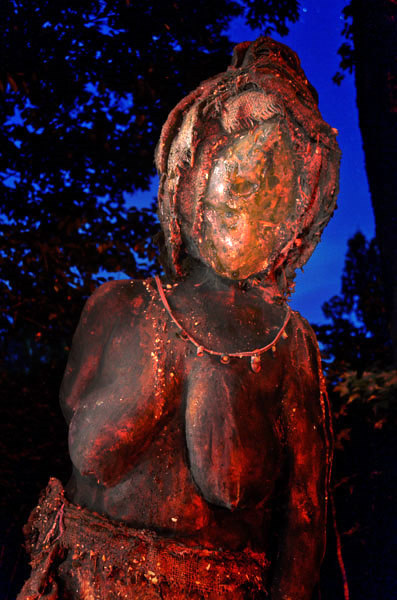
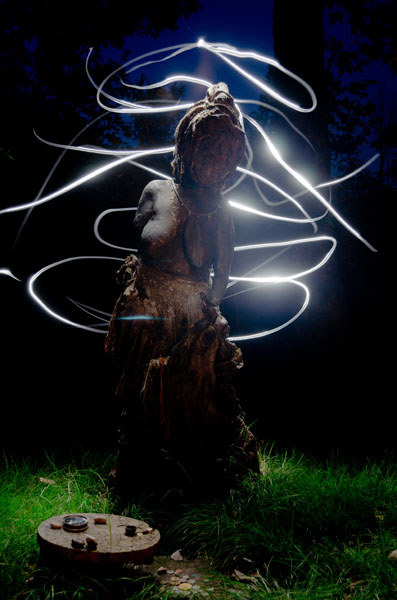
The Watcher at Night, 2013, photo by Fred Hatt

The Watcher at Night, 2013, photo by Fred Hatt

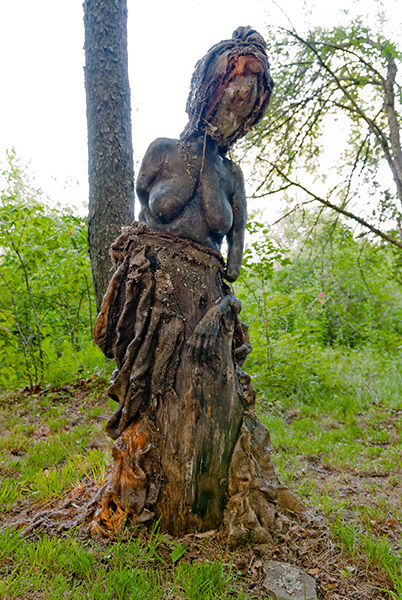
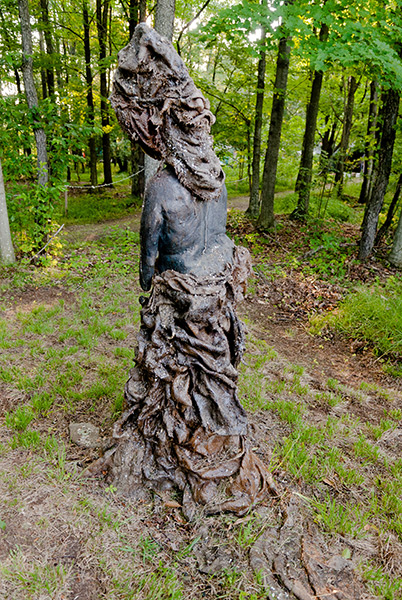
The Watcher is a life-size figurative sculpture that overlooks a quiet path in the woods at the Brushwood Folklore Center in Sherman, New York. It’s been there for six or seven years, but coming upon it, you’d think it had been there for centuries. It seems to grow out of the land, manifesting the spirit of the place.

The Watcher, front view, 2009, by Fred Hatt

The Watcher, front view, 2009, by Fred Hatt

If this is a wood nymph, it is no pale, delicate fairy. The Watcher is rough and gnarled like an old tree, an embodiment of life force that survives the lashings of seasons by twisting and toughening and enduring.

The Watcher (back view), 2009, photo by Fred Hatt

The Watcher, back view, 2009, photo by Fred Hatt

Bellavia is the artist who created The Watcher. For many years she has been a strong presence in the creative community of the festivals at Brushwood. A few years ago she moved from Western New York to New Orleans, but still returns to Brushwood when she can. (Click on her name above to see other artwork by Bellavia.)

Bellavia, 2004, photo and face paint by Fred Hatt

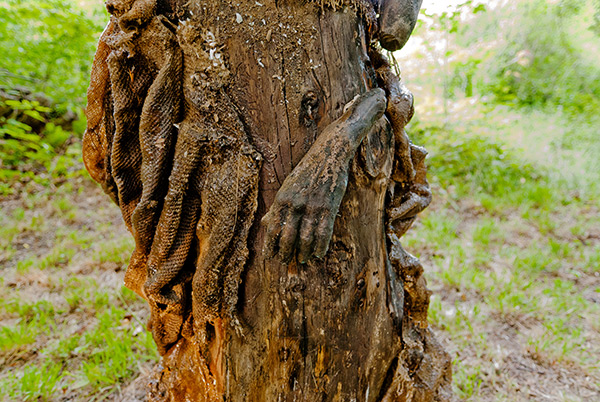
The Watcher is made is made of bronze, pine, burlap, organic matter, fiberglass resin, bone, and cast glass. Parts of it are cast from a live model, Liag, who is a friend of the artist. Liag told me “I have felt an attachment to The Watcher since I first saw Bella’s sketches in 2004.  The process of me becoming part of the sculpture, my torso and arms and hand, was profound.  I feel she is now part of me.  I sense her presence within and around me all the time.  She is alive.”

Head of the Watcher, 2009, photo by Fred Hatt

Head of the Watcher, 2009, photo by Fred Hatt

I asked Bellavia if she designed the work in advance or if it emerged from experimentation. She replied, “I had a rough vision of the piece when I started. It turned out a little like the sketches but so very different at the same time. The piece itself takes over at some point and brings itself to the front and I just become a conduit for it.”

Hand of the Watcher, 2009, photo by Fred Hatt

Hand of the Watcher, 2009, photo by Fred Hatt

She said the Watcher “was not made with brushwood in mind. I don’t work with places in mind for the work. I simply could not move her down south with me and I felt like I really wanted to give something back to the community at Brushwood.”

The Watcher, upper body, 2009, photo by Fred Hatt

The Watcher, upper body, 2009, photo by Fred Hatt

For Bellavia, the work is about female identity and body image. In an artist’s statement, she says:

As a human who happens to be a woman I am all too aware that public opinion and disapproval is something that we are still essentially bound by. Our societal teachings about the many aspects of “self” are generally distorted and inaccurate. I am interested in presenting the viewer with a look into those distortions and offering glimpses of the possibilities in transforming that fear of disapproval or censure. My personal modes of perception towards the meaning and substance of life in all its complexities cause my work to be up close, personal and visceral. My artwork is exploration as a process of defining/redefining an image of the self and body. Oftentimes beautiful, dangerous and disturbing, a palpable presence arises from my work. There is always a hint of darkness underneath the beauty, completing the circle of light and dark. My work is daring, and shows courage, grace and beauty in being willing to challenge normal assumptions about sexuality and boundaries. I am very upfront about the assertion of ones sexuality and exploration of such. I am often my own subject, facing myself, my past and my demons. I endeavor to show the transformation process that starts in the soul towards a new definition of the self. This artistic process brings a freedom from the weight of prejudices, traditions, and custom and the healing from that lies not in distancing myself from it, not in attempting to heal it, but in embracing the experience as part of being alive.

Eye of the Watcher, 2013, photo by Fred Hatt

Eye of the Watcher, 2013, light painting photo by Fred Hatt

Many people are drawn to spend time with The Watcher, and a sort of altar has grown around the base of the sculpture. I feel a power in the work, and I’ve occasionally tried to capture some of its spirit in photographs. This summer, I used The Watcher as a model for light painting. Light painting photographs are taken in the dark with a long exposure time, during which I move around the subject with flashlights or other hand-held lights, applying strokes of light to bring out aspects of the form or to suggest energy within.

The Watcher with Wings, 2013, photo by Fred Hatt

The Watcher with Wings, 2013, light painting photo by Fred Hatt

The video below is made up of some of my light painting images of The Watcher, dissolving one into another so that light seems to move around and animate her earthy form. This is my personal exploration of the palpable presence of The Watcher.

The Watcher from Fred Hatt on Vimeo.

All of the photographs in this video are straight shots, with no digital painting or manipulation.

2013/08/17

Stereo Botanicals

Filed under: Photography: Stereoscopic — Tags: , , , , — fred @ 21:43
Looking Down, 2013, photo by Fred Hatt

Looking Down, 2013, photo by Fred Hatt

If you’re ready for a new life drawing post, click over to Museworthy, where the great art model and my blogging mentor Claudia has posted about our recent session working together in my studio, with photos and drawings!

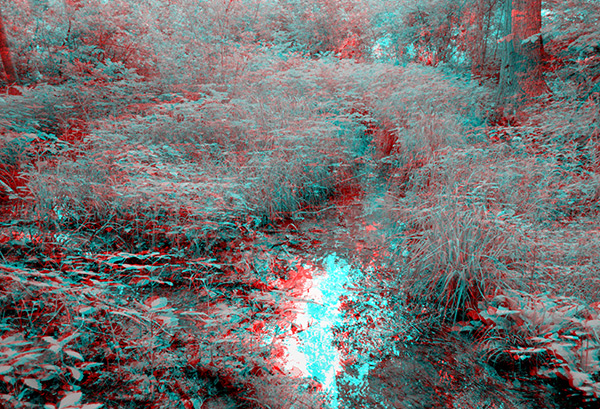
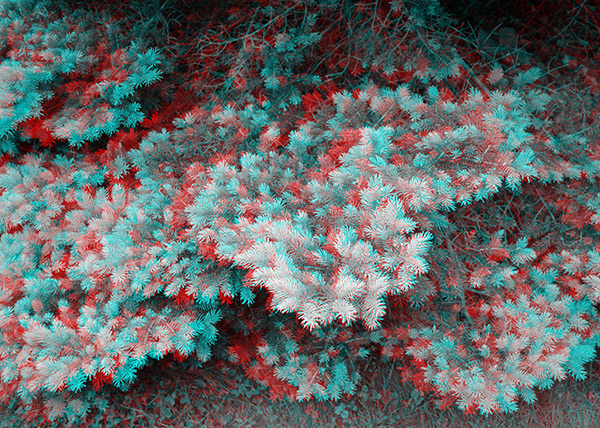
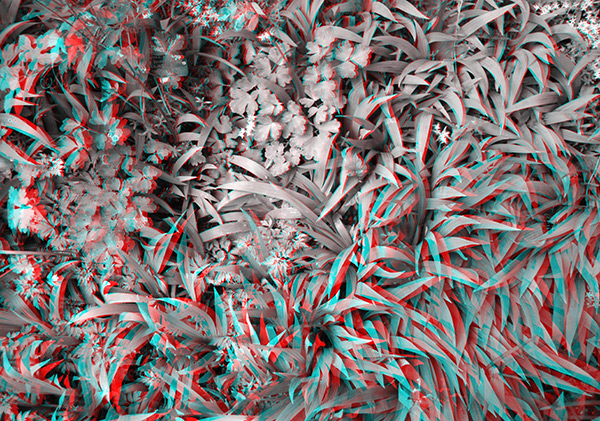
I like to use stereoscopic photography to study the shapes of things in space – especially complex forms like those of trees and flowers, which can only really be understood in three dimensions. Flat photographs of plants are like pressed flowers – still lovely, but a certain violence has been done.

Stereo photographs reproduce human spatial perception. To see depth in the images in this post, you’ll need a pair of common red/cyan 3D glasses. If you don’t have a pair lying around, you can get one for free here. Ask for red/cyan anaglyph 3D glasses. If you look at these photos without the glasses, you’re missing a lot!

The originals of these photos were in color, but I don’t like any of the methods for presenting stereo photos in color on the web, so I’ve converted them to monochrome for this post. Most pictures of plants and flowers dazzle us with colorfulness, but here we’ll get rid of that distracting factor the better to study forms in space.

Lyman Conservatory at the Botanic Garden of Smith College, 2013, photo by Fred Hatt

Lyman Conservatory at the Botanic Garden of Smith College, 2013, photo by Fred Hatt

My brother Frank lives in Northampton, Massachusetts, a lovely and lively town that is the home of Smith College. The campus has wonderful landscaping and botanical gardens, including this magnificent victorian-era Lyman Conservatory, which houses over 2500 species of plants from around the world. It’s one of my favorite places to visit when I’m in town to hang with Frank, and all of the pictures in this post were taken on the Smith College campus last June.

Conservatory Door, 2013, photo by Fred Hatt

Conservatory Door, 2013, photo by Fred Hatt

This tree forms a kind of leafy dome under which one may take shelter from sun or rain.

View from Under the Weeping Beech, 2013, photo by Fred Hatt

View from Under the Weeping Beech, 2013, photo by Fred Hatt

The campus has a good-sized lake surrounded by woods where students can wander the paths and ponder on questions and wonder at the glorious diversity of earthly lifeforms.

Paradise Pond, Smith College, 2013, photo by Fred Hatt

Paradise Pond, Smith College, 2013, photo by Fred Hatt

The shapes of the land itself are organic forms, just as much as are the living things that adorn the hillocks and hollows of that sod.

Grassy Slope, 2013, photo by Fred Hatt

Grassy Slope, 2013, photo by Fred Hatt

Whatever dies falls down and is recycled in water and earth and its vitality bursts up out of the muck.

Marsh, 2013, photo by Fred Hatt

Marsh, 2013, photo by Fred Hatt

Every kind of plant has its own characteristic kinds of leaves and patterns of growth, and there seems to be no limit to the variations that can thrive given the right conditions.

Japanese Maple, 2013, photo by Fred Hatt

Japanese Maple, 2013, photo by Fred Hatt

Some are soft and some are spiky, some yielding and some aggressive. The different forms are like different personalities.

Fir Tree, 2013, photo by Fred Hatt

Fir Tree, 2013, photo by Fred Hatt

Plant forms reach out into space to gather energy from light and air and matter from earth and water. Every plant is an alchemical flask of transformation.

Negative Spaces, 2013, by Fred Hatt

Negative Spaces, 2013, by Fred Hatt

Contemplating nature requires all the senses: smell and taste, touch and sight and hearing, intuition and reason.

Mixed Leaf Types, 2013, photo by Fred Hatt

Mixed Leaf Types, 2013, photo by Fred Hatt

Nature is reaching out to us, asking us to reconnect, to remember that we are beings of Earth. Alas, we have isolated ourselves in pods and given all our attention to things that flash and sparkle and pretend to respond to us.

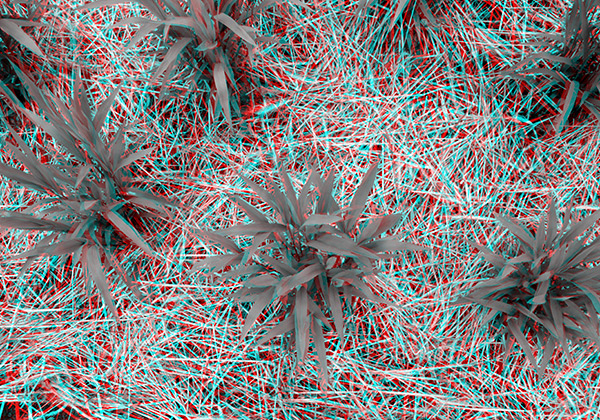
Lanceolate Clusters, 2013, photo by Fred Hatt

Lanceolate Clusters, 2013, photo by Fred Hatt

If soft nature cannot touch us, sharp and prickly nature will some day come to bear.

Agave, 2013, photo by Fred Hatt

Agave, 2013, photo by Fred Hatt

The world seems to be a perfect laboratory for generating changing conditions, to which life must respond by adapting into astonishing and wondrous forms.

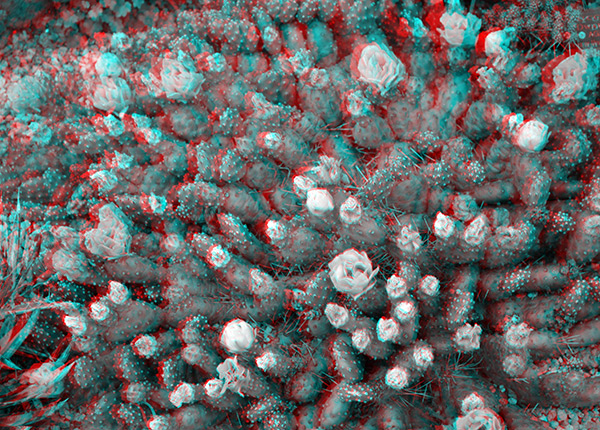
Cacti, 2013, by Fred Hatt

Cacti, 2013, by Fred Hatt

While we dispute over abstractions, the ever-flowing life force manifests all around us in a billion ways, always aborning, dying, and being born again.

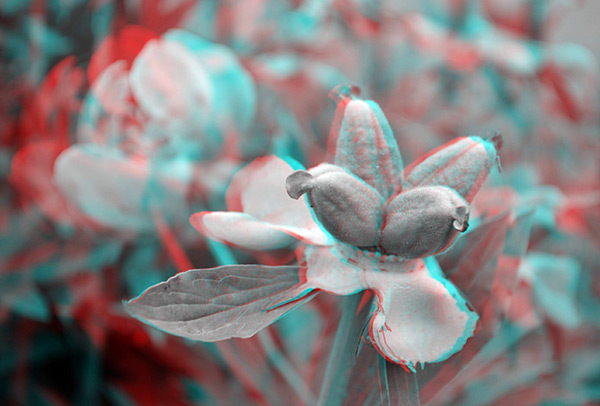
Four-Way Bud, 2013, photo by Fred Hatt

Four-Way Bud, 2013, photo by Fred Hatt

We dream of being visited by alien spacemen that talk and use technology like we do, imagining they will bring us wisdom, while the real deep wisdom shows itself to us in the ever-changing costumes of thriving things and feeling creatures.

Purple Iris, 2013, photo by Fred Hatt

Purple Iris, 2013, photo by Fred Hatt

Stop for a moment, stop using and consuming everything, stop entertaining yourself, stop competing with everyone. Look, and touch, and smell. You don’t need to meditate on a mountaintop. The magic is right here.

White Irises, 2013, photo by Fred Hatt

All of these photos were taken with a regular digital SLR camera, by taking one shot as a left-eye view and then shifting a few inches to take a second shot as a right-eye view. Alignment and conversion into anaglyphs was done with the great free software StereoPhoto Maker, which can also convert to many other formats of stereo photography.

Previous posts of stereo photography are here and here.

I love looking at plants but I’m no expert. If you notice that I’ve mislabeled anything here, please let me know in comments.


2013/07/26

Surface Tension

Curled Back, 2013, by Fred Hatt

Curled Back, 2013, by Fred Hatt

On the scale of galaxies and bodies, the universe embodies the elegant equations of Einstein and Newton, but at the subatomic scale, it’s all quantum weirdness, a foamy chaos of particles popping in and out of existence. Processes of evolution have generated the great panoply of Gaian life, but to the individual creature it’s just an ongoing struggle to survive and thrive. A human life viewed in retrospect by a biographer can have the structural inevitability of an epic novel, but that same life lived day-by-day may be experienced as a jumble of more-or-less random encounters and issues.

I aspire to reflect this dichotomy of scale in my drawings: on the big scale, elegant form, while on the small scale, chaos. From a distance, I would like my drawings to appear realistic, even classical, while a closer approach reveals an underlying turbulence of colors and markings. I avoid blending and smoothing, as I feel the energy of the marks captures something of the living energy of my subjects. Vivid hues blend in the eye to give the impression of subtly variegated tones.

Curled Back (detail), 2013, by Fred Hatt

Curled Back (detail), 2013, by Fred Hatt

This scribbly way of rendering values and volumes takes some time, but a relatively limited ten- or twenty-minute sketch shows it in its roughest and perhaps clearest form. When I am working this way, I generally try to do so right from the start of sketching, not to draw in a more formal way and then add a layer of chaos as a veneer. The drawing holds together because it’s craziness all the way down.

Sketch in Primaries, 2013, by Fred Hatt

Sketch in Primaries, 2013, by Fred Hatt

Rough Torso, 2013, by Fred Hatt

Rough Torso, 2013, by Fred Hatt

In the early stages of drawing, value (lightness/darkness) is the most important consideration in choosing a color to draw with, while hue is a secondary concern. As the drawing develops and the values from shadow to highlight becomes well established, the relative lightness of additional marks has a diminished effect, and color becomes the primary reason to choose one crayon over another.

Seated Side, 2013, by Fred Hatt

Seated Side, 2013, by Fred Hatt

Seated Back, 2013, by Fred Hatt

The following drawings are mostly longer, more developed pieces made using this technique of building a larger order out of small passages of chaos.

Curly Hair, 2013, by Fred Hatt

Curly Hair, 2013, by Fred Hatt

Human skin is never a flat surface color that can be matched the way a decorator might mix pigments to replicate a paint swatch. Skin is translucent, exhibiting properties of specular reflection and subsurface light scattering. Its coloration comes not only from melanin and other pigments inside the skin, but from the colors of blood and muscle and connective tissue showing through it. It has constant subtle variations. Figurative artists have all sorts of esoteric methods and theories for capturing skin tones. The one that works best for me is additive color mixing with scribbly strokes.

Poet, 2013, by Fred Hatt

Poet, 2013, by Fred Hatt

Green Blue Purple, 2013, by Fred Hatt

Green Blue Purple, 2013, by Fred Hatt

The great magic of figurative art is to capture the sense of aliveness of the subject. By expressing energy in the vigorous markings at the smaller scale of the drawing, I hope to convey the feeling that this person I am showing you is alive, is full of breath and blood and might potentially move or speak at any moment. I put as much of my own energy as possible into the work of drawing, and I want to preserve the record of that kinetic energy in the markings that compose the image.

Sculptor, 2013, by Fred Hatt

Sculptor, 2013, by Fred Hatt 

Body Artist, 2013, by Fred Hatt

Body Artist, 2013, by Fred Hatt

The model expresses her or his energy through the body, the pose and expression. The process of seeing and drawing is necessarily a process of abstraction, as this living being is translated into perceptions of angles and curves, contours and volumes. The magic of capturing aliveness depends on not letting the subtler aspects of the subject get lost in that translation. I try to achieve it by approaching everything as energy. Life is energy, the body is energy, perception is energy, mark-making is energy, a completed drawing is energy.  Energy is the aspect that unifies every stage of the process.

Ballerina, 2013, by Fred Hatt

If, while drawing, even one thing you see or do is dead, the drawing dies. All of it, every object, every mark, every thought, every moment, is alive. In this way, the drawing is full of life.

Rodinesque, 2013, by Fred Hatt

Rodinesque, 2013, by Fred Hatt

All of these drawings are roughly 19 1/2? x 25 1/2? (50 cm x 65 cm), aquarelle crayon on gray or black paper. “Curled Back” is done in a combination of aquarelle crayon and gouache.

« Newer PostsOlder Posts »

Powered by WordPress

Theme Tweaker by Unreal