DRAWING LIFE by fred hatt

2011/08/30

A Torso Even More So

Filed under: Figure Drawing: Anatomy — Tags: , , , , , — fred @ 15:08

Face of the Body, 2011, by Fred Hatt

“Torso” is the art term for a depiction of the human form focused primarily on the trunk of the body rather than the head or limbs.  The word derives from a Greek/Latin word meaning stalk.  It’s a botanical analogy, like its synonym, “trunk”, the core out of which the branches grow.  The Greek root word, thyrsos, denotes the magic wand of the followers of Dionysos, a god of fertility, ecstasy, ritual madness, and theater.  The thyrsos, a fennel rod with a pine cone head, twined with ivy vines, embodies the unruly and indomitable life force.

Nautilus, 2011, by Fred Hatt

The torso often expresses this life force in its ability to twist, though as far as I can determine it is a coincidence that the word torso resembles the word torsion.  Torsion means twisting, and that word is related to the terms torque, torture, and torment.  The torso can express coursing vital energy but also vulnerability, leaping joy and convulsive anguish.

Mesh Fem, 2010, by Fred Hatt

The torso includes the heart and lungs and the organs of digestion and sex.  It is the seat of gut feelings, and of the swellings of erotic desire, hunger, and pride.

Supine Lotus, 2010, by Fred Hatt

We all grow in the womb and find our first nourishment at the breast.  Humans and other mammals crave the feeling of warmth and acceptance that is only felt in an embrace with full body closeness.

Arranged Around the Knee, 2011, by Fred Hatt

The torso is a rich subject for the artist because of its complexity of form, revealing different aspects at different angles of view and in varying relationships to the limbs and head.

Oxbow Hip Curve, 2010, by Fred Hatt

In drawing the body, I always imagine that my hands are feeling it, clasping the waist, holding the ribcage, following the underlying structure of bones and the fibers of muscle, sensitive to the warmth of the body, the expansive tide of the breath and the buzzing of nerves and blood vessels.

Inverted Rest, 2011, by Fred Hatt

The arms and legs thrust or relax outward in various directions, and their long forms create expressive angles, but the origin of the energy expressed by the limbs is always found in the core of the body.

Iliac Power, 2010, by Fred Hatt

My friend Mana Hashimoto, a dancer who is blind, teaches workshops on “Dance Without Sight“.  Part of her workshop involves observing the movement of another person by touch alone.  When I took Mana’s workshop I was struck by how clearly I could  understand all the movements of another person with hands placed gently on the back.  It was impossible to follow a dance by touching the head or extremities, but a hand on the back could feel the movements of all parts of the body, including the head, arms, and legs.

Back and Bottle, 2011, by Fred Hatt

The classic standing pose in figurative sculpture and painting is “contrapposto“.  This generally means the weight of the body is primarily on one leg, causing the pelvis to be tilted, and usually the shoulders are tilted in the opposite direction.  The slight asymmetry that is introduced in this way gives an appearance of liveliness to a still figure.  In practice, there are countless variations on the basic principle of contrapposto, as the ribcage/shoulder girdle and the pelvis can each be shifted or tilted in many directions, and the spine can be arched forward or back, bent to the side, twisted, extended or compressed.

Curved Torso Straight Arm, 2011, by Fred Hatt

Symmetrical poses, however, do not need to appear rigid.  In fact, symmetrical poses can be very relaxed because of their balanced weight. Looking at such a pose from an angle is all it takes to give assymmetry to a drawing, and if the artist’s calm hand follows the calmness of the model, the picture will have a certain serenity.

Balasana, 2011, by Fred Hatt

In a drawing, the body reveals its structure in the form of curves and angles going in various directions.  In the drawing below, note the forward thrust of the shoulder softened by the curling hair, and the rearward angle of the elbow balanced by the point of the breast.

Chair Back, 2010, by Fred Hatt

The outside contours of the body, the curve of the spine, and the shadows and highlights make the drawing below a study of sinuous flow.

Sheen, 2010, by Fred Hatt

The contrapposto principles can be seen even in an unusual seated pose seen from the side, as below.  A line drawn across the nipples and one drawn across the crests of the pelvis would create an angle pointing to the right.  The head turns away from the viewer while the far knee and hand come toward us, giving the pose that dynamic twist, while the near arm reaching out of frame to the left acts compositionally like an unresolved chord in music, keeping things a bit off balance.

Hoop Earring, 2011, by Fred Hatt

The spine is really the core of the body, and its movement is a key to the energetic expression of the pose.  Notice the difference in the next two drawings.  Here the spine seems to be lengthening, rising up.

Uplifting, 2011, by Fred Hatt

In the one below, by contrast, there’s a feeling of weight, of the spine relaxing downward.  Unlike most of the other drawings in this post, these two show facial expressions, which surely contribute to the contrasting moods, but even if you cover the faces you can see the difference in the energy.

Leaning on Wall, 2011, by Fred Hatt

In the two drawings above, the abstract treatment of the light around the figures suggests a kind of energetic aura.  In the drawing below a similar effect is achieved by using colored lines to indicate the complex ways that various light sources, both direct and reflected, flow over the curves of the body.

Mesh Masc, 2010, by Fred Hatt

All the parts of the torso are formed around a center line.  I try to locate this center line and then to develop the forms to either side, sketching with cross-contours, or strokes that follow the three-dimensional shapes of the body.

Terrestrial Body, 2010, by Fred Hatt

Here’s another contrapposto from behind, with the angles of the legs echoing the angles of hips and shoulders.

Helical Zigzag, 2011, by Fred Hatt

The energy of the pose below emerges powerfully from the stable center of the sacrum, the base of the spine.  The cross contours show the structure of muscles and bones of the back as a kind of swirling energy.

Sacral Center, 2010, by Fred Hatt

Here’s an unusual pose supported on one hip and forearm.  All four limbs are bent at more or less right angles, all pointing in different directions.

Lateral Bridge, 2011, by Fred Hatt

The features of the frontal torso are arranged similarly to the features of the face.  The face is the window of the soul, showing emotion, intelligence, engagement.  The torso is the face of the life force, showing energy and balance and movement.

Hand on Hip, Forearm on Doorknob, 2011, by Fred Hatt

The torso can embody vigor, sensuality, boldness, timidity, and so on.  The quality of spirit resides in the body as well as in the mind or brain.  Entering into a contemplative state requires releasing and balancing and stabilizing the energy of the body as well as the mind.

Grounded Sitting, 2011, by Fred Hatt


All the drawings in this post are about 50 x 65 cm, or 19 1/2″ x 25 1/2″, aquarelle crayon on paper.  All of these were drawn during 20-minute poses at Figureworks Gallery in Brooklyn.

(The title of this post is a line from the song “Lydia the Tattooed Lady”, by Harold Arlen and Yip Harburg, made famous by Groucho Marx in the 1939 film “At the Circus”.)

2011/08/07

Made Man

Dear readers, I’ll have another post for you here some time this week, but in the meantime check out my “guest post” on Daniel Maidman’s blog.  Daniel’s a figurative painter, of a more classical bent than me, and he’s also a stimulating writer, often considering artistic issues in the light of scientific and philosophical ideas.  I wrote a rather extensive comment on Daniel’s recent post, “The Integrated Visual Field”, going into what I’ve learned about the science of human visual perception as it pertains to observational drawing.  Daniel invited me to expand on that response, and then he combined my comments with those of Stephen Wright, another really interesting figurative artist, and made the whole thing into this guest post.  I hope some of you will appreciate being turned on to Maidman’s blog.


2011/08/02

Try, Try Again

Filed under: Figure Drawing: Practice — Tags: , , , , , , — fred @ 23:28

Marilyn 1, June, 2011, by Fred Hatt

Last week I posted about the master of the “naked portrait”, Lucian Freud, who often spent hundreds of hours over a period of many months on a single painting.  Naked portraits are also among my practices, but I lack the patience to spend so much time laboring over a single image.  I feel my best work arises more from spontaneity than from perseverance, and so I just churn ’em out and hope a few are worth saving.

I run a weekly session at New York’s Spring Studio featuring a nude “long pose” – long by sketch standards, not by oil painting standards.  My class lasts three hours and starts with a set of two-minute warm-up poses; subtracting that set and breaks, the amount of time allotted for drawing the pose amounts to two hours.

Most artists work on a single drawing or painting during the session.  So do I, sometimes, but I also frequently decide to start over again one or more times.  In this post I’ll share recent examples of multiple tries at the same pose from the same viewing angle.  I’m sharing some of my failures, work I wouldn’t normally exhibit, because of what they reveal about my process.

The sketch that opens this post shows how I begin analyzing the angles of a pose.  You can see how I use a combination of triangulation and rhythmic curves to find the tension and structural energy of the pose.  In my second attempt, below, I’m building on that analysis, but drawing closer.  I often use lines to indicate the contours between shadows and highlights.

Marilyn 2, June, 2011, by Fred Hatt

Finally, I decide that all the magnificent arches and cantilevers of this pose are distilled in Marilyn’s face, with its pointed eyebrows and lips, and the lovely taut bow of the collarbone.

Marilyn 3, June, 2011, by Fred Hatt

Christophe is a model with an acting background, and his specialty is facial expressions.  Here he gave us anguish, leaning to one side.

Christophe 1, June, 2011, by Fred Hatt

Here I spent most of the session developing the drawing above.  At some point near the end of the session I decided I’d best stop working on it. lest I overwork it and destroy its power, a mistake I still sometimes make.  So I spent the last half hour or so simplifying what  I’d learned from the previous hours of study of Christophe’s expression into a linear abstraction of emotion, below.  Even though this drawing is an afterthought, I think it’s stronger than the one I spent more time on.  I wouldn’t have been able to do something like this from the start – its simplicity only arises from the experience of prolonged looking.

Christophe 2, June, 2011, by Fred Hatt

Here’s one of my favorite models, Betty.  I think I began drawing using the yellow crayon sideways to indicate the highlights of the body, then used white and black lines to delineate details and the contours between highlight and shadow areas.  Proportions are wildly off here, with the head half the size of the torso.

Betty 1, July, 2011, by Fred Hatt

So I started again and developed this figure in relation to the elements around it.  The head may still be a little too big, but that’s my strongest distortive tendency.  The face has so much structural complexity and carries so much expressive power, it needs as much space in the drawing as it needs!

Betty 2, July, 2011, by Fred Hatt

Below is another example where I managed to come up with a representation of the model’s face, body and expression that was pretty satisfactory, overall, but a bit dull, perhaps.

Mitchell 1, July, 2011, by Fred Hatt

So I moved in on the face and tried to summarize its specificity in line.

Mitchell 2, July, 2011, by Fred Hatt

Here’s stage one of a look at Luke’s seated pose.  All the drawings in this post were made during the summer.  In the hot months, the aquarelle crayons I use are softer and lay down a thicker layer of wax than they do in the cooler months.  Once there’s a certain density of wax on the paper, revision is hopeless.

Luke 1, July, 2011, by Fred Hatt

A second attempt shows my understanding of the figure sharpening.  Here I’m using a lot of cross-contours.

Luke 2, July, 2011, by Fred Hatt

Finally, again, I move in closer.  Here the style I”m using is like carving with a chisel.  I’m trying to approximate colors by the method of optical mixing.

Luke 3, July, 2011, by Fred Hatt

The final series of drawings in this post is from this past Monday.  This was my first shot at drawing Leah, a model that has inspired several lovely paintings by Daniel Maidman.  I started out measuring the pose by head-lengths.

Leah 1, August, 2011, by Fred Hatt

In the second attempt, the head was oversized – my usual tendency.  The pose has subtly changed since the first set, with the left knee and arm covering less of the torso.  Most of the artists were clustered to the model’s right side during this pose, and probably didn’t even notice the change in the pose.  I took advantage of it to study the structure of the chest and abdomen.

Leah 2, August, 2011, by Fred Hatt

My third try at this pose finds me moving closer, to allow a more detailed treatment of the face.  Still not quite right, though.

Leah 3, August, 2011, by Fred Hatt

Here’s the final try, developed during the last third of the session.  I still haven’t really captured Leah’s face, but I’m happy with the color and the challenging dangling hand in front of the thigh.  It can be hard to really get the essence of a model in the first session of studying her or him – you get what you can, and then time’s up!

Leah 4, August, 2011, by Fred Hatt

All the drawings in this post are aquarelle crayon on paper, 19 1/2″ x 25 1/2″ (50 cm x 65 cm).  Similar previous posts showing multiple attempts at the same pose include Variations and Redrawing.

2011/07/26

Freudian Analysis

Double Portrait, 1986, by Lucian Freud

Lucian Freud, who just died on July 20, 2011, devoted his long career to painting figures and portraits from life, perfectly ignoring all the art-world trends of his era.

Bella, 1987, by Lucian Freud

Many of his images are of people and/or animals sleeping.  He always painted directly from live models, often friends or family members rather than professionals, and he worked very slowly, so the sleeping poses may be an accommodation to the models.  I am struck, though, by the sense of struggle and intensity in these works.  Freud’s paint has the writhing quality of Goya’s horrors or El Greco’s spiritual transports, but in pictures of people simply relaxing on beds and sofas.  I think the sense of agitation arises from Freud’s own restless struggle to see more deeply and to capture in paint the intensity of his own visual experience.  For Freud, every canvas was a wrestling match against a powerful foe.

Pregnant Girl, 1961, by Lucian Freud

The fleshiness of his painting can be a distraction.  I got a better understanding of  the energy of Freud’s searching eye by looking at his etchings, where the quality of movement stands out.  Most portraitists view their sitters across a distance.  Freud’s perceptual focus hikes over his subjects like a surveyor mapping a territory.  He treats the figure as a landscape, to be explored by touch and movement.

Head and Shoulders, 1982, etching by Lucian Freud

Freud loved animals, and he often shows his own dogs posing with his models.  He told William Feaver, who wrote a book about Freud’s work, “I’m really interested in people as animals.  Part of my liking to work from them naked is for that reason.  Because I can see more, and it’s also very exciting to see the forms repeating through the body and often the head as well.  I like people to look as natural and as physically at ease as animals, as Pluto my whippet.”

Sunny Morning - Eight Legs, 1997, by Lucian Freud

Lucian Freud was the grandson of Sigmund Freud, the progenitor of psychoanalysis.  Sigmund Freud spent hundreds of hours with his subjects lying on a couch, trying to penetrate the hidden recesses of the mind through dreams and free association.  Lucian Freud also spent hundreds of hours with his subjects lying on a couch, but he kept an intense focus on the surface.  I think he felt that the physical body, truly seen, could reveal hidden depths.  Surely Lucian Freud’s work reveals depths, although, as with Sigmund’s work, it could be argued that those depths belong to Freud more than they do to his subjects.

David Hockney; Lucian Freud, 2003, photo by David Dawson

Freud said, “My work is purely autobiographical… It is about myself and my surroundings. I work from people that interest me and that I care about, in rooms that I know.”  Given the necessity of spending a great deal of time with his sitters, he wouldn’t work with anyone unless he genuinely liked that person.  Still, he absolutely avoided any sentimentality or idealization.  Freud’s subjects had to accept that he would portray their every flaw, that he would reveal their mortality.

David Hockney, 2003, by Lucian Freud

While Freud, as far as I know, never worked from photographs, some of his models were photographed while posing for his paintings, which gives us an excellent way of seeing where he exaggerates and what he emphasizes.

Sue Tilley posing for Lucian Freud, 1995, photo by Bruce Bernard

Benefits Supervisor Sleeping, 1995, by Lucian Freud

The painting above is one of Freud’s best-known works, having set a record for the highest price paid for a painting by a living artist when it was sold at Christie’s in 2008 for 33.6 million dollars.  Notice how much older the model appears in the painting than in the photograph.  He seems to have made her more obese and more splotchy.

Many figurative painters do the opposite, omitting bruises and calluses and visible veins, subtly idealizing the body.  And many people are repelled by Freud’s figures, with their sexuality and mortality so blatantly on display.  Speaking for myself, this is the very aspect of Freud’s work that gives it spiritual power.  It is the essence of the human condition that we are spiritual beings manifested in animal bodies that experience fear and desire, suffering and decay.  I see this as the quality of art that Federico Garcia Lorca calls duende, the life force intensified by the closeness of death.

Naked Man with Rat, 1977, by Lucian Freud

Freud’s earlier work, such as the portrait below of Lady Caroline Blackwood, lacks the blotchy impasto of his later work, but there is already a kind of magical realism, with enlarged eyes and expressive distortions.

Girl in Bed, 1952, by Lucian Freud

Freud said, “The longer you look at an object, the more abstract it becomes, and, ironically, the more real.”  You can see this principle not only in the individual works, but across the artist’s entire oeuvre.  The later work is unquestionably more abstract, the strokes wilder and freer, but they also have a living presence that is much stronger than in the earlier work.

Four Figures, 1991, etching by Lucian Freud


The Painter's Mother III, 1972, painting by Lucian Freud, and The Painter's Mother, 1982, etching by Lucian Freud

The face below is surely distorted, yet you can see the intensity of the artist’s perception in every thick stroke.  There is a kind of aura, a powerful presence that cannot be achieved by working from photographs and fretting over accuracy.

Esther, 1982, by Lucian Freud


Lucian Freud and model, 2004, photo by David Dawson

Freud said, “Perhaps when you have the sort of temperament that is always looking for flaws and trouble it might stop you from having what you always want, which is to be as audacious as possible. One has to find the courage to keep on trying not to paint in a stale or predictable way.”

Night Portrait, 1978, by Lucian Freud

I’ll conclude this post with two of my favorite Freud nudes.  Night Portrait, above, finds beauty in a pose that seems to be both resting and running, and in the textural contrast between the body and the quilt.  Naked Man, Back View, one of Freud’s many paintings of the model Leigh Bowery, also well known as a performance artist and costume designer, suggests an interior life through the turned-away display of a mountainous back.

Naked Man, Back View, 1992, by Lucian Freud

All the images in this post were found on the web.  Clicking on the pictures links to the pages where I found them.  The Lucian Freud quotes were also found on the web.  All the quote sites seem to have a similar collection of Freud quotes, unfortunately not sourced.

2011/06/03

Choices

Filed under: Figure Drawing: Practice — Tags: , , , , , — fred @ 11:08

Opposite Sides, 2011, by Fred Hatt

Life drawing as a practice involves a tension between habit and novelty.  Everyone I know who attends open figure drawing sessions has their favorite places to set up, their usual distance and scale, their familiar materials and techniques.  Anything unfamiliar, even a model you aren’t used to, is likely to make the quality of your work suffer.  Naturally, most artists are happy when they’re drawing or painting fluently, and unhappy when they’re struggling and stumbling, and they find that cleaving to habitual ways helps a lot.  This is as true for me as it is for any artist.

On the other hand, constantly working a well-worn rut will never get you anywhere new.  It’s exercise, but not the kind of exercise that builds strength or expands capacity.  It’s boring, and often the artwork that comes out of it is well-controlled but boring.  I believe most artists are far too sensitive to doing bad or awkward work, and far too insensitive to the hazards of the rut.

Boredom is a regular aspect of life drawing sessions.  Even when you love drawing and love looking at naked bodies, and often feel excitement and flow in your work, there are times when you’re looking at the same model in the same pose you’ve seen a hundred times, when your angle of view obscures the most dynamic part of the pose, or when your energy level flags.

My strategy is to introduce controlled variations, to break one part of the set of habits at a time.  I might try changing my scale of drawing, moving away from my habitual spot, or focusing on a particular aspect of the pose or scene that’s different from my usual approach.  When the model takes the pose, I’ll often make a choice at that moment:  Which element of my work should depart from the norm?

The drawing at the top of the post is from the Monday morning long pose class I supervise at Spring Studio.  After a set of quick poses for warm-up, the model takes a single pose for the rest of the session.  Subtracting the breaks, we have about two hours of drawing time for the long pose.  I’m quick, so my greatest hazard is to overwork drawings, a mistake I still find myself making sometimes.

Kuan, the model for the above drawing, has a beautifully toned and well-defined body.  She took a sideways seated pose, looking towards the center of the room.  I took the opportunity to go to the left side of the room and study her back.  But I thought I’d be likely to overwork just the back, so I used half the sheet of paper, saving the other half for a study of the same pose from the opposite side of the room.  Besides going beyond the one-sided view to which two-dimensional artists usually confine themselves, this turned out to be a fascinating study in proportional and structural relationships.

Absence, 2011, by Fred Hatt

The 20-minute drawing above was done at Figureworks, where the models pose in an archway between two rooms.  I was at an angle where this reclining pose was highly foreshortened and partially blocked by the edge of the arch on the left.  I could have moved to a different spot, to see an unobstructed view, or a more straight-on angle.  Instead, I chose to let the left edge of the paper be the edge of the arch, centering the composition on the empty part of the blanket on which the model was lying.

Floor Cloth, 2010, by Fred Hatt

In this reclining pose, I also focused on the floor and the blanket, leaving the body as a silhouette with some cross-contour shading.  Here the shape formed by the body is defined by its negative space.  The folds of the fabric even help give a sense of the weight and solidity of the body.

Framing, 2010, by Fred Hatt

Here’s another pose defined largely by coloring in the negative spaces.  The colors used for walls, floor and fabric have nothing to do with the actual hues of the scene.  They’re chosen to enhance the form of the pose.  I particularly like the diamond-shaped space between the arms, chest and thigh, that takes on the appearance of a tetrahedron with yellow and green faces.

Contour, 2010, by Fred Hatt

Here’s another archway pose, with the model turned away from me and the edge on the right blocked.  I started drawing in red, just the front contour of the body from shoulder to knee, but then I decided I wanted to include the foot and the hair, so I flipped the paper upside down and drew again, at a smaller scale, on the opposite side of the page.  I left the upside-down red contour, making an interesting river of negative space between the two views of the pose.

Right Triangles, 2011, by Fred Hatt

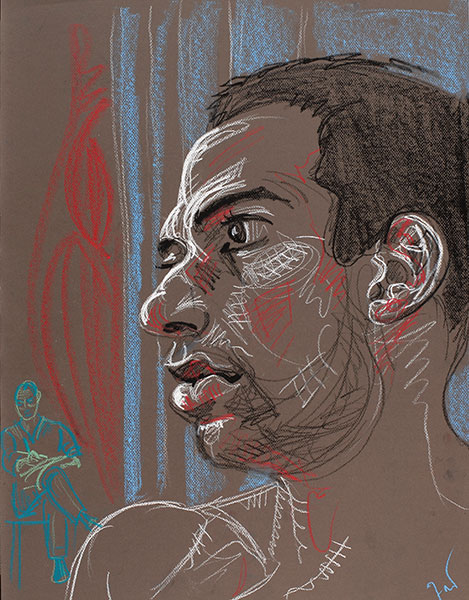
Side views of the body are particularly challenging, especially when none of the landmark features are visible.  Here my attention was captured by the squareness of the seated pose and the angularity of the model’s face.  The colored areas in the background are pure invention, to emphasize this contrast between right angles and diagonals.

Cluster of Fingers, 2011, by Fred Hatt

Here is yet another seated pose, viewed from the side.  I could find no dynamism in the pose or composition, and couldn’t see the model’s face, but the hands were clasped together in a way that was highly complex, and I was close enough to see them pretty well, so I took the opportunity to practice hands, widely considered the most difficult part of the body to capture in drawing.

Nazarene, 2011, by Fred Hatt

Like complicated hand positions, the face at an unusual angle is very challenging to draw, so I try to practice it when the opportunity arises.  These attempts often turn out with distortions, and this drawing does have certain distortions, but I think it succeeds in capturing a sense of aliveness, not only through the facial expression, but also through the angles and composition.

Sketcher and Poser, 2011, by Fred Hatt

This portrait from a Figureworks life drawing session needed one more element, so I included a sketch of Randall, Firgureworks’ proprietor, with his sketchbook on the other side of the room.  I made him much smaller in relation to the main figure than he actually appeared from my angle of view, which makes the main figure appear to be seen from very close.  This is the same effect you get with a photo taken from close to the subject with a wide-angle lens, with the perspective differences between foreground and background exaggerated.

Facing Light, 2011, by Fred Hatt

Here’s a back view with the shape of the figure highlighted by the window she’s facing and the light from the window reflecting off the polished hardwood floor.  Sometimes a very simple treatment of the background greatly enhances the sense of real presence of a figure by creating a space for it to occupy.

In a Room, 2011, by Fred Hatt

Here’s a more complex variation on the same idea.  The space is simplified into areas of differing value and color, just enough to make the figure a solid reality in a world of air and light.

Many of these poses could have been boring drawings had I not made choices to do something different from my habitual approach.  These experiments aren’t always successful – in fact they increase my chances of making terrible, embarrassing drawings.  But without the unusual choices, the results might have been competent but rather dull.

All the drawings in this post are aquarelle crayon on paper, approximately 18″ x 24″.

« Newer PostsOlder Posts »

Powered by WordPress

Theme Tweaker by Unreal