DRAWING LIFE by fred hatt

2012/07/27

Cut to the Quick

Julio Quick Poses, 2012, by Fred Hatt

As the 2012 Olympic Games get underway in London, we’ll have an opportunity to observe the elegance and power of the human body in action, diverse kinds of bodies honed through intensive training for different skills.  Here I salute the occasion with my own studies of the body from figure drawing sessions at Figureworks Gallery in Brooklyn and Spring Studio in Manhattan.   All of these sketches are made with watercolor and brush during sequences of two-minute poses.  The illustrations are presented in random order, and the interspersed text is not specifically related to the adjacent images, but generally to the whole collection.

Alley Quick Poses, 2012, by Fred Hatt

A sequence of quick poses is a kind of dance, as the model moves from one position to another to reveal the anatomical structure and the expressive range of the body.  The artist has only a moment to capture whatever can be captured.  I am fascinated by the variety and dynamism of quick poses – the models can do all sorts of things that would be impossible or painful to hold for even a five or ten minute pose.  Knowing that the timer is relentlessly counting down, I enter into a mode of hyperfocused flow, my eyes and my brush both in constant and coordinated motion.  The only way to get anything interesting is to work with swift efficiency.

Gwen Quick Poses, 2012, by Fred Hatt

Here I’m posting complete sequences, so you’ll see some awkward passages as well as some lovely bits of brushwork that reveal something true of the model’s aliveness or individuality.  Every real brushstroke is a rough approximation of the ideal brushstroke into which the visual cortex is translating the forms it perceives.  I’ve been practicing this for many years, so my approximations are pretty good when my focus is on.  It’s more important that the lines be confident and expressive than that they be accurate.  If I were to stop to measure or take a moment to step back and look critically at the sketch, I would hardly be able to get anything at all in two minutes.  I have to go unhesitatingly with the flow, and trust the flow.

Pedro Quick Poses, 2012, by Fred Hatt

I look for curves – the curve of the spine, of the hip, of the neck, of the knee, and make each curve a stroke of the brush.  I try to emphasize what makes each individual body unique, not to genericize the anatomy.  That uniqueness is in the curves.  The curve of one person’s hip is quite different from that of another’s hip.  I always look for the physical idiosyncracies.

Crolie Quick Poses, 2012, by Fred Hatt

I generally omit or radically simplify faces, hair, hands and feet.  Those parts of the body are detail traps, best saved for more leisurely studies.  But they are also often key to the particular expression of a pose or model, so I try to get some indication of their angles.  The direction of a gaze, the splay or curl of the fingers, the twist of an instep can be the detail that makes the pose come alive in the sketch.  For me, angles and curves are practically the whole of quick drawing.

Eric Quick Poses, 2012, by Fred Hatt

Quick poses are a special exchange of energy between model and artist.  A set of quick poses gives the model an opportunity to perform, to stretch out, to test their limits, to offer contrasts of feeling or form.  As the artist, I cannot let such a gift go unappreciated.  When a model is really giving the energy, drawing is like dancing with a fantastically graceful or dynamic partner – complete abandon is the only appropriate response.

Claudia Quick Poses, 2012, by Fred Hatt

A kind of time dilation can occur during quick poses.  From my own experience as a model, I can tell you that holding a challenging pose can make two minutes seem like an eon.  For the artist, a pose that’s complicated to draw can make two minutes feel like a few seconds.

James Quick Poses, 2012, by Fred Hatt

Observing angles is a quick way to see how one thing relates to another thing in space.  When I’m doing quick sketches, I’m making lots of lines that I don’t draw.  In my mind, I make lines between points to see how they relate in space.  I check the angle going from nipple to nose, or from fold of elbow to bulge of heel, or from where the arm meets the leg to the pubic ridge.  When all of those parts are in the right angular relations to each other in space, proportions will be a fair approximation of the reality.

Robyn Quick Poses, 2012, by Fred Hatt

Sometimes it’s easier to see curves and shapes and angles by looking at the negative spaces, the places where the body is not, and how those places relate to each other.  Or the angles of the body may become clearer by seeing them in relation to straight lines such as a wall or surface, the pole the model holds or the wall on which he leans.

Adam Quick Poses, 2012, by Fred Hatt

I’ve pored over anatomy books, assimilating as much structural understanding of the body as I can, but I depict only details I can see.  The knowledge helps me to grasp these features of the body, but I can’t get lost in an analytical breakdown of the body.  I try to get as many anatomical details into the sketches as I can, because these details individualize the body.

Tin Quick Poses, 2012, by Fred Hatt

Curves and angles, negative spaces, spatial relationships, anatomical details, flow and rhythm – it’s a lot to see and a lot to try to depict in two minutes.  The only way to do it is to merge perceiving and drawing into a unified process.  This is achieved by trying and trying and refining through hundreds of hours of practice.

When you watch an Olympic gymnast, you are seeing someone who has developed a perfect unity of perception and action through relentless practice.  Drawing is more subjective, but the learning process is similar.  All the details have to come together, to become one act.

Claire Quick Poses, 2012, by Fred Hatt

All of the original sketches in this post are made with watercolor and a brush in 18″ x 24″ sketchbooks.  Multiple pages have been stacked vertically in the illustrations so a whole series of quick poses appear in a single image, as though the drawings were made on a scroll.  Action sketches actually made on scrolls, drawn by me more than a decade ago, can be seen in this post.  I have also written previously about the similarities between life drawing practice and athletic practice, here.


2012/07/15

Framing Absence

Filed under: Photography: Framing — Tags: , , , — fred @ 21:13

Window Wall, 2003, photo by Fred Hatt

A frame makes a picture.  A frame that is around nothing makes something of that nothing.  Most people probably never look out a window with no view, but if you take the frame’s cue and view this brick wall as a view, it is a rather intense study in texture and light.

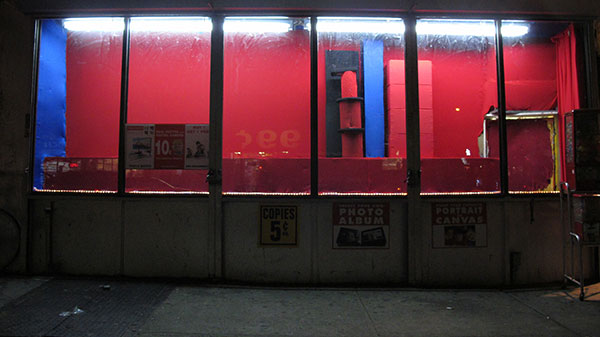
I’ve always found something compelling in “empty” frames.  Here are a few of them.

Now Showing, 2002, photo by Fred Hatt

An empty frame is a memento mori, a reminder of mortality, a window on nothingness that tells us there was once something where now there is nothing.

Red on Blue, 2009, photo by Fred Hatt

A big red box frames something – maybe a keyhole? – and, combined with shadows from a scaffold, makes an abstract painting of a blank blue wall.

Dots, 2010, photo by Fred Hatt

Here was once a fine locking glass poster case.  Then it became a community bulletin board.  Then someone pulled down the bulletins, leaving behind scraps of tape.  Now it is a sad cabinet of glass, empty inside and marred outside.  Or you can look at it as a jaunty composition of colored dots and tape on a transparent surface.

Boutique, 2004, photo by Fred Hatt

This storefront once attracted window shoppers with provocatively posed mannequins in garish urban fashions.  A sagging tarp, blue and dusty, hangs there as the flag of failure.

Billboard Support, 2003, photo by Fred Hatt

A vivid golden sculpture rising into the gray sky is so much more appealing than would be another commercial message.

Caution No Floor, 2004, photo by Fred Hatt

Everything has been done to make this once inviting store entrance forbidding:  paint splattered on the inside of the glass, a steel gate, caution tape, and a spray-painted sign that says “Caution No Floor”.  Here is the gate to hell, it would appear.

Exit ACE. 2010, photo by Fred Hatt

Peel, scrape, erase – all but a remnant of a baby’s face.

Glass Frame, 2010, photo by Fred Hatt

This is a little vitrine on a Subway platform where the Transit Authority posts notifications to commuters.  Someone tagged the glass with some clearish substance, creating a piece of abstract expressionism in subtle tones of translucency on transparency, casting faint shadows on a dully reflective aluminum back plate.

Now Serving Soup!, 2005, photo by Fred Hatt

This frame was not an empty frame until the clumping snow made it so.  You can still read the message “Now Serving Soup!” – just what you’d want on a blizzardy day.

Chalked Plates, 2011, photo by Fred Hatt

Some kids with street chalk clearly saw this textured steel access plate as a frame, and decided to fill it in with colors.

Wet Cardboard, 2011, photo by Fred Hatt

Here’s a double frame made of an upside-down box spring and a piece of blue-edged cardboard that maybe used to be behind a mirror or a picture.  In its demise, this piece of cardboard has finally become a picture itself, as the moisture has stained it with something that looks like a misty watercolor painting of mountains.  The hard-edged multiple framing really emphasizes the pictorial quality of the cardboard, as a fancy inset double mat might enhance a soft picture.

Triptych, 2005, photo by Fred Hatt

A triple window of water-stained board becomes a holy triptych.  “And God said, Let there be a firmament in the midst of the waters, and let it divide the waters from the waters.  And God made the firmament, and divided the waters which were under the firmament from the waters which were above the firmament: and it was so.   And God called the firmament Heaven.  And the evening and the morning were the second day.  And God said, Let the waters under the heaven be gathered together unto one place, and let the dry land appear: and it was so.   And God called the dry land Earth; and the gathering together of the waters called he Seas: and God saw that it was good.  And God said, Let the earth bring forth grass, the herb yielding seed, and the fruit tree yielding fruit after his kind, whose seed is in itself, upon the earth: and it was so.  And the earth brought forth grass, and herb yielding seed after his kind, and the tree yielding fruit, whose seed was in itself, after his kind: and God saw that it was good.  And the evening and the morning were the third day.”

Red Rectangle, 2003, photo by Fred Hatt

Will humanity one day emulate and extend the act of creation, seeding life on Mars or other planets?  Or will we destroy ourselves in the fire of our own consumptiveness?

Blinds, 2002, photo by Fred Hatt

Someone who likes to hide in shadows got a building made for putting things on display, and so they put their depression and decay on display.

Rectangles and Diagonals, 2001, photo by Fred Hatt

The paper in these windows, raked with shadows from an awning frame, looks like a silken kimono decorated with delicate diagonal stripes.

You Us We Now, 2010, photo by Fred Hatt

This scraped poster has remnants that suggest a landscape, with brown below and blue above.  The black shapes in the lower left seem to be figures sitting in the landscape.

Blue Rectangle, 2001, photo by Fred Hatt

Here on a plywood fence the artistic battle between figuration and abstraction is being waged.

White on Black, 2003, photo by Fred Hatt

I almost think I can read a message in this remnant in poster paste, but it’s illegible, a distorted echo, a white shadow.

Stone, 2006, photo by Fred Hatt

An artificial texture reminiscent of coral, surrounded in a bold rectilinear frame, marks this stone.  From a distance, it’s just a random pattern, like camouflage, but looked at closely it has a great writhing energy.

Empty Display, 2010, photo by Fred Hatt

This storefront window between displays is the stage of a shabby rundown theater in an entertainment district the cool people no longer frequent.

Antidepressant, 2010, photo by Fred Hatt

I think maybe this window is supposed to be a conceptual art installation, but it doesn’t look much different from the definitely unintentional depressing empty windows elsewhere in this post.  I like how the neon sign casts its shadow on the plywood – the shadow of light.  This was a storefront window in Williamsburg, Brooklyn.  The artist is unknown to me – let me know if you know.

Dusty Window with Rubber Cement, 2008, photo by Fred Hatt

This dusty window depicts an encounter between a rather rigid character whose plaid slacks are seen in the lower left pane, and an angel of anunciation, descending from heaven in the middle upper frame.

Restaurant, 2001, photo by Fred Hatt

Paper is often used to block the windows of defunct businesses.  Fallen paper, rumpled and stained behind the glass, is an emblem of fragility and collapse, but the rest of the world goes on, and that outside beauty is also seen in the glass, in reflection.

Van Windows, 2002, photo by Fred Hatt

Some kind of film has been applied inside these van windows to block the interior from outside peering.  The sun (?) has caused this fascinating pattern of cracks, both dark and light, to appear in the film.  It reminds me of the tessellation of a dried lake bed.

Pink Window, 2012, photo by Fred Hatt

Notice how much more cheerful satiny pink fabric is in a covered display window, compared with the dusty blinds, tarps, or collapsing paper seen in other images of this post.  But it doesn’t completely overcome the depressing aspect of a shrouded display case.  If the window showed us a colorful piñata donkey, or a tin man made of stovepipe, with the pink fabric behind, that would liven it up nicely.

Window, 2010, photo by Fred Hatt

I think this one may be a bathroom window.  The glass is frosted and there seem to be little shelves and a towel up against the window.  The frames always make me see these empty windows as abstract or minimalist compositions.

Governors Island Window, 2009, photo by Fred Hatt

This is a view looking out from a window by the waterfront on New York’s Governors Island.  The simplicity of this view, with tree branches in front of silvery water, is another lovely minimalist composition, made so by its frame.

Niche, 2011, photo by Fred Hatt

Something – a bust or a plaque, perhaps, surely once occupied this niche flanked by cornucopias and wreathed with ornate floral decorations.  Now it is a beautiful monument to the mystery of the void.  The gaps are where imagination comes to life, where memory and potential coexist.  Sometimes our world is overfilled with stuff and messages and sensations.  I value the absences, the empty spaces, the shells left behind by things that are gone.  The frame around emptiness says here is art, contemplate this.  And nothing rewards contemplation as much as does no thing.

2012/07/10

You Are Invited

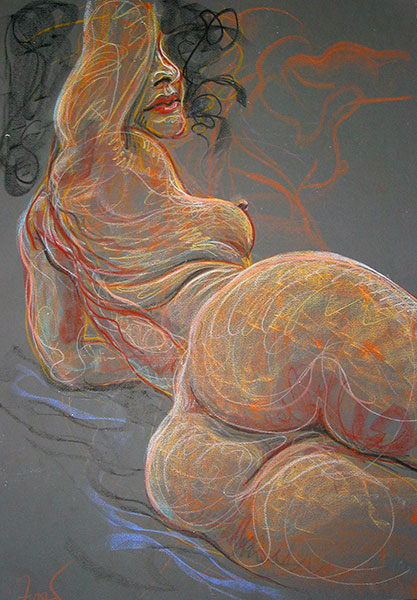
Callipyge, 2002, by Fred Hatt

“Life Drawing”, a group exhibition at Brooklyn’s Figureworks gallery celebrating twelve years of weekly figure drawing sessions at the gallery continues through July 29.  I have been a regular at Figureworks’ sessions since their inception, and two drawings I made there are in the show.  I posted an announcement of the show before it opened, but I’m posting again because the gallery is having a mid-show reception this Friday, so you have a second chance to meet the artists and check out the beautiful home-like space where we draw and where proprietor Randall Harris features a strong and diverse selection of figurative art.  Here are the details from Figureworks’ official ann0uncement of this week’s reception:

Come to Williamsburg this Friday the 13thOur current exhibition has gained great attention with many drawings sold since the opening reception in June.
New drawings have replaced the sold ones so a mid-show reception is in order.

Our reception is being held to coincide with Williamsburg Every 2nd Friday, a monthly gallery crawl when galleries stay open until 9pm with special events.

Life Drawing
12 Year Celebration
artists include:
Raina Bajpai
Susan Berkowitz
Rodney Dickson
Howard Eisman
Susan Hamburger
Randall Harris
Fred Hatt
Elliot Lloyd
Karen Miles
Doug Safranek
K. Saito
Samantha Smith

June 8 – July 29, 2012
Mid-Show Reception: Friday, July 13th from 6-9PM

at FIGUREWORKS

fine art of the human form

168 North 6th St. (1 block from Bedford Avenue “L” train)
Williamsburg, Brooklyn, NY 11211
www.figureworks.com

hours: Saturday and Sunday from 1-6PM

Since 2000, Figureworks has hosted a weekly life drawing session every Saturday morning before the gallery opens. Over the years we have showcased the drawings from those artists who have faithfully supported these sessions.

This year, taking advantage of this longevity, we have created a timeline using artist’s earlier works with their current endeavors. It is exciting to see this history. Some artists have retained their signature style with more confidence while others have chosen to explore new techniques and various mediums. The diversity of this group is remarkable, especially in medium, which includes Ink, magic marker, oil pastel, watercolor, graphite, and colored pencil.

It is worth noting that these exquisite figure studies were executed from 2 minute to 20 minute poses. They are fresh, spontaneous, and many times unfinished. Foremost, all of these drawings are explorations into form and the study of human anatomy, many never intended to be formally shown.

Figureworks is located at 168 N. 6th St., Williamsburg, Brooklyn, NY 11211, one block from the Bedford Avenue “L” train. The gallery is open to the public Friday, Saturday, and Sunday from 1-6 PM and is dedicated to exhibiting contemporary and 20th century fine art of the human form.
For more information please call 718-486-7021 or visit us online at www.figureworks.com


2012/07/04

Different Strokes

Porcupine, 1951, woodcut by Leonard Baskin


The magic of drawing or printmaking is in the strokes.  By strokes I mean the particular and idiosyncratic quality of the lines or other marks the artist makes.  Some lines jab while others meander.  Some markings are cloudy while others are crisp.  The strokes convey in a tactile way the essence of how the artist comes to grips with the challenge of capturing a thing seen or actualizing an inner vision.  Making a drawing is a journey of exploration, and these markings are the spoor of the trek.  When we look at a drawing, we can feel the energy that went into it in the particular flavor of its lineaments.

In this post I present a goodly selection of mostly monochrome sketches and prints by a wide diversity of masterly mark-makers.  I’ll let the works speak for themselves and leave it to you to contemplate the contrasts among them.  I have generally chosen pieces with a direct, spontaneous quality, avoiding highly finished styles where the quality of line may be more a matter of design than of the energy of the mind and the hand.  I often tried to find unfamiliar examples of the work of well-known artists, and sometimes individual works that are not representative of the artists’ familiar styles.  I think you’ll be particularly surprised by the early De Kooning sketch!

Man Walking in a Field, 1883, conte crayon drawing by Georges Seurat


Portrait, title, date and medium unknown, by Paul Cadmus


Composition, 1916, medium unknown, by Wassily Kandinsky


Edward Scissorhands, 1990, pen and pencil drawing by Tim Burton


Autumn, 1970, engraving by Salvador Dalí


Self Portrait, 1946, by David Alfaro Siqueiros


Musician portrait, date, title, and medium unknown, by Edgar Degas


Drawings, 1939, title and medium unknown, by Jackson Pollock


Saturn, 1516, engraving(?) by Hans Baldung Grien


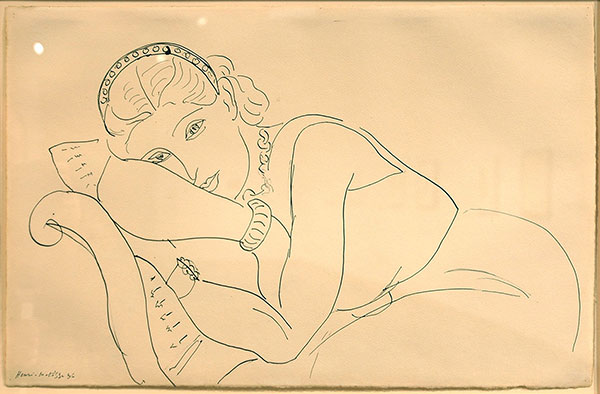
Resting Woman Wearing Tiara, 1936, pen and ink drawing by Henri Matisse


Sketchbook pages, date unknown, drawings by R. Crumb


Reproduction Drawing III (after the Leonardo cartoon), 2010, media unknown, by Jenny Saville


Self Portrait at the Age of Eighty-Three, 1843, ink brush drawing by Hokusai


Untitled, 1981, drawing by Jean-Michel Basquiat


Study for the Head of Leda, 1506, ink and chalk drawing by Leonardo da Vinci


Gregory Hines, date and medium unknown, sketch by Jules Feiffer


Study of the Head of Elizabeth Siddal for “Ophelia”, 1852, medium unknown, by John Everett Millais


Femme nue couchée, 1932, charcoal drawing by Pablo Picasso


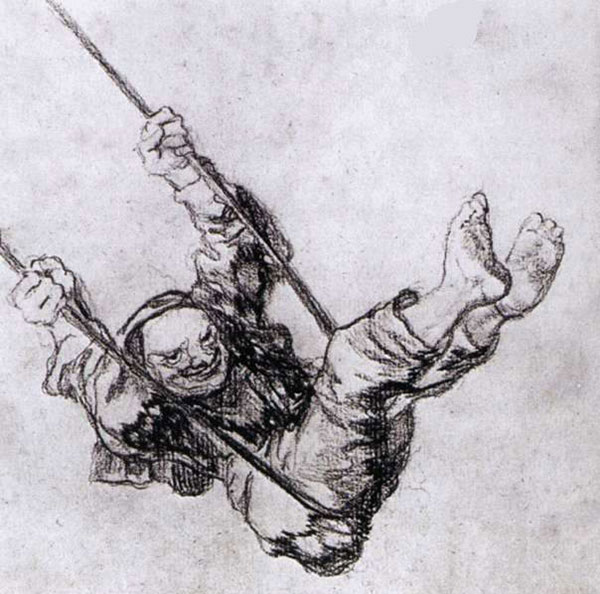
Old Man on a Swing, 1826, medium unknown, by Francisco Goya


Untitled, 1950, ink drawing on parchment by Philip Guston


Europa, 1953, lithograph by Hans Erni


Portrait of the Artist’s Mother, 1514, by Albrecht Dürer


Love Forever (TAOW), 2004, marker drawing on canvas by Yayoi Kusama


Bird Personage, date and medium unknown, by Remedios Varo


Court Room Scene, date and medium unknown, by Honoré Daumier


Beekeepers, 1568, etching(?) by Pieter Bruegel the Elder


Drawings, dates, titles and media unknown, by Alberto Giacometti


Self Portrait, date and medium unknown, by Henry Fuseli


Tree with Trunk, 1998, etching by Louise Bourgeois


Drawing, 1944, title and medium unknown, by Pavel Tchelitchew


Nude Study, 1908, etching by Georges Braque


The Sower, 1888, pencil and pen and ink drawing by Vincent van Gogh


Portrait of Elaine De Kooning, 1940, pencil drawing by Willem De Kooning


Some Can Fly and Some Can’t, 1939, medium unknown, by Rico Lebrun


Le Chapeau-Main, 1947, lithograph by Hans Bellmer


Sketch for “Apollo Slays Python”, 1850, medium unknown, drawing by Eugène Delacroix


Madame Louis-Francois Godinot, 1829, medium unknown, drawing by Jean Auguste Dominique Ingres, with detail


Corps de Dame, 1950, medium unknown, by Jean Dubuffet


Cape Lion, 1650, medium unknown, drawing by Rembrandt van Rijn


The Man who Taught Blake Painting in his Dreams, 1820, print(?) by William Blake


Five Swearing, 1912, oil sketch by Ferdinand Hodler


Madame Sohn, 1918, charcoal sketch by Egon Schiele


Seated Bodhidharma, 18th century, ink brush drawing by Suio Genro


All the images used in this post were found on the web, and clicking on an image will take you to the page where I found it.  Any information about the artwork that is listed as “unknown” is information I was not able to find at the time of making the post.  If you can provide additional or corrected information I will incorporate it.

Readers are invited to nominate some of their favorite drawings for an eventual sequel to this post!

Powered by WordPress

Theme Tweaker by Unreal