DRAWING LIFE by fred hatt

2011/08/30

A Torso Even More So

Filed under: Figure Drawing: Anatomy — Tags: , , , , , — fred @ 15:08

Face of the Body, 2011, by Fred Hatt

“Torso” is the art term for a depiction of the human form focused primarily on the trunk of the body rather than the head or limbs.  The word derives from a Greek/Latin word meaning stalk.  It’s a botanical analogy, like its synonym, “trunk”, the core out of which the branches grow.  The Greek root word, thyrsos, denotes the magic wand of the followers of Dionysos, a god of fertility, ecstasy, ritual madness, and theater.  The thyrsos, a fennel rod with a pine cone head, twined with ivy vines, embodies the unruly and indomitable life force.

Nautilus, 2011, by Fred Hatt

The torso often expresses this life force in its ability to twist, though as far as I can determine it is a coincidence that the word torso resembles the word torsion.  Torsion means twisting, and that word is related to the terms torque, torture, and torment.  The torso can express coursing vital energy but also vulnerability, leaping joy and convulsive anguish.

Mesh Fem, 2010, by Fred Hatt

The torso includes the heart and lungs and the organs of digestion and sex.  It is the seat of gut feelings, and of the swellings of erotic desire, hunger, and pride.

Supine Lotus, 2010, by Fred Hatt

We all grow in the womb and find our first nourishment at the breast.  Humans and other mammals crave the feeling of warmth and acceptance that is only felt in an embrace with full body closeness.

Arranged Around the Knee, 2011, by Fred Hatt

The torso is a rich subject for the artist because of its complexity of form, revealing different aspects at different angles of view and in varying relationships to the limbs and head.

Oxbow Hip Curve, 2010, by Fred Hatt

In drawing the body, I always imagine that my hands are feeling it, clasping the waist, holding the ribcage, following the underlying structure of bones and the fibers of muscle, sensitive to the warmth of the body, the expansive tide of the breath and the buzzing of nerves and blood vessels.

Inverted Rest, 2011, by Fred Hatt

The arms and legs thrust or relax outward in various directions, and their long forms create expressive angles, but the origin of the energy expressed by the limbs is always found in the core of the body.

Iliac Power, 2010, by Fred Hatt

My friend Mana Hashimoto, a dancer who is blind, teaches workshops on “Dance Without Sight“.  Part of her workshop involves observing the movement of another person by touch alone.  When I took Mana’s workshop I was struck by how clearly I could  understand all the movements of another person with hands placed gently on the back.  It was impossible to follow a dance by touching the head or extremities, but a hand on the back could feel the movements of all parts of the body, including the head, arms, and legs.

Back and Bottle, 2011, by Fred Hatt

The classic standing pose in figurative sculpture and painting is “contrapposto“.  This generally means the weight of the body is primarily on one leg, causing the pelvis to be tilted, and usually the shoulders are tilted in the opposite direction.  The slight asymmetry that is introduced in this way gives an appearance of liveliness to a still figure.  In practice, there are countless variations on the basic principle of contrapposto, as the ribcage/shoulder girdle and the pelvis can each be shifted or tilted in many directions, and the spine can be arched forward or back, bent to the side, twisted, extended or compressed.

Curved Torso Straight Arm, 2011, by Fred Hatt

Symmetrical poses, however, do not need to appear rigid.  In fact, symmetrical poses can be very relaxed because of their balanced weight. Looking at such a pose from an angle is all it takes to give assymmetry to a drawing, and if the artist’s calm hand follows the calmness of the model, the picture will have a certain serenity.

Balasana, 2011, by Fred Hatt

In a drawing, the body reveals its structure in the form of curves and angles going in various directions.  In the drawing below, note the forward thrust of the shoulder softened by the curling hair, and the rearward angle of the elbow balanced by the point of the breast.

Chair Back, 2010, by Fred Hatt

The outside contours of the body, the curve of the spine, and the shadows and highlights make the drawing below a study of sinuous flow.

Sheen, 2010, by Fred Hatt

The contrapposto principles can be seen even in an unusual seated pose seen from the side, as below.  A line drawn across the nipples and one drawn across the crests of the pelvis would create an angle pointing to the right.  The head turns away from the viewer while the far knee and hand come toward us, giving the pose that dynamic twist, while the near arm reaching out of frame to the left acts compositionally like an unresolved chord in music, keeping things a bit off balance.

Hoop Earring, 2011, by Fred Hatt

The spine is really the core of the body, and its movement is a key to the energetic expression of the pose.  Notice the difference in the next two drawings.  Here the spine seems to be lengthening, rising up.

Uplifting, 2011, by Fred Hatt

In the one below, by contrast, there’s a feeling of weight, of the spine relaxing downward.  Unlike most of the other drawings in this post, these two show facial expressions, which surely contribute to the contrasting moods, but even if you cover the faces you can see the difference in the energy.

Leaning on Wall, 2011, by Fred Hatt

In the two drawings above, the abstract treatment of the light around the figures suggests a kind of energetic aura.  In the drawing below a similar effect is achieved by using colored lines to indicate the complex ways that various light sources, both direct and reflected, flow over the curves of the body.

Mesh Masc, 2010, by Fred Hatt

All the parts of the torso are formed around a center line.  I try to locate this center line and then to develop the forms to either side, sketching with cross-contours, or strokes that follow the three-dimensional shapes of the body.

Terrestrial Body, 2010, by Fred Hatt

Here’s another contrapposto from behind, with the angles of the legs echoing the angles of hips and shoulders.

Helical Zigzag, 2011, by Fred Hatt

The energy of the pose below emerges powerfully from the stable center of the sacrum, the base of the spine.  The cross contours show the structure of muscles and bones of the back as a kind of swirling energy.

Sacral Center, 2010, by Fred Hatt

Here’s an unusual pose supported on one hip and forearm.  All four limbs are bent at more or less right angles, all pointing in different directions.

Lateral Bridge, 2011, by Fred Hatt

The features of the frontal torso are arranged similarly to the features of the face.  The face is the window of the soul, showing emotion, intelligence, engagement.  The torso is the face of the life force, showing energy and balance and movement.

Hand on Hip, Forearm on Doorknob, 2011, by Fred Hatt

The torso can embody vigor, sensuality, boldness, timidity, and so on.  The quality of spirit resides in the body as well as in the mind or brain.  Entering into a contemplative state requires releasing and balancing and stabilizing the energy of the body as well as the mind.

Grounded Sitting, 2011, by Fred Hatt


All the drawings in this post are about 50 x 65 cm, or 19 1/2″ x 25 1/2″, aquarelle crayon on paper.  All of these were drawn during 20-minute poses at Figureworks Gallery in Brooklyn.

(The title of this post is a line from the song “Lydia the Tattooed Lady”, by Harold Arlen and Yip Harburg, made famous by Groucho Marx in the 1939 film “At the Circus”.)

2011/08/22

Curiosity as Cure

Filed under: Abstract Art,Art and Philosophy — Tags: , , , , — fred @ 15:29

Sound Suit, 2011, doodle by Fred Hatt

Sometimes there’s something I’d like to write about, but I don’t have good visuals to accompany it.  And sometimes I have images I’d like to share, but can’t think of much to say about them.  I’ve always considered the combination of words and pictures to be the essence of Drawing Life as a blog.  Here I’m going to talk about some ideas that are close to the heart of my artist’s philosophy, my intuitive sense of the moment we humans find ourselves in.  I’ll intersperse these ideas with some of my recent doodles.  There’s no direct correspondence between the pictures and the words, except of course that doodling is what I often do while listening to someone drone on and on, and if I’m going to drone on in text, I may as well break up the words with some of my wiggly, loopy lines.

Multitask, 2011, doodle by Fred Hatt

In 1999-2000, the American Museum of Natural History in New York hosted a temporary exhibit called “Body Art:  Marks of Identity”.  It was a survey of tattooing, piercing, scarification, body painting and other kinds of body modification across many cultures and through history.  My friend Matty Jankowski, a tattoo artist and a collector and scholar of materials and artifacts related to the history of body arts, was one of the consultants to the curators of the exhibit.  Thanks to Matty, a few of my own body painting images were included in a portion of the show devoted to contemporary body art.

Herald Angel, 2011, doodle by Fred Hatt

Matty also worked with the education department of the museum to present some special programs.  One day there was a kind of open house for the public to learn about body art from artists.  There was a henna artist, a tattooist, a piercer, and I was there as a body painter.  There was a slide show, and all of the artists gave brief presentations on their particular crafts.  People attending the workshop were given the opportunity to try out an electric tattoo needle on a honeydew melon.  The henna artist and I had our materials on hand to give temporary body art to anyone who wanted it.

Bug & Oak, 2011, doodle by Fred Hatt

There were a lot of parents with young kids at the event, and many of them formed an orderly queue at my body painting table.  Most of my previous experience of body painting was with adults, in my own studio or in art galleries or performance settings, but that day I had a long line of little kids, with their parents, waiting their turn.  As I was painting, I heard the parents talking to their kids:  “What do you want?  Just think about what you want and tell the man what you want?  You can get whatever you want.  Do you want a butterfly?  Do you want a dragon?  Decide what you want and the man will paint it for you.”  Kids were presenting their tiny arms and asking me to paint Furbys or Pokemon characters I’d never seen before.  A small minority, maybe one in ten, would show some curiosity, would ask questions about my paints or my experiences painting people, or would say, “Just paint whatever comes to you,” or “Go wild.”

Cornucopia, 2011, doodle by Fred Hatt

Listening to the endless litany of “What do you want?”, I realized that indoctrination into the consumer mindset wasn’t just accomplished through TV commercials and mass marketing campaigns bankrolled by multinational megacorporations.  Parents were actively programming their kids to the idea that everything was about consumer choice and acquisition, about defining desires and having those desires satisfied.  Even such an odd experience as having a strange artist paint on your arm or hand or cheek was reduced to choosing a brand and displaying it.

Sole & Canopy, 2011, doodle by Fred Hatt

Recall that the name of the exhibit was “Body Art:  Marks of Identity.”  The thesis of the curators was that body art was used to mark its wearer as a member of a tribe, to indicate a special cultural role such as warrior or bride.  These children, under the relentless prodding of their parents, were engaging in the modern form of this practice, something the commercial world calls “branding”.  (Of course the term derives from the practice of searing a mark of ownership into the hide of a livestock animal.)  We are encouraged to define ourselves by our choice of symbols, corporate logos, or popular culture.  It is no longer so much about our role in society, but about our status as consumers.

Cretan Goddess, 2011, doodle by Fred Hatt

The curious minority in my body painting queue hadn’t been steered to see every opportunity as a consumer choice or a branding of their identity.  They saw this as a chance to experience something fresh, to learn something new.

Coral, 2011, doodle by Fred Hatt

The consumer mindset says “The one who dies with the most toys wins.”  It’s a zero-sum game, a world of winners and losers.  The curious mindset says “We live in a world of inexhaustible wonders.  What will I experience today?”  It is a world of free play, a world of abundance for all.  It is not a zero-sum game because it’s oriented towards experience, not ownership.  One who collects experiences does not deny them to others.

Bicycle, 2011, doodle by Fred Hatt

We humans are now in the early stages of a great crisis.  The industrial revolution of the past three centuries has allowed the human population to increase tenfold (it has more than doubled just in my lifetime), and has provided to the common person comforts and luxuries once reserved for kings, even luxuries unimagined by kings.  All of this was made possible by fossil fuels – hundreds of millions of years worth of stored energy expended in an explosive orgy – and by an economic system in which constant increase is the only definition of wealth.  For a few centuries it worked, because there were always new natural resources to be discovered, always undeveloped places to develop and unexploited markets to expand into.

Beatrice, 2011, doodle by Fred Hatt

Alas, we are now coming to that inevitable point where the exponential growth curve must become a bell curve, leveling off and sloping back down, if we are to survive.  The earth itself is beginning to assert its limits, to push back against unchecked growth.  Climate change and resource depletion are becoming costly problems that cannot be solved by ever more spending and extraction and ever more complicated technology.  Our economic system, based on lending at interest, needs constant growth, but facing the slowing of real expansion, it is now just blowing bubbles.  The owners of great wealth are trying to hold onto what they have by no longer sharing their bounty with the masses, but this strategy may ultimately fail too, as wealth defined as growth evaporates when growth stops.

Pipe Organ, 2011, doodle by Fred Hatt

Everyone is in denial now, imagining that there is something that will make the material economy grow again.  But we don’t need more growth.  Human population increase needs to slow down.  Expansion in the per capita consumption of energy and natural resources needs to slow down and even begin to contract.  From the standpoint of the capitalist economy, the slowdown of growth is a dire crisis and even a disaster.  From the standpoint of planetary health, the slowdown of growth is an essential correction.

Eye Pop & Face Slap, 2011, doodle by Fred Hatt

A child’s body grows by leaps and bounds, but when maturity is reached, physical growth slows and stops.  Getting bigger is for childhood, but in adulthood it gives way to spiritual and mental development.  Wisdom, skill and knowledge, the immaterial aspects of the living being, can expand for a lifetime.  Unchecked growth of the organs and tissues in an adult is cancer.

Merkin Raygun, 2011, doodle by Fred Hatt

There is now widespread agreement that we need to find “sustainable” technologies and ways of life.  Many still seem reluctant to see that a sustainable economy must be a steady-state economy, not one based on constant growth, at least not as regards population and conversion of raw materials into stuff and stuff into trash.

Insect, 2011, doodle by Fred Hatt

The consumer/industrial economy says profits must get ever bigger.  Every generation must have more material wealth than the one before.  Our stores have become superstores, our houses mansions, our cars trucks, and our bodies obese.

Spaghetti Structure, 2011, doodle by Fred Hatt

Marketing propaganda is so pervasive in our culture that we internalize it.  We base our sense of identity on our consumer choices, and raise our children to be good consumers above all.

Winehouse, 2011, doodle by Fred Hatt

Our highest value is choice.  We associate choice with democracy and the modern way of life.  We have so many choices now we may feel paralyzed by indecision.  Constantly making choices gives us a limited kind of freedom, but it is constrained by the options that are offered to us:  Democrat or Republican, Wal-Mart or Target, paper or plastic.   The more we are focused on these choices the more we can be prevented from imagining what other possibilities are not being put before us.  The more we define ourselves by choices the more we box ourselves into categories the marketers can exploit.

Nutcracker, 2011, doodle by Fred Hatt

The curious mind is always wide open, finding interest and beauty in whatever it encounters.  It is always engaged with the unknown, asking questions, speculating, wondering.  The curious mind moves through the world on an exploratory path, following beauty and seeking knowledge.  The curious mind tries to maximize flexibility and avoid being boxed in.

Fruit Tree, 2011, doodle by Fred Hatt

Our civilization faces a difficult period as natural limits awaken us from our dream of opulent consumption.  There will be a period of denial, recrimination, rage.  Those of us who have devoted our lives to curiosity and creativity already know there are pleasures deeper and more satisfying than those offered by consumerism.

Secret Language, 2011, doodle by Fred Hatt

Even as we are forced to cut back, to use less energy and less materials, even as extravagant materialism slips out of the grasp of most people, opportunities for learning and experience will remain abundant.  Creative minds that can ask penetrating questions and imagine fresh solutions will be needed by all.  Curiosity and creativity will see us through stormy times.


Stealth, 2011, doodle by Fred Hatt

The doodles that illustrate this post were all made in the last few months.  All are made with Tombow brush markers on letter-sized printer paper.


2011/08/12

Chaotic Landscape

Filed under: Drawing: Experimenting — Tags: , , , , , , , — fred @ 21:36


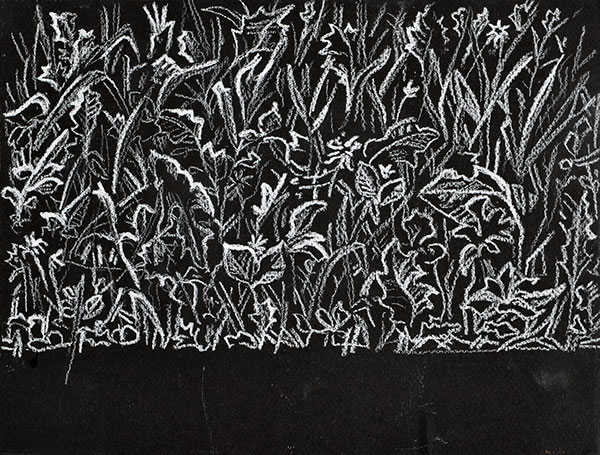
Mixed Grass, 2011, by Fred Hatt

Drawing landscapes and plants is not my strong suit.  I love wildernesses and gardens, but I feel overwhelmed trying to capture their forms in drawing or painting.  They present a bewildering chaos of detail, a vast, borderless scale, and a range of color and tone that makes my palette look paltry.  My urge to draw operates comfortably at the scale of the human body, a form and an expressive range I know intimately from inside and out.  But the body is a product of Earth, an efflorescence of organic forms that reflect evolutionary history and evoke the forms of the land and its creatures.  A hip is a hill, an ear a shell, an elbow a crooked branch.  Even if the body is my primary subject, I need to understand it as a microcosm by looking to the macrocosm.  And purely from the standpoint of practice, I can only benefit by straying outside my comfort zone, trying to draw what I am incompetent to draw.  In this post I’ll present some of my awkward stabs at landscape.  I’ll immediately make them look worse by setting them in the context of some real masters!

The sketch of my own I’ve chosen to head this post was made while looking at a field of mixed short grasses and weeds in a rural field.  I was struck by the variety of different leaf shapes all jumbled together.  What seems at first glance a tranquil and plush tapestry of green becomes on close inspection a dense jungle, and that is surely how it would appear if you could shrink to the size of an ant to make your way through it.

Below is Albrecht Dürer’s astonishingly realistic watercolor portrayal of a similar patch of sod, known as the “Great Piece of Turf”  (Go to this link to see it in a much larger size).  Botanists can clearly identify at least nine species of herbs in this drawing.  The production of this painting was an act of profound and sustained meditation on the reality of nature, made at a time when nature in art was usually idealized and symbolic, a mere setting for human and spiritual subjects.  The artist’s intensity of attention, directed at something that most would see as utterly inconsequential, has preserved a bit of nature over the centuries like a specimen in amber.  Dürer has captured the chaotic quality of wild plant life, but has somehow given it a kind of clarity that even photography couldn’t provide.  This painting sets a standard that every great naturalist illustrator can only hope to approach.

The Great Piece of Turf, 1503, by Albrecht Dürer

Even if the detail of photography rarely achieves the clarity of Dürer’s vision, by the late nineteenth century many painters had ceded this kind of hard physical detail to the new light-capturing technology and tried instead to depict the wild energy of the natural world with brushy, gestural strokes of color that give a sense of leaves fluttering in a breeze and rays of light dancing over and through shimmery water and misty air.  Claude Monet painted the same scenes over and over again, at different seasons and times of day, striving to capture the mercurial subtleties of luminosity and atmosphere.

Rainy Morning on the Seine, 1890’s (?), by Claude Monet

Charles Burchfield is a magical realist, seeing the natural world as a physical manifestation of different qualities of spiritual energy.  The forms of land and sky and plants are abstracted slightly to more closely resemble the Platonic archetypes of these forces.  The chaos is there, but it is unified within a greater spirit of pure Nature.

Dawn of Spring, 1960’s (?), by Charles E. Burchfield

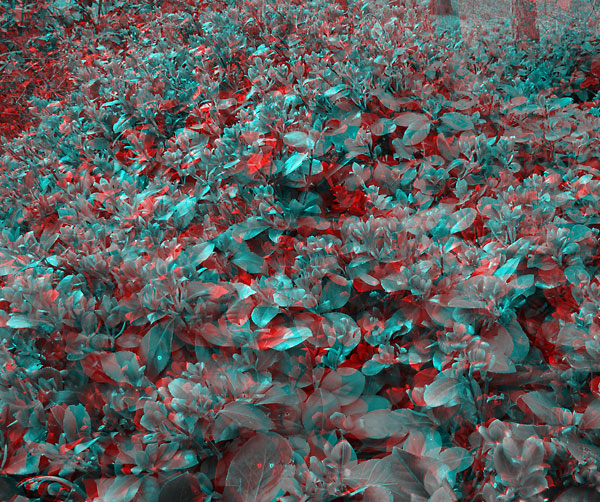
I have usually avoided drawing and painting the landscape, but I’ve frequently tried to capture it with photography.  I’ve always felt especially drawn to the raw and ragged forms of uncultivated plant life.  Thick thatches of foliage are challenging subjects even for photography, as the transition from three dimensions to two reduces the bursting and branching shapes to a flat patchwork like a camouflage pattern.  Stereo photography can better portray the complexity.  If you look at the picture below (previously posted here) with red/cyan 3D glasses you’ll see what I mean.  If you look at it without glasses, it’s pure abstract field.

Sprouting Hedge, 2010, stereo photo by Fred Hatt

But now let’s take a look at some of my recent fumbling attempts to draw complex, chaotic plant forms.  Just today I took a sketchbook and a camera to my neighborhood park.  Here’s a snapshot of a particularly plush evergreen tree, and below it, my scribbly marker sketch, drawn from direct observation of the tree without any reference to the photo.

Evergreen, 2011, photo by Fred Hatt

Evergreen, 2011, sketch by Fred Hatt

The drawing doesn’t get much of the texture or spatial form of the tree, but it has, perhaps, something of its energy.  Another day I made a sketch of the plants growing in a window box, with these ornate curly leaves in front of a stand of long spear-like leaves.  This is a smaller subject, a closer focus, and a more careful hand with the drawing.

Leaves, 2011, by Fred Hatt

Here’s a sketch of a flowering plant with trumpet-shaped flowers (some kind of orchid?) drooping thickly around a central stalk.  (If anyone recognizes any of the species depicted in these drawings, let me know – my botanical taxonomical knowledge is practically nonexistent.)

Flowers, 2011, by Fred Hatt

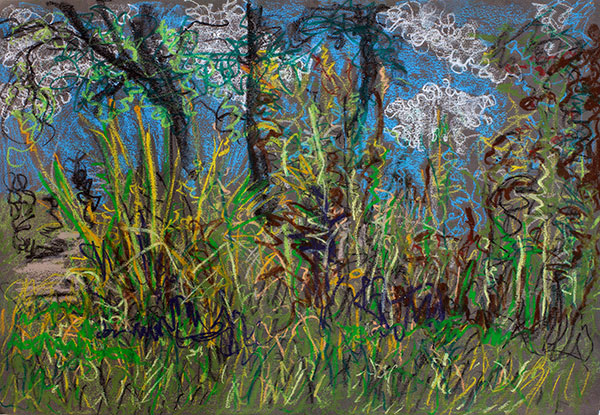
Last month I spent a week teaching workshops and attending the festival at the Brushwood Folklore Center in Western New York State.  I spent some of my spare time making crayon sketches.  Here you see the fire-builders’ woodpile in the foreground, the Roundhouse (a sort of ritual structure for drum circles) and bonfire stack in the middle ground, and the trees of the forest in the background.

Roundhouse and Bonfire Stack, 2011, by Fred Hatt

The sky was clear, deep and luminous, with the great zaftig white bodies of cumulus clouds lazing across the heavens like manatees in a warm current.

Clouds, 2011, by Fred Hatt

Near my campsite was this traditional Plains Indian tepee.

Tepee, 2011, by Fred Hatt

This last Brushwood landscape was drawn a couple of years ago.  This is a clump of plants in the hollow under a big tree where the henna artists and body painters decorate people.

Under the Henna Tree, 2009, by Fred Hatt

I still always feel completely unequal to the task when I try to make a drawing from a landscape, but I try to open myself to the chaos and let some attenuated remnant of that vast current flow through me and into my sketch.  I may feel like a mouse trying to sing opera, but sometimes it is better to squeak than to be silent.

Drawings on black paper are 9″ x 12″, medium is aquarelle crayon.  Drawings on white paper are 11″ x 14″ or smaller, medium is brush-tip marker.  The images of pieces by other artists were found on the web; clicking on a picture links to source.

2011/08/07

Made Man

Dear readers, I’ll have another post for you here some time this week, but in the meantime check out my “guest post” on Daniel Maidman’s blog.  Daniel’s a figurative painter, of a more classical bent than me, and he’s also a stimulating writer, often considering artistic issues in the light of scientific and philosophical ideas.  I wrote a rather extensive comment on Daniel’s recent post, “The Integrated Visual Field”, going into what I’ve learned about the science of human visual perception as it pertains to observational drawing.  Daniel invited me to expand on that response, and then he combined my comments with those of Stephen Wright, another really interesting figurative artist, and made the whole thing into this guest post.  I hope some of you will appreciate being turned on to Maidman’s blog.


2011/08/02

Try, Try Again

Filed under: Figure Drawing: Practice — Tags: , , , , , , — fred @ 23:28

Marilyn 1, June, 2011, by Fred Hatt

Last week I posted about the master of the “naked portrait”, Lucian Freud, who often spent hundreds of hours over a period of many months on a single painting.  Naked portraits are also among my practices, but I lack the patience to spend so much time laboring over a single image.  I feel my best work arises more from spontaneity than from perseverance, and so I just churn ’em out and hope a few are worth saving.

I run a weekly session at New York’s Spring Studio featuring a nude “long pose” – long by sketch standards, not by oil painting standards.  My class lasts three hours and starts with a set of two-minute warm-up poses; subtracting that set and breaks, the amount of time allotted for drawing the pose amounts to two hours.

Most artists work on a single drawing or painting during the session.  So do I, sometimes, but I also frequently decide to start over again one or more times.  In this post I’ll share recent examples of multiple tries at the same pose from the same viewing angle.  I’m sharing some of my failures, work I wouldn’t normally exhibit, because of what they reveal about my process.

The sketch that opens this post shows how I begin analyzing the angles of a pose.  You can see how I use a combination of triangulation and rhythmic curves to find the tension and structural energy of the pose.  In my second attempt, below, I’m building on that analysis, but drawing closer.  I often use lines to indicate the contours between shadows and highlights.

Marilyn 2, June, 2011, by Fred Hatt

Finally, I decide that all the magnificent arches and cantilevers of this pose are distilled in Marilyn’s face, with its pointed eyebrows and lips, and the lovely taut bow of the collarbone.

Marilyn 3, June, 2011, by Fred Hatt

Christophe is a model with an acting background, and his specialty is facial expressions.  Here he gave us anguish, leaning to one side.

Christophe 1, June, 2011, by Fred Hatt

Here I spent most of the session developing the drawing above.  At some point near the end of the session I decided I’d best stop working on it. lest I overwork it and destroy its power, a mistake I still sometimes make.  So I spent the last half hour or so simplifying what  I’d learned from the previous hours of study of Christophe’s expression into a linear abstraction of emotion, below.  Even though this drawing is an afterthought, I think it’s stronger than the one I spent more time on.  I wouldn’t have been able to do something like this from the start – its simplicity only arises from the experience of prolonged looking.

Christophe 2, June, 2011, by Fred Hatt

Here’s one of my favorite models, Betty.  I think I began drawing using the yellow crayon sideways to indicate the highlights of the body, then used white and black lines to delineate details and the contours between highlight and shadow areas.  Proportions are wildly off here, with the head half the size of the torso.

Betty 1, July, 2011, by Fred Hatt

So I started again and developed this figure in relation to the elements around it.  The head may still be a little too big, but that’s my strongest distortive tendency.  The face has so much structural complexity and carries so much expressive power, it needs as much space in the drawing as it needs!

Betty 2, July, 2011, by Fred Hatt

Below is another example where I managed to come up with a representation of the model’s face, body and expression that was pretty satisfactory, overall, but a bit dull, perhaps.

Mitchell 1, July, 2011, by Fred Hatt

So I moved in on the face and tried to summarize its specificity in line.

Mitchell 2, July, 2011, by Fred Hatt

Here’s stage one of a look at Luke’s seated pose.  All the drawings in this post were made during the summer.  In the hot months, the aquarelle crayons I use are softer and lay down a thicker layer of wax than they do in the cooler months.  Once there’s a certain density of wax on the paper, revision is hopeless.

Luke 1, July, 2011, by Fred Hatt

A second attempt shows my understanding of the figure sharpening.  Here I’m using a lot of cross-contours.

Luke 2, July, 2011, by Fred Hatt

Finally, again, I move in closer.  Here the style I”m using is like carving with a chisel.  I’m trying to approximate colors by the method of optical mixing.

Luke 3, July, 2011, by Fred Hatt

The final series of drawings in this post is from this past Monday.  This was my first shot at drawing Leah, a model that has inspired several lovely paintings by Daniel Maidman.  I started out measuring the pose by head-lengths.

Leah 1, August, 2011, by Fred Hatt

In the second attempt, the head was oversized – my usual tendency.  The pose has subtly changed since the first set, with the left knee and arm covering less of the torso.  Most of the artists were clustered to the model’s right side during this pose, and probably didn’t even notice the change in the pose.  I took advantage of it to study the structure of the chest and abdomen.

Leah 2, August, 2011, by Fred Hatt

My third try at this pose finds me moving closer, to allow a more detailed treatment of the face.  Still not quite right, though.

Leah 3, August, 2011, by Fred Hatt

Here’s the final try, developed during the last third of the session.  I still haven’t really captured Leah’s face, but I’m happy with the color and the challenging dangling hand in front of the thigh.  It can be hard to really get the essence of a model in the first session of studying her or him – you get what you can, and then time’s up!

Leah 4, August, 2011, by Fred Hatt

All the drawings in this post are aquarelle crayon on paper, 19 1/2″ x 25 1/2″ (50 cm x 65 cm).  Similar previous posts showing multiple attempts at the same pose include Variations and Redrawing.

Powered by WordPress

Theme Tweaker by Unreal