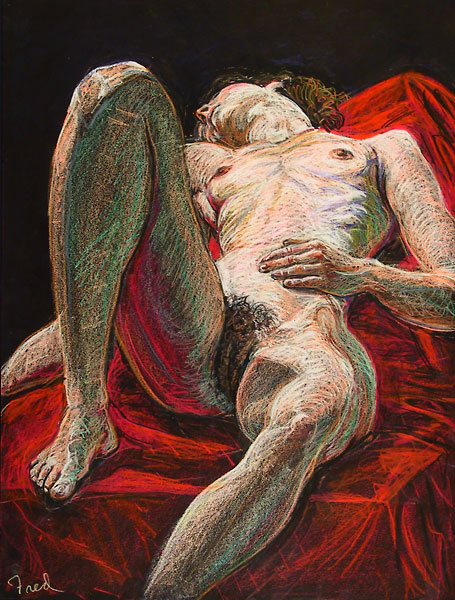
DRAWING LIFE by fred hatt

2010/10/07

Nudes with Projections

Nox, 1996, by Fred Hatt

Some readers have expressed an interest in seeing more of my early figurative drawings, and more of my more “finished” work, so here’s a post drawn from the early years of my intensive practice of life drawing.

In 1996 I had been practicing life drawing regularly at New York’s Spring Studio for two years.  Minerva Durham, the artist and teacher who founded the studio, asked me to be the monitor (overseer, proctor, invigilator) of a regular once-a-week three hour long pose figure drawing class.  I had to show up every week at the same time, whether I felt like it or not, and take responsibility for the smooth operation of the session.  There was no pay, but I got to draw for free.

I had been developing a technique of color drawing with crayons on dark-toned paper, trying to get much of the richness of painting with the speed and spontaneity of drawing.  For me, three hours was a long time, and  my greatest challenge was to sustain the focus for such a protracted period.  (I can hear the oil painters laughing!  The egg tempera painters just sigh disdainfully.)

Creating a satisfying composition within three hours soon proved to provide plenty of diversion for my short attention span.  Of course the study of the human body and how to render its form and expression is the first task, but if you spend the whole time on that you end up with a figure floating in a void.  In reality, the body exists in an environment, with gravity and light and spatial relationships.  The actual setting of the model in the studio, though, is cluttered and distracting.

I really had no interest in placing my models into fake nature, mythological forests or imaginary harems.  A more abstract treatment of the background seemed the most promising approach.

I had been attracted to drawing more than to painting partly because I was interested in the direct expressiveness of the artist’s marks.  In a painting, these marks tend to get blended and obscured, whereas in a drawing they remain more visible.  Of course, now that I was developing my figures over several hours, striving towards an illusion of reality, as my drawings were becoming more polished, the process of the drawing was becoming more obscured.  So it struck me that I could use the background to reveal some of the process of abstract analysis that the artist goes through on the way to even the most photographic rendering.

Web, 1996, by Fred Hatt

I always figure out a pose partly by tracing angular relationships between different parts.  There’s a line from the knee to the shoulder, a line from the left nipple to the navel and another from the nipple to the notch of the collarbone, and on and on.  Every landmark of the figure has an angular relationship to every other landmark.  In the figure above the original markings that were made in constructing the figure were darkened and extended, creating a web of relationships in which the figure is suspended.

Pensée, 1997, by Fred Hatt

That approach proved fruitful.  What began as a study of internal relationships vanished from the drawing of the body as its light, shadow and color was developed, but then reappeared in the space surrounding the body.  The internal structure manifested in its spatial container.

Gem, 1997, by Fred Hatt

Sometimes the lines were more delicately indicated by their points of intersection.

Filament, 1998, by Fred Hatt

I tried to show the body itself as close as possible to what I actually saw, and to use the surrounding space to show its hidden geometry.

Throne, 1998, by Fred Hatt

At times the treatment could be more subtle, suggesting not so much hard geometrical structure, but a field of energy.

Space, 1998, by Fred Hatt

The pose below has a particularly clear simple triangular structure, so the projected lines show the sub-triangles that give it facets.

Pyramid, 1998, by Fred Hatt

The body can be projected in curves rather than straight lines.  Shadows, furniture and objects, and folds of fabric also create a linear environment in which the figure is embedded.

Rings, 1998, by Fred Hatt

Miha, 1998, by Fred Hatt

The figure below was perched symmetrically on a stool.  I didn’t bother to draw the stool, but instead traced a stack of horizontal markers that define the proportions of this pose:  ankles, knees, hipbones, breasts, shoulders, eyes and ears.

Pagoda, 1998, by Fred Hatt

The angles of the figure imply a crystalline structure that defines the person’s energetic being in geometrical terms.

Start, 1998, by Fred Hatt

Every being is an organic manifestation of a web of relationships.

Ombre, 1998, by Fred Hatt

Action is structure.

Bagua, 1998, by Fred Hatt

The engagement of a person with their environment is an organic flow, at least as complex as the internal flow that sustains the life of the individual.

Oeil, 1998, by Fred Hatt

All of these drawings are aquarelle on paper, around 18″ x 24″ or a bit bigger.  More selections of my work from this period can be seen at the portfolio I put online in 2000, as well as in several posts on this blog.

2010/09/26

End-On: Extreme Foreshortening

Filed under: Figure Drawing: Poses,Top Ten — Tags: , , , , , — fred @ 23:18

Dynamo, 2010, by Fred Hatt

My friend, model/muse and blogging mentor Claudia likes to post photos of herself to celebrate the anniversaries (first, second, third) of the launching of her great blog, Museworthy, and it has been my honor to be the chosen photographer each year so far.  This year we were seeking a new approach.  Claudia had the idea of getting in low and close with the camera, treating the body as a landscape.  She chose this sensual abstraction for this year’s anniversary post.

I love seeing the body this way.  Unusual angles create perspective effects and unfamiliar juxtapositions, and utterly transform the familiar forms of the body.  Foreshortening is a fundamental concept in drawing, designating the distortion of long shapes when seen end-on.  Often, in figure drawing, this refers only to an arm or leg that appears pointed toward the viewer of the image.  A familiar example would be the pointing finger and arm of Uncle Sam in James Montgomery Flagg’s iconic army recruiting poster of 1917.  Here I post examples of my figure drawings in which not only the extremities but the entire body is seen from a foreshortened perspective.

Looking at the body from an angle close to the central axis is very helpful in understanding it as a three dimensional form.  In these foreshortened torsos, we see the protuberances of the iliac spine of the pelvis rising to either side of the pubic bone.  The abdomen is a saddle-like shape, concave in one direction and convex in the other.  The ribcage is a converging arch.  The pectoral or breast muscles show a continuity with the deltoid muscles of the shoulder.  The upper of these drawings still shows analytical lines I drew to figure out the angular relationships of bodily landmarks.

Surveyed, 2004, by Fred Hatt

Thorax, 2009, by Fred Hatt

Looking at the body from the head end shows a succession of rounded or symmetrically swelling forms:  the top of the skull, then the cheekbones and nose, the jaw, the collarbone, the shoulders, the chest, the ribs, the abdomen and pelvis.  You can see it as a kind of architecture based on a series of differently shaped arches that you pass through or over, or as a landscape of hills and valleys that you can traverse on a meandering trail.  From this angle the legs and feet are often severely forshortened, and are best observed in relation to the cross-sectional contours of the torso.

Lounging, 2000, by Fred Hatt

Head End 2, 2006, by Fred Hatt

Head End, 2006, by Fred Hatt

I try to see organic physical forms as manifestations of patterns of energy.  In looking down the length of the body, you can see each of these levels as manifestations of the elemental forces associated with the chakras, a series of focal points arranged along the central column of the body in a Yogic conception of energy anatomy.  For example, the pelvis, corresponding to the water element, has the form of a basin, while the chest, corresponding with the air element, has the form of a bellows.  Here are a few sketches from a series exploring the energy patterns of the body in this context:

Strata, 2002, by Fred Hatt

Flat, 2002, by Fred Hatt

Zones 1, 2002, by Fred Hatt

To see the body in extreme foreshortening, I find it helpful to look at it not in terms of an understanding of structural relationships and proportions, but cross-sectionally, as a series of transverse contours receding in space.  The National Library of Medicine’s Visible Human Project, a three-dimensional atlas of human anatomy, has a website that offers animated “fly-throughs” of the human body in the various planes of sectioning.  Here’s the transverse section animation, the one most relevant to these end-on views of the human body.

Here are some more of my compositions of the body in extreme foreshortening:

Crossed Ankles, 2004, by Fred Hatt

Nuit, 1999, by Fred Hatt

The examples above are drawn from a distance of at least three meters and so show a sort of compressed perspective.  The feet and head are roughly in the same proportional scale but the angle of view has caused things to be seen in unfamiliar juxtaposition.  The drawing below is drawn from much closer, so it shows more perspectival diminution.  The feet and legs, closer to me, are large in comparison to the upper body and head, which are further away.  The length of the foot, measured on the drawing, is more than twice the width of the skull, but it looks right because it represents the perception of perspective.

Perspective, 2010, by Fred Hatt

In this foot-end view, the angles of the feet and legs are the foreground of the drawing, while the upper body becomes the mountain on the horizon.

Side Drawn Up, 2001, by Fred Hatt

Prone Reach, 2006, by Fred Hatt

Splay, 1999, by Fred Hatt

When the head is the foreground element, it remains abstract as we are looking at the top of the skull, and the face, if seen, is highly abstracted.  The body is even more landscape-like seen from the head end.

Climber, 2006, by Fred Hatt

In the drawing below, the blue line in the background is the “horizon”, or edge of the floor on which the model was lying.  The body formed a tilted rectangular form, so I tilted my drawing board to maximize usage of the page.

Tilted Horizon, 2001, by Fred Hatt

Sometimes these end-on views become visions of pure organic form.

Prone Twist, 2009, by Fred Hatt

The twisting of the body, as seen in the example above, also creates interesting sculptural forms seen from the foot end.

Corner, 2010, by Fred Hatt

Here the legs go one direction and the head the opposite, with the hand and arm reflecting that arc of movement.

Helix, 2001, by Fred Hatt

Here the position of the legs gives a soft curve to one side of the figure and a sharp angle to the other.

Bow and Arrow, 2000, by Fred Hatt

When the body is visually compressed by foreshortening, an upraised knee becomes dramatically long and vertical by contrast.

Wrist to Knee, 2008, by Fred Hatt

Angular Recline, 1998, by Fred Hatt

In the drawing below, the use of a mirror gives a view of the same pose from both the head end and the foot end.

Mira, 1996, by Fred Hatt

I’ll close this collection with a more finished piece, a foreshortened figure of graceful serenity.

Tranquility, 2008, by Fred Hatt

All the drawings in this post are aquarelle crayon on paper, in the size range of 18″ x 24″ to 20″ x 30″.  Other examples of foreshortened figures can be seen in this post and this one, and there are many others scattered through my portfolio site and other figure drawing posts on this blog.  This post features a famous 15th century foreshortened figure painting by Andrea Mantegna.

If you’re a student of drawing, you might be interested in a new series of articles on learning the basics of drawing that has begun appearing in the Opinion pages of the New York Times online edition, under the title “Line by Line” by James McMullan.

2010/08/04

3D or Not 3D

Still from “Convergence”, 2010, video by Fred Hatt

I love stereoscopic or 3D photography for the way it turns a picture into a window.  I’ve posted some of my 3D photographs on this blog (here and here), converted from side-by-side pairs to the anaglyphic process, which can be viewed with cheap old-fashioned red/cyan 3D glasses (available free from this site).  I noticed that the more abstract shots were quite beautiful as anaglyphs without the 3D glasses.  This led me to imagine ways of making simple and abstract anaglyphic 3D images that could be appreciated either with or without the glasses.  One form of simplified image that has long fascinated me is the shadow, and I’ve done several shadowplay performances, including this one.  I’ve also noticed that two colored lights will produce overlapping colored shadows.  So it occurred to me that if the light source for a shadowplay performance were not a single white light, but side by side lights, one red and one cyan, the shadows would appear as 3D if viewed with red/cyan 3D glasses.

Stereo photography has been around almost as long as regular photography.  The stereoscopic 3D effect occurs because each eye sees from a slightly different angle, and the brain uses the difference between these views to perceive depth or distance.  3D photography or cinema uses various techniques to show separate views to each eye, creating the illusion of depth.  If you see a 3D movie at your local multiplex nowadays, the views are separated through the use of polarizing filters.  The anaglyphic technique is an older way of separating the views using colored filters.  In the shadowplay video I’ve made here, the slight offset between the two adjacent colored lights casting the shadows differs in exactly the same way that the views between your two eyes differ, and when the video is viewed with red/cyan glasses the shadows take on an illusory but very convincing depth.

Still from “Convergence”, 2010, video by Fred Hatt

But of course my intention here was to create something that would be equally, if differently, beautiful when viewed without glasses.  Seen in that way, the shadows are fringed in red and blue, and the lighter areas are in various shades of pink, purple and violet.

The title “Convergence” refers to the coming together of contrasting principles: red and blue, light and shadow, male and female, giving and receiving, and also to the convergence of the eyes that is the basis of the 3D effect. The film portrays the fertile moment, the magical conjunction of opposites.

Still from “Convergence”, 2010, video by Fred Hatt

This film was produced simply and quickly, shot in one day in the studio at CRS, where I had my most recent art exhibit.  The performers are dancers Aya Shibahara and Masanori Asahara.  I was assisted in the production by Ignacio Valero, Yuko Takebe, Lili White and Alex Kahan.  The music is derived from music played at a ritual body painting performance I did at the Didge Dome at Brushwood Folklore Center back in 2002.  Drummer Daveed Korup got a bunch of percussionists, didgeridoo players, and others to play for that performance, and I sampled and remixed sound from a rather low-fidelity video made at that performance.

Stereoscopic or 3D cinema has been a passing fad several times over the past 50 years, and it’s currently enjoying its greatest possibility ever.  It’s a natural for computer-generated animation, which uses 3D graphics anyway, and James Cameron’s Avatar featured the most technically advanced form of 3D ever seen in mainstream commercial cinema.  I also recently had the opportunity to watch one of the FIFA World Cup games on ESPN 3D.  Unfortunately, most live action films now being released in 3D are really in fake 3D, a computer simulation applied after the fact to a movie shot in 2D, and I suspect the current 3D craze will be, once again, a passing fad.

So here I present my own very simple, very low-budget version of 3D cinema, that can be viewed equally well with or without the 3D effect:  “Convergence”.

convergence from Fred Hatt on Vimeo.

2010/06/28

Reclining, Not Boring

Body Helix (Beu), 2010, by Fred Hatt

Some artists denigrate the reclining pose as the choice of the lazy model getting paid to nap.  But reclining poses can embody tension or emotion rather than just relaxation, and the open-minded artist will revel in the chance to see parts of the body foreshortened and juxtaposed in unusual and even complex ways they would never see in a vertically composed pose.  This post is a collection of my recent reclining pose sketches, twenty-minute or ten-minute poses, mostly from the Saturday morning life drawing sessions at Figureworks Gallery in Brooklyn.

The above sketch is as far as possible from the familiar gently-curved sideways reclining nude painted by many artists from Giorgione to Modigliani.  Note particularly the twisted torso, showing both front and back of the body, the balanced angled supports of left arm and leg, and the lower leg folded up the wall.

The posing area at Figureworks is in an archway between two rooms, with artists drawing from both rooms.  Models are not posing in the round, but to two sides, with a sort of frame providing supports for leaning.  The model in the drawing below raised his left leg with his foot up on the wall of the arch:

Dreams (Saeed), 2010, by Fred Hatt

Here are some other uses of the wall as a leg support.  Here the body is held in a state of tension between the hands pressing against the floor and the foot pressing against the wall:

Angle Tension (Theresa), 2010, by Fred Hatt

This pose conveys an unusual bold power in the contrast between the closed upper limbs and the open lower limbs propped against the wall:

Arms Crossed Legs Open (Beu), 2010, by Fred Hatt

Another pose by the same model, also using the wall as a support for the legs:

Right Angle (Beu), 2010, by Fred Hatt

Reclining poses can provide interesting challenges in foreshortening.  I try to see the body as though it were a landscape, with the shapes as hills and mountains arranged at different distances.

Hands Clasped Behind (Jiri), 2010, by Fred Hatt

The face is a particular challenge when seen from an angle at which the features are not in standard frontal relationship.  Studying faces from these unusual perspectives can give you a much stronger sense of their three-dimensional structure.

Lying Back (Danielle), 2009, by Fred Hatt

Ribcage (Jiri), 2009, by Fred Hatt

I often approach the foreshortened forms of the body using cross-contours and studying light that strikes the body from opposite my viewing angle, as in these two studies of the model Corey’s unusually well-defined musculature:

Hammock Style (Corey), 2009, by Fred Hatt

Hugging the Blanket (Corey), 2009, by Fred Hatt

Similar techniques are used to convey the form of this beautiful female back:

Callipygia (Lilli), 2009, by Fred Hatt

Various twists and crossings can add interest to reclining poses:

Ankle Knee Cross (Jiri), 2007, by Fred Hatt

The quick sketch below is interesting because you can see my first approach to analyzing the figure, building it out of ovals, in beige, and then a second stage, going for more precision, in black and white, with significant corrections to proportion and relative positions:

L with Twist (Claudia), 2008, by Fred Hatt

That’s Claudia, the Museworthy blogger.  Here’s another of her great poses.  This is dynamism in a horizontal orientation:

Arm Overhead (Claudia), 2010, by Fred Hatt

Here are three wonderfully sinuous poses from the model Madelyn:

Complex Repose (Madelyn), 2010, by Fred Hatt

Tight Coil (Madelyn), 2010, by Fred Hatt

Supine Arched (Madelyn), 2010, by Fred Hatt

This model created an evocative pose simply by posing with a flashlight, giving a feeling of lying awake at night in a lonely tent:

Flashlight (Taylor), 2010, by Fred Hatt

Contrasting that waking stillness, the final pose in this post gives me the impression of active dreaming:

Dreaming Puppeteer (Theresa), 2010, by Fred Hatt

In previous posts I haven’t always credited all the models by name, but in this case it seemed appropriate, because these poses are all so creative and expressive.  You’ll notice some of the same names appearing several times.  These are magnificent models, and I would never have been able to make these images without them.

All drawings are aquarelle crayon on paper, sizes ranging from 18″ x 24″ to 20″ x 28″.  All are 10-minute or 20-minute sketches, mostly drawn at Figureworks Gallery.

2010/06/20

Exercising Perception

"Innenperspektive", illustration from "Beiträge zur Analyse der Empfindungen", by Ernst Mach, 1886, G. Fischer

 Your ability to draw what you see is limited by your ability to see.  Vision is not simply a mechanical process that is naturally perfect.  Seeing takes place more in the brain than in the eyes, and it can be transformed and expanded by serious practice, just like any other skill that involves the interaction of body and mind. 

The complexities of human visual perception, and techniques for training or honing your vision, are a topic for a whole book.  This post offers a collection of links and ideas as a very basic introduction. 

If you’re up for an experiment, this link describes a “Selective Attention Test” involving counting basketball passes in a video.  Read the description and then take the video test before reading further. 

Part of learning to see is simply learning to notice things.  Most people actually notice very little of what passes before their eyes.  What they do see is what they have been taught or told to pay attention to.  Stage magicians can make you not see something simply by directing your attention to something else.  (Unfortunately marketers and politicians have also mastered such manipulations of attention.) 

Cover of "Pilgrim at Tinker Creek" by Annie Dillard, first edition, 1974, Harper's Magazine Press

 In the classic Pilgrim at Tinker Creek, Annie Dillard writes eloquently about learning to see in the natural world.  Dillard is a poet, philosopher, artist, and keen observer of nature.  Her words helped awaken me to the rich and strange mystery of seeing.  Read chapter 2, titled “Seeing”, or better, get the book and treat yourself to one of the literary masterpieces of our time.  Learning how to see more and better is a primary concern of the whole book. 

Nearly any craft or specialty involves learning to see what most eyes would miss.  For example, the ancient Polynesian navigators, who crossed thousands of miles of ocean in simple boats without any instruments, learned to see land beyond the horizon by observing light reflected on the bottoms of clouds.   Noticing and naming the phenomenon awoke their vision to it. 

Surface Anatomy of the Back, fig. 477 from "Applied Anatomy: The Construction Of The Human Body" by Gwylim G. Davis, 1913, Lippincott

Surface Anatomy of the Back, fig. 477 from "Applied Anatomy: The Construction of the Human Body", by Gwylim G. Davis, 1913, Lippincott

 This is why figurative artists study anatomy.  When you learn the names and locations of bones and muscles, you can see them because you know what they are.  The subtle and sometimes confusing bumps and curves on the surface of the body are more clearly seen because you understand them as manifestations of an underlying structure. 

But there’s a contrary principle.  Sometimes what you know can actually make it hard to see what you see.  For example, you know that the legs, for instance, are long shapes.  But when they are foreshortened, that is, when they face you along their axis, they may not appear long at all.  Thinking of the leg as a long shape may interfere with your ability to see it as a foreshortened, oval form.  So there are cases in which you need to forget what you know in order to draw what you see. 

"The Dead Christ" by Andrea Mantegna, c. 1480

 The illustration at the top of this post is from The Analysis of Sensations and the Relation of the Physical to the Psychical,  by Austrian physicist and philosopher Ernst Mach, whose name has become the scientific term for the speed of sound.  Mach’s philosophy starts from the idea that all we can know, we know via the senses, so understanding how the senses work is fundamental to understanding anything.  In the illustration, he is attempting to represent the view from inside his head, through his left eye.  You can see his nose and mustache to the right of the eye socket. This is a pretty good representation of what you can see with one eye, sitting in one place, keeping the head still, but moving the eye around. 

Everything in the Mach illustration is in sharp focus.  If the eye does not move, only a tiny fraction of what it takes in is actually seen sharply.  The fovea is a dense cluster of light-sensitive cells in the center of the retina, the image-receiving surface in the eye.  The fovea sees in high-resolution and full color, but it only covers a very narrow spot of the complete field of view of the eye.  The eye does take in close to a 180 degree view, but away from center it becomes increasingly lower-resolution and less sensitive to color.  If you could capture a snapshot of sensor output from the retina for a single instant, it would look something like this simulation: 

Rough Simulation of Foveal and Peripheral Vision, illustration by Fred Hatt derived from "Fisheye Domilise's", photo by Editor B

 The eye provides a wide-field view, like a photographer’s fisheye lens, but not very sharp, superimposed with a very sharp narrow-angle view like that of a telephoto lens.  The wide view, or peripheral vision, is useful for noticing movement coming from any direction, and for orientation and aiming of the foveal center of attention.  Of course we’re just describing the raw data coming in from the eye.  The eye scans about and the visual cortex, or image processing center of the brain, knits all of this moving data together into a seemingly sharp view of everything.  But fix your eye on one word on the page of a book and see if you can read a word a few inches away without moving the eye, and you will see that the area of sharp vision is quite small. 

In observational drawing, we’re using these eyes, a sharp foveal scanning element combined with an unsharp peripheral image.  The foveal vision cannot see the whole shape or composition, just one small area at a time.  The peripheral vision can see the whole shape but without much clarity. 

Certain practices and exercises can train you to make better use of this dual data stream.  Artists understand this instinctively.  Often you’ll see artists squinting at their subject or at their work.  Squinting is a way of partially disabling the foveal vision, throwing the whole visual field out-of-focus.  Since foveal input usually dominates the processing functions of the visual cortex, disabling the fovea allows attention to take in more of the peripheral view.  This can help you to see the whole general field at once, understanding it as a simplified and unified shape.  If you are an artist trying to turn vision into a picture, that is just what you need.  It helps you to see compositionally, and to maintain proper proportions and spatial relationships. 

I do many practices to improve my visual perception, not just when I’m drawing but when I’m moving about in the world.  For example, I squint or cross my eyes to bring awareness to my peripheral view when I’m walking down the street.  It is not unsafe, as your peripheral perception, important for navigation and collision avoidance, is actually heightened when you’re doing these things.  Still, I don’t advise doing it while crossing a street as the unfamiliarity of looking at the world this way could be disorienting. 

I also use photography as a tool for honing perception.  If you carry a camera with a single focal-length lens, not a zoom, you will learn to look for images that fit within the angle of view of that lens.  Your brain will be composing your visual world into a rectangular frame as you look at it.  You are learning to see the world in terms of compositions and patterns, another vital skill for an artist. 

Whether you are an artist or not, exercises to improve your ability to perceive the world can open you up to more of the beauty the world has to offer, and can liberate you from some of the marketers’ attempts to manipulate what you notice. 

Illustrations in this post link back to their original online sources.

« Newer PostsOlder Posts »

Powered by WordPress

Theme Tweaker by Unreal