Some readers have expressed an interest in seeing more of my early figurative drawings, and more of my more “finished” work, so here’s a post drawn from the early years of my intensive practice of life drawing.
In 1996 I had been practicing life drawing regularly at New York’s Spring Studio for two years. Minerva Durham, the artist and teacher who founded the studio, asked me to be the monitor (overseer, proctor, invigilator) of a regular once-a-week three hour long pose figure drawing class. I had to show up every week at the same time, whether I felt like it or not, and take responsibility for the smooth operation of the session. There was no pay, but I got to draw for free.
I had been developing a technique of color drawing with crayons on dark-toned paper, trying to get much of the richness of painting with the speed and spontaneity of drawing. For me, three hours was a long time, and my greatest challenge was to sustain the focus for such a protracted period. (I can hear the oil painters laughing! The egg tempera painters just sigh disdainfully.)
Creating a satisfying composition within three hours soon proved to provide plenty of diversion for my short attention span. Of course the study of the human body and how to render its form and expression is the first task, but if you spend the whole time on that you end up with a figure floating in a void. In reality, the body exists in an environment, with gravity and light and spatial relationships. The actual setting of the model in the studio, though, is cluttered and distracting.
I really had no interest in placing my models into fake nature, mythological forests or imaginary harems. A more abstract treatment of the background seemed the most promising approach.
I had been attracted to drawing more than to painting partly because I was interested in the direct expressiveness of the artist’s marks. In a painting, these marks tend to get blended and obscured, whereas in a drawing they remain more visible. Of course, now that I was developing my figures over several hours, striving towards an illusion of reality, as my drawings were becoming more polished, the process of the drawing was becoming more obscured. So it struck me that I could use the background to reveal some of the process of abstract analysis that the artist goes through on the way to even the most photographic rendering.
Web, 1996, by Fred Hatt
I always figure out a pose partly by tracing angular relationships between different parts. There’s a line from the knee to the shoulder, a line from the left nipple to the navel and another from the nipple to the notch of the collarbone, and on and on. Every landmark of the figure has an angular relationship to every other landmark. In the figure above the original markings that were made in constructing the figure were darkened and extended, creating a web of relationships in which the figure is suspended.
Pensée, 1997, by Fred Hatt
That approach proved fruitful. What began as a study of internal relationships vanished from the drawing of the body as its light, shadow and color was developed, but then reappeared in the space surrounding the body. The internal structure manifested in its spatial container.
Gem, 1997, by Fred Hatt
Sometimes the lines were more delicately indicated by their points of intersection.
Filament, 1998, by Fred Hatt
I tried to show the body itself as close as possible to what I actually saw, and to use the surrounding space to show its hidden geometry.
Throne, 1998, by Fred Hatt
At times the treatment could be more subtle, suggesting not so much hard geometrical structure, but a field of energy.
Space, 1998, by Fred Hatt
The pose below has a particularly clear simple triangular structure, so the projected lines show the sub-triangles that give it facets.
Pyramid, 1998, by Fred Hatt
The body can be projected in curves rather than straight lines. Shadows, furniture and objects, and folds of fabric also create a linear environment in which the figure is embedded.
Rings, 1998, by Fred Hatt
Miha, 1998, by Fred Hatt
The figure below was perched symmetrically on a stool. I didn’t bother to draw the stool, but instead traced a stack of horizontal markers that define the proportions of this pose: ankles, knees, hipbones, breasts, shoulders, eyes and ears.
Pagoda, 1998, by Fred Hatt
The angles of the figure imply a crystalline structure that defines the person’s energetic being in geometrical terms.
Start, 1998, by Fred Hatt
Every being is an organic manifestation of a web of relationships.
Ombre, 1998, by Fred Hatt
Action is structure.
Bagua, 1998, by Fred Hatt
The engagement of a person with their environment is an organic flow, at least as complex as the internal flow that sustains the life of the individual.
Oeil, 1998, by Fred Hatt
All of these drawings are aquarelle on paper, around 18″ x 24″ or a bit bigger. More selections of my work from this period can be seen at the portfolio I put online in 2000, as well as in several posts on this blog.
“The Active Mirror”, 2002, by Fred Hatt, detail of acetate drawing
New York City is a magnificent environment for people watching. On the streets, manual laborers mingle with capitalist big shots, celebrities blend in with the masses, and economic refugees share the sidewalks with tourists on spending sprees. I know of no other city that compares with New York for ethnic and cultural diversity. If you love humanity for its endless variations, New York is a sumptuous banquet.
“The Active Mirror”, 2002, by Fred Hatt, performance photo by April Panzer
Of course, once you leave the street or Subway and step into a culturally specific environment, most of that diversity disappears. Unfortunately, that is true in the galleries and performance venues of the art world. The art world in New York is not all white or all American, but it is almost entirely populated by people with a certain kind of education and upbringing, with certain well-defined ways of speaking and acting and dressing.
“The Active Mirror”, 2002, by Fred Hatt, performance photo by April Panzer
Those who work in arts administration are united in proclaiming the value of diversity and have been trying for years to reach out to “underserved audiences” and “underrepresented populations”. Their efforts have been somewhat successful – I think art audiences in New York, especially for large, well-publicized events, are clearly more diverse now than when I moved here two decades ago. Still, it doesn’t begin to compare with the diversity on the streets. Art galleries in New York are all free to enter, but the vast majority of people never do. Unfortunately a lot of art is pretentious and unfriendly to the uninitiated. This attracts an audience of initiates, whose aura of exclusivity tends to deter those who do not see themselves as art world insiders.
“The Active Mirror”,2003, by Fred Hatt, detail of acetate drawing
A few years ago I took advantage of an opportunity to use my art to connect with people on the street. Chashama is an arts organization that has special access to the asset that is most problematic in the dense and expensive city – space. Chashama’s founder and artistic director, Anita Durst, is a member of a legendary real estate dynasty family. The Durst Organization develops skyscrapers in Manhattan. Properties that are condemned or transitional are made available for the arts through Chashama. I’ve been involved with Chashama events since the mid-1990’s. They have a great track record of supporting all kinds of artists, including some that most of the institutions would consider too underground or outsider or offbeat to present.
“The Active Mirror”, 2002, by Fred Hatt, performance photo by April Panzer
During the early 2000’s, Chashama had a whole block of storefronts on 42nd Street between Sixth Avenue and Broadway, while the Durst Organization was constructing the Conde Nast Building at the corner of Broadway and 42nd, the southern end of Times Square and the Theater District. They hosted a huge festival of theater and dance, performance art, visual art and installations called “Windows on 42nd Street“. In April, 2002, and again in July, 2003, I presented a drawing performance called “The Active Mirror.”
“The Active Mirror”, 2002, by Fred Hatt, performance photo by April Panzer
A sign on the window read: “A reflection is the view of a virtual eye behind the glass. Look at your reflection in a storefront window, and you see yourself and your surroundings, superimposed over the merchandise on display. But in this window, on this day, the view you see in the window is that of another subjective eye, an artist who sketches what he sees through the window, on the window. Stop to watch, and your portrait may appear there on the window.”
“The Active Mirror”, 2003, by Fred Hatt, detail of acetate drawing
I lined the inside of the window space with white fabric and the inside of the plate glass with clear acetate. I hung some of my portraits in the window space, to prove, I suppose, that I was a qualified portrait artist. I stood at the window with my black Sharpie and sketched the urban landscape until I could attract passersby to stop for me. If anyone paused to watch, I quickly began sketching a likeness, starting with a recognizable detail of attire or hairstyle so the subject would know that I was drawing him or her. I had to work quickly, as I couldn’t expect anyone to have the patience to give me a prolonged pose. Other passersby would stop to watch the action, and I would quickly move on to the next subject, since if my audience would disperse I would face the difficult challenge of gathering a new cluster.
“The Active Mirror”, 2003, by Fred Hatt, detail of acetate drawing
Visual art is usually considered an indirect form of communication. You make a painting or whatever, and later, people look at it and try to imagine what you were thinking or feeling in the act of creating it. For a long time I’ve had an interest in the potential of visual art as a more direct way of relating to another person. This interest has been explored through a highly collaborative way of working with models, through the idea of art as a ritual or experience (such as body painting), and through treating the act of drawing or painting as a dance or performance, for an audience.
“The Active Mirror”, 2002, by Fred Hatt, performance photo by April Panzer
In “The Active Mirror”, my offer to strangers was to share with them my way of seeing them. I could not speak to my subjects, nor they to me, through the thick plate glass. My sharpie sketches were my only way of relating to people. Around the corner in Times Square, there are portrait and caricature artists who make a living sketching the tourists. My sketches were not for sale, just for public display, and I think many of the people who stopped for me were not tourists, but New Yorkers who would never think of sitting for a street caricaturist.
“The Active Mirror”, 2002, by Fred Hatt, detail of acetate drawing
Everyone is comfortable looking at something in a store window, even people who would never enter an art gallery or performance space, so by the end of five hours of sketching, the windows were covered with images reflecting the wondrous diversity of the New York street.
“The Active Mirror”, 2002, view from inside the window, drawings and photo by Fred Hatt
Here are some more details:
“The Active Mirror”, 2003, by Fred Hatt, detail of acetate drawing
“The Active Mirror”, 2002, by Fred Hatt, detail of acetate drawing
“The Active Mirror”, 2003, by Fred Hatt, detail of acetate drawing
“The Active Mirror”, 2003, by Fred Hatt, detail of acetate drawing
“The Active Mirror”, 2002, by Fred Hatt, detail of acetate drawing
“The Active Mirror”, 2003, by Fred Hatt, detail of acetate drawing
“The Active Mirror”, 2002, by Fred Hatt, detail of acetate drawing
“The Active Mirror”, 2002, by Fred Hatt, detail of acetate drawing
“The Active Mirror”, 2003, by Fred Hatt, detail of acetate drawing
“The Active Mirror”, 2002, by Fred Hatt, view from inside window, drawings and photo by Fred Hatt
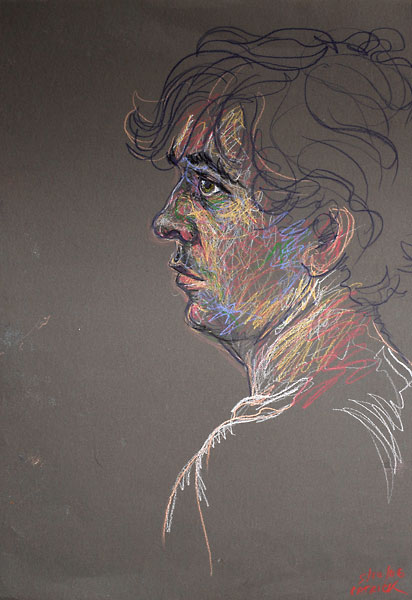
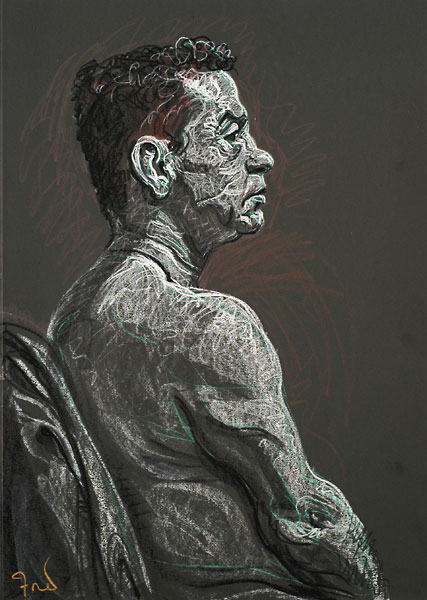
The profile or side view of the face has been a standard for coin portraits since ancient times, probably because it remains recognizable even when worn smooth. The contour of the front of the face, and of the head and neck, conveys the individuality of the subject even when it lacks such significant interior details as eyes and ears.
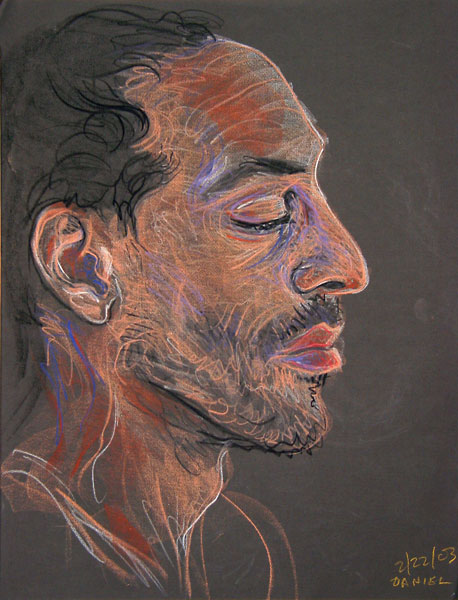
A couple of decades ago, the side view of the face would probably have been the first meaning of the word “profile” to come to mind for most people. Now the word is more likely to evoke a Facebook profile, a company profile, “racial profiling” or some such more informational expression of identity. Facebook profiles include profile pictures, of course, but hardly anyone uses a side view. It’s just not the way people see themselves. But the side view can be a distinctive and highly expressive aspect of the human face. In this post I’ve gathered together a variety of my own drawings of faces in the profile view.
Daniel Eyes Closed, 2003, by Fred Hatt
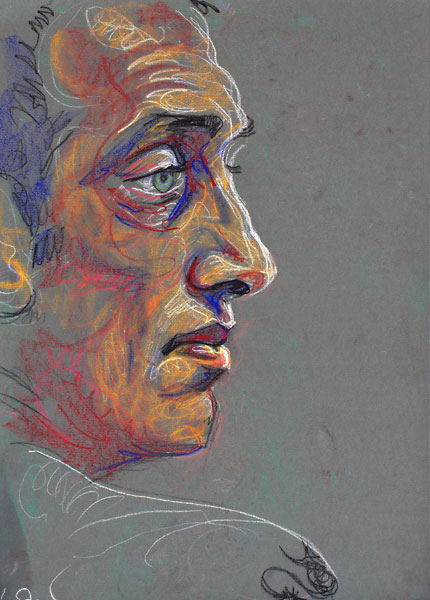
The subject of the drawing above has bold, prominent features, but his energy is turned inward as though in meditation. The one below has a similar facial contour, but the pale eye and the shadows and wrinkles around it, give it a completely different expression.
Scott, 2008, by Fred Hatt
In the drawing below, the primary light source is behind the subject, making the facial contour both a bright line and an indicator of the more complex three dimensional structure of the face.
Che, 2002, by Fred Hatt
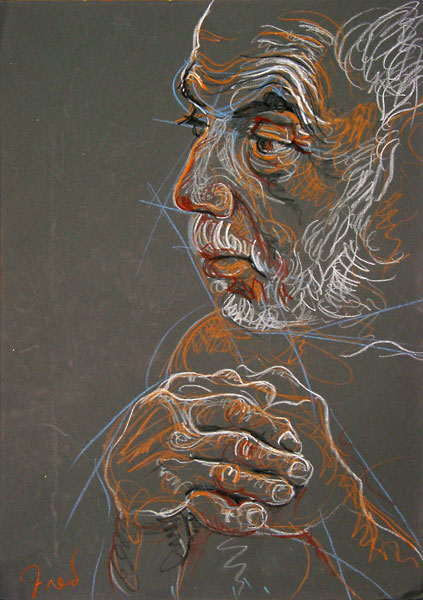
Below, the internal contours of hair and beard and brow wrinkles add a lot to the feeling of the personality of the subject. As in the sketch above, you can see part of the eyelid of the hidden side of the face, which gives a clearer direction to the gaze.
John, 2002, by Fred Hatt
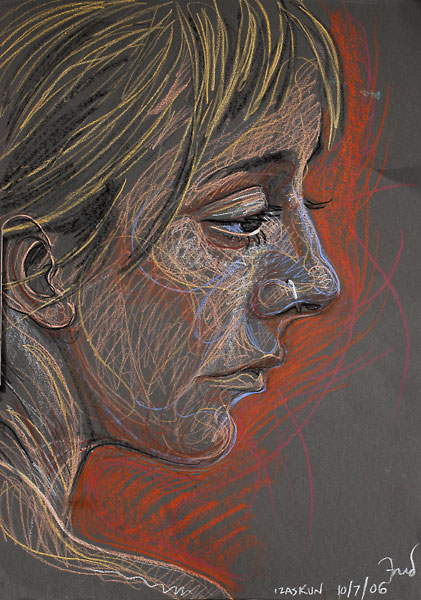
The angles of nose, jaw and brow help to define the individuality of the face. The eyelids and the usually shadowed area where brow, eyelid and nose meet are also significant forms.
Izaskun, 2006, by Fred Hatt
Alley, 2009, by Fred Hatt
The way a person arranges, or does not arrange, their hair, and the way the neck carries the head atop the body, are other distinctive aspects of the body that convey personality, and that can be observed in most of these examples.
Patrick, 2006, by Fred Hatt
The arrangement of the neck and jaw in particular can give a profile a more sensitive or a more aggressive appearance.
Vinnie, 2009, by Fred Hatt
In the side view of the face, the ear is a central element. The human ear is a wonderful convoluted shape, with considerable variation in size and overall shape among individuals.
Tram, 2008, by Fred Hatt
Hair can alter or emphasize the shapes of the head, as in the jutting beard above or the haircut below that reinforces the rectangularity of the model’s head.
Robert, 2004, by Fred Hatt
Marilyn, 2010, by Fred Hatt
Sometimes the neck and collarbone and shoulders are nearly as expressive as the face. When I am drawing I often feel that I am exploring a landscape of hills and valleys, ridges and chasms.
Tanya, 2005, by Fred Hatt
Rios, 2010, by Fred Hatt
On a hairless head, the face and the skull are unified. Hair often frames the face and disguises the shape of the rest of the skull. This can make the face look larger or smaller in relation to the head.
Theresa, 2010, by Fred Hatt
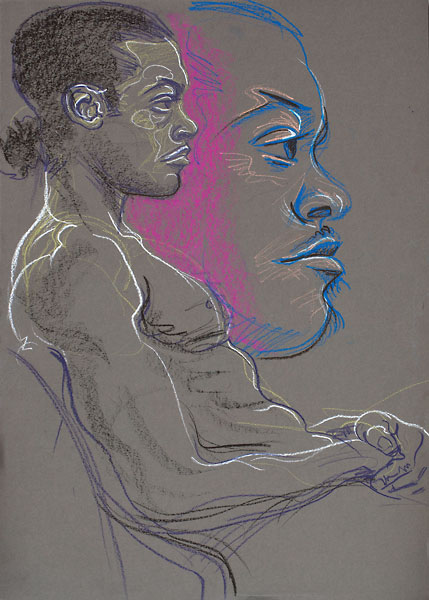
In the drawing below, I knew I hadn’t captured the contour of the face accurately in the full upper body sketch. Projecting the face in a larger size made it easier to capture this model’s distinctive profile.
Corey Two Profiles, 2009, by Fred Hatt
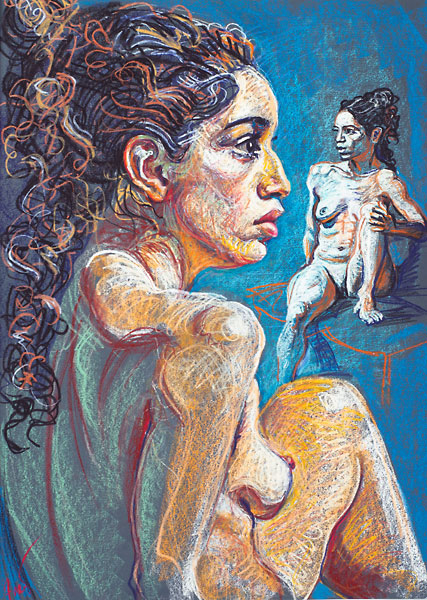
In the drawing below, I did the face large, and the full body smaller, from the opposite side.
Ivanhova Two Views, 2010, by Fred Hatt
And in my final example, two models posing together show very different facial structures. The female figure in the foreground has prominent cheekbones, shallow eye sockets, and a relatively flat nose. The male figure behind her has a prominent brow ridge and a more pointed nose. Both models are sitting back, resting on the elbows. The female settles her head into the shoulders, while the male’s head is slightly more lifted. In drawing from life, capturing a likeness relies very much on observing the subtle differences that make each person physically unique.
Sasho & Tin, 2010, by Fred Hatt
The drawings in this post are in the range of 18″ x 24″ to 20″ x 27″, drawn in aquarelle crayon on paper. Most of these were done during life drawing sessions at Spring Studio or Figureworks Gallery. Some other side view portraits are among those in this earlier post.
The portrait and the nude are generally considered distinct and separate genres within pictorial art. The nude is rarely a depiction of a particular person; rather, it is usually generalized or idealized, used to depict eroticism or heroism, struggle or abjection, joy or disgust as universal phenomena. The portrait is about conveying the essential character of an individual. Historically, the line separating these subjects was rarely breached, except in the occasional portrait of a mistress.Alice Neel and Lucian Freud both made highly individualized depictions of nudes, but they’re outliers. In contemporary art, the body is still nearly always de-individualized and even depersonalized, used as a symbol or provocation.
Piera, 2010, by Fred Hatt
The realistically observed portrait has been a staple of art since the Greeks and Romans, but of all the classic genres it has been the most challenged by the rise of photography and the most marginalized by the conceptual turn of contemporary art. To me portraiture remains a compelling pursuit. I believe a drawing or painting captures a subjective reality that photographs often miss, and the essence of a person is a rich and complex subject to tackle.
Jeremiah, 2010, by Fred Hatt
The nude portrait became one of my own primary genres simply because, many years ago, I was asked to be the monitor, or session supervisor, for a weekly three-hour nude pose at Spring Studio. This isn’t the class I would have chosen to run, as I was more interested in quick poses and movement than in long poses and academic rendering. Nevertheless, learning to sustain my focus and to develop drawings through a longer process was a great learning experience.
Aimi, 2010, by Fred Hatt
Minerva Durham, the proprietor of Spring Studio, favors models who have unique character, and that surely helps keep it interesting for the more advanced artists. When you draw from life as a regular practice for years, after a time you struggle more with boredom and the rut than you do with form and proportion. Drawing endless generic nudes could get a bit dry, but if you try to perceive and capture the specialness of each model, it remains much more interesting.
Sue, 2010, by Fred Hatt
The face and the body both show us something about the person’s character and life experience. The face is the window to the soul but also the public mask of self-presentation. In the body we see how the energy flows and rests. The body also conveys a great deal about the subject’s attitude and way of relating to the world.
Kate, 2010, by Fred Hatt
Nude portraits are nearly impossible to sell in a gallery show. People love these pictures, but no casual collector wants a recognizable picture of a nude individual hanging in their home – even if it is themselves. People have often commissioned me to do nude portraits of them, and they love the resulting pictures but have difficulty deciding where – or if – they should hang them! But since I have always supported myself by other work in order to keep my art free from the dictates of the marketplace, I don’t mind that the work is unsellable.
Christophe, 2010, by Fred Hatt
The division separating the nude from the portrait may exist because of market realities, rather than because of any deeper reason. But the combination, the nude portrait, represents to me a reunification of the primal split in the human soul, our loss of connection with our physicality and our earthly nature. Technology has allowed us to separate ourselves more and more from Nature, which is our origin and on which we are utterly dependent whether we realize it or not. Only our own bodies can reassert this primal symbiosis. A portrayal of face and body as one is a small statement of the unity of spirit and matter.
All portraits in this post were made in the last six months during the Monday morning long pose session I monitor at Spring Studio. All are aquarelle crayon on paper. Sizes range from 18″ x 24″ to 20″ x 28″.
Yasuko Kasaki interviews Fred Hatt at CRS, May 1, 2010, photo by Satomi Kitahara
At the May 1 opening of my solo exhibition “Healing Hands” at CRS in New York, I was interviewed by Yasuko Kasaki, author, teacher, healer and founder of CRS, in their beautiful, newly renovated studio.
The exhibit consisted of three bodies of work: “Healing Hands”, a series of color drawings based on the hands of the people who do healing work at CRS, “Heads”, larger than life-size portrait drawings, and “Chaos Compositions”, large scale, mostly multi-figure color drawings on black paper. The “Healing Hands” series remains on view at CRS through May 26, while the other two bodies of work were hung in the CRS studio for the opening on May 1 only. CRS Art Gallery Director Satomi Kitahara organized the event. See additional photos of the opening here.
The interview was part of the opening program, to introduce those interested in my artwork to my ideas and process. Just below the next photo is a full transcript of the interview. I have omitted the audience Q and A section to keep this to a reasonable length, but questioners brought up some interesting ideas that will be addressed in this blog soon.
Yasuko Kasaki interviews Fred Hatt at CRS, May 1, 2010, photo by Satomi Kitahara
Yasuko Kasaki: We’ve set up this series named Artist’s Way. Do you know the book, The Artist’s Way? Yeah, great book about process and how to progress our creative energy and so on. I’d like to let Fred talk about his secrets and his way of seeing things. First we should start with the Healing Hands, our exhibition. Those are the hands of healers, including mine. We do spiritual healing, and we see so-called energy. Energy is not actually the appropriate word, as a matter of fact. We are not seeing energy, but we see the quality of the spirit and mind and networking and flow, and connection and balance of the mind power or life force, or something like that. While we are doing this kind of healing, Fred, you see us and see something through your eyes. How do you see the energy?
Fred Hatt: Those drawings were mostly done before and after the healing circles that you have here. The various healers that were models for the drawings would sit in meditation, so they were just sitting and focusing their own energy within and I was just sketching.
Healing Hands #8, 2010, by Fred Hatt
I have always tried to see the human subject as energy rather than as an object. I don’t claim to have any clairvoyant ability or anything like that, but I have practiced life drawing with devotion and discipline over a long time. I go to two or three life drawing classes with timed poses every week. I’ve been doing that for about fifteen years. I’ve gotten to a level where the response of my hand is very quick. I think that what the lines of the drawing record are the movements of perception. I’m constantly looking, and as the eyes move and see a surface or notice some little thing, there’s a gesture of the hand that goes exactly with that. The closer the link is between the perceiving and the gesture, the more it picks up the energy or the movement of the act of perception. The act of perception is an interactive energetic or spiritual link with the person that I’m looking at. I think that intuitively it really captures something.
I did sketches of the healers’ hands, then later I took them away and did some further work, colors and backgrounds, in my own studio. More imagination comes into that part of it, but that’s also an intuitive response to what I can see from the position of the hands. Every little thing expresses something about the person: the way they choose to show their hands, the way that they’re resting, every little movement – little fidgets and adjustments. All of those things are ways of perceiving some quality of the energy. You start to see things not so much as an object of solid matter, but as something that’s flowing.
YK: I thought figurative painters study anatomy of the muscles and bones, but you don’t see those things?
FH: Well, I do, and I have studied that kind of thing also of course. I’m fascinated with that. But I also thought that’s not the only kind of anatomy there is. I’m self-taught as an artist, so I just looked into anything I thought was interesting and relevant. I learned about different ideas of the energy body, chakras and meridians and auras and all that kind of thing, because those systems are created by people who have focused on understanding the energy flow and the ways that different parts of the body are dynamically related, so there are insights to be had from any of that. But I don’t rigidly follow any of those things. I just take in as much information as possible and then try to respond intuitively in the moment, rather than systematically.
Healing Hands #9, 2010, by Fred Hatt
YK: You say moment, but those hands are still, and those faces are still – but not still at all. They are moving, because you are drawing movement. So then, you are drawing and constantly changing, right? So change and movement – you just try to get everything on the paper.
FH: Well, the model is basically still, although a living person is never really still. Even if a model in an art class is trying to sit perfectly still, they’re breathing, the blood is flowing, the mind is working, the nerves are working. There’s a lot of flowing energy going on. There’s also a lot of energy being exchanged between the model and the artist, because for the person posing, when you are being witnessed, when you feel that you are being seen, that really changes your experience. It makes everything you do, it makes your being a communication, a sharing. I think of drawing also as a sharing. I feel like if someone is posing for me, that’s a generous act, letting me really look, letting me try to see as much as I can see of someone. I feel like I have to work as hard as I can, I have to put as much as I can put into it, to honor that. I want that to be a gift back. I think that a lot of artists are making work for the public or the critics or whoever. I always feel like I’m doing it for the models first. I want them to see how I see them. I want it to be a mutual sharing act.
Donna, 2009, by Fred Hatt
YK: When I saw you for the first time here [at CRS], you were dancing here. [To audience] You know that he is a great dancer, great performer, he is so talented. And among other performers, he is really, I don’t want to use the word outstanding – outstanding too, but I don’t want to compare – but the quality of his performance is a little bit different. Other performers just showed us what they created, and said “See us.” But Fred’s way is “See? Can you see? Let’s see together. You can see this movement, you can see this light, see? It’s beautiful. See? You enjoy this?” Anything he does, his attitude is like that. [back to Fred] So sharing is all the time your core. And the gift is not from me to you, it’s just together. Let’s get this gift. This is your attitude. Great, I think.
FH: Picasso said “Creativity is happiness.” I really believe that.
(The video embedded above is a performance by Fred Hatt and Corinna Brown, done at CRS in 2007. More info available here.)
YK: Can you talk about color? I see color in the energy field. But how do you see these colors? I don’t think you perceive the same color, probably differently.
FH: I don’t take the same approach to color all the time. In some of the heads, the portrait drawings here, if you look at them from a distance the color looks fairly realistic, it looks like skin tone, but if you look close, there are no skin tone colors there. It’s a lot of different colors kind of mixing in the eye. I’m actually trying to capture some sense of the color I see, with the idea that color is a relative rather than an absolute quality. Colors change according to what they’re next to, and the colors of something like human skin are so subtle that if you try to just copy the surface color it’s flat and dead looking, so I’m trying to find those subtle variations. Where the blood is closer to the surface you get pinker tones, for example. That sort of thing gives this feeling of what’s below the surface, the life.
Michael W, 2009, by Fred Hatt
On these larger drawings with the multiple overlapping figures, I use color in a much more abstract way. I should describe the process. I work in my studio with a model. We start out doing quick poses, and I just do simple line drawings. I just grab colors at random. I have a big bowl of crayons, and I just use whatever I pull out. That way, once I have a huge mess of overlapping drawings, I can sort of follow one out of the mess by following the same color. It becomes a massive chaotic mess of lines that looks like nothing but static, and then I try to go into it and find order in the chaos. I develop parts of some of the figures, pull things forward, push things back, and find some kind of structure into it. It’s an improvisational process. This way of working creates these complex compositions which I would never be able to design. If I made preparatory sketches and tried to figure it all out on paper, I couldn’t do it. It only emerges from the process.
Seer, 2009, by Fred Hatt
Another thing that’s interesting to me about these is that for the viewer, it requires a much more active kind of looking than a picture. If you look at the portrait drawings, that’s a picture. You see and grasp the whole image. It’s very direct. Most figurative artwork is like that. When you look at these more complex pieces, you look into them and try to find what’s there and find the interesting juxtapositions that happen by chance.
The color in these pieces is, in the beginning of the work, random, as are several other aspects of the process. In the later development stages, I choose colors just out of an aesthetic sense. The colors in these aren’t symbolic or anything like that, but they emerge in the process. I think just because they’re on black, the colors have this neon, or black velvet painting, quality of light. I like to draw on a darker surface, because I think I see the light first, then the shadows. If you draw on white paper you really have to start with the shadows.
YK: What’s the difference between your seeing movement and drawing it, and your doing movement yourself, very different ways of expression as an artist?
FH: My experience with movement and performance happened from just following my interests, because since I was self-taught I didn’t have any teacher telling me I need to go in a particular direction. I think most figurative artists are not interested in experimental performance art. At least, when I meet other figurative artists, and I tell them I’m interested in that sort of stuff, they’re like “Ugh.” But for me that experimental work was really interesting because the artists were treating the creative process as an experience, rather than as the production of an object. I think that’s a very interesting approach. Before the invention of photography, just the ability to create a realistic image was a form of magic. Images were rare and had power just in their illusion of reality. Nowadays, we live in a world where we’re bombarded with images constantly. There are screens and advertising everywhere you look. Images don’t, in themselves, have any magic at all any more. They’re just pollution. How do you get back to that feeling of it having magic and power? To me, these really experimental artists, the butoh artists, the people that were doing happenings and that kind of thing, were trying to approach that problem by giving people an experience that can transform your perception.
I needed to incorporate this approach into my own exploration. I studied butoh dance and I did a lot of work with performance. I had to eventually come back more to visual art and drawing because I felt like that’s where my talent was strongest, and it’s where I found that I had the ability to do a really disciplined practice. And I’m an introverted kind of person, so visual art is more natural for that. But I think that the experience of performing was about trying to find new states. To enter into a performing state is sort of shamanic. What I learned from that really does inform the way that I draw, because if I’m trying to capture someone’s movement or their inner states, my own experience of feeling movement informs it, at least intuitively.
Range, 2009, by Fred Hatt
YK: You were doing really interesting and crazy things in New York City with the performers, gathering in the early morning and doing really crazy things and naked things.
FH: I haven’t really done that kind of thing recently, but back in the 90’s, in the days before 9/11, when there was no security anywhere, you could get away with anything in New York City, and we did. I think the specific thing you’re talking about is a series of performances in the summer of ’97. It was a collaboration that I worked out with Julie Atlas Muz, who is a well known burlesque performer and also a really good postmodern choreographer who did a lot of really creative and unusual performances. In that summer, every day that was a new moon or a full moon day, we would go out before dawn, with whatever other performers we could get to come with us, to some location around the city, the Staten Island Ferry, or Central Park, or Coney Island, some interesting location where there were a lot of things to interact with, and we did these interactive, improvisational happenings. Usually the only audience was people that we invited to come along and take pictures or video, but sometimes there were other people around, especially on the Staten Island Ferry where we sort of had a captive audience. The people that were performing could pretty much do whatever they wanted, but at that time of day, five o’clock in the morning, there is this incredible, powerful thing happening, the transformation of night into day. It’s a lighting effect that you couldn’t get from a theater lighting designer. If you had millions of dollars you couldn’t make something that amazing, and each time it was different. The birds are the rulers of that time, and they’re so loud, and human beings are so quiet. It’s the time when everyone is asleep, everyone is dreaming, and so even though you’re awake, you can be in a dream in the real world, because it’s the time when everyone is dreaming, That’s the predominant energy. Really amazing things happened in those performances. It was a struggle to get up really early in the morning and trek out to some place to do this thing, but then when we got done, we had to kill several hours before going to work or whatever.
Video capture from "Early Morning Dances: Belvedere Castle", 1997, performance by Julie Atlas Muz and Fred Hatt
YK: Yeah, now there’s security, everything has changed, but you are still open to happening. And happening is the same as miracles. You cannot make up a happening, but you can keep your mind open to happening. But to do so, I believe you need discipline. So your mind is really based on the steady, long discipline, I believe. So what kind of discipline are you keeping?
FH: The regular life drawing classes I mentioned, I’m really devoted to that, and that’s a kind of a meditative practice, but it’s an active thing. I also have had a practice, not quite as disciplined I have to say, with movement. All of the practice is to get to that place where you are confident enough that you can just respond immediately without having to think about anything, without uncertainty.
YK: How many years have you been doing so?
FH: You know, that’s really hard to answer, because since I’m self-taught as an artist, people say, “How long have you been doing that, when did you start?” Well, I was drawing when I was a kid. It took me many years to kind of find my way in bits and pieces, and that’s just an impossible question to answer because there are so many different moments where you could say it started here, or it started there. The regular life drawing practice has been the most consistent thing, and that started in the mid-90’s, but before that I was also doing a lot of creative things, but I was just a little bit unfocused, I would be writing poetry for a while, and then I’d lose my inspiration, and I’d start to do painting, and then I’d do that until I just felt like I was doing the same thing all the time, and then I’d stop and I’d start making films or something. It took me a while to realize that I wasn’t going to get anywhere that way. I think my youthful idea was that art was about being in an inspired state, and over time I realized it’s really more about steady work and discipline. The inspired state is not so much about something that strikes you from the clouds, but more like really long work on changing the way that you experience the world, so that it’s experienced as magical.
Auricle, 2008, by Fred Hatt
YK: Do you know even Picasso tried to write a poem? He was struggling from painting and one day thought, writing looks much easier, and he wrote some poems and recited in front of friends, and Gertrude Stein said “Stop it! Go back to painting. At least your painting is better than your poems!”
FH: One thing I think I learned from deciding to be dedicated to practice is that when you feel frustrated, that’s not a bad thing, because usually when you feel frustrated, it’s not going very well, what that really means is somewhere on the inside you’ve already moved up to another level. You just aren’t able to do it yet. So if you just keep going, you will reach that level.
YK: So to say something as the artist is to go beyond perception. So beyond perception is to try to reach vision, and reaching vision is always a happy experience, but somehow we are scared at happiness itself. So that’s why you are training yourself to be happy, happy, to get used to the happy experience. That’s why we can’t stop joining you. Your art is like that for me.
But I can answer what you couldn’t answer by yourself, when you started drawing. It’s 1961. [Holds up copy of drawing] This is José Greco. Fred Hatt, three year old boy, just saw flamenco, and somehow, he drew it. This is his first – it’s amazing.
José Greco Dancing in Purple Boots, 1961, by Fred Hatt
FH: The story of that: I was a well-behaved little child, and I was the first child, and my parents were young, they were really interested in cultural events, and they could get away with bringing me, because I didn’t make noise, so they took me to all these things. They took me to see this famous flamenco dancer of the time, José Greco. I was so turned on by that, because it had stomping, and it was passionate, and I had never encountered anything like that before, so I drew that. I rediscovered that drawing when I was around 40 years old. I had finally come to the point I was really developing my visual art, and I was running these movement drawing classes where we had the models moving instead of standing still, and artists that were willing to try that would try to capture the feeling of movement, and I was working with a lot of dancers and performers. I went back and visited my parents and I decided to look for the old artwork that they saved, and that’s the earliest thing. I thought, wow, look at this: I was three and I already was inspired by movement and dance, and the way I was trying to capture it was scribbling with crayons! And it took me almost forty years to find my way back!
(An earlier blog post also tells the story of the José Greco drawing).
Here’s a panoramic view showing the large works in the CRS Studio. You may need to scroll to the right to see it all.
Panorama of exhibit in CRS Studio, 2010, photo by Fred Hatt
The Healing Hands drawings are 18 3/8″ x 24 1/2″. The Heads (portraits) are 50 cm x 70 cm. The larger works seen above range from 36″ x 48″ to 60″ x 60″. All works are aquarelle on paper.