
November, my video collaboration with dancer/choreographer Jung Woong Kim, is on the program at the Frameworks Dance Film Series this Thursday night at 7:00 p.m. at Dance New Amsterdam. Click here for all the details.
November, my video collaboration with dancer/choreographer Jung Woong Kim, is on the program at the Frameworks Dance Film Series this Thursday night at 7:00 p.m. at Dance New Amsterdam. Click here for all the details.

New Leaves, 2010, stereo photo by Fred Hatt
The image above may appear a mild abstraction on a natural scene, some curling leaves fringed in red and blue. But put on a pair of old-fashioned 3-D glasses, with a red filter over the left eye and a cyan filter over the right eye, and a window opens up in your monitor, offering a view down upon a sensuous early spring plant, reaching towards you from a vivid texture of dirt and twigs.
Last year’s post, Shapes of Things, featured stereoscopic photographs I took seventeen years ago, in 1993. This year I’ve been taking new ones, now using the Canon G11 that I usually carry with me as I move about the city going to jobs and visiting friends. To take a 3D or stereo photograph, I just take one shot, then move the camera a few inches to the right and take another. I use free software called Stereo Photo Maker to align them and to convert them to various viewing formats. For these samples on the blog, I’ve chosen to use the “gray anaglyph” format, for viewing with traditional anaglyphic 3D glasses. If you don’t have a pair, you can get one for free at this site. Ask for Red/Cyan Anaglyph 3D Glasses.

Snow Tree, 2010, stereo photo by Fred Hatt
Here, a snow-covered winter tree spreads elegantly in front of an apartment building, while below a bare tree adds its complexity to an otherwise geometrical landscape. The branching patterns of trees resemble the neurons in the brain, as well as the patterns formed by electrical discharges such as lightning. Although they form much more slowly, trees express the same motion of formation as these examples of instant impulse.

Treeburst, 2010, stereo photo by Fred Hatt
Old trees can express as much character in their trunks as in their branches or leaves. This one’s had the initials of generations carved into it.

Elder Tree, 2010, stereo photo by Fred Hatt
Below is an early, tripartite stage of something that might one day fuse into something as majestically bumpy as the one above.

Trunk Trio, 2010, stereo photo by Fred Hatt
Here’s an old tree that has been hollowed by rot into a sort of vertical canoe form.

Tree Shell, 2010, stereo photo by Fred Hatt
Rolling hills and trees reaching and leaning in all directions create a dynamic spatial environment that makes the experience of walking through woods invigorating in any season.

Downhill, 2010, stereo photo by Fred Hatt

Garden, 2010, stereo photo by Fred Hatt
Here you can see the form of a hedge in early spring. Last year’s leaves are broad and flat, dark and shiny. Newer leaves, lighter and much smaller, sprout in clusters from among the old leaves.
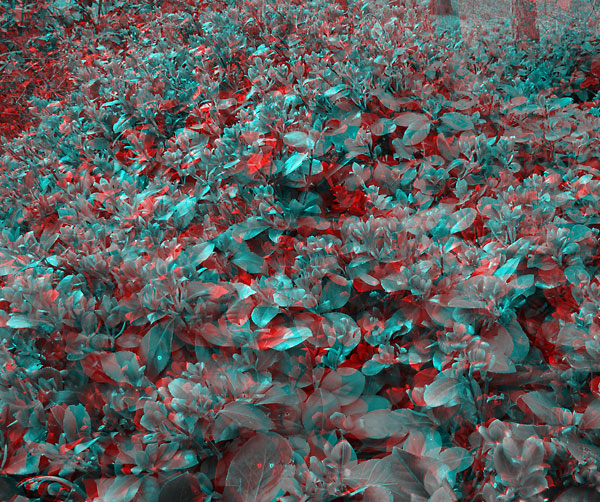
Sprouting Hedge, 2010, stereo photo by Fred Hatt
We’ll turn now to the shapes of man-made things, letting this shop window with potted plants behind a neon sign serve as a segue.

Qi Gong Tui-Na, 2010, photo by Fred Hatt
Shop windows are a natural subject for stereo photography, since we look through them into enclosed places where objects have been composed in spatial arrangement.

Pastry Shop, 2010, stereo photo by Fred Hatt

Lamp Store, 2010, stereo photo by Fred Hatt
The window below has been decorated with a huge transparent photographic image, which we look through to see a dress on display within the open space of the store.

Calvin Klein Store, 2010, stereo photo by Fred Hatt
This antique store has arranged a family of wooden manikins on a leather upholstered bench.

Manikins, 2010, stereo photo by Fred Hatt
Instead of looking through a glass window, we can look through a steel mesh gate to see the receding space of a narrow passageway.

Passageway, 2010, stereo photo by Fred Hatt
This chain-link fence slides on a track to let trucks in and out of a loading dock. The framework of the gate produces a beautiful geometric shadow.

Rolling Gate, 2010, stereo photo by Fred Hatt
This frame was put up to support multiple billboards. It’s now being a bit under-utilized.

Sign Frame, 2010, stereo photo by Fred Hatt
Here, a huge, mottled block supports a cast-iron bannister for a set of brownstone steps adorned with a ratty carpet.

Stoop Steps, 2010, stereo photo by Fred Hatt
A construction shovel is another rough form on a residential street.

Shovel, 2010, stereo photo by Fred Hatt
The rough form below reminded me of an aging roué with a young mistress.

Beauty and the Beast, 2010, stereo photo by Fred Hatt
I find that looking at 3D photographs makes me more aware of three dimensional form and texture, and the topological complexity of the landscape, aspects of the world we may often overlook.

Yasuko Kasaki interviews Fred Hatt at CRS, May 1, 2010, photo by Satomi Kitahara
At the May 1 opening of my solo exhibition “Healing Hands” at CRS in New York, I was interviewed by Yasuko Kasaki, author, teacher, healer and founder of CRS, in their beautiful, newly renovated studio.
The exhibit consisted of three bodies of work: “Healing Hands”, a series of color drawings based on the hands of the people who do healing work at CRS, “Heads”, larger than life-size portrait drawings, and “Chaos Compositions”, large scale, mostly multi-figure color drawings on black paper. The “Healing Hands” series remains on view at CRS through May 26, while the other two bodies of work were hung in the CRS studio for the opening on May 1 only. CRS Art Gallery Director Satomi Kitahara organized the event. See additional photos of the opening here.
The interview was part of the opening program, to introduce those interested in my artwork to my ideas and process. Just below the next photo is a full transcript of the interview. I have omitted the audience Q and A section to keep this to a reasonable length, but questioners brought up some interesting ideas that will be addressed in this blog soon.

Yasuko Kasaki interviews Fred Hatt at CRS, May 1, 2010, photo by Satomi Kitahara
Yasuko Kasaki: We’ve set up this series named Artist’s Way. Do you know the book, The Artist’s Way? Yeah, great book about process and how to progress our creative energy and so on. I’d like to let Fred talk about his secrets and his way of seeing things. First we should start with the Healing Hands, our exhibition. Those are the hands of healers, including mine. We do spiritual healing, and we see so-called energy. Energy is not actually the appropriate word, as a matter of fact. We are not seeing energy, but we see the quality of the spirit and mind and networking and flow, and connection and balance of the mind power or life force, or something like that. While we are doing this kind of healing, Fred, you see us and see something through your eyes. How do you see the energy?
Fred Hatt: Those drawings were mostly done before and after the healing circles that you have here. The various healers that were models for the drawings would sit in meditation, so they were just sitting and focusing their own energy within and I was just sketching.

Healing Hands #8, 2010, by Fred Hatt
I have always tried to see the human subject as energy rather than as an object. I don’t claim to have any clairvoyant ability or anything like that, but I have practiced life drawing with devotion and discipline over a long time. I go to two or three life drawing classes with timed poses every week. I’ve been doing that for about fifteen years. I’ve gotten to a level where the response of my hand is very quick. I think that what the lines of the drawing record are the movements of perception. I’m constantly looking, and as the eyes move and see a surface or notice some little thing, there’s a gesture of the hand that goes exactly with that. The closer the link is between the perceiving and the gesture, the more it picks up the energy or the movement of the act of perception. The act of perception is an interactive energetic or spiritual link with the person that I’m looking at. I think that intuitively it really captures something.
I did sketches of the healers’ hands, then later I took them away and did some further work, colors and backgrounds, in my own studio. More imagination comes into that part of it, but that’s also an intuitive response to what I can see from the position of the hands. Every little thing expresses something about the person: the way they choose to show their hands, the way that they’re resting, every little movement – little fidgets and adjustments. All of those things are ways of perceiving some quality of the energy. You start to see things not so much as an object of solid matter, but as something that’s flowing.
YK: I thought figurative painters study anatomy of the muscles and bones, but you don’t see those things?
FH: Well, I do, and I have studied that kind of thing also of course. I’m fascinated with that. But I also thought that’s not the only kind of anatomy there is. I’m self-taught as an artist, so I just looked into anything I thought was interesting and relevant. I learned about different ideas of the energy body, chakras and meridians and auras and all that kind of thing, because those systems are created by people who have focused on understanding the energy flow and the ways that different parts of the body are dynamically related, so there are insights to be had from any of that. But I don’t rigidly follow any of those things. I just take in as much information as possible and then try to respond intuitively in the moment, rather than systematically.

Healing Hands #9, 2010, by Fred Hatt
YK: You say moment, but those hands are still, and those faces are still – but not still at all. They are moving, because you are drawing movement. So then, you are drawing and constantly changing, right? So change and movement – you just try to get everything on the paper.
FH: Well, the model is basically still, although a living person is never really still. Even if a model in an art class is trying to sit perfectly still, they’re breathing, the blood is flowing, the mind is working, the nerves are working. There’s a lot of flowing energy going on. There’s also a lot of energy being exchanged between the model and the artist, because for the person posing, when you are being witnessed, when you feel that you are being seen, that really changes your experience. It makes everything you do, it makes your being a communication, a sharing. I think of drawing also as a sharing. I feel like if someone is posing for me, that’s a generous act, letting me really look, letting me try to see as much as I can see of someone. I feel like I have to work as hard as I can, I have to put as much as I can put into it, to honor that. I want that to be a gift back. I think that a lot of artists are making work for the public or the critics or whoever. I always feel like I’m doing it for the models first. I want them to see how I see them. I want it to be a mutual sharing act.

Donna, 2009, by Fred Hatt
YK: When I saw you for the first time here [at CRS], you were dancing here. [To audience] You know that he is a great dancer, great performer, he is so talented. And among other performers, he is really, I don’t want to use the word outstanding – outstanding too, but I don’t want to compare – but the quality of his performance is a little bit different. Other performers just showed us what they created, and said “See us.” But Fred’s way is “See? Can you see? Let’s see together. You can see this movement, you can see this light, see? It’s beautiful. See? You enjoy this?” Anything he does, his attitude is like that. [back to Fred] So sharing is all the time your core. And the gift is not from me to you, it’s just together. Let’s get this gift. This is your attitude. Great, I think.
FH: Picasso said “Creativity is happiness.” I really believe that.
Shadows from Fred Hatt on Vimeo.
(The video embedded above is a performance by Fred Hatt and Corinna Brown, done at CRS in 2007. More info available here.)
YK: Can you talk about color? I see color in the energy field. But how do you see these colors? I don’t think you perceive the same color, probably differently.
FH: I don’t take the same approach to color all the time. In some of the heads, the portrait drawings here, if you look at them from a distance the color looks fairly realistic, it looks like skin tone, but if you look close, there are no skin tone colors there. It’s a lot of different colors kind of mixing in the eye. I’m actually trying to capture some sense of the color I see, with the idea that color is a relative rather than an absolute quality. Colors change according to what they’re next to, and the colors of something like human skin are so subtle that if you try to just copy the surface color it’s flat and dead looking, so I’m trying to find those subtle variations. Where the blood is closer to the surface you get pinker tones, for example. That sort of thing gives this feeling of what’s below the surface, the life.

Michael W, 2009, by Fred Hatt
On these larger drawings with the multiple overlapping figures, I use color in a much more abstract way. I should describe the process. I work in my studio with a model. We start out doing quick poses, and I just do simple line drawings. I just grab colors at random. I have a big bowl of crayons, and I just use whatever I pull out. That way, once I have a huge mess of overlapping drawings, I can sort of follow one out of the mess by following the same color. It becomes a massive chaotic mess of lines that looks like nothing but static, and then I try to go into it and find order in the chaos. I develop parts of some of the figures, pull things forward, push things back, and find some kind of structure into it. It’s an improvisational process. This way of working creates these complex compositions which I would never be able to design. If I made preparatory sketches and tried to figure it all out on paper, I couldn’t do it. It only emerges from the process.

Seer, 2009, by Fred Hatt
Another thing that’s interesting to me about these is that for the viewer, it requires a much more active kind of looking than a picture. If you look at the portrait drawings, that’s a picture. You see and grasp the whole image. It’s very direct. Most figurative artwork is like that. When you look at these more complex pieces, you look into them and try to find what’s there and find the interesting juxtapositions that happen by chance.
The color in these pieces is, in the beginning of the work, random, as are several other aspects of the process. In the later development stages, I choose colors just out of an aesthetic sense. The colors in these aren’t symbolic or anything like that, but they emerge in the process. I think just because they’re on black, the colors have this neon, or black velvet painting, quality of light. I like to draw on a darker surface, because I think I see the light first, then the shadows. If you draw on white paper you really have to start with the shadows.
YK: What’s the difference between your seeing movement and drawing it, and your doing movement yourself, very different ways of expression as an artist?
FH: My experience with movement and performance happened from just following my interests, because since I was self-taught I didn’t have any teacher telling me I need to go in a particular direction. I think most figurative artists are not interested in experimental performance art. At least, when I meet other figurative artists, and I tell them I’m interested in that sort of stuff, they’re like “Ugh.” But for me that experimental work was really interesting because the artists were treating the creative process as an experience, rather than as the production of an object. I think that’s a very interesting approach. Before the invention of photography, just the ability to create a realistic image was a form of magic. Images were rare and had power just in their illusion of reality. Nowadays, we live in a world where we’re bombarded with images constantly. There are screens and advertising everywhere you look. Images don’t, in themselves, have any magic at all any more. They’re just pollution. How do you get back to that feeling of it having magic and power? To me, these really experimental artists, the butoh artists, the people that were doing happenings and that kind of thing, were trying to approach that problem by giving people an experience that can transform your perception.
I needed to incorporate this approach into my own exploration. I studied butoh dance and I did a lot of work with performance. I had to eventually come back more to visual art and drawing because I felt like that’s where my talent was strongest, and it’s where I found that I had the ability to do a really disciplined practice. And I’m an introverted kind of person, so visual art is more natural for that. But I think that the experience of performing was about trying to find new states. To enter into a performing state is sort of shamanic. What I learned from that really does inform the way that I draw, because if I’m trying to capture someone’s movement or their inner states, my own experience of feeling movement informs it, at least intuitively.

Range, 2009, by Fred Hatt
YK: You were doing really interesting and crazy things in New York City with the performers, gathering in the early morning and doing really crazy things and naked things.
FH: I haven’t really done that kind of thing recently, but back in the 90’s, in the days before 9/11, when there was no security anywhere, you could get away with anything in New York City, and we did. I think the specific thing you’re talking about is a series of performances in the summer of ’97. It was a collaboration that I worked out with Julie Atlas Muz, who is a well known burlesque performer and also a really good postmodern choreographer who did a lot of really creative and unusual performances. In that summer, every day that was a new moon or a full moon day, we would go out before dawn, with whatever other performers we could get to come with us, to some location around the city, the Staten Island Ferry, or Central Park, or Coney Island, some interesting location where there were a lot of things to interact with, and we did these interactive, improvisational happenings. Usually the only audience was people that we invited to come along and take pictures or video, but sometimes there were other people around, especially on the Staten Island Ferry where we sort of had a captive audience. The people that were performing could pretty much do whatever they wanted, but at that time of day, five o’clock in the morning, there is this incredible, powerful thing happening, the transformation of night into day. It’s a lighting effect that you couldn’t get from a theater lighting designer. If you had millions of dollars you couldn’t make something that amazing, and each time it was different. The birds are the rulers of that time, and they’re so loud, and human beings are so quiet. It’s the time when everyone is asleep, everyone is dreaming, and so even though you’re awake, you can be in a dream in the real world, because it’s the time when everyone is dreaming, That’s the predominant energy. Really amazing things happened in those performances. It was a struggle to get up really early in the morning and trek out to some place to do this thing, but then when we got done, we had to kill several hours before going to work or whatever.

Video capture from "Early Morning Dances: Belvedere Castle", 1997, performance by Julie Atlas Muz and Fred Hatt
YK: Yeah, now there’s security, everything has changed, but you are still open to happening. And happening is the same as miracles. You cannot make up a happening, but you can keep your mind open to happening. But to do so, I believe you need discipline. So your mind is really based on the steady, long discipline, I believe. So what kind of discipline are you keeping?
FH: The regular life drawing classes I mentioned, I’m really devoted to that, and that’s a kind of a meditative practice, but it’s an active thing. I also have had a practice, not quite as disciplined I have to say, with movement. All of the practice is to get to that place where you are confident enough that you can just respond immediately without having to think about anything, without uncertainty.
YK: How many years have you been doing so?
FH: You know, that’s really hard to answer, because since I’m self-taught as an artist, people say, “How long have you been doing that, when did you start?” Well, I was drawing when I was a kid. It took me many years to kind of find my way in bits and pieces, and that’s just an impossible question to answer because there are so many different moments where you could say it started here, or it started there. The regular life drawing practice has been the most consistent thing, and that started in the mid-90’s, but before that I was also doing a lot of creative things, but I was just a little bit unfocused, I would be writing poetry for a while, and then I’d lose my inspiration, and I’d start to do painting, and then I’d do that until I just felt like I was doing the same thing all the time, and then I’d stop and I’d start making films or something. It took me a while to realize that I wasn’t going to get anywhere that way. I think my youthful idea was that art was about being in an inspired state, and over time I realized it’s really more about steady work and discipline. The inspired state is not so much about something that strikes you from the clouds, but more like really long work on changing the way that you experience the world, so that it’s experienced as magical.

Auricle, 2008, by Fred Hatt
YK: Do you know even Picasso tried to write a poem? He was struggling from painting and one day thought, writing looks much easier, and he wrote some poems and recited in front of friends, and Gertrude Stein said “Stop it! Go back to painting. At least your painting is better than your poems!”
FH: One thing I think I learned from deciding to be dedicated to practice is that when you feel frustrated, that’s not a bad thing, because usually when you feel frustrated, it’s not going very well, what that really means is somewhere on the inside you’ve already moved up to another level. You just aren’t able to do it yet. So if you just keep going, you will reach that level.
YK: So to say something as the artist is to go beyond perception. So beyond perception is to try to reach vision, and reaching vision is always a happy experience, but somehow we are scared at happiness itself. So that’s why you are training yourself to be happy, happy, to get used to the happy experience. That’s why we can’t stop joining you. Your art is like that for me.
But I can answer what you couldn’t answer by yourself, when you started drawing. It’s 1961. [Holds up copy of drawing] This is José Greco. Fred Hatt, three year old boy, just saw flamenco, and somehow, he drew it. This is his first – it’s amazing.

José Greco Dancing in Purple Boots, 1961, by Fred Hatt
FH: The story of that: I was a well-behaved little child, and I was the first child, and my parents were young, they were really interested in cultural events, and they could get away with bringing me, because I didn’t make noise, so they took me to all these things. They took me to see this famous flamenco dancer of the time, José Greco. I was so turned on by that, because it had stomping, and it was passionate, and I had never encountered anything like that before, so I drew that. I rediscovered that drawing when I was around 40 years old. I had finally come to the point I was really developing my visual art, and I was running these movement drawing classes where we had the models moving instead of standing still, and artists that were willing to try that would try to capture the feeling of movement, and I was working with a lot of dancers and performers. I went back and visited my parents and I decided to look for the old artwork that they saved, and that’s the earliest thing. I thought, wow, look at this: I was three and I already was inspired by movement and dance, and the way I was trying to capture it was scribbling with crayons! And it took me almost forty years to find my way back!
(An earlier blog post also tells the story of the José Greco drawing).
Here’s a panoramic view showing the large works in the CRS Studio. You may need to scroll to the right to see it all.

Panorama of exhibit in CRS Studio, 2010, photo by Fred Hatt
The Healing Hands drawings are 18 3/8″ x 24 1/2″. The Heads (portraits) are 50 cm x 70 cm. The larger works seen above range from 36″ x 48″ to 60″ x 60″. All works are aquarelle on paper.

Chair Shadow, 2010, photo by Fred Hatt
I like to keep a small camera with me when I’m out and about in the city. I rarely go anywhere for the specific purpose of photography unless it’s a paying job, but I find having the camera with me helps me to look at the world around me with a more engaged eye. My personality is neither aggressive enough nor gregarious enough to shoot pictures of strangers in public. Instead, I look for striking or unusual compositions made by the juxtapositions of shapes and colors and textures, effects of light and shadow, objects and displays, and ever-changing natural and man-made phenomena. This post consists entirely of shots taken since the beginning of this year with my inconspicuous Canon G11.
The shot above was taken while sitting with a friend in a little outdoor cafe in Central Park on a late spring afternoon. I was struck by the complex cluster of lines made by the table and chair legs, the elongated chair shadow stretching across the irregular stone slab floor, and my friend’s shoe to one side. I believe the thicker, inverted Y-shaped shadow is that of a large tree.
Many of the most interesting patterns are seen only by looking at the ground, as above, or to the sky, as in the image below. This is another composition of angles and lines, at the corner of Bogart and Grattan Streets in Bushwick, Brooklyn.

Bogart and Grattan, 2010, photo by Fred Hatt
New York City is packed with tall buildings from different eras, creating many different kinds of juxtapositions of shapes and styles depending on your angle of view. Zooming to the longer position of the lens flattens the perspective, emphasizing the density of the forms. The view below is looking north from Union Square.

Looking North from Union Square, 2010, photo by Fred Hatt
And this one is looking south from Columbus Circle. These show a striking difference in style between the two ends of Manhattan’s dense midtown cluster.

Looking South from Columbus Circle, 2010, photo by Fred Hatt
Over on the West Side, near Lincoln Tunnel and the Port Authority Bus Terminal, there is, for some reason, an unusually high concentration of pigeons.

Midtown Pigeons, 2010, photo by Fred Hatt
And here’s a view looking towards the far East Side of Manhattan, from Long Island City, Queens, with the Queensboro or 59th Street Bridge rising over the streets. The textures in this picture are fascinating, though I’m afraid it loses something in this small size.

Queensboro Bridge, 2010, photo by Fred Hatt
Looking up at buildings in the city, a frequently-seen motif is something tall towering above something broad. The Lever House, a classic of the 1950’s International Style, deliberately invokes this juxtaposition.

Lever House, 2010, photo by Fred Hatt
More often, it’s an accident of separate buildings seen from a particular angle.

Bloomingdales at Dusk, 2010, photo by Fred Hatt
Perfectly contrasting the glossy elegance of Lever House is this orange-shrouded construction site rising behind a blank billboard.

NYC Law, 2010, photo by Fred Hatt
Blankness can give a building a massive feel even when it is surrounded by much larger buildings.

Roosevelt Post Office, 2010, photo by Fred Hatt
Curved shapes give a much softer impression.

Terraces and Tower Top, 2010, photo by Fred Hatt
I find something oddly inviting about rounded interior spaces. The best known of those in New York City is of course the Guggenheim Museum, but here’s an oval plaza in a newer building near Bloomingdales on the East Side.

Oval Plaza, 2010, photo by Fred Hatt
A few blocks away from that is found this spiral staircase at the Fifth Avenue Apple Store.

Apple Store Stairs, 2010, photo by Fred Hatt
Compare that to this old style cast iron and tile spiral staircase in a courthouse on the West Side.

Spiral Stairwell, 2010, photo by Fred Hatt
The black vertical bars above contrast with the silvery horizontal bars found in these Subway turnstiles below.

Egg Slicer Turnstiles, 2010, photo by Fred Hatt
There are lots of dense grids in the urban environment. They’re so commonplace we often don’t notice them. Colored lights can bring them out of the background noise.

Construction Shed Scaffold, 2010, photo by Fred Hatt
This is a roll-down store security gate, over a window with neon signs.

Neon Security Gate, 2010, photo by Fred Hatt
Colored lights can be used to break up and add movement to a monolithic surface.

Cascade of Colored Light, 2010, photo by Fred Hatt
Even a subtle use of colored lights, like these filtered fluorescents in a parking garage, can make an otherwise forbidding space more appealing.

Parking Garage, 2010, photo by Fred Hatt
I’m fascinated by patchwork patterns, where rectangles and other shapes of different tones and hues are clustered with some kind of irregularity.

Pastel Rectangles and Vendor Cart, 2010, photo by Fred Hatt
Sometimes these patchworks are an accident of angle of view.

Gate in Red Wall, 2010, photo by Fred Hatt
Here the weathered red panels are contrasted with the plain gray ones and the mysterious half face on plywood.

The Ghost of Ralph Nader, 2010, photo by Fred Hatt
Graffiti often becomes an element of patterns in the city.

Blue Anarchy & Red Square, 2010, photo by Fred Hatt
I live in Williamsburg, Brooklyn, where much of the culture is driven by the hipster sense of irony. I don’t know if this Williamsburg window is deliberately or accidentally ironic.

Antidepressant, 2010, photo by Fred Hatt
The patchwork effect we’ve been looking at can be generated by distorted reflections in grids of glass windows.

New Reflects Old, 2010, photo by Fred Hatt
The effects of light and shadow, especially in the early morning and late afternoon, can transform mundane structures into wonderful visual arrangements.

Security Gate Shadows, 2010, photo by Fred Hatt
This store window display is a perfectly nice example of the clean tropical aesthetic, but the late afternoon sun casts shadows that transform it into a joyous abstract painting.

Window Display in Sunlight, 2010, photo by Fred Hatt
Keep your eyes open – visual pleasures are abundant and free to enjoy!

Healing Hands #11, 2010, by Fred Hatt
Tonight I’m hanging a new suite of drawings entitled Healing Hands for a solo exhibit at CRS, 123 Fourth Avenue (between 12th and 13th Streets), NYC, second floor. The artwork will be on view April 24 through May 26, 2010. The opening reception will take place ONE WEEK LATER, on Saturday, May 1, from 5:30 to 7:30. On May 1 only, I will show a large selection of my work, in addition to the Healing Hands series, in the beautiful large dance studio at CRS, and at 6:30 I’ll be publicly interviewed by CRS director Yasuko Kasaki. Details on the opening are here.
I got involved with CRS several years ago, through their performing arts program, Dharma Road Productions, directed by Christopher Pelham. Dharma Road and CRS sponsor artists from Japan and other countries working in New York, and have become one of the city’s important presenters of butoh dance, action theater, puppet and clown theater and other forms. I have studied butoh myself and have a long history of collaborating with dance and experimental theater artists. Since many of these artists were performing at CRS, I had multiple occasions to work there and to get to know Chris and Yasuko.
Earlier this year, CRS renovated their studios. They’ve added a full schedule of classes and workshops in dance, exercise and meditation, and they’ve appointed Satomi Kitahara as art gallery director. I was honored to be asked to be the first artist to exhibit visual art in the beautiful new space.
The mission of CRS has always combined performing arts and visual arts with healing arts. They host regular meditations and healing circles and provide working spaces for practitioners of various bodywork modalities. Yasuko invited me to observe and sketch at healing circles, and the energy healers who work at CRS sat in meditation for me while I drew their hands.

Healing Hands #2, 2010, by Fred Hatt
If you’re in or near New York City, please join me at the Healing Hands opening on Saturday, May 1. Please note, the work is on view starting April 24, but the opening reception is one week later, on May 1, 2010!
I also have two pieces in the exhibit Ten Years of Figureworks, which remains on view through June 6, 2010 at Figureworks in Williamsburg, Brooklyn.

Powered by WordPress