DRAWING LIFE by fred hatt

2010/10/07

Nudes with Projections

Nox, 1996, by Fred Hatt

Some readers have expressed an interest in seeing more of my early figurative drawings, and more of my more “finished” work, so here’s a post drawn from the early years of my intensive practice of life drawing.

In 1996 I had been practicing life drawing regularly at New York’s Spring Studio for two years.  Minerva Durham, the artist and teacher who founded the studio, asked me to be the monitor (overseer, proctor, invigilator) of a regular once-a-week three hour long pose figure drawing class.  I had to show up every week at the same time, whether I felt like it or not, and take responsibility for the smooth operation of the session.  There was no pay, but I got to draw for free.

I had been developing a technique of color drawing with crayons on dark-toned paper, trying to get much of the richness of painting with the speed and spontaneity of drawing.  For me, three hours was a long time, and  my greatest challenge was to sustain the focus for such a protracted period.  (I can hear the oil painters laughing!  The egg tempera painters just sigh disdainfully.)

Creating a satisfying composition within three hours soon proved to provide plenty of diversion for my short attention span.  Of course the study of the human body and how to render its form and expression is the first task, but if you spend the whole time on that you end up with a figure floating in a void.  In reality, the body exists in an environment, with gravity and light and spatial relationships.  The actual setting of the model in the studio, though, is cluttered and distracting.

I really had no interest in placing my models into fake nature, mythological forests or imaginary harems.  A more abstract treatment of the background seemed the most promising approach.

I had been attracted to drawing more than to painting partly because I was interested in the direct expressiveness of the artist’s marks.  In a painting, these marks tend to get blended and obscured, whereas in a drawing they remain more visible.  Of course, now that I was developing my figures over several hours, striving towards an illusion of reality, as my drawings were becoming more polished, the process of the drawing was becoming more obscured.  So it struck me that I could use the background to reveal some of the process of abstract analysis that the artist goes through on the way to even the most photographic rendering.

Web, 1996, by Fred Hatt

I always figure out a pose partly by tracing angular relationships between different parts.  There’s a line from the knee to the shoulder, a line from the left nipple to the navel and another from the nipple to the notch of the collarbone, and on and on.  Every landmark of the figure has an angular relationship to every other landmark.  In the figure above the original markings that were made in constructing the figure were darkened and extended, creating a web of relationships in which the figure is suspended.

Pensée, 1997, by Fred Hatt

That approach proved fruitful.  What began as a study of internal relationships vanished from the drawing of the body as its light, shadow and color was developed, but then reappeared in the space surrounding the body.  The internal structure manifested in its spatial container.

Gem, 1997, by Fred Hatt

Sometimes the lines were more delicately indicated by their points of intersection.

Filament, 1998, by Fred Hatt

I tried to show the body itself as close as possible to what I actually saw, and to use the surrounding space to show its hidden geometry.

Throne, 1998, by Fred Hatt

At times the treatment could be more subtle, suggesting not so much hard geometrical structure, but a field of energy.

Space, 1998, by Fred Hatt

The pose below has a particularly clear simple triangular structure, so the projected lines show the sub-triangles that give it facets.

Pyramid, 1998, by Fred Hatt

The body can be projected in curves rather than straight lines.  Shadows, furniture and objects, and folds of fabric also create a linear environment in which the figure is embedded.

Rings, 1998, by Fred Hatt

Miha, 1998, by Fred Hatt

The figure below was perched symmetrically on a stool.  I didn’t bother to draw the stool, but instead traced a stack of horizontal markers that define the proportions of this pose:  ankles, knees, hipbones, breasts, shoulders, eyes and ears.

Pagoda, 1998, by Fred Hatt

The angles of the figure imply a crystalline structure that defines the person’s energetic being in geometrical terms.

Start, 1998, by Fred Hatt

Every being is an organic manifestation of a web of relationships.

Ombre, 1998, by Fred Hatt

Action is structure.

Bagua, 1998, by Fred Hatt

The engagement of a person with their environment is an organic flow, at least as complex as the internal flow that sustains the life of the individual.

Oeil, 1998, by Fred Hatt

All of these drawings are aquarelle on paper, around 18″ x 24″ or a bit bigger.  More selections of my work from this period can be seen at the portfolio I put online in 2000, as well as in several posts on this blog.

2010/09/26

End-On: Extreme Foreshortening

Filed under: Figure Drawing: Poses,Top Ten — Tags: , , , , , — fred @ 23:18

Dynamo, 2010, by Fred Hatt

My friend, model/muse and blogging mentor Claudia likes to post photos of herself to celebrate the anniversaries (first, second, third) of the launching of her great blog, Museworthy, and it has been my honor to be the chosen photographer each year so far.  This year we were seeking a new approach.  Claudia had the idea of getting in low and close with the camera, treating the body as a landscape.  She chose this sensual abstraction for this year’s anniversary post.

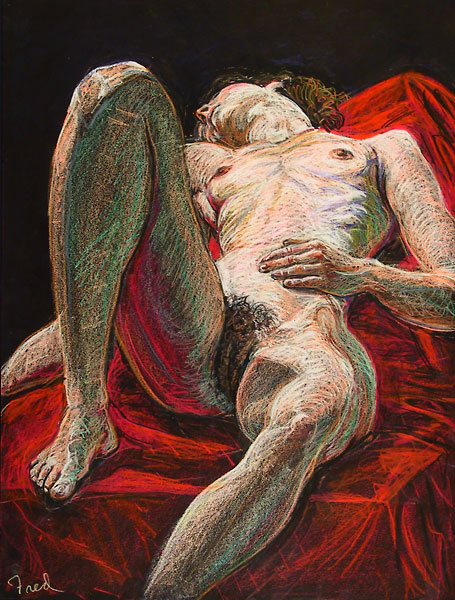
I love seeing the body this way.  Unusual angles create perspective effects and unfamiliar juxtapositions, and utterly transform the familiar forms of the body.  Foreshortening is a fundamental concept in drawing, designating the distortion of long shapes when seen end-on.  Often, in figure drawing, this refers only to an arm or leg that appears pointed toward the viewer of the image.  A familiar example would be the pointing finger and arm of Uncle Sam in James Montgomery Flagg’s iconic army recruiting poster of 1917.  Here I post examples of my figure drawings in which not only the extremities but the entire body is seen from a foreshortened perspective.

Looking at the body from an angle close to the central axis is very helpful in understanding it as a three dimensional form.  In these foreshortened torsos, we see the protuberances of the iliac spine of the pelvis rising to either side of the pubic bone.  The abdomen is a saddle-like shape, concave in one direction and convex in the other.  The ribcage is a converging arch.  The pectoral or breast muscles show a continuity with the deltoid muscles of the shoulder.  The upper of these drawings still shows analytical lines I drew to figure out the angular relationships of bodily landmarks.

Surveyed, 2004, by Fred Hatt

Thorax, 2009, by Fred Hatt

Looking at the body from the head end shows a succession of rounded or symmetrically swelling forms:  the top of the skull, then the cheekbones and nose, the jaw, the collarbone, the shoulders, the chest, the ribs, the abdomen and pelvis.  You can see it as a kind of architecture based on a series of differently shaped arches that you pass through or over, or as a landscape of hills and valleys that you can traverse on a meandering trail.  From this angle the legs and feet are often severely forshortened, and are best observed in relation to the cross-sectional contours of the torso.

Lounging, 2000, by Fred Hatt

Head End 2, 2006, by Fred Hatt

Head End, 2006, by Fred Hatt

I try to see organic physical forms as manifestations of patterns of energy.  In looking down the length of the body, you can see each of these levels as manifestations of the elemental forces associated with the chakras, a series of focal points arranged along the central column of the body in a Yogic conception of energy anatomy.  For example, the pelvis, corresponding to the water element, has the form of a basin, while the chest, corresponding with the air element, has the form of a bellows.  Here are a few sketches from a series exploring the energy patterns of the body in this context:

Strata, 2002, by Fred Hatt

Flat, 2002, by Fred Hatt

Zones 1, 2002, by Fred Hatt

To see the body in extreme foreshortening, I find it helpful to look at it not in terms of an understanding of structural relationships and proportions, but cross-sectionally, as a series of transverse contours receding in space.  The National Library of Medicine’s Visible Human Project, a three-dimensional atlas of human anatomy, has a website that offers animated “fly-throughs” of the human body in the various planes of sectioning.  Here’s the transverse section animation, the one most relevant to these end-on views of the human body.

Here are some more of my compositions of the body in extreme foreshortening:

Crossed Ankles, 2004, by Fred Hatt

Nuit, 1999, by Fred Hatt

The examples above are drawn from a distance of at least three meters and so show a sort of compressed perspective.  The feet and head are roughly in the same proportional scale but the angle of view has caused things to be seen in unfamiliar juxtaposition.  The drawing below is drawn from much closer, so it shows more perspectival diminution.  The feet and legs, closer to me, are large in comparison to the upper body and head, which are further away.  The length of the foot, measured on the drawing, is more than twice the width of the skull, but it looks right because it represents the perception of perspective.

Perspective, 2010, by Fred Hatt

In this foot-end view, the angles of the feet and legs are the foreground of the drawing, while the upper body becomes the mountain on the horizon.

Side Drawn Up, 2001, by Fred Hatt

Prone Reach, 2006, by Fred Hatt

Splay, 1999, by Fred Hatt

When the head is the foreground element, it remains abstract as we are looking at the top of the skull, and the face, if seen, is highly abstracted.  The body is even more landscape-like seen from the head end.

Climber, 2006, by Fred Hatt

In the drawing below, the blue line in the background is the “horizon”, or edge of the floor on which the model was lying.  The body formed a tilted rectangular form, so I tilted my drawing board to maximize usage of the page.

Tilted Horizon, 2001, by Fred Hatt

Sometimes these end-on views become visions of pure organic form.

Prone Twist, 2009, by Fred Hatt

The twisting of the body, as seen in the example above, also creates interesting sculptural forms seen from the foot end.

Corner, 2010, by Fred Hatt

Here the legs go one direction and the head the opposite, with the hand and arm reflecting that arc of movement.

Helix, 2001, by Fred Hatt

Here the position of the legs gives a soft curve to one side of the figure and a sharp angle to the other.

Bow and Arrow, 2000, by Fred Hatt

When the body is visually compressed by foreshortening, an upraised knee becomes dramatically long and vertical by contrast.

Wrist to Knee, 2008, by Fred Hatt

Angular Recline, 1998, by Fred Hatt

In the drawing below, the use of a mirror gives a view of the same pose from both the head end and the foot end.

Mira, 1996, by Fred Hatt

I’ll close this collection with a more finished piece, a foreshortened figure of graceful serenity.

Tranquility, 2008, by Fred Hatt

All the drawings in this post are aquarelle crayon on paper, in the size range of 18″ x 24″ to 20″ x 30″.  Other examples of foreshortened figures can be seen in this post and this one, and there are many others scattered through my portfolio site and other figure drawing posts on this blog.  This post features a famous 15th century foreshortened figure painting by Andrea Mantegna.

If you’re a student of drawing, you might be interested in a new series of articles on learning the basics of drawing that has begun appearing in the Opinion pages of the New York Times online edition, under the title “Line by Line” by James McMullan.

2010/08/26

Synapse Opens September 2

Filed under: My Events: Exhibitions — Tags: , , , , — fred @ 22:47

Hand stencils, Santa Cruz Cueva Manos, Argentina, circa 7370 BCE (postcard image for "Synapse" exhibition)

SYNAPSE, a group exhibition curated by Anthony Troncale

2/20 Gallery

220 West 16th Street

New York, NY 10011

212-807-8348

September 2 – 16,  2010.

Opening reception: Thurs., Sept. 2, 6:00 – 9:00pm

rsvp:  atroncale@yahoo.com

Artists included in the exhibition:

Dan Leo

David Schafer

Eric Olson

Marilyn McLaren

Michelle Beshaw

Josh Gura

Anthony Troncale

Bill Eldred, Jr.

Fred Hatt

Yuri Lev

If you’re in town come and meet me and Anthony and the other artists in the show.  Here’s one of two pieces I’m showing in Synapse:

Creature, 2010, by Fred Hatt

2010/08/13

Profile View

Filed under: Figure Drawing: Portraits — Tags: , , , , — fred @ 14:50

Kika Eyes Closed, 2002, by Fred Hatt

The profile or side view of the face has been a standard for coin portraits since ancient times, probably because it remains recognizable even when worn smooth.  The contour of the front of the face, and of the head and neck, conveys the individuality of the subject even when it lacks such significant interior details as eyes and ears.

A couple of decades ago, the side view of the face would probably have been the first meaning of the word “profile” to come to mind for most people.  Now the word is more likely to evoke a Facebook profile, a company profile, “racial profiling” or some such more informational expression of identity.  Facebook profiles include profile pictures, of course, but hardly anyone uses a side view.  It’s just not the way people see themselves.  But the side view can be a distinctive and highly expressive aspect of the human face.  In this post I’ve gathered together a variety of my own drawings of faces in the profile view.

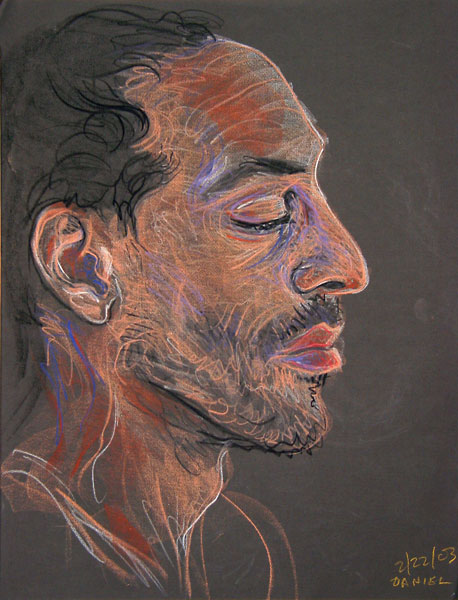
Daniel Eyes Closed, 2003, by Fred Hatt

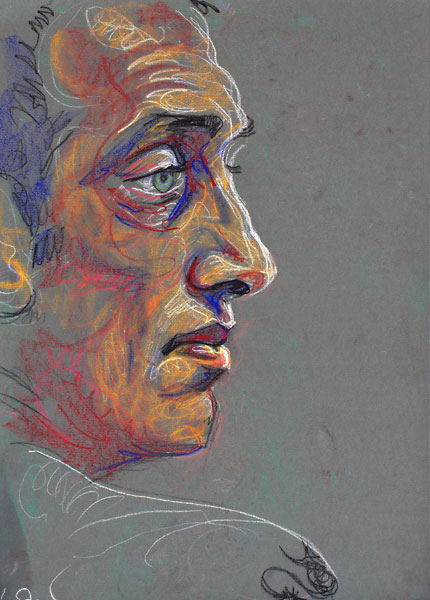
The subject of the drawing above has bold, prominent features, but his energy is turned inward as though in meditation.  The one below has a similar facial contour, but the pale eye and the shadows and wrinkles around it, give it a completely different expression.

Scott, 2008, by Fred Hatt

In the drawing below, the primary light source is behind the subject, making the facial contour both a bright line and an indicator of the more complex three dimensional structure of the face.

Che, 2002, by Fred Hatt

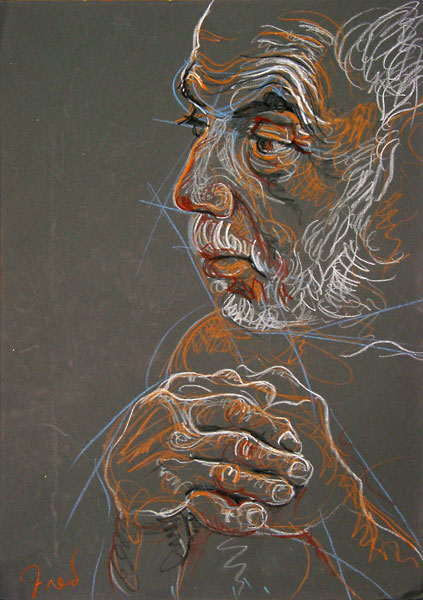
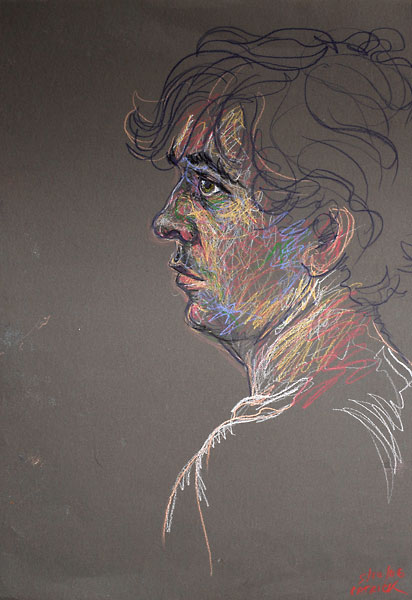
Below, the internal contours of hair and beard and brow wrinkles add a lot to the feeling of the personality of the subject.  As in the sketch above, you can see part of the eyelid of the hidden side of the face, which gives a clearer direction to the gaze.

John, 2002, by Fred Hatt

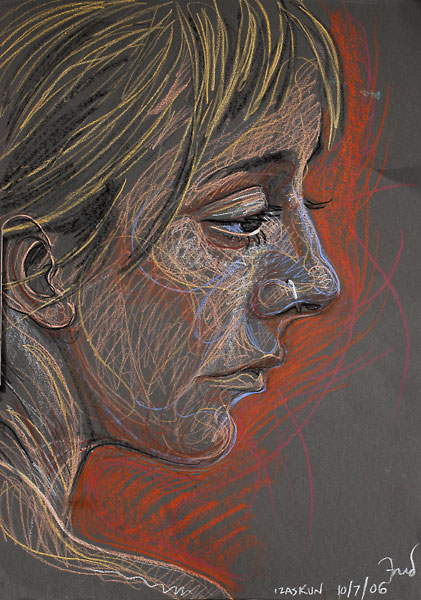
The angles of nose, jaw and brow help to define the individuality of the face.  The eyelids and the usually shadowed area where brow, eyelid and nose meet are also significant forms.

Izaskun, 2006, by Fred Hatt

Alley, 2009, by Fred Hatt

The way a person arranges, or does not arrange, their hair, and the way the neck carries the head atop the body, are other distinctive aspects of the body that convey personality, and that can be observed in most of these examples.

Patrick, 2006, by Fred Hatt

The arrangement of the neck and jaw in particular can give a profile a more sensitive or a more aggressive appearance.

Vinnie, 2009, by Fred Hatt

In the side view of the face, the ear is a central element.  The human ear is a wonderful convoluted shape, with considerable variation in size and overall shape among individuals.

Tram, 2008, by Fred Hatt

Hair can alter or emphasize the shapes of the head, as in the jutting beard above or the haircut below that reinforces the rectangularity of the model’s head.

Robert, 2004, by Fred Hatt

Marilyn, 2010, by Fred Hatt

Sometimes the neck and collarbone and shoulders are nearly as expressive as the face.  When I am drawing I often feel that I am exploring a landscape of hills and valleys, ridges and chasms.

Tanya, 2005, by Fred Hatt

Rios, 2010, by Fred Hatt

On a hairless head, the face and the skull are unified.  Hair often frames the face and disguises the shape of the rest of the skull.  This can make the face look larger or smaller in relation to the head.

Theresa, 2010, by Fred Hatt

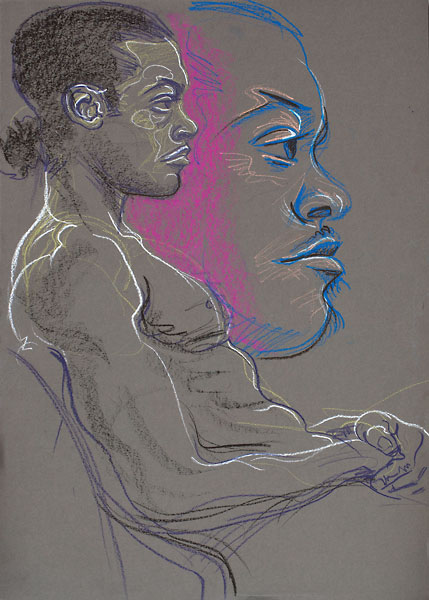
In the drawing below, I knew I hadn’t captured the contour of the face accurately in the full upper body sketch.  Projecting the face in a larger size made it easier to capture this model’s distinctive profile.

Corey Two Profiles, 2009, by Fred Hatt

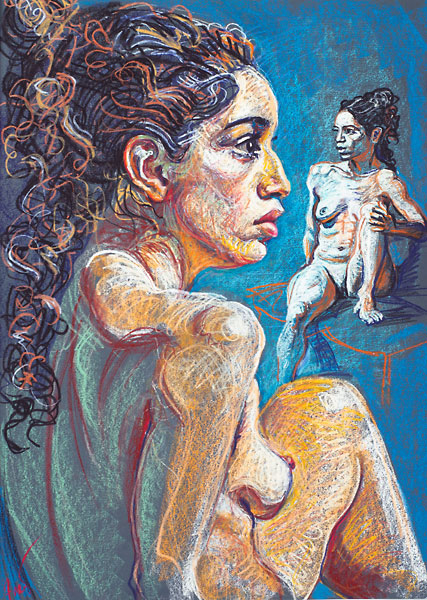
In the drawing below, I did the face large, and the full body smaller, from the opposite side.

Ivanhova Two Views, 2010, by Fred Hatt

And in my final example, two models posing together show very different facial structures.  The female figure in the foreground has prominent cheekbones, shallow eye sockets, and a relatively flat nose.  The male figure behind her has a prominent brow ridge and a more pointed nose.  Both models are sitting back, resting on the elbows.  The female settles her head into the shoulders, while the male’s head is slightly more lifted.  In drawing from life, capturing a likeness relies very much on observing the subtle differences that make each person physically unique.

Sasho & Tin, 2010, by Fred Hatt

The drawings in this post are in the range of 18″ x 24″ to 20″ x 27″, drawn in aquarelle crayon on paper.  Most of these were done during life drawing sessions at Spring Studio or Figureworks Gallery.  Some other side view portraits are among those in this earlier post.

2010/07/18

Movement Multiples

Space Between (Anna), c. 1998, by Fred Hatt

In the late 1990’s, an important focus of my drawing practice was capturing the energy of moving figures through expressive line.  This week’s post is a selection of drawings from 1997 through 1999.  All of these feature multiple renderings of the same pose in different positions.  It was my attempt to introduce the dimension of time into the two-dimensional world of the sketch.

Nested (Ignacio), c.1998, by Fred Hatt

In the drawing above, the transition of the figure from upright to fetal forms a natural nested composition, with different colored lines used to keep the phases of the movement separate.  The drawing below is more like a stroboscopic sequence moving across the frame, reminiscent of this kind of photograph I remembered seeing as a kid.

Stage Cross (Arthur), c. 1998, by Fred Hatt

Here’s a beautifully simple study of the movement of the spine:

Spinal Movement (Francisca), c. 1998, by Fred Hatt

In drawing from a model in motion, it is often impossible to capture the entire figure.  The composition below arises from the bony contours of ribs and arms, shoulderblades and collarbones:

Bony (Francisco), c. 1998, by Fred Hatt

A model who is an expressive dancer can convey feeling even in quick movement sketches:

Emotion (Anna), c. 1998, by Fred Hatt

Here are two figures, with two phases each:

Turns (Heather), c. 1998, by Fred Hatt

Here, the arm of the forward bending figure becomes the leg of the standing figure:

Unfolding (Caitlin), c. 1998, by Fred Hatt

Ink drawing with a brush has the spontaneity of dance:

Motion 4, c. 1998, by Fred Hatt

Here, the soft colors seem to be separating from the hard colors:

Stepping Out of Oneself (Miha), c. 1998, by Fred Hatt

There are five fragmentary figures here, two drawn softly, in white, using the edge of the crayon, and three drawn crisply, in dark blue, using the point.  The differing techniques make the white and the blue drawings appear to be on different planes:

Circularity (Corinna), c. 1998, by Fred Hatt

The cool softness above is contrasted by the hot energy below:

Lunge (Claudia), c. 1998, by Fred Hatt

At times, the overlapping lines of the figures cease being figures and become abstract patterns:

Grass (Anna), c. 1998, by Fred Hatt

In drawing from moving models, I often focused on one part of the body.  Here, it is the movement of the legs:

Legwork (Joe), c. 1998, by Fred Hatt

The simplicity of the ink drawing below makes it possible to see many forms, not just figures, suggested in the flowing brushstrokes.

Motion 3, c. 1998, by Fred Hatt

When the models movements suggest power and vigor, those qualities come through in the drawing:

Explode (Toby), c. 1998, by Fred Hatt

A softer style of movement makes a softer drawing:

Shimmy (Nyonnoweh), c. 1998, by Fred Hatt

The model for the next two drawings was a dancer whose movements all seemed to flow from a supple spine:

Spinal Flexure (Donna), c. 1998, by Fred Hatt

Leap & Turn (Donna), c. 1998, by Fred Hatt

In the one below, the model must have been holding the poses for at least a minute, as there are relatively complete figures, kept mostly separated on the page:

Angst (Joe), c. 1998, by Fred Hatt

Here two phases of the model’s changing states find expression in the drawing.  The face, like a placid moon, looks down upon the thrusting figures below it:
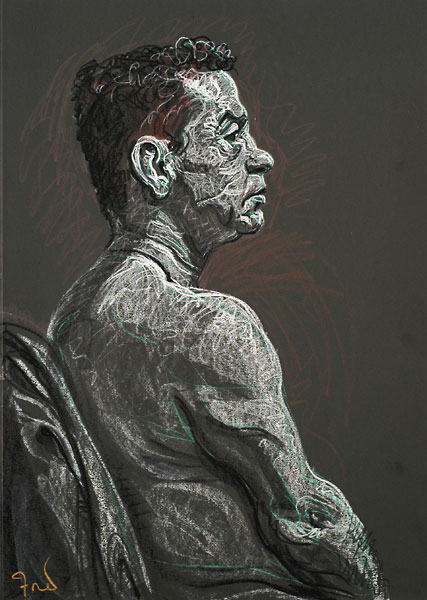
Serene Vigor (Julie), c. 1998, by Fred Hatt

I believe the drawing below arose from a model moving very slowly.  As the upper body gradually changed position, I kept sketching the contours.  In this case slow movement produced a sketch with a lot of energy:

Twist and Reach (Lea), c. 1998, by Fred Hatt

Many of these drawings look like they should be painted on the walls of a cave.  They have the roughness and vitality of stone age painting.

Stone (Claudia), c. 1998, by Fred Hatt

All of these drawings were done between the years, 1997 and 1999, mostly at the movement drawing sessions I used to run at Spring Studio in New York.  The color drawings are done with aquarelle crayons and sometimes ink, and are about 18″ x 24″.  Some of the ink drawings here may be as small as 10″ x 10″.  The digital images used in this post were made in the same era as the drawings, by photographing the drawings on 35mm film and scanning the prints, so they’re not quite up to the artwork photography standards I try to maintain today.

Note:  The “Claudia” that is credited as the model in two of the drawings in this post is not the same Claudia that many of my readers know as the blogger of Museworthy.

My portfolio site from this era is still online, and features a selection of movement drawings.

This week I’ll be teaching workshops and doing body painting and other fun things at the Brushwood Folklore Center in Sherman, NY.  I won’t have access to a computer, so forgive me if I don’t reply to your comments right away, or if the next post takes a little more than a week to appear here.

« Newer PostsOlder Posts »

Powered by WordPress

Theme Tweaker by Unreal