DRAWING LIFE by fred hatt

2013/03/27

Exploring Together

Still from "Rocks Remember", 2011, video edited by Yuko Takebe

Still from “Rocks Remember”, 2011, video edited by Yuko Takebe

I’m interested in the moving body and movement in nature, and I’m always trying to capture the spirit of motion in my drawings, but of course I love actual moving pictures too. I like to make simple, non-narrative films, often working with dancers. A couple of years ago I suggested to my friend, dancer Kristin Hatleberg that if she would like to do some kind of dance film, I’d be up for it. She mentioned a curious landscape she wanted to explore, Ringing Rocks State Park, in Pennsylvania.

Still from "Ringing Rocks", 2011, video edited by Fred Hatt

Still from “Ringing Rocks”, 2011, video edited by Fred Hatt

Ringing Rocks Park has a large field of boulders that ring like metal bells when struck with a hammer or with another stone. These boulders are called “lithophonic” or “sonorous rocks”. Geologists believe the tones emitted by these stones are the result of “internal elastic stresses”, but the science isn’t settled. It’s a mysterious and enchanting phenomenon.

Still from "Rocks Remember", 2011, video edited by Yuko Takebe

Still from “Rocks Remember”, 2011, video edited by Yuko Takebe

So one day Kristin rented a Zipcar and we took a day trip to Bucks County, Pennsylvania. With us were Kristin’s friend Jim Smith, a composer and music producer, and my friend Yuko Takebe, a talented dance filmmaker who’d just gotten a new HD camcorder and was eager to put it to use. I had my camera with me too.

Still from "Ringing Rocks", 2011, video edited by Fred Hatt

Still from “Ringing Rocks”, 2011, video edited by Fred Hatt

We had almost no plan about how to film at this site, aside from the idea that Jim was going to go around and hammer on the rocks and record sounds, and Kristin was going to dance in the environment, and Yuko and I were going to film Kristin and the landscape. None of us had ever been to Ringing Rocks before, so we didn’t know exactly what we’d encounter. Together we would explore and collect images and sounds, and then we would see what we could make of them. It was a fairly egalitarian collaboration, and the whole process would be a journey without a map.

Still from "Rocks Remember", 2011, video edited by Yuko Takebe

Still from “Rocks Remember”, 2011, video edited by Yuko Takebe

There was a large clearing covered with big jagged boulders, a forested area, and a small ravine with a waterfall. It was a late autumn day so our daylight hours would be limited, and the angle of the sun would change quickly through the afternoon.

Still from "Ringing Rocks", 2011, video edited by Fred Hatt

Still from “Ringing Rocks”, 2011, video edited by Fred Hatt

Dancing on a jumble of sharp and irregular rocks is nothing like dancing in a studio with open space and a nice smooth hardwood floor. In fact, it’s a bit dangerous. I’m not sure if Kristin imagined doing balletic leaps from stone to stone, but when she actually started moving in the boulder field, she found herself hugging the rocks, rolling over them and in and out of the crevices. It looked a little like contact improvisation with very heavy, very hard dance partners.  Kristin took the same grounded, tactile approach to other elements of the landscape as well.

Still from "Rocks Remember", 2011, video edited by Yuko Takebe

Still from “Rocks Remember”, 2011, video edited by Yuko Takebe

Since there was no script and almost no plan, we all just sort of went about doing our own explorations in whatever way felt appropriate in the moment. Jim rang the rocks until he got the birds to join in the symphony. Yuko and I looked for aesthetically pleasing compositions and dynamic camera angles. Kristin climbed and stroked and became one with the earth.

Still from "Ringing Rocks", 2011, video edited by Fred Hatt

Still from “Ringing Rocks”, 2011, video edited by Fred Hatt

We decided that Yuko and I would share all our footage and sound recordings, but each of us would edit our own version of the material. When I started editing, I found it really challenging. It felt like a random collection of shots that just wouldn’t gel. There was no clear beginning, middle, or end, no unifying design, no choreographic continuity. The color and visual quality of the images from the two cameras was way different, and there were lots of technical problems such as sun glare and noisy tourists who were also at the park that day on the sound track. The rapidly changing light meant a shot made at 2:00 would never match with one made at 3:00.

Still from "Rocks Remember", 2011, video edited by Yuko Takebe

Still from “Rocks Remember”, 2011, video edited by Yuko Takebe

For my first edit, I decided to use just two parts of our footage, the waterfall scene and the field of boulders. I decided to convert everything to black and white, both to eliminate the color differences between the two cameras and to make Kristin, who was dressed in tones of pink and purple, blend in more with the textures of stone and earth. I pulled out what I thought were the best bits of movement and labeled them according to whether the movement was up or down or rotating or whatever, and then basically assembled those movements into an illusion of continuity. It sort of worked, but it had a monotonous rhythm, and after test-screening it for Kristin and my filmmaker friend David Finkelstein, I ended up making it more fragmented and spare, maybe more about the landscape and less about the dance. For my version of the piece, Jim Smith structured some of the sound recordings from the site into a simple composition.

I think my final version captures something beautiful about experiencing oneself as part of the earth by direct contact with it. Human beings are of the earth just as much as are stones or trees, and we should feel it in our bones and in our skin.

A video piece is something different than the experience by which its source material came to be.  In the end it becomes something in itself, something that is experienced as a moving image, by people who have no knowledge of its making. My struggle to structure this material into a piece helped me to find a new sense of how to assemble moving images, and after editing this piece I found I was finally able to complete several other video pieces I had shot that had lingered unfinished for years.

Still from "Ringing Rocks", 2011, video edited by Fred Hatt

Still from “Ringing Rocks”, 2011, video edited by Fred Hatt

I don’t know too much about how Yuko approached the task of editing. Her basic impulse is more narrative and less formal than mine, and she has a knack for making good use of “flaws” like camera shake and lens flare. Her version is in color,and I feel it gives more of a sense of Kristin as a person interacting with the landscape, where mine seems more like some kind of elemental ritual.

Still from "Rocks Remember", 2011, video edited by Yuko Takebe

Still from “Rocks Remember”, 2011, video edited by Yuko Takebe

Here’s what Kristin wrote about the experience:

When Fred asked what I’d like to collaborate on, I thought here’s a rare opportunity to distill a moment. What if every element of this lasting capsule, this film, results completely from its environment? I chose Ringing Rocks State Park because of how literally it could yield all the elements. Our agreement was to focus fully on the park itself, and for me the rocks were a solidity into which I could melt away. I set out to evaporate over them, roll like an ocean wave across their challenging formations. What a metaphorical parallel this act was to dealing with life. I used all my strength to simply be, there.

For me our experience at the Ringing Rocks State Park was a meditative experience, and I think that spills over into the intent of each of the resulting films. It was meditation that arose from necessity, for the sake of harmonious survival. While we were in the park, I was not there to recreate or mimic anything. Instead, my focus was to listen to all the textures. I dove into my senses and I tried to absorb every texture of the place until the most dominant ones seeped back out of me. Because I was approaching it through absorption, I was meditating and accepting. Accepting the jagged contours into my flesh as I rolled over them, softening the harshness of the landscape by joining a wave of air and riding its current over the topography. When each element has its autonomy, it is simpler to find harmony.

All I am doing in my actions is revealing what was revealed to me, simply by being there: there, hanging off the top of that rock upside down; there, perched between three trunks of a tree without a limb on which to sit; there, hearing the beautiful water while feeling the cold, smooth stone slide away from under me. The films that resulted therefore do not give me any answers or pose questions to me. They simply reveal contours, light, textures. Watching them, I can momentarily breathe again a cleaner air.

Still from "Ringing Rocks", 2011, video edited by Fred Hatt

Still from “Ringing Rocks”, 2011, video edited by Fred Hatt

Yuko said this about the experience:

I had never known stone that resonates like a bell until Kristin took me to Ringing Rocks Park. The high-pitched tone, but involving the profound sound as hit by a hammer, brought me to feel time immemorial. Kristin danced as if she were swimming, freely and slowly, between big rough rocks. Her movement looked like just a spirit of the rocks to me. The rock has immanent memories since the earth has existed, and its sound tells us the history of our life. The water flows and wind blows on the surface of the rocks. The beautiful golden strings are spun by a spider and gnats are flying between rocks. That moment fulfilled by stillness and serenity only appeared in an early evening glow. I wanted to capture the eternal flow of time and the spiritual harmony between the perpetuity of nature and a mortal life through Kristin’s dance and my lenses.

So now I have told you my story. My collaborators have offered their beautiful perspectives on this joint exploration of the land in movement and film. There is nothing left but for you to watch the two films, first, “Rocks Remember”, Yuko’s edit, and then “Ringing Rocks”, my version.

Rocks Remember from Yuko Takebe on Vimeo.

Ringing Rocks from Fred Hatt on Vimeo.

Both of these films will be projected outdoors as part of the SB-ADaPT Festival of Dance and Physical Theater in Santa Barbara, California, this summer. I’ll add the dates and more info here when I have it. 
2013/03/12

Rough and Refined Versions


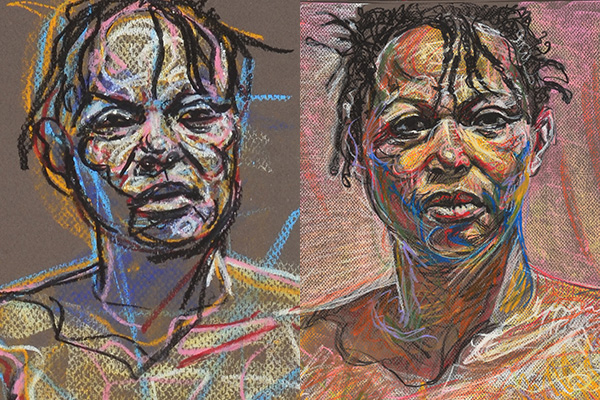
Sh About to Rise, 2013, by Fred Hatt, details of sketch and final version side-by-side

Sh About to Rise, 2013, by Fred Hatt, details of sketch and final version side-by-side

The first post of Drawing Life was published on March 15, 2009, so the fourth blogaversary is upon us. I want to thank my readers, those that have been following since the start and those that have recently discovered the blog, those that subscribe by email and those that just check it out a few times a year. I just can’t help producing a constant flow of images – it’s my nature – but looking at the site stats and seeing how many people look in on what I post here, and especially receiving comments, motivates me to keep sharing with you through this forum. I invite you, dear reader, to tell me what you’d like to see more of here, questions you’ve wanted to ask me, or topics you think I should address. Please comment.

Some readers are mainly interested in figure drawing and art technique, some are interested in body art, others respond most strongly to the photographic visual essays, and still others to the art-historical surveys. For me, it’s all of a piece, all about my approach to visual art as a practice of self-development – a journey I have chosen as the central journey of my life, an effort to transform perception and a quest for mastery in an open-ended craft.

I long ago discovered that I needed a core practice, a strong trellis upon which to cultivate my twisty vines. For me, that core practice is figure drawing. It provides me with an ideal combination of discipline and inspiration, self-measurement and freedom to explore. Looking back over the last six months of posts on Drawing Life I noticed it’s been a long time since I just posted an update on my recent figure drawing work, and I’ve built up quite an archive of unposted work in the past year – enough to explore various themes in separate posts.

In my figure drawing practice I attend two regular weekly sessions, one of which (at Figureworks) consists of poses two minutes to twenty minutes in length, and the other of which (at Spring Studio) includes a single longer pose. Total drawing time on that pose, subtracting breaks, amounts to about two hours. It’s enough time to do a fairly refined drawing, though I approach it differently at different times, sometimes focusing on capturing a likeness, sometimes looking at subtleties of color or shading, sometimes studying the relationship of the face to the body or of the model to the surroundings, or any combination of these things. Sometimes I get off to a solid start and keep working on one sheet of paper for the whole duration of the pose. Other times I do a sketch and then start over again for one reason or another. This post is a collection of recent pairs of rough, sketchy versions and more finished versions of the same poses. It’s a way of looking into my process.  For each pair, my commentary will be inserted between the sketchy and polished versions.

Ch Diagonal, sketch version, 2012, by Fred Hatt

Ch Diagonal, sketch version, 2012, by Fred Hatt

Often I start out studying the whole figure and then decide to focus on a cropped view. This pose has a strong diagonal through-line, from right foot to head, with the model’s left limbs acting as right-angled buttresses.  After doing the sketch above, I decided I wanted to work larger to get more detail in the face, realizing that the diagonal tilt of the body worked in the composition without having to go all the way down to the right foot. In this case, the sketch was weak, but doing it helped to sharpen my perception for the more developed drawing.

Ch Diagonal, final version, 2012, by Fred Hatt

Ch Diagonal, final version, 2012, by Fred Hatt

Sage, sketch version, 2012, by Fred Hatt

Here I felt the initial sketch was, in its rough form, a superb realization of my way of analyzing the figure, using curved lines to trace continuities of form, light, and body energy.  Further developing the drawing above would have obscured the white energy lines, destroying a drawing that is simple and intense. In this case I stopped, not because the sketch was weak or flawed, but because it was excellent in its undeveloped form. I went on to do the study below, applying most of my attention to the model’s face as an image of strong character and lived experience. I’m glad I stopped and saved the above version as a separate drawing, because it shows the robust, vibrant energy of the model’s abdomen, something that the second drawing omits.

Sage, final version, 2012, by Fred Hatt

Sage, final version, 2012, by Fred Hatt

B with Mannequins, sketch version, 2012, by Fred Hatt

B with Mannequins, sketch version, 2012, by Fred Hatt

This is a wonderful model I’ve drawn many times before. For this pose, she set up an array of background elements and I decided to place her in this spatial context, with the blocks and boxes, hanging fabrics, and tattooed mannequin parts around her. In my initial sketch, above, I tried to get everything in the frame.  Later, I decided to develop the drawing with the model more centered, omitting details on the left. But there’s something almost Matissean about the stripped-down, off-center composition of the rough sketch.

B with Mannequins, final version, 2012, by Fred Hatt

B with Mannequins, final version, 2012, by Fred Hatt

M with Stockings, sketch version, 2013, by Fred Hatt

M with Stockings, sketch version, 2013, by Fred Hatt

This model, a fine artist in her own right, has the artist’s sense of what will make an interesting pose. She came up with this Schiele-esque pose, angular, fascinatingly awkward, casual and odd, with one stocking on and one hanging from the hands. This kind of pose is complicated and not easy to draw. I studied it in the above sketch for several layers of light and dark forms, angles and curves and cut facets, before attempting the realistic/impressionistic monochrome rendering, below.

M with Stockings, final version, 2013, by Fred Hatt

M with Stockings, final version, 2013, by Fred Hatt

Cl Physique, sketch version, 2012, by Fred Hatt

Cl Physique, sketch version, 2012, by Fred Hatt

This model is a bodybuilder with incredibly defined muscles, and drawing him is an anatomical study. My initial sketch was an attempt to understand the pose, but I was craving more detail in the face and torso, and decided to develop the drawing in a vertical frame rather than the horizontal one with which I’d begun. This was a session I had to leave early because of a work obligation, so the second drawing here is less refined than some of the others in this post.

Cl Physique, final version, 2012, by Fred Hatt

Cl Physique, final version, 2012, by Fred Hatt

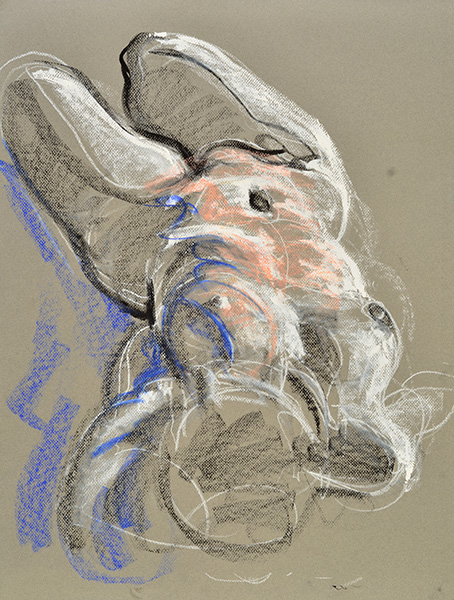
Sh About to Rise, sketch version, 2013, by Fred Hatt

Sh About to Rise, sketch version, 2013, by Fred Hatt

Here’s another one where the sketch was too good to ruin by developing it, and I felt the model’s face needed more space to show its character. These two drawings need to be seen together. The sketch above shows the character of the body, and the sketch below shows more detail in the character of the face. There’s a limit to the paper size that can be used n the context of the crowded group session. Sometimes I wish I could draw everything in life size.

Sh About to Rise, final version, 2013, by Fred Hatt

Sh About to Rise, final version, 2013, by Fred Hatt

Reclining K from Head End, sketch version, 2013, by Fred Hatt

Reclining K from Head End, sketch version, 2013, by Fred Hatt

This pair is done in my studio, not in the Monday morning long-pose session at Spring Studio, as are all the other examples in this post. Recently I’ve had an opportunity to work with the same model almost weekly in my own studio. I expect there will eventually be a post here about this experience. In my own studio I can work with dramatic lighting that is not practical in the group setting of Spring Studio, and can work directly with the model to refine the poses. After doing the rough crayon and gouache sketch above, the pose was modified to paint the foreshortened view below.

Reclining K from Head End, final version, 2013, by Fred Hatt

Reclining K from Head End, final version, 2013, by Fred Hatt

All of the original drawings shown in this post are roughly 19″ x 25″ (48 c 64 cm). Some are drawn with Caran d’Ache aqruarelle crayons alone, and some are painted in gouache, combined with the crayons.

2013/03/08

Opening with Projections

Filed under: My Events: Exhibitions — Tags: , , , — fred @ 09:06
Hostess, 2013, by Yuliya Lanina

Hostess, 2012, by Yuliya Lanina

This Saturday evening, March 9, 2013, my long-time friend Yuliya Lanina has a solo show opening at Figureworks gallery in Williamsburg, Brooklyn, in conjunction with Williamsburg After Hours‘ annual Armory Show weekend event.  I’ll be projecting video onto the sidewalk in front of the gallery, one animated piece by Yuliya and a video of my own in rotation.  The reception runs from 7-10 – please come see us.  Here’s the full info:

Yuliya Lanina
Honky-tonk Belles
March 9 – April 21, 2013
Reception: Saturday, March 9th from 7-10PM  *SPECIAL EVENT – SEE BELOW
at
FIGUREWORKS
fine art of the human form
168 North 6th St. (1 block from Bedford Avenue “L” train)
Williamsburg, Brooklyn, NY 11211
 hours: Saturday and Sunday from 1-6PM

Yuliya Lanina is a Russian-born American multimedia artist who splits her time between New York City and Austin, Texas. Having shown at Figureworks for many years, this solo exhibition highlights her most recent series of paintings and will also showcase her latest animatronic sculpture. This body of work portrays alternate realities that fuse fantasy, femininity, and humor.

Employing fanciful imagery from plants, animals and humans, Lanina’s characters simultaneously elicit feelings of uneasiness and empathy. Mostly female in gender, they are made of parts that are not supposed to go together and are derived from the artist’s own projections of nonsensical events and consequences. Painted on a stark white background, the primary isolated figure is accompanied by small winged creatures and quirky floral personas – all gesturing to get her attention. These unusual compositions celebrate feminine power and its connection to the mysterious, the beautiful, and the sensual.  Lanina’s largest canvases are now introducing some intricately tattooed appendages that personalize and provide greater insight into these mysterious beings.

Lanina draws from many sources to create these characters. Though she often taps into Greek mythology with the half-human and half-animal demigods, she also relies on her personal roots with Russian fairy tales, which are filled with fantastic beings deeply rooted in paganism, mysticism, and symbolism. Her creatures and their stories move freely between logical and illogical, realistic and illusory, predictable and surprising, representing life that can only be lived, but never understood.

Bringing these two dimensional characters to life, Lanina has collaborated with Theodore Johnson (technical direction) and Yevgeniy Sharlat (musical score) to create “Honky-tonk Belles”, a festive, animatronic sculpture with characters from her paintings frolicking to an original soundtrack.

Figureworks is located at 168 N. 6th St., Williamsburg, Brooklyn, NY 11211, one block from the Bedford Avenue “L” train. The gallery is open to the public Saturday and Sunday from 1-6 PM and is dedicated to exhibiting contemporary and 20th century fine art of the human form.

For more information please email harris@figureworks.com, call the gallery at 718-486-7021 or visit us online at www.figureworks.com

* THIS RECEPTION COINCIDES WITH A SPECIAL WILLIAMSBURG EVENT:

Williamsburg After Hours

7 pm to 10 pm
Sat March 9th

2013/02/24

Motion in Stills

Dynamism of a Dog on a Leash, 1912, by Giacomo Balla

Dynamism of a Dog on a Leash, 1912, by Giacomo Balla

Isn’t this a wonderful evocation of the movement of an excited dachshund out for a walk? You can just feel the undulations of the leash and the wagging of the tail, and you can almost hear the clicking of the dog’s toenails on the sidewalk. A camera might capture this scene by freezing an instant. This would give us more surface detail, but none of the jaunty spirit that Balla shares with us here.

In this post I present a variety of modern approaches to capturing movement in the still media of drawing and painting, sculpture, and photography. If you’d like a more systematic approach to the topic, I recommend this excellent overview by James E. Cutting. I have had a longstanding interest in depicting the spirit of movement, especially human movement, through drawing, and my selection here reflects that.

Classical art tends to imply the energy and movement of characters by putting them in poses of dynamic tension, or by depicting the flow of hair or drapery to suggest motion – some great sculptural examples are examined in the earlier post “Stories in the Round”.

Many of the prints in Hokusai’s series of “manga” (sketchbooks) are sharply observed pictures of human movement, sometimes shown in series of little drawings that look very much like the work of an animator.  Surely Hokusai would have made animations if the concept had existed in his time!

Yakko-Odori, c. 1814, by Katsushika Hokusai

Yakko-Odori, c. 1814, by Katsushika Hokusai 

The sculptor Auguste Rodin discusses how he endeavors to endow his works with movement, from the book Rodin on Art and Artists.

Note, first, that movement is the transition from one attitude to another. . . You have certainly read in Ovid how Daphne was transformed into a bay-tree and Procne into a swallow. This charming writer shows us the body of the one taking on its covering of leaves and bark and the members of the other clothing themselves in feathers, so that in each of them one still sees the woman which will cease to be and the tree or bird which she will become. . . It is, in short, a metamorphosis of this kind that the painter or the sculptor effects in giving movement to his personages.  He represents the transition from one pose to another. . . while my Saint John is represented with both feet on the ground, it is probable that an instantaneous photograph from a model making the same movement would show the back foot already raised and carried toward the other. . . this model photographed would present the odd appearance of a man suddenly stricken with paralysis and petrified in his pose. . . If, in fact, in instantaneous photographs, the figures, though taken while moving, seem suddenly fixed in mid-air, it is because , all parts of the body being reproduced exactly at the same twentieth or fortieth of a second, there is no progressive development of movement as there is in art. . . It is the artist who is truthful and it is photography which lies, for in reality time does not stop, and if the artist succeeds in producing the impression of a movement which takes several moments for accomplishment, his work is certainly much less conventional than the scientific image, where time is abruptly suspended.

St. John the Baptist Preaching, 1878, by Auguste Rodin

St. John the Baptist Preaching, 1878, by Auguste Rodin

Rodin is defending the traditional artistic approach of depicting moments against the new, photographically influenced, way of seeing time as a series of instants. Though he aligns himself with the classicists in this, Rodin was more interested in movement than the more academic artists.  He did countless quick sketches, both in clay and in pencil and watercolor, observing figures in motion and capturing the quality of their aliveness with a remarkably free hand.

Psyche, c. 1900, by Auguste Rodin

Psyche, c. 1900, by Auguste Rodin 

The “instantaneous photography” Rodin mentions was a new development in the late 19th Century.  It enabled the analysis of movement too quick for the human eye, much less the drawing hand, to capture. In the 1880’s, Marey in France and Muybridge in California developed technologies for photographing movement in sequences of still photographs. Muybridge’s work was bankrolled by former California Governor Leland Stanford to settle a bet he had going about whether all four legs of a running horse were off the ground simultaneously at some point in the gallop (they are). This was something that could not be determined by naked eye observation. Muybridge went on to photograph analytical movement sequences of many animals and human models performing all kinds of actions, and his pictures are still studied by artists, animators, and anatomists.

Long Jump, 1887, from "Human and Animal Locomotion", photo by Eadweard Muybridge

Long Jump, 1887, from “Human and Animal Locomotion”, photo by Eadweard Muybridge

Where Muybridge’s method produced a series of discrete stills, Marey’s technique superimposed the phases of movement in a single image.

Flight of the Pelican, 1883, photo by Etienne-Jules Marey

Flight of the Pelican, 1883, photo by Etienne-Jules Marey

The photography of Muybridge and Marey is a kind of proto-cinema, and motion picture technology grew out of their work. This study of walking (below) using a black body suit with reflective lines and dots on it even seems to prefigure the “motion capture” techniques used today to transfer movement from live actors to digitally generated characters.

Geometric Chronophotograph of the Man in the Black Suit, 1883, photo by Etienne-Jules Marey

Geometric Chronophotograph of the Man in the Black Suit, 1883, photo by Etienne-Jules Marey

From Marey’s photography Marcel Duchamp took this idea of superimposing temporal instants and combined it with a cubist fragmentation of form to produce his famous “Nude Descending a Staircase”, which caused a sensation – both of outrage and of inspiration – when it was exhibited at the Armory Show of 1913, the first major exhibition of European avant-garde art in America.

Nude Descending a Staircase, 1912, by Marcel Duchamp

Nude Descending a Staircase, 1912, by Marcel Duchamp

Boccioni attempted something similar in sculptural form, distorting the figure to emphasize its dynamism. Boccioni, who also painted, and Balla, whose trotting dachshund leads this post, were members of the Italian Futurist art movement, obsessed with speed and frenzy.

Unique Forms of Continuity in Space, 1913, by Umberto Boccioni

Unique Forms of Continuity in Space, 1913, by Umberto Boccioni

This is an excerpt from the Futurist Manifesto of 1909, by F. T. Marinetti:

  1. We want to sing the love of danger, the habit of energy and rashness.
  2. The essential elements of our poetry will be courage, audacity and revolt.
  3. Literature has up to now magnified pensive immobility, ecstasy and slumber. We want to exalt movements of aggression, feverish sleeplessness, the double march, the perilous leap, the slap and the blow with the fist.
  4. We declare that the splendor of the world has been enriched by a new beauty: the beauty of speed. A racing automobile with its bonnet adorned with great tubes like serpents with explosive breath … a roaring motor car which seems to run on machine-gun fire, is more beautiful than the Victory of Samothrace.
  5. We want to sing the man at the wheel, the ideal axis of which crosses the earth, itself hurled along its orbit.
Elasticity, 1912, by Umberto Boccioni

Elasticity, 1912, by Umberto Boccioni

The world was being transformed and unsettled by new technologies and new media, and all the conventions of art seemed to lose their power, opening up new worlds of creative possibility.  Among purely abstract painters, Kandinsky seemed to have a special ability to create compositions that felt like they contained leaping, vibrating life force.

Blue Segment, 1921, by Wassily Kandinsky

Blue Segment, 1921, by Wassily Kandinsky 

In the 1930’s, electrical engineer Harold “Doc” Edgerton and Life Magazine photographer Gjon Mili worked together to develop the photographic possibilities of electronic strobe lighting, which made it possible to slice time into increasingly brief instants.

Milk Coronet, 1957, by Harold Edgerton

Milk Coronet, 1957, photo by Harold Edgerton

Stroboscopic photography improved Marey’s sequential superimposition technique, capturing faster motion with ultra clarity.

Bobby Jones Multi Flash, 1938, by Harold Edgerton

Bobby Jones Multi Flash, 1938, photo by Harold Edgerton

These photographers saw themselves as following in the footsteps of Duchamp. Here are two stroboscopic photo homages to the avant-garde master, by Life Magazine photographers Gjon Mili and Eliot Elisofon.

Nude Descending  1942, by Gjon Mili

Nude Descending, 1942, photo by Gjon Mili

Duchamp Descending a Staircase, 1952, photo by Eliot Elisofon

Duchamp Descending a Staircase, 1952, photo by Eliot Elisofon

Strobes distilled the energy and grace of great performing artists into striking images for magazines, the great popular graphic art medium of the era. Below, the dancer and choreographer Martha Graham and the drummer Gene Krupa.

Martha Graham performing "Punch and Judy", 1941, photo by Gjon Mili

Martha Graham performing “Punch and Judy”, 1941, photo by Gjon Mili

Gene Krupa Playing a Drum, 1941, photo by Gjon Mili

Gene Krupa Playing a Drum, 1941, photo by Gjon Mili

Of course, the art of painting is also fundamentally a movement art, as demonstrated here by Picasso, drawing in the air with a penlight, captured by the photographer with a long exposure combined with three strobe flashes.

Picasso Drawing with Light, 1949, by Gjon Mili

Picasso Drawing with Light, 1949, by Gjon Mili

Asian calligraphy had always been taught as an art of expressive movement, but Jackson Pollock was one of the first Western artists to treat painting as a form of dance. Here’s a video clip of Pollock at work.

Jackson Pollock Painting in his Long Island Studio, 1950, photo by Hans Namuth

Jackson Pollock Painting in his Long Island Studio, 1949, photo by Hans Namuth 

Dancers also used drawing and painting to try to show what they feel kinesthetically and proprioceptually. Here’s a sketch by Nijinsky, the dancer of Debussy’s Afternoon of a Faun and the original choreographer of Stravinsky’s Rite of Spring.

Dancer, 1917, by Vaclav Nijinsky

Dancer, 1917, by Vaslav Nijinsky

Nijinsky’s painting looks remarkably similar to the analytical drawing below by choreographer Rudolf von Laban. Laban created a system for analyzing and describing bodily movement. Laban described qualities of movement using evocative verbs: Float and Punch, Glide and Slash, Dab and Wring, Flick and Press. Those words could just as easily describe the different kinds of strokes a painter or drawer makes.

Illustration from Sketches of the "Scales", 1920s (?), by Rudolf von Laban

Illustration from Sketches of the “Scales”, 1920s (?), by Rudolf von Laban

For an artist attempting to describe movement, it’s all about the flow of the hand, the rhythm and quality of the line.  The Charlotte Trowbridge sketch below is made in response to the dance of Martha Graham, seen here previously in one of Gjon Mili’s stroboscopic studies.

Martha Graham's "Letter to the World", 1940, by Charlotte Trowbridge

Martha Graham’s “Letter to the World”, 1940, by Charlotte Trowbridge 

This understanding of the expressive power of curved lines is essential in the art of cartoonists and animators.

Illustration from "Advanced Animation", 1947, by Preston Blair

Line of Action, illustration from “Advanced Animation”, 1947, by Preston Blair

Monkey Concepts 2 for "Kung Fu Panda", 2008 film, artwork by Nicholas Marlet

Monkey Concepts 2 for “Kung Fu Panda”, 2008 film, artwork by Nicholas Marlet

Dance photographers also look for those distinctive contours.  Below are two pieces from Lois Greenfield, perhaps the most famous dance photographer of our time.  Greenfield uses strobe lighting (single, not multiple, flashes) to capture the peak moment of a movement, that instant at the top of a leap or the ultimate arc of a gesture.  She also frequently employs the movement of fabrics, hair, or, below, flour (?), frozen in an instant, to magnify physicality with pure physics.

Sham Mosher, 1995, photo by Lois Greenfield

Sham Mosher, 1995, photo by Lois Greenfield

Odara Jaeali-Nash/Philadanco, 2007, photo by Lois Greenfield

Odara Jaeali-Nash/Philadanco, 2007, photo by Lois Greenfield

Greenfield’s shots are always frozen, perfectly sharp.  Other dance photographers use longer exposures to show movement with motion blur.  The challenge with motion blur is to find just the right amount – too little just looks like a mistake, while too much makes the figure disappear.

Motion (one from a series), 2012, photo by Bill Wadman

Motion (one from a series), 2012, photo by Bill Wadman

3y1IE

Motion (one from a series), 2012, photo by Bill Wadman

In the picture below, long exposure blurs are combined with strobe bursts to givc crisp renditions of the extremes of the sequence.

The Red Mistress, 2012, photo by Benjamin Von Wong

The Red Mistress, 2012, photo by Benjamin Von Wong 

So far we’ve seen movement expressed through blurs, stroboscopic multiple images, and expressive lines.  It can also be shown by distortion.  Look at the tire in the photo below.  It seems to lean forward with effort, while the spectators in the background lean in the opposite direction.  This is the effect of a slit shutter, a gap that moves across the frame, exposing parts of it sequentially.  In this image, the shutter exposes the bottom of the frame first and moves upward through a brief interval of time.  The racing car is moving as the shutter goes up, so the upper part of the wheel, which is exposed later, has moved further to the right than the lower part of the wheel that was exposed earlier.  The spectators bend to the left because the camera is panning to the right to try to keep up with the movement of the car, but it isn’t panning as fast as the car is moving.

Grand Prix of the Automobile Club of France, 1911, photo by Jacques Henri Lartigue

Grand Prix of the Automobile Club of France, 1911, photo by Jacques Henri Lartigue 

The “slit scan” shutter is the principle behind the “photo finish” camera.  Such a camera has a slit shutter centered on the finish line of a race.  As the racers approach the line, a photo is made with the shutter opening remaining stationary, while the film moves across in the same direction as the racers. This produces a photograph in which the horizontal dimension shows not space, but time.  Every vertical slice of this photo represents the same vertical slice of space – the finish line – but further to the right is earlier in time, and further to the left is later. The background looks like a streak because it is the same slice of space spread out right to left.  The runners appear distorted because different parts of their bodies are recorded at different times.

Harrison Dillard Winning the 100 Meter Dash at the Olympics, 1948, photo-finish photo

Harrison Dillard Winning the 100 Meter Dash at the Olympics, 1948, photo-finish photo

Some photographers have used slit-scan cameras of this kind to create artistic studies of movement.  If you stuck your hand in a scanner or photocopier and waved it as the scanner moved across, you’d be doing basically the same thing that’s happening in these photos.  The resultant image would show your fingers bending zigzag as the scanner moves laterally through time.

Priscilla Electric Lodge #47-1, 2007, photo by Jay Mark Johnson

Priscilla Electric Lodge #47-1, 2007, photo by Jay Mark Johnson

Temporal Form no. 11, c. 2006, photo by Ansen Seale

Temporal Form no. 11, c. 2006, photo by Ansen Seale

The below images are made by digitally combining “10,000 individual photographs of a dancer”.  I don’t know exactly what that means, but I presume the images are frames from an ultra-high-speed camera such as those used to produce those ultra slow motion videos of bursting water balloons and the like, and that these images are somehow digitally combined.  The result has the smoothness of the blur photographs combined with the sharpness of the stroboscopic images or the slit-scan images.

Nude #6, 2012, photo by Shinichi Maruyama

Nude #6, 2012, photo by Shinichi Maruyama

Nude #4, 2012, photo by Shinichi Maruyama

Nude #4, 2012, photo by Shinichi Maruyama 

The photographer Adam Fuss makes large scale photograms, images made by placing objects on top of film and exposing it directly to light, so that it records the shadow of the object. He uses water to transform the movement of the subject into ripples that show how its movement affects the space around it. It’s a beautiful way to show a snake, or a baby, not as a thing, but as a force in the energy field.

Untitled, 1998, photogram by Adam Fuss

Untitled, 1998, photogram by Adam Fuss

Invocation, 1992, photo by Adam Fuss

Invocation, 1992, photo by Adam Fuss

All the illustrations in this post were found on the web.  Clicking on the photos will take you to the pages where I found them, and often to larger versions, additional work by the same artists, or further information placing the works in historical context or explaining the techniques used.

2013/02/08

Juxtaposition

Filed under: Photography: Signs and Displays — Tags: , , , — fred @ 00:10
Squint, 2011, photo by Fred Hatt

Squint, 2011, photo by Fred Hatt 

André Breton, the poet and founder of the original Surrealist movement, conceived of an aesthetic of “convulsive beauty” founded on sensory echoes and ironies, and random conjunctions of things that become evocative in the mind.  As an example of the latter he offered a famous line from the proto-surrealist 19th century writer Isidore Ducasse, AKA Comte de Lautréamont: “Beautiful as the encounter of a sewing machine with an umbrella on a dissection table.”  There is a terrifying randomness about the world, but the mind with which we sense this randomness is a powerful generator of meaning or significance, a machine for recognizing patterns and extrapolating them into grand intuitions of unity or into destructive paranoid delusions.

This post is a collection of photographs of evocative random juxtapositions.

Planter and Racket, 2011, photo by Fred Hatt

Planter and Racket, 2011, photo by Fred Hatt

The sculptural form of objects may be revealed when they come into relation with other objects.

Red Glove, 2011, photo by Fred Hatt

Red Glove, 2011, photo by Fred Hatt

Did you hear that the elusive giant squid has finally been captured on video?

Chelsea Gallery, 2011, photo by Fred Hatt

Chelsea Gallery, 2011, photo by Fred Hatt

A person is always part of a scene, defined by that scene.

Chef, 2012, photo by Fred Hatt

Chef, 2012, photo by Fred Hatt

The contemporary scene is replete with images of desire, but such images always exist in relation to a down and dirty real world.

Shoes, 2004, photo by Fred Hatt

Shoes, 2004, photo by Fred Hatt

In our fantasy, we soar like nature.

Dance, 2004, photo by Fred Hatt

Dance, 2004, photo by Fred Hatt

We are colorful and emotional, in a world of stone and steel.

Tiers, 2011, photo by Fred Hatt

Tiers, 2011, photo by Fred Hatt

We make images to express ourselves.  These images are subject to the changing weather of the world, as are we.

Eye of the Storm, 2006, photo by Fred Hatt

Eye of the Storm, 2006, photo by Fred Hatt 

Our monsters and our goddesses loom always over our chaotic streets.

Hannibal, 2001, photo by Fred Hatt

Hannibal, 2001, photo by Fred Hatt

23, 2007, photo by Fred Hatt

23, 2007, photo by Fred Hatt

Departure, 2005, photo by Fred Hatt

Departure, 2005, photo by Fred Hatt

Our images of frenzy and rage loom over our calm streets.

Eras, 2010, photo by Fred Hatt

Eras, 2010, photo by Fred Hatt

Bar Pizza, 2012, photo by Fred Hatt

Bar Pizza, 2012, photo by Fred Hatt

Two Worlds, 2005, photo by Fred Hatt

Two Worlds, 2005, photo by Fred Hatt

We desire exuberance and extravagance, but the world we create is extravagant mainly in its wastefulness.

Foofy Dogs, 2004, photo by Fred Hatt

Foofy Dogs, 2004, photo by Fred Hatt

Route, 2004, photo by Fred Hatt

Route, 2004, photo by Fred Hatt

Can the magnificence of nature be distilled in a material object?

Ansel Adams at 100, 2003, photo by Fred Hatt

Ansel Adams at 100, 2003, photo by Fred Hatt

Can desire be rendered in glowing pixels?

T Loc, 2005, photo by Fred Hatt

T Loc, 2005, photo by Fred Hatt

Can an image endow righteousness with glamour?  (The ad on the left side of this phone shelter is for the Brad Pitt/Angelina Jolie film Mr. and Mrs. Smith.  The ad on the right promotes a Billy Graham evangelical revival tour.)

Omission, 2005, photo by Fred Hatt

Omission, 2005, photo by Fred Hatt

Can eros and thanatos be printed up and pasted on the wall, to win our attention?

Hottie and Monster, 2003, photo by Fred Hatt

Hottie and Monster, 2003, photo by Fred Hatt

Can I seduce you with extravagance?  Do you like it artificial, or natural?

Hair and Trunk, 2005, photo by Fred Hatt

Hair and Trunk, 2005, photo by Fred Hatt

Do you like clarity, or mystery?

Mind & Spirit, 2011, photo by Fred Hatt

Mind & Spirit, 2011, photo by Fred Hatt

Everything we can construct reflects everything that constitutes its environment.

Urban Hair, 2003, photo by Fred Hatt

Urban Hair, 2003, photo by Fred Hatt

Everything we can envision is distilled out of what we already know.

Mind's Eye, 2006, photo by Fred Hatt

Mind’s Eye, 2006, photo by Fred Hatt

We love love and pleasure, and we love rage and destruction.

Rapture, 2011, photo by Fred Hatt

Rapture, 2011, photo by Fred Hatt

Power is the ultimate fantasy.  Decay is the ultimate reality.

Marriage with Bullets, 2012, photo by Fred Hatt

Marriage with Bullets, 2012, photo by Fred Hatt

Fix the Problems, 2011, photo by Fred Hatt

Fix the Problems, 2011, photo by Fred Hatt

Everything that has an opposite exists only in relation to its opposite.  There is no life without death, and vice versa.  They are two surfaces of a membrane.

Closed-Nepo, 2011, photo by Fred Hatt

Closed-Nepo, 2011, photo by Fred Hatt

Our world is nothing but numbers, and nothing but aliveness.

171-Five, 2005, photo by Fred Hatt

171-Five, 2005, photo by Fred Hatt

« Newer PostsOlder Posts »

Powered by WordPress

Theme Tweaker by Unreal