DRAWING LIFE by fred hatt

2011/01/24

Quick Pose as Dance

Chuck 20101018a (crayon), by Fred Hatt


I fill up a sketchbook every couple of months with the quick (one minute to five minute) poses from the life drawing sessions I attend regularly.  I almost never exhibit or sell these pieces.  The sketchbook is a practice space.  I try different media, experiment with things like varying the scale or drawing shadows as contours, and I really don’t worry that some of the drawings fall flat or even crash and burn.  Sometimes I use a big sketchbook and sometimes a smaller one.  In the fall of 2010, I filled up two 18″ x 24″ (45.7 x 61 cm) spiral-bound sketch pads.  More recently, I’ve been using a smaller sketchbook, but when I looked back at the bigger ones I felt the fact that I could get multiple figures on a single page conveyed a sense of movement, of one pose flowing into the next, much more effectively than the smaller sketchbooks, where most of the poses are isolated one to a page.

In this post I’ll share some of those fall 2010 sketchbook pages.  Rather than discussing them individually, I’ll give the images in random order, with my thoughts interspersed.  Most of the words relate to the whole set of sketches, not just those directly above or below.

Adam 20101106c, by Fred Hatt


For me, a drawing can reproduce the form and structure of the body, the light and shadow, space and weight, with precision, and that can be beautiful.  But if a drawing captures the feeling of living energy or movement, now that’s exciting.  So I like to view a series of quick poses as a kind of dance performance.

Kuan 20100906q, by Fred Hatt


Most, maybe all, of the sketches in this post are from two-minute poses.  In a typical quick pose set, a model will perform ten two-minute poses of their own choosing.  Usually the monitor or supervisor of the session will call “Change,” at two minute intervals.  It’s like a dance, but instead of being performed in flowing movement, it’s composed of a series of held positions.

MichaelR 20101002b, by Fred Hatt


Many of the models are dancers or actors.  Others are visual artists themselves, or writers, musicians, athletes, bodyworkers, yogis.  Some of them have a deeper working knowledge of anatomy than do most of the figurative artists drawing them.

Betty 20100927c, by Fred Hatt


Some models want to express emotion, others want to show energy, to reveal structure, or to explore grounding and focus.

MichaelH 20100911b, by Fred Hatt


I don’t just look at the pose.  I watch the transitions even more intently.  In the way the model moves from one pose to the next you can see where in the body the energy is concentrated, where there is a push or a pull into the next pose.  The contours that express that impulse or that tension are the lines that make the drawing dynamic.

Maho 20100122b, by Fred Hatt


At the two drawing venues I attend regularly, Spring Studio and Figureworks Gallery, we’re fortunate to have a great variety of models, ranging in age from 18 to 90 or so, and in body type from emaciated to corpulent.  Our models also vary greatly in their personality and their approach to the job of modeling.

Kyle 20101115d, by Fred Hatt


I look for the characteristics that make each model unique.  This means focusing on specific curves and angles.  Some teachers of drawing urge an approach that simplifies and abstracts the body structures, but too much abstraction makes all the figures generic.  It’s much more interesting to be as specific as possible.

Jiri 20101122c, by Fred Hatt


Each model has particular qualities.  The model above has long, angular limbs and a face that reaches forward with intensity.  The one below has an elegant torso that is all parabolic curves, with a beautiful bowlike collarbone.

Vassilea 20101206b, by Fred Hatt


In The Natural Way to Draw, Kimon Nicolaides teaches a method of learning figure drawing that starts from two seemingly opposite exercises – scribbly, spontaneous “gesture” drawing, and slow, painstaking “contour” drawing.  When you get more practiced, you begin to understand that every contour has a gestural expressive aspect, and every gestural marking has its own contour, so these extremes meet and merge.

Shizu 20100918b, by Fred Hatt


I often let the figures spill off the edges of the page.  The sketches can look more dynamic that way, and it is often more interesting to capture more detail in the most dynamic part of the pose than to spend that time dotting the i’s and crossing the t’s, so to speak.  But the direction of the head, and of the hands and feet, can be an important part of what makes the pose expressive.

Chuck 20101018c (crayon), by Fred Hatt


Some models like to act out scenes or perform actions, either everyday ones or dramatic ones.

Adam 20101106d, by Fred Hatt


Some models come out of one pose completely and then go into a completely different next pose, while others treat the transition from one pose to the next as a flow, perhaps keeping part of the body anchored while another part changes direction.

Ellen 20101129b (pen), by Fred Hatt


Some models are students of the history of figurative art, and derive their poses from what they’ve seen in the work of Caravaggio, Rubens, or Rodin.

Yisroel 20101011b, by Fred Hatt


Some models take casual poses, varying attitudes or presentations of the balanced body.

Carmen 20101030d (ink brush), by Fred Hatt


Other models like to use quick poses to explore their limits of stretching or balancing, taking poses that are highly challenging to hold even for one or two minutes.

Elizabeth 20100920a, by Fred Hatt


Poses that twist or reach into open space tend to untwist or droop a bit, even in just a minute or two.  Many of the classic poses involve bracing one part of the body against another or against a wall or support, to ensure stability.

Shizu 20101113a, by Fred Hatt


Most models have a repertory of poses that they use frequently.  Most have a consistent style or feeling that is maintained through a whole set of long poses.  When the feeling or type of pose changes radically from one to the next, a multi-pose page looks less like a record of the flow of movement, and more like a scene with more than one character.

Sue 20101025c, by Fred Hatt


A set of quick poses usually reveals more of the particular character of a model than a long pose does.  It’s not possible for a model to really push limits or put intense energy into a long pose.  Quick poses are a performance, a gift of energy to the artist.  I always feel that I must give total focus and intensity to this exercise.  Like most of the good things in life, a quick pose must be savored in the moment, because it can’t last long!

Ellen 20101129c (pen), by Fred Hatt


All of these sketchbook pages are 18″ x 24″, and all were made between September and December of 2010.  All are done in pencil unless otherwise noted.

2011/01/12

Mixing in the Eye

Alley, 2009, by Fred Hatt

Most contemporary technologies of color image reproduction use optical mixing to obtain a full range of colors.  Four-color process printing, CRT, LCD and plasma displays, all reproduce a wide gamut of hues and values using tiny dots of ink or luminous pixels in just three or four colors.  The colors remain discrete in the image, and are only blended in the eye.  The illustration below shows a detail of a printed color picture, with inks of cyan, magenta, yellow and black in dots of variable size.  A color monitor performs a similar trick with glowing red, green and blue dots of variable brightness.

Image printed in four-color process, with detail showing halftone dots

The old masters who developed the craft of pictorial oil painting did not, as far as I know, ever consciously use the phenomenon of optical color mixing.  Most of them used some variation of the technique of grisaille, or painting in black and white (or sometimes in greens or earth tones), then adding color by applying thin transparent glazes over this monochrome foundation.  Jan Van Eyck is often considered the first master of this technique, and it’s still commonly used by painters who follow the classical methods.  Here are two versions of a painting by Jean Auguste Dominique Ingres, the first version in grisaille, and the second with color glazes applied.

Odalisque in Grisaille, 1824-34, by Jean Auguste Dominique Ingres

Grande Odalisque, 1814, by Jean Auguste Dominique Ingres

The great virtue of this method is to achieve a feeling of solidity and luminosity.  The grisaille painting allows for a sculptural rendition of values, and the white of the grisaille reflects all wavelengths of light, which are then subtly filtered by the glazes.  Light penetrates the transparent surface layer of the painting and reflects back to us from a deeper level, tinged as the setting sun or the distant mountain are tinged by the intervening atmosphere.

Directly mixing pigments on the palette or on the canvas, on the other hand, tends to give dull and flat colors.  Every opaque blend of two pigments has less brightness and less intensity of color than either of its components.  The natural mineral pigments available to painters before the industrial revolution were extremely limited, so the glazing technique was often the only way to achieve color that was both vivid and subtle in its gradations.

In the nineteenth century, several technological innovations led to a completely new approach to color in painting.  Photography quickly surpassed the painters in its ability to render monochromatic values.  This made painters strive to reproduce the more vibrant effects of color that photography still could not capture.  Modern industrial chemistry discovered new synthetic pigments that were both permanent and far more vivid than the classical artists’ pigments.  All those paints with chemical sounding names like alizarin and phthalocyanine are products of the new chemistry.  Pre-mixed paints in squeezable metal tubes were yet another nineteenth century development that made it much easier for an artist to leave the studio and study the colors of nature and the effects of light outdoors, or en plein air.

French Impressionism was the product of all these changes.  The old methods started to seem stodgy and lacking in spontaneity, and in any case were unsuited to plein air painting.  You can observe optical color mixing effects starting from the beginnings of the impressionist movement, as in this Renoir painting.

Bal au Moulin de la Galette, 1876, by Pierre-Auguste Renoir

In the detail below, you can see that the clothing and shadows on the ground are painted with various bright colors in close proximity, colors that do not correspond with the actual surface colors of the objects being depicted.  The overall impression of the colors in the painting is vibrant but not unnatural.

Bal au Moulin de la Galette, 1876, by Pierre-Auguste Renoir, detail

Monet painted haystacks in a field and the facade of Rouen Cathedral over and over again, trying to capture the ever-changing subtleties of light and air.  [Both links in the preceding sentence are well worth a click!]  Here the haystack contains dabs of red, olive, lavender, violet and black.

Grainstack (Sunset), 1890-91, by Claude Monet

Artists such as Edgar Degas and Mary Cassatt used optical mixes of odd colors like greens and purples to depict flesh tones.

Lydia Leaning on her Arms, Seated in a Loge, 1879, by Mary Cassatt

George Seurat studied the science of color perception, and developed an analytical approach to painting with optically mixing colors.  He called his method chromoluminarism, though it’s better known today as pointillism, a word originally coined by critics.  Here’s one of his mural-scale canvases, followed by a detail of a face in profile, showing the discrete dots of color.

La Parade du Cirque (Invitation to the Sideshow), 1889, by George Seurat

La Parade du Cirque (Invitation to the Sideshow), 1889, by George Seurat, detail

What Seurat does with analytical coolness, Vincent van Gogh does with fiery intensity.

Sower with Setting Sun, 1888, by Vincent van Gogh

Optical mixing of colors also interested abstract expressionists such as Joan Mitchell.

Weeds, 1976, by Joan Mitchell

Chuck Close is the heir to Seurat’s analytical approach, as in this monumental self-portrait.

Self Portrait, 1997, by Chuck Close

Self Portrait, 1997, by Chuck Close, detail

For my own work in color, I usually use aquarelle crayons on toothy charcoal paper.  The crayons deposit bits of pigmented wax on the ridges of the paper.  Going over an area with more than one color leaves the markings separate, and the colors mix optically.  Here’s a detail of the portrait of Alley featured at the top of this post.  You can see that the flesh tones are made up of strokes of blue gray, pink, yellow, light blue, reddish brown and white, on a neutral gray paper.  The technique is particularly effective at depicting reflected light in shadow areas.

Alley, 2009, by Fred Hatt, detail

Here’s a quicker figure sketch, followed by an enlarged detail.  Here the colors making up the flesh tones include turquoise, orange, fuschia, and yellow.

Maira Horizontal, 2010, by Fred Hatt

Maira Horizontal, 2010, by Fred Hatt, detail

Mixing colors in the eye, rather than on the palette, produces color impressions that are bright and shimmery, that suggest not only the effects of light but the slippery nature of flesh tones.  The actual colors of living human skin are subtle to the point of elusiveness.  Skin is translucent, imbued with underlying colors of blood and fat.  Its surface is nearly iridescent, and reflects and refracts the colors of surrounding objects and lights.  Flat colors cannot capture this subtlety.  Grisaille and glazing can, and so can optical mixing, in a very different way.

All the images in this post, besides those of my own work, were found on the web.  Clicking on the pictures will take you to their source pages, and in many cases, to larger versions of the images.

2011/01/05

12 Months

Filed under: Photography: The Seasons — Tags: , , , , , — fred @ 00:50

Slick Sidewalks, January, 2010, photo by Fred Hatt

Here we take a look back at 2010 in the landscape of New York City, with one photo from each month.  I often keep a camera with me as I walk around the city, and photograph scenes and patterns and effects of the light that catch my eye, like the rainy reflections above, or the illusion of a face in a mound of plowed snow, below.

God of Dirty Snow, February, 2010, photo by Fred Hatt

Road Plate, March, 2010, photo by Fred Hatt

Metallic gray is warmed by the brown of rust or the pink of spring blossoms.

Petaled Accord, April, 2010, photo by Fred Hatt

Deepwater Demon, May, 2010, photo by Fred Hatt

Sunset Shorts, June, 2010, photo by Fred Hatt

The Summer is about relaxing outdoors.  Streetlights through leaves make an urban park at night an impressionist fantasy.

Bryant Park at Night, July, 2010, photo by Fred Hatt

Signals, August, 2010, photo by Fred Hatt

The chaos of signs, patterns and colors embodies the energy of the city.

Sign Painter, September, 2010, photo by Fred Hatt

Shadowscreen, October, 2010, photo by Fred Hatt

Autumn in New York is a long, lingering season of mild weather and gentle brightness.

S Curve, November, 2010, photo by Fred Hatt

Wall Sheen, December, 2010, photo by Fred Hatt

All of these pictures were made with a Canon G11, casual shots of scenes glimpsed as I made my quotidian peregrinations of jobs and errands in Manhattan, Brooklyn and Queens.  I have selected one photo out of all those made in each month of 2010.  Happy 2011!

2010/12/27

Books for Artists

Most artists could name a few books that have helped to light the path for them.  Here I’ll share some of those books that have been important to me as an artist, with brief excerpts to give you a little taste of each.  I hope you will be inspired to seek out and read some of these books, or to comment here on books that have been important to you.  Excerpts appear below an image of the cover of each book, in regular type.  My own comments are in italics.

One of Annie Dillard’s great themes is learning how to see – a subject far deeper than it might initially seem.

Pilgrim at Tinker Creek, by Annie Dillard (1974)

“When I was six or seven years old, growing up in Pittsburgh, I used to take a precious penny of my own and hide it for someone else to find. It was a curious compulsion; sadly, I’ve never been seized by it since. For some reason I always “hid” the penny along the same stretch of sidewalk up the street. I would cradle it at the roots of a sycamore, say, or in a hole left by a chipped-off piece of sidewalk. Then I would take a piece of chalk, and, starting at either end of the block, draw huge arrows leading up to the penny from both directions. After I learned to write I labeled the arrows: SURPRISE AHEAD or MONEY THIS WAY. I was greatly excited, during all this arrow-drawing, at the thought of the first lucky passer-by who would receive in this way, regardless of merit, a free gift from the universe. But I never lurked about. I would go straight home and not give the matter another thought, until, some months later, I would be gripped again by the impulse to hide another penny.

“It is still the first week in January, and I’ve got great plans. I’ve been thinking about seeing. There are lots of things to see, unwrapped gifts and free surprises. The world is fairly studded and strewn with pennies cast broadside from a generous hand. But—and this is the point—who gets excited by a mere penny? If you follow one arrow, if you crouch motionless on a bank to watch a tremulous ripple thrill on the water and are rewarded by the sight of a muskrat kid paddling from its den, will you count that sight a chip of copper only, and go your rueful way? It is dire poverty indeed when a man is so malnourished and fatigued that he won’t stoop to pick up a penny. But if you cultivate a healthy poverty and simplicity, so that finding a penny will literally make your day, then, since the world is in fact planted in pennies, you have with your poverty bought a lifetime of days. It is that simple. What you see is what you get.”

Kimon Nicolaides writes with great passion about the art of drawing, and his approach is about a method of learning that helps you develop your own way of drawing, rather than about imparting his own tips and tricks, as most drawing instruction books seem to try to do.  Nicolaides would be the second thing I’d recommend to a beginner in life drawing study, after James McMullan’s excellent introduction to learning the art of drawing in “Line by Line“, his recent series of posts on the New York Times website.

The Natural Way to Draw, by Kimon Nicolaides (1941)

“YOU SHOULD DRAW, NOT WHAT THE THING LOOKS LIKE, NOT EVEN WHAT IT IS, BUT WHAT IT IS DOING.  Feel how the figure lifts or droops – pushes forward here – pulls back there – pushes out here – drops down easily there.  Suppose that the model takes the pose of a fighter with fists clenched and jaw thrust forward angrily. Try to draw the actual thrust of the jaw, the clenching of the hand.  A drawing of prize fighters should show the push, from foot to fist, behind their blows that makes them hurt.
. . .
“To be able to see the gesture, you must be able to feel it in your own body.  You should feel that  you are doing whatever the model is doing.  If the model stoops or reaches, pushes or relaxes, you should feel that your own muscles likewise stoop or reach, push or relax.  IF YOU DO NOT RESPOND IN LIKE MANNER TO WHAT THE MODEL IS DOING, YOU CANNOT UNDERSTAND WHAT YOU SEE.  If you do not feel as the model feels, your drawing is only a map or a plan.”

If I had to pick one all time favorite book about the work of the artist, it might be Salvador Dali’s “50 Secrets of Magic Craftsmanship”.  This book is, in part, a hilarious parody of such classic handbooks of master techniques as Cennino Cennini’s “Il Libro dell’ Arte“, but its suggested techniques, while preposterous and described in overblown language by a supremely conceited madman, manage to convey a great deal of real nitty gritty craft knowledge, along with a sense of the odd mixture of discipline and calculated derangement that drives many of the great artists.

50 Secrets of Magic Craftsmanship, by Salvador Dalí (1948)

“The apprentice’s Secret Number 22 is that of the drawing of the geodesic lines of his model.  Nothing will reveal itself more useful for the understanding of the mysteries of the nude figure than the knowledge to be derived from the assiduous practice of this method.  Preferably you must choose a plump model, the curves of whose flesh are as turgescent as possible.  The best poses for this are the recumbent ones.  You need a provision of strings of back cotton which have been previously soaked in lnseed oil to which venetian turpentine has been added, in a proportion of five to three.  these strings should be hung up the day before using them, so that they may drip off the excess oil, but without drying altogether.  Once the model is lying down in the pose which you desire you begin cautiously to lay the strings on the model’s body in the places where you wish a clearer indication of the forms.  the curve which these strings adopt will naturally be the geodesic lines of the surface which you want made clear.  You may then draw your nude, but especially these geodesic lines which, if they are in sufficient quantity, will suffice – even should you efface the nude – to imprint its absent volume.”

Qualia, the subjective aspects of experience, have become a major problem in the philosophy of mind.  For example, a physicist can tell you that different colors are simply different wavelengths of light, and that theory can be proven by experiment, but a difference of wavelength does not account for the very different impressions made on us by red and blue.  Wittgenstein was one of the first philosophers to tackle this subject.  This posthumously published book consists mostly of question after question about what we can know and what we should doubt.

Remarks on Colour, by Ludwig Wittgenstein (1978)

“‘The colours’ are not things that have definite properties, so that one could straight off look for or imagine colours that we don’t yet know, or imagine someone who knows different ones than we do.  It is quite possible that, under certain circumstances, we would say that people know colours that we don’t know, but we are not forced to say this, for there is no indication as to what we should regard as adequate analogies to our colours, in order to be able to say it.  This is like the case in which we speak of infra-red ‘light’; there is a good reason for doing it, but we can also call it a misuse.  And something similar is true with my concept ‘having pain in someone else’s body’.”

Josef Albers’ “Interaction of Color” is based on his course for artists, a series of experiments that powerfully demonstrate the relativistic nature of color perception.  There are many books for artists about understanding color, but none are as illuminating as Albers.

Interaction of Color, by Josef Albers (1963)

“Imagine in front of us 3 pots containing water, from left to right:
WARM        LUKEWARM        COLD
When the hands are dipped first into the outer containers, one feels – experiences – perceives – 2 different temperatures:
WARM (at left)                (at right) COLD
Then dipping both hands
into the middle container,
one perceives again
2 different temperatures,
this time, however,
in reversed order
(at left) COLD – WARM (at right)
though the water is neither of these temperatures, but of another, namely
LUKEWARM
Herewith one experiences a discrepancy between physical fact and psychic effect called, in this case, a haptic illusion – haptic as related to the sense of touch – the haptic sense.
In much the same way as haptic sensations deceive us, so optical illusions deceive.  they lead us to “see” and to “read” other colors than those with which we are confronted physically.”

Here are a pair of classic books of art appreciation.  John Berger’s writings aim to expand the ways we think about the artwork we see.

Ways of Seeing, by John Berger (1972)

“Original paintings are silent and still in a sense that information never is.  Even a reproduction hung on a wall is not comparable in this respect for in the original the silence and stillness permeate the actual material, the paint, in which one follows the traces of the painter’s immediate gestures.  This has the effect of closing the distance in time between the painting of the picture and one’s own act of looking at it.  In this special sense all paintings are contemporary.  Hence the immediacy of their testimony. Their historical moment is literally there before our eyes.  Cézanne made a similar observation from the painter’s point of view.  ‘A minute in the world’s life passes!  To paint it in its reality, and forget everything for that!  To become that minute, to be the sensitive plate . . . give the image of what we see, forgetting everything that has appeared before our time . . . ‘  What we make of that painted moment when it is before our eyes depends upon what we expect of art, and that in turn depends today upon how we have already experienced the meaning of paintings through reproductions.”

About Looking, by John Berger (1980)

(On Grünewald’s Altarpiece)
“. . . the European tradition is full of images of torture and pain, most of them sadistic.  How is it that this, which is one of the harshest and most pain-filled of all, is an exception?  How is it painted?
It is painted inch by inch.  No contour, no cavity, no rise within the contours, reveals a moment’s flickering of the intensity of depiction.  Depiction is pinned to the pain suffered.  Since no part of the body escapes pain, the depiction can nowhere slack its precision.  The cause of the pain is irrelevant; all that matters now is the faithfulness of the depiction.  This faithfulness came from the empathy of love.”

Finally, recommended for artists’ models, artists that work with models, people that book models for life drawing classes or groups, or students that attend such groups, at this site.  This book is the real deal about the profession of modeling for artists:

The Art Model's Handbook, by Andrew Cahner (2009)

2010/12/19

Dawn After the Longest Night

The Winter, 1563, by Giuseppe Arcimboldo


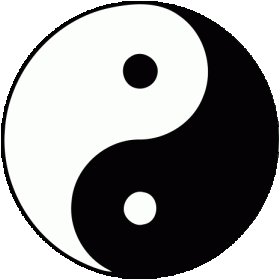
The year’s longest night falls around December 21st in the Northern hemisphere, and the return of the Sun symbolizes rebirth or renewal in cultures around the world.  Italian Renaissance painter Arcimboldo, who anthropomorphized the seasons and elements as grotesque heads composed of bits of flora and fauna, here reveals the face of Winter in gnarly roots and gray bark, with hair of ivy and lips of fungus, but includes a lemon, surely a sign of the sun.  This shows the promise of returning light and life, of which our understanding of the nature of cycles gives us faith.  In the famous “yin/yang”, the Asian emblem of cyclic nature, the yin contains a little seed of yang, and vice versa, telling us that all dualities are cyclic and each extreme contains the potential of its own reversal.The Winter Solstice is the scientific name for the moment of the Earth’s maximum axial tilt away from the Sun.  On Earth we experience it as the shortest daylight and longest night, and the Sun’s lowest path across the sky, the effect the more extreme the farther one is from the equator.  This photograph combines 43 exposures over the course of a day to show the low southern arc of the Winter Solstice sun looking over the Tyrrhenian Sea, the Mediterranean area between the Italian peninsula and the islands of Corsica and Sardinia.  (Of course the Southern Hemisphere’s Winter Solstice is the Northern Hemisphere’s Summer Solstice, and vice versa.) 
Tyrrhenian Sea and Solstice Sky, 2005, photo by Danilo Pivato


The cycles of the heavenly bodies were among the first natural phenomena to be understood with scientific precision.  Artifacts like the Mayan Calendar or the Antikythera Mechanism show that these celestial cycles engaged the most sophisticated minds of ancient times.  While theories of the function of Stonehenge and other megalithic monuments as astronomical observatories are disputed by scholars, new evidence shows that prehistoric peoples conducted ritual sacrifices at these sites around the time of the Winter Solstice. 

Stonehenge Winter Solstice, photographer unknown


Walking a Labyrinth is another ancient ritual that has seen revival in our time.  In walking meditation, the convolutions of the labyrinth provide a physical experience of cycles, of gradual penetration to the depths and re-emergence.  Below is a labyrinth made out of candles, which are themselves symbols of the survival of light through the darkness, set up for a contemporary Winter Solstice festival

Labyrinth of Light, Secret Lantern Society Winter Solstice Lantern Festival, Vancouver, photographer unknown


The most popular holiday of classical Rome was the Saturnalia, a seven-day period around the Winter Solstice when king of the gods Jupiter ceded his throne to Saturn, god of harvest.  It was a time for the reversal of social roles, when servants played at bossing the masters and feasting and revelry replaced work.  We still keep a bit of this spirit alive in Saturn’s day, Saturday, the day to play. 

Saturnus, 1592, by Polidoro Caldara da Caravaggio


In a work of satirist Lucian of Samosata, Saturn says, “Mine is a limited monarchy, you see. To begin with, it only lasts a week; that over, I am a private person, just a man in the street. Secondly, during my week the serious is barred; no business allowed. Drinking and being drunk, noise and games and dice, appointing of kings and feasting of slaves, singing naked, clapping of tremulous hands, an occasional ducking of corked faces in icy water,–such are the functions over which I preside. But the great things, wealth and gold and such, Zeus [Jupiter] distributes as he will.”  (source of quote) 

In the fourth century, when Christianity became the official religion of the Roman Empire, authorities knew it was hopeless to stop people celebrating Saturnalia, so they simply changed the name of the holiday – to Christmas

Saturnalia, 1909, by Ernesto Biondi, Jardín Botánico de la Ciudad de Buenos Aires, photo by Daniel Smiriglio


In the Christian era, the central image of the coming of light into the darkness became the Holy Nativity, or birth of Jesus, God made flesh, in a stable for livestock.  Thousands of paintings depict the scene. Giotto’s fresco of the event is stark and simple. 

Nativity, 1304-06, by Giotto di Bondone, Cappella Scrovegni, Padua


Botticelli’s visionary manger scene combines celestial beauty with apocalyptic elements, a version in which the light is on the surface and something darker emerges only on closer inspection. 

Mystic Nativity, 1500, by Sandro Botticelli


By the 17th century, an aesthetic of realism is emerging.  Georges de la Tour, the master of candlelight effects, gives us this intimate grouping around the peaceful sleeping infant. 

Adoration of the Shepherds, 1644, by Georges de la Tour


Proto-psychedelic painter Abdul Mati Klarwein painted this 1960’s “Nativity”, a post-nuclear, pop art, new age vision of a birth of new consciousness.  The yin-yang symbol is there, beneath the legs of the central figure.  (Note that the de la Tour painting is roughly right in the middle between the Giotto and the Klarwein on the art history timeline.) 

Nativity, 1961, by Mati Klarwein


In contemporary American culture, Christmas is a complex and contested amalgam of Christian, pagan, and commercial elements.  The central figure is no longer the baby Jesus but the jolly old Santa Claus.  Santa Claus is himself derived from multiple cultural traditions, some surprisingly devilish.  The very name “Santa”, of course, is an anagram for the name of the Prince of Darkness.  David Sedaris has written hilariously about European Christmas legends that may be surprising to Americans. 

Our contemporary image of the jolly old elf can be traced back to Clement Clarke Moore‘s “The Night Before Christmas”, and to the illustrations of the great political cartoonist Thomas Nast, originator of the Republican Elephant and Democratic Donkey. 

Santa Claus, 1881, by Thomas Nast, published in Harper's Weekly


Another icon of the Winter Solstice holiday season is the New Years Baby, popularized by the great illustrator J. C. Leyendecker in annual Saturday Evening Post covers.  For an image of rebirth, I’ll leave you with this awakening infant from an earlier era, troubled like our own.  May you and the 2011 baby face the coming year with innocence and the power of growth!  Blessed Solstice, Io Saturnalia, Merry Christmas and Happy New Year to all! 

New Year's Baby, 1938, by J. C. Leyendecker for the New York Post


All illustrations in this post were found on the web.  Clicking on the images links to their source.

« Newer PostsOlder Posts »

Powered by WordPress

Theme Tweaker by Unreal