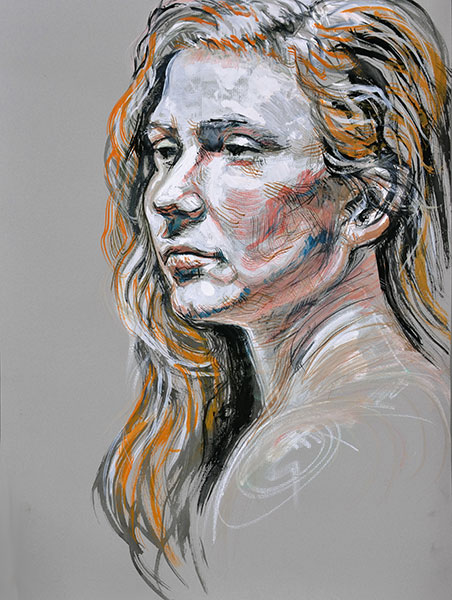
DRAWING LIFE by fred hatt

2012/05/25

A Foraging Eye

Filed under: Photography: Framing — Tags: , , , , , — fred @ 19:13

[Before getting to the subject of this post, I’m pleased to announce that my drawing is the subject of a new post by Courtney Jordan on the Artist Daily blog.  Check it out!]

Lean on Wall, 2012, photo by Fred Hatt

Photography satisfies the ancient human instincts of hunting and gathering.  Armed with specialized gear, photographers go out in search of their particular quarry, chasing after it or lying in wait for it.  At just the right moment, with sure technique and trained reflexes, they shoot and they capture.  Nailing the perfectly-timed shot of an epic sports moment, a stunning nature scene, an indelible image of war’s horror, or a celebrity wardrobe malfunction is like bagging the big game.

I lack the aggressiveness and the single-mindedness it takes to be a great hunter.  I’m more of a forager.  I walk around the city a lot, and I usually carry a camera with me (a dedicated camera, not a phone).  I rarely go looking for specific images; instead, I just go about my normal business and social life, constantly scanning the environment for the kinds of images that feed me.  Usually, that means some combination of natural or cultural phenomena, contrasting forms, and striking effects of light.

I don’t think of myself as a Fine Art Photographer.  I have no concern for reaching a pinnacle of craft or making a bold statement through this work.  It is in my drawing practice that I am serious about constantly challenging myself.  Photography is a more casual pursuit, a way of gathering impressions so I can study and contemplate on them later.  The concern that unifies the drawing practice and the photography practice is an effort to hone and expand visual perception.

Here are some of the fruits I gathered in my photographic foraging in New York City since the beginning of this year, presented in random order.

Sunset Reflection, 2012, photo by Fred Hatt

Because the nerves of our eyes feel light, we can touch at a distance everything the light touches.  But light does not simply show us where things are and their shapes and sizes.  Light is a mercurial substance that can be knife-sharp or misty, golden or leaden.

Bike Cluster, 2012, photo by Fred Hatt

Humans like to think of themselves as free and unencumbered like birds, but we are more like corals, building around ourselves great accretions of stuff.

Scraped, 2012, photo by Fred Hatt

The constant building and tearing down, refinishing and repurposing, makes hidden layers and then sometimes reveals them, a world of palimpsests and pentimenti.

Broken Mirror, 2012, photo by Fred Hatt

The world is a shattered mirror that makes the one thing look like a complicated lot of ragged striving things.

MoMA Garden in Winter, 2012, photo by Fred Hatt

Organic forms and rectilinear forms go together like a bow-legged woman and a knock-kneed man.

Bench with Rings, 2012, photo by Fred Hatt

The rain has cleared this park bench of sitters, the better to reveal its ring-and-spiral ironwork.

Mister Softee, 2012, photo by Fred Hatt

A cop on the beat, a man with a baby stroller, a Mister Softee truck, and a steam vent in the street – a Manhattan melody.

A Frames, 2012, photo by Fred Hatt

Sure, the Brooklyn Bridge is a beautiful piece of engineering, but look at all the geometry some designer put into these simple plastic barrier frames.

November, 2012, photo by Fred Hatt

Another palimpsest – scraped away layers of advertising on a Subway poster frame.  Is this great abstract painting an accident, or someone’s deliberate creation?

Rust Drips, 2012, photo by Fred Hatt

Water leaks in around the ironwork, leaving blood-like trickles on a concrete wall.  The roughness of the wall makes the drips scribbly and frizzy.

Orange Blue, 2012, photo by Fred Hatt

At just a certain time of the evening, the deep blue of the twilight sky and the golden orange of the sodium-vapor streetlamps balance each other just so, giving magic to the most mundane features of the environment.

Gate Shadows, 2012, photo by Fred Hatt

This sidewalk at night is haunted by the shadows of the old cast-iron fences and gates.

Mobile, 2012, photo by Fred Hatt

Street art is exposed to the chaos of the unsecured environment.  This skull with a cell phone has flyers pasted on its forehead and is joined by a painting inspired by chemical diagrams, orange construction webbing, and some yellow caution tape that says “Screwtape” (a C. S. Lewis reference?), and then the shadows of leaves give the whole thing a mottled camouflage effect.

Wet Horsehead, 2012, photo by Fred Hatt

Beads of rain bejewel this fiberglass horsey-ride painted in psychedelic colors.

Banana Peel, 2012, photo by Fred Hatt

A minimalist found composition in red, green, gray and yellow.

Concave Plywood, 2012, photo by Fred Hatt

These warped plywood sheets looming over the sidewalk remind me of Richard Serra’s space-bending steel walls.

Hands to Face, 2012, photo by Fred Hatt

This one is definitely a deliberate bit of sabotage collage of a kind often inflicted upon the posters in the Subway stations.  The anonymous cut-and-paster has a certain surrealist flair.

Reflective Row of Cars, 2012, photo by Fred Hatt

A row of parked cars has to be the dullest thing in the modern world, but even here that great conjurer light works its enchantment.

Reclining Forms, 2012, photo by Fred Hatt

The rectilinear, the organic, and the circular will all lie down together.

Evening Blossoms, 2012, photo by Fred Hatt

A bare tree in twilight and a blooming one in warm light, all of it crackling with the life force as it expresses itself in forms.

Night Shadows, 2012, photo by Fred Hatt

Mixed light sources and the shadows of foliage give the camouflage treatment to this stack of rectangles.

Mural, 2012, photo by Fred Hatt

This mural turns a plain street with a windowless wall into an 8-bit video game.

E

Perspective with Lamps, 2012, photo by Fred Hatt

The oblique angle and the compressed perspective of a telephoto lens emphasize color shifts across this row of windows and sconces.

Golden Female, 2012, photo by Fred Hatt

A womanly figure beckons from a back-lit sign.  The golden glow and the elegant curves beckon grail-like in dim and ragtag surroundings.

Lace Curtain, 2012, photo by Fred Hatt

The lights of night are seen behind the homey screen of a lace door curtain.

Embroidery, 2012, photo by Fred Hatt

A tree is the earth exploring space and air by reaching and branching into it.

Chainlink Fence, 2012, photo by Fred Hatt

At night a fence and a vacant lot full of weeds are a veil of mystery.  Although I used a randomizing program to put these pictures in a thoroughly mixed up order, these last three all suggest lattices that reveal nocturnal space behind them.

Compressed Stairs, 2012, photo by Fred Hatt

Looking up a really long flight of stairs sometimes feels like standing at the base of a Mayan pyramid.

Fountain, 2012, photo by Fred Hatt

It’s hard to get the esssence of water in a still photograph, because it is all about how it moves.  Sometimes, though, just the right kind of light and just the right amount of motion blur get the feel of movement in a still image.  Can I get that kind of energy in my drawings?

2012/05/13

Back in Gray

Leaning Ahead, 2012, by Fred Hatt

For any artist, I think, regularity of work is essential.  For an artist like me who does other work to make a living, it can be very difficult to keep the creative practice vital and central.  I hold my life drawing practice as a constant.  Sometimes in my life I’m working on special creative projects, and sometimes I’m not.  Sometimes I’m spending huge amounts of time doing jobs to pay the bills, or dealing with family responsibilities, or whatever.  No matter what, I get to my life drawing sessions faithfully.  There are two three-hour classes I attend nearly every week, one a long pose class and another one featuring shorter poses.  I may miss the occasional session due to work schedule, travel, or other unavoidable disruptions, but I will not miss a session because I’m tired or not in the mood or not feeling confident.  The structure of the session solves all my potential “blocks”.  The model gives me a focus that takes me out of my own head.  The model is an active stimulus to which I can respond, without having to come up with any ideas.  The timed poses give me a sense of urgency – there is never quite enough time, so I have to get right into it, no dithering.  The critical eye can only be indulged fleetingly – it can’t be allowed to take over from the direct action of drawing.

I don’t allow the practice to become just a hobby, doing the same things over and over again because they please me.  It must be a constant struggle, a quest to see more, understand more, capture more.  There is no end to the study.  There is always something new I can understand about the structure or the expressiveness of the body, something new I can learn about light or about how eye and mind interact, some new bit of technique or material I can explore, some new challenge of spontaneity or carefulness that I can undertake as I draw.

Last year I had begun to feel that I was getting a bit too comfortable in my technique of drawing with aquarelle crayons on gray or black paper, and I decided to start working with watercolors at my life drawing sessions.  If you have been following Drawing Life over the last several months you’ve seen my struggles with the unforgiving medium.  In recent weeks I’ve been trying different papers, including gray paper, and returning sometimes to crayons or using the crayons in conjunction with the paints.  In this post I’ll share some of that work.  All of these pieces were made in the past month.  If you’re not a painter the discussion may be a bit technical, so feel free to just enjoy the pictures.

Knee L, 2012, by Fred Hatt

The wet brush makes more expressive strokes than dry media.  In part this is because it is less controllable, or to be more precise it is controlled more by physics and less by the artist’s hand.  An oil painter may use as much underdrawing and overpainting as necessary to master the painted image, but watercolors are transparent, so all the work shows through.  The unruly nature of the brush is understood in East Asian calligraphy as a virtue.  To make a spontaneous stroke that conveys energy, movement and feeling, using a big floppy wet brush, is a taoist exercise par excellence – going with the flow, dancing on the wind, trusting the chaos of nature to impart its ineffable beauty to your human gesture.

Iridescence of Skin, 2012, by Fred Hatt

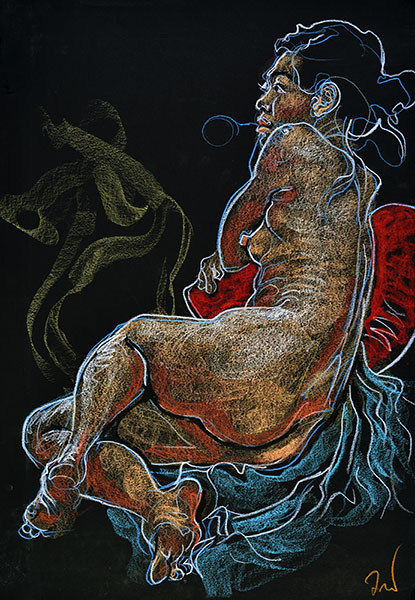
The sketches above and below are done with the aquarelle crayons I’ve used for so much of my work over the years.  The crayons have several special qualities.  They can easily be used either sideways, to smear out areas of color, or on point, to make lines.  Hues can be blended by layering on the paper, without mixing and muddying the pigments, perfect for an additive approach to color.  On dark paper, the lighter crayons have a special luminosity, effectively rendering subtle effects of light.  I like to draw by looking at light before anything else, and usually this means drawing highlights before shadows and edges of things – an approach that is impossible when using transparent paints on a white ground.

Touch of Light, 2012, by Fred Hatt

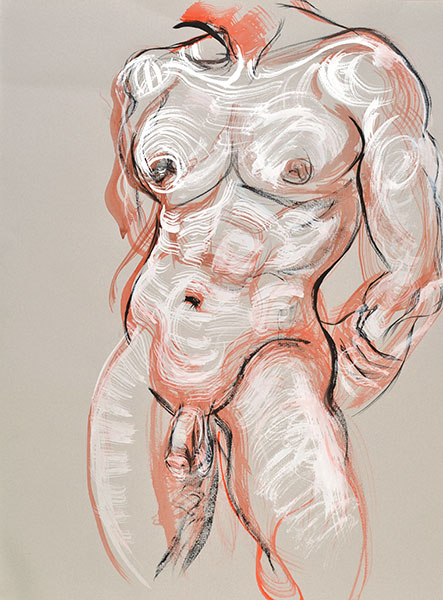
Recently I’ve been using white gouache (opaque watercolor) combined with transparent colors on gray paper, trying for those glowing highlights.  At this point I’m not good enough with the paint to get anything like the color complexity I can get with the crayons.  The crayon drawing above and the gouache/watercolor sketch below are both twenty-minute studies.  With paint, it takes longer to get the light and dark, so there’s less time for color, and since the white gouache is the only paint lighter than the gray background, color in the highlights is a two-stage process, not a one-stage process as with the crayons.

Torso, 2012, by Fred Hatt

The long-pose class gives a longer time to work at subtleties of color and tone.  It’s a three-hour class, and when the warm-up poses and the breaks are subtracted, there’s about two solid hours of studying a single pose.

Akimbo, 2012, by Fred Hatt

The long pose studies above and below are painted in watercolor on white bristol vellum, with some white gouache used for highlight detailing and corrections.  The white gouache never cleanly covers anything.  Any color that is underneath bleeds into it, and it can quickly become dull and dirty-looking.  I’m still trying to use my additive color approach, not mixing paints on the palette, but using straight colors in proximity to each other, so they mix in the eye to give the impression of smooth transitions.  It’s very hard to get this to work as well as it does with the crayons.  The crayons can be applied lightly on the side, introducing a subtle tone to an area.  My best approximation of that with the paint is to use a fan brush with a rather dry load of paint to put down some thin subtle lines of color.  Wherever the white paper shows through, though, it dominates, as it is obviously the brightest and strongest color of them all.

Inward Look, 2012, by Fred Hatt

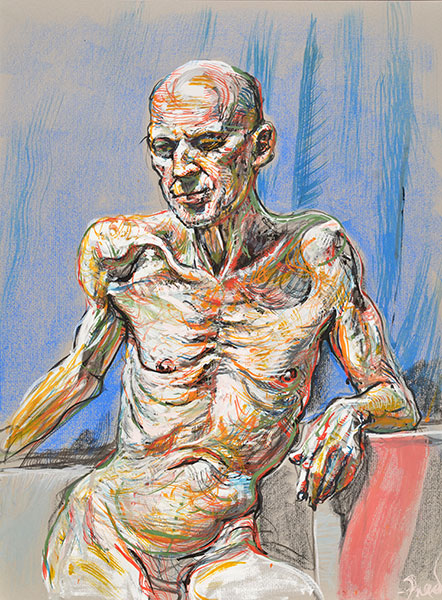
I finally found a kind of gray paper that takes the watercolor and gouache paints well, without too much friction and without sucking all the water out of the brush or puckering at the wetness.  As you can see in the long-pose example below, this allows me to use white as a highlight, so I can work with paint both lighter and darker than the ground, but it doesn’t do much to make the color mixing easier.  In the background of this one, I’ve used crayons on edge to get soft area coloration, but the colors in the figure are all paint.

Reader of Proust, 2012, by Fred Hatt

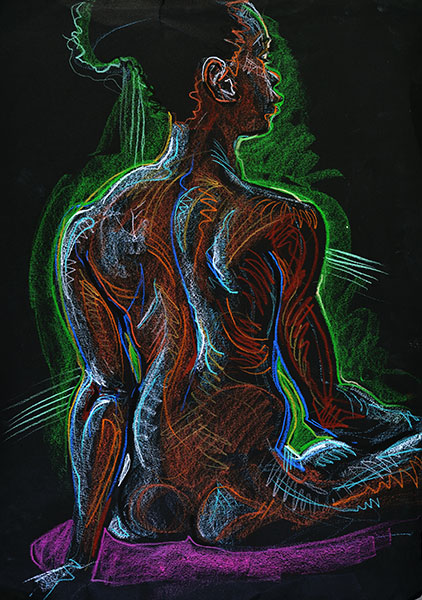
Below is a crayon drawing on black paper, 20-minute pose.  Working on black paper offers its own special challenges – as with white paper, I can only go in one direction with the values.  But I think in twenty minutes with crayons I’ve been able to get as much color variance as I was able to do in six times the time in those long pose studies with paint.

Side and Back, 2012, by Fred Hatt

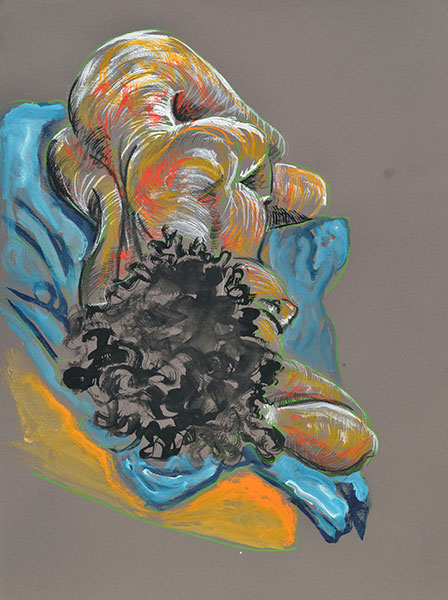
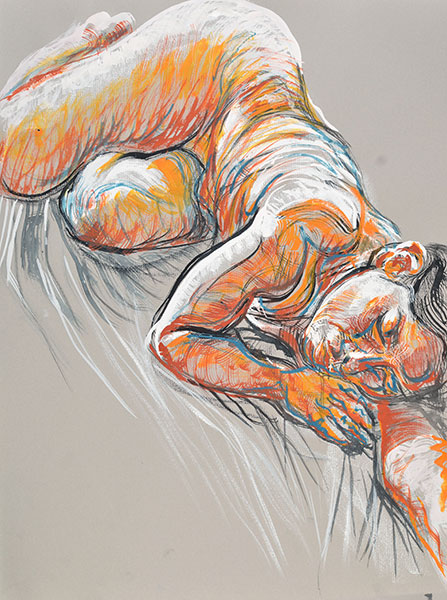
The next three pictures are all 20-minute foreshortened reclining poses.  The first one is done with watercolor and gouache, on a medium gray paper that works well with the crayons.  With the paint, it’s resistant.  The paint doesn’t flow smoothly on this paper, and you may be able to see the scratchy quality of the brushstrokes.  But the middle gray is perfect for bringing out the bold contrast between the black and white paint, and the vividness of the colors against the neutral ground.

Head End Reclining Figure, 2012, by Fred Hatt

Below is a similar pose, painted on the lighter gray paper that handles the wet media more smoothly.  Here I was able to abstract the strokes in a more deliberate way, especially in the face.

Dune, 2012, by Fred Hatt

I used the same paper for the one below.  I used a red crayon to sketch out the figure, then used white gouache and black watercolor to render highlights, edges, and shadows in a relatively realistic style.  The odd angle nevertheless gives this figure a mildly cubist aspect.

Sleeping Weightlifter, 2012, by Fred Hatt

Portraits are the most challenging mode of all, and I’ll conclude this post with four paintings of faces.  The first one is a quick watercolor sketch on bristol vellum, with rough, brushy color.

Knee Kiss, 2012, by Fred Hatt

This one’s on the brush-resistant medium gray paper.  I love the way the gouache-painted highlights look on this darker ground.  The paint becomes light itself.

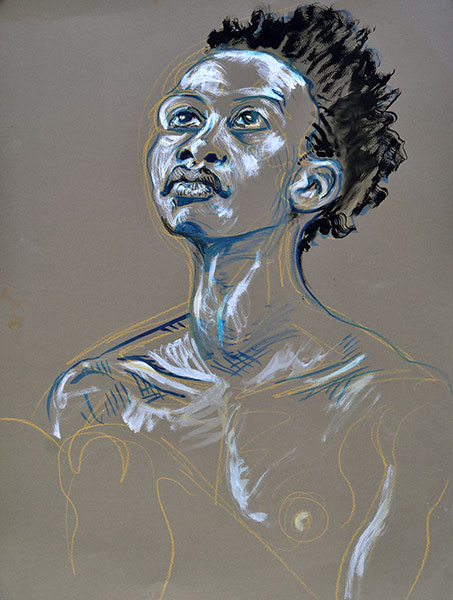
Heavenward, 2012, by Fred Hatt

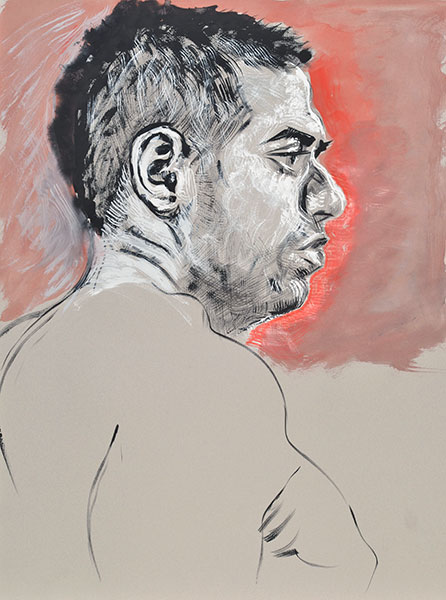
These last two are both painted on the lighter gray paper (though the photographs make the background color look quite different.  It’s a little too warm in the first one and definitely too cool in the second one).  I have to say I’ve always loved working on gray paper.  I can paint the highlights and the shadows, and let the paper provide the tones in between.

Mike in Profile, 2012, by Fred Hatt

The neutrality of the gray ground also has the effect of calming the mind.  For the purposes of drawing, it is a perfect nothingness.  White shines all over and all you can do is try to knock it down a bit.  Black always stays in the background, making anything that  is lighter than itself glow, but its main quality is to suck up and extinguish as much light as it can.  Gray is the synthesis of black and white.  It is serene and unassertive.  It glows, but gently.  It absorbs, but just a bit.  Gray contains all the colors, dark and light, somber and wild, in balance.  Put a red next to it, and you will see the coolness of the gray.  Put a blue next to it, and evoke gray’s warmth.  Gray possesses the underappreciated magic of moderation!

Alley, 2012, 2012, by Fred Hatt

Sizes of the works shown in this post are as follows:

On white paper:  19″ x 24″ (48.3 x 61 cm)

On black paper:  27.5″ x 19.75″ (50 x 70 cm)

On medium gray paper:  18.5″ x 24.5″ (47 x 62 cm)

On light gray paper:  18″ x 24″ (46 x 60 cm)

2012/05/03

Navigational Perception

Marshall Islands stick chart, a map of islands, ocean swells, and currents, original source of photo unknown

Synchronicity is a concept describing how seemingly unrelated things take on meaning by being experienced concurrently.  Years ago a friend gave me the Fall 1991 issue of the magazine “Whole Earth Review”.  It is 144 pages densely filled with a wide variety of articles on technology, ecology, and human potential – the promo on the inside front cover starts, “Mayans, Hawaiians, and Tibetans.  Virtual reality, psychedelic alchemy, neuro-tarot.  Youth culture and elder care.  Teaching lumber companies not to trespass.  Radio as anarchic medium.  A grandmother’s advice on childrearing.  Zines.  Independent music producers.  Lucid dreams.”  Lots of interesting thoughts and speculations there.

There were two articles within that issue that stuck with me and that have informed my thought and my creative process ever since.  The magazine draws no particular connection between the two articles – it puts them in separate sections – but both have to do with developing special perceptual skills for purposes of moving through the world.  If I hadn’t encountered these articles in the same place, they might not have made such an impression on me, but their alignment opened a door for me about how we can train and expand our perception of the world, not through drugs or mystical experiences, but through simple practice.

For me, artistic development is about learning to perceive more deeply, to notice beauty that most miss.  Mass commercial culture is all about bombarding people with sensations, pushing their buttons and pulling their strings.  By appreciating subtle things and enjoying all the fantastic phenomena the world gives us for free, we can liberate ourselves from commercial mind control.  But even if you don’t care about all that and just read this blog for the drawing tips, there’s no technique more powerful than learning to see more when you look.

So, back to “Whole Earth Review” – both of the articles I’ll be talking about are available in full online, and you’ll find a list of links at the bottom of this post.

Cover of “Whole Earth Review”, Fall 1991 issue

Nightwalking: Exploring the Dark with Peripheral Vision” tells of its authors Zink and Parks’ experiments in enhancing peripheral vision.  The human eye contains two types of light sensitive receptor cells.  Cones, densely packed in the center of the visual field, see color and fine detail.  Rods predominate in the outer circle of the visual field.  They see neither color nor fine detail, but are far more sensitive than the cone cells in dark conditions.  The visual cortex uses this peripheral rod vision for orientation and to notice movement happening away from our point of focus.  (See my earlier post, “Exercising Perception”, or my guest post on Daniel Maidman’s blog for more detail on all this.)

Peripheral vision is usually a subconscious process.  Zink and Parks found that they could expand their conscious attention into the peripheral visual field by locking their central vision on the end of a stick attached to a hat and extending about a foot in front of their eyes.  When the focal point is immobilized, awareness is free to move elsewhere.  They practiced hiking in the desert, over very uneven terrain, this way, and found that they were able to move smoothly and sure-footedly, avoiding obstacles and pitfalls without looking at them.

Even before I read this article I had been doing perceptual experiments on my own.  I had often tried walking around the city with my eyes crossed, which is essentially the same thing Zink and Parks were doing, and had discovered the fascinating ability to watch things happening far away from my line of sight, even simultaneous things on opposite sides of me.

New Mexico Desert at Night, photographer unknown

Since the peripheral visual field is dominated by rod cells, noted for their high sensitivity to extremely low levels of light, Zink and Parks decided to try the technique walking in the wilderness in the moonless night.  If you’ve tried walking on a moonless (or new moon or crescent moon) night far from artificial light sources, you know how hard it can be to see where you’re stepping or what’s around you.  Zink and Parks again used the hat with a stick in front, adding a dot of phosphorescent paint to the end of the stick, and again went hiking in the New Mexico wilds.  They found they were able to see all sorts of things one would never see by normal looking in the dark – rabbits and bats moving around them, the faint bioluminescence of decaying wood.  They were able to move swiftly and safely over rocks and ravines.  (I wonder if anyone has tried this in a dense forest at night – that would be much darker than the open desert landscape, even on a moonless night.)

Nightwalking participant, from Australian site NLP Cafe Brisbane. This nightwalker’s hat has a glow-in-the-dark plastic heart instead of a dot of phosphorescent paint as described in Zink’s original article.  Photographer unknown.

In my own practice as an artist, I’ve found the ability to move my awareness into the peripheral visual field is a vital skill.  I can look at a detail with my sharp central field and still maintain a sense of the whole of what I’m looking at because the peripheral vision is taking it all in.  Many observational artists intuitively squint at their subject – this disables the sharp vision, helping you to see the whole pattern.  A deliberate practice of developing peripheral sight can be even more powerful.

Centered on the Feet, 2012, watercolor on paper, by Fred Hatt

The second article that struck me in the Fall 1991 issue of “Whole Earth Review” was “The Soft, Warm, Wet Technology of Native Oceania,” Harriet Witt-Miller’s piece on the traditional navigation techniques of the peoples of the Pacific islands.  Eighteenth-century European explorers were astonished to find that the far-flung islands of the Pacific, widely scattered across thousands of miles of open ocean, had nearly all been settled long ago by people with outrigger canoes who had no sextants or compasses or chronometers.  How did they cross such distances, and find tiny dots of land in the vast expanse of ocean?

Micronesian Proa, still from “The Navigators”, a film by Sam Low

These cultures, now tragically threatened by rising sea levels, had highly sophisticated methods of accurate maritime navigation, all based on direct observation rather than on abstract patterns such as latitude and longitude or the geometrical satellite array of the Global Positioning System.

GPS satellites, original source of illustration unknown

Traditional Pacific navigators or wayfinders learn to observe very subtle things.  They can look at the light reflecting off the bottom of a distant cloud and tell whether it is over green land or over a coral atoll’s crystalline lagoon, thus detecting islands beyond the horizon.  They know the stars and the way their arcs of movement change with the hour and the season.  They observe the behavior of sea birds and the properties of water and floating debris to determine in what direction lies land.  They have a deep understanding of the movement of wind and water currents.  They learn to distinguish the constant patterns of ocean swells from the shifting surface waves by sensing the deeper movements with their scrotums resting on the bottom of their boats.

Currents of the Pacific, warm currents in orange, cold currents in green, original source of map unknown

Currents of the Pacific, warm currents in orange, cold currents in green, original source of map unknown

The Micronesians map their world with “stick charts”, made of palm sticks.  According to the caption of the below illustration from Witt-Miller’s article, credited to “Exploratorium Quarterly”, “Curved sticks showed prevailing wave fronts, shells represented the locations of islands, and threads indicated where islands came into view.”

Micronesian stick map, illustration from “Whole Earth Review”, Fall 1991 issue, page 67

Western ways of knowledge and technology have often been about superimposing an abstract pattern over the real world, and operating according to the abstraction.  For the visual artist, that traditionally means systems of linear perspective, canons of human proportion, color theories, etc.  For the contemporary artist it may also include the abstracting analyses of critical theory and semiotics.

Proportions of Man, 1557, by Albrecht Dürer

I understand and use such abstractions – well, critical theory, not so much – but in my own practice of observational figure drawing I stay much closer to the Pacific wayfinder’s method, looking at subtleties of reflected light, following the swells and hollows of the model’s body as though I am moving across a territory.  I look at the points of inflection, such as nipples or kneecaps, in terms of angular relationships and the flowing patterns that join them, as the sticks connect the shells on a Micronesian sailing chart.  My process is tactile.  I feel my way along.

Hands Reversed, 2012, black watercolor on paper, by Fred Hatt

All of these different kinds of observation are happening simultaneously, or in quick succession.  Part of my mind is aware of the peripheral view.  Part of it is looking at the colors in the shadows or the direction of hairs on the body.  Part of it is mapping the points and following the flows.  Part of it is focused on my paper, my brush, my colors.  It is impossible to coordinate all these factors into a systematic method I could describe or define.  The magic that makes it work is intuition, the power of the mind to integrate a torrent of incoming sensations, conscious and not, into a coherent experience.  Intuition is trained by practice, not by theory.  It must be rigorously exercised, and then it must be trusted.

As I have pursued my artistic discipline, I have been deeply informed by these ideas of navigational perception.  To draw or paint or sculpt from observation is to explore, to discover, to wonder.

Both the short articles cited here are full of details I haven’t mentioned, and well worth reading for themselves:

 “Nightwalking: Exploring the Dark with Peripheral Vision”, by Nelson Zink and Stephen Parks

“The Soft, Warm, Wet Technology of Native Oceania”, by Harriet Witt-Miller

Both articles were originally published in “Whole Earth Review” No. 72, Fall, 1991.

Other relevant links:

Nelson Zink’s website NavaChing

Harriet Witt’s website Passenger Planet

Exploratorium’s website “Never Lost” on Polynesian navigation

Sam Low’s article “A World of Natural Signs”

Illustrations here besides my own drawings were found on the web.  Clicking on a picture will take you to the place where I found it.

Powered by WordPress

Theme Tweaker by Unreal