DRAWING LIFE by fred hatt

2011/02/11

Rough Likeness

Chuck, 2009, by Fred Hatt

There’s an old saying that all artists paint themselves.  Take a look at these examples compiled by art historian Simon Abrahams, different artists’ portraits of Napoleon, paired with the same artists’ self-portraits, to get a sense of how literally this statement may be taken.  In a broader sense, of course, the artist depicts her or his own perception, energy, and way of relating to the world and other people.  The portrait is perhaps the most relational, the most other-directed of all the traditional forms of pictorial art.  The most wonderful portraitists, from Diego Velasquez to Alice Neel, seem to feel their sitters so deeply that the subject’s personality shines through the work even despite the artist’s very distinctive style.

The whole point of the portrait, after all, is to capture a likeness.  Of course, a snapshot can get a pretty good likeness.  The interesting thing about a portrait drawn or painted by hand, directly from life, is in how it records the way an artist looks at another person, the interplay between how the sitter presents himself or herself, and how the artist experiences that through the focus of artistic representation.

In this post I share some of my portrait drawings for what they reveal about how I see and draw.  Here I have selected only relatively rough sketches, mostly 20-minute pieces.  The rough sketch shows the feeling out of the form, the attempt to understand the distinctive features that will give the drawing a likeness to the subject.  In a more finished work the initial analysis is obscured under layers of refining, so here we’ll look only at quick sketches for what they show best.  All of these are drawn directly from life, with no photographs, preliminary sketches, or optical aids.  All of these are from open life drawing sessions, not from commissioned sittings.  I find I draw more freely in these sessions, where there is no requirement to succeed.

Here’s a famous illustration from Alfred L. Yarbus’ study, Eye Movements and Vision:

Saccadic eye movements looking at a face, from Yarbus, "Eye Movements and Vision" (1967)

Human visual perception is quite different from photography.  A camera records a whole field of light levels simultaneously.  The human eye has only a very indistinct perception of the wide field.  We see by constantly scanning the scene, and the full picture is assembled in the brain, not in the eye.  A fuller explanation can be found in this post.

Yarbus used eye-tracking equipment to analyze how people scanned objects, their perception dancing from one salient detail to another.  The tracing of the eye movements in the above illustration is, in itself, a very rough portrait.  This is essentially what the process of observational drawing is:  every glance of the eyes is a moment of perception, recorded by the artist’s hand rather than Yarbus’ eye-tracking system.  Most artists combine this direct perceptual recording with various analytical techniques.

Michael R, 2010, by Fred Hatt

The fundamental particles of perception in drawing are contours and light/dark variation.  For me, the trick of faithfully converting visual perceptions to marks on the paper is to experience the sensations of the eye as tactile sensations.  All the human senses are extensions of the sense of touch, complex organs evolved to focus particular aspects of the environment to be felt by specialized nerves and interpreted by specialized areas of the brain.  I think my extensive experience in body painting helped me to train my brain to this task.  I am used to feeling the body through the soft touch of a brush stroking over its surface.  When I look at the light falling upon the body or face, I imagine that the light is stroking the skin, being gently applied by an invisible brush.  My hands are familiar with the feeling of this brush, and naturally reproduce the movements of this imaginary brush of light.

Alexa, 2010, by Fred Hatt

I usually prefer to draw on a gray or mid-toned paper.  I use a light crayon, white or any color lighter than the ground, as I follow the undulations of light over the three-dimensional surface of the face.  In the same way that I think of the light crayon as a brush, I sometimes imagine the black or dark crayon (or pencil, or marker) as a chisel working on a sculpture, carving the deeper shadows, the hard edges and crisp contours.  On gray paper, I focus alternately on the highlights and the dark places, and let the paper provide the more passive in-between values.

Michael H, 2011, by Fred Hatt

I try to stay always engaged in a tactile way, moving with force and feeling as though I am engaged in massage or sculpture.  I almost never allow myself to lapse into imagining the drawing as a flat surface.

Bob, 2007, by Fred Hatt

The particular contours of an individual’s features convey the singular essence that the viewer experiences as likeness to the person.  In the sketch above, note the free-flowing quality of the light lines, and the very different quality of the dark lines as they clearly delineate the shapes of such salient features as eyebrows, lips and jawline.

Adam, 2011, by Fred Hatt

Adam, the face above, is utterly different from Bob, the previous one. Adam had a wiry intensity, and that energy affected the quality of all my lines.  If the light lines in the Bob drawing meandered like a delta stream, those in this Adam drawing are quick and jagged, like strokes of lightning.  The eyes are surely larger than proper proportionality would dictate, but it works with the energy and does not destroy the likeness.

Robyn, 2010, by Fred Hatt

On this one, Robyn, the mouth is too big.  Caricaturists have long understood that if you get the shapes of the features right, proportions can be way off and the likeness still holds.  [Check out the fantastic celebrity caricatures of my friend, Dan Springer, to see this principle masterfully applied.]  If I’m doing a longer portrait, I’ll try to correct the proportions as I go along, but I don’t worry about it at first.  The likeness will be better if the drawing captures the sitter’s energy, and for that, the drawing must be spontaneous.

Shizu, 2010, by Fred Hatt

After I’ve brushed in the lights and chiseled in the darks, sometimes I use mid-value colors to analyze the structure, to figure out angular relationships or to unify forms that remain vague even after the light and dark have been separated.

Izaskun, 2009, by Fred Hatt

When the drawing conveys both the quality of energy that the sitter expresses, and the particular shapes of individual features, it will seem to have likeness to its subject.

Taylor, 2010, by Fred Hatt

Each of these drawings was done in approximately twenty minutes.  All of them are drawn with aquarelle crayons on paper.  All are 18″ x 24″ (45.7 x 61 cm) or a little bigger.

2011/01/12

Mixing in the Eye

Alley, 2009, by Fred Hatt

Most contemporary technologies of color image reproduction use optical mixing to obtain a full range of colors.  Four-color process printing, CRT, LCD and plasma displays, all reproduce a wide gamut of hues and values using tiny dots of ink or luminous pixels in just three or four colors.  The colors remain discrete in the image, and are only blended in the eye.  The illustration below shows a detail of a printed color picture, with inks of cyan, magenta, yellow and black in dots of variable size.  A color monitor performs a similar trick with glowing red, green and blue dots of variable brightness.

Image printed in four-color process, with detail showing halftone dots

The old masters who developed the craft of pictorial oil painting did not, as far as I know, ever consciously use the phenomenon of optical color mixing.  Most of them used some variation of the technique of grisaille, or painting in black and white (or sometimes in greens or earth tones), then adding color by applying thin transparent glazes over this monochrome foundation.  Jan Van Eyck is often considered the first master of this technique, and it’s still commonly used by painters who follow the classical methods.  Here are two versions of a painting by Jean Auguste Dominique Ingres, the first version in grisaille, and the second with color glazes applied.

Odalisque in Grisaille, 1824-34, by Jean Auguste Dominique Ingres

Grande Odalisque, 1814, by Jean Auguste Dominique Ingres

The great virtue of this method is to achieve a feeling of solidity and luminosity.  The grisaille painting allows for a sculptural rendition of values, and the white of the grisaille reflects all wavelengths of light, which are then subtly filtered by the glazes.  Light penetrates the transparent surface layer of the painting and reflects back to us from a deeper level, tinged as the setting sun or the distant mountain are tinged by the intervening atmosphere.

Directly mixing pigments on the palette or on the canvas, on the other hand, tends to give dull and flat colors.  Every opaque blend of two pigments has less brightness and less intensity of color than either of its components.  The natural mineral pigments available to painters before the industrial revolution were extremely limited, so the glazing technique was often the only way to achieve color that was both vivid and subtle in its gradations.

In the nineteenth century, several technological innovations led to a completely new approach to color in painting.  Photography quickly surpassed the painters in its ability to render monochromatic values.  This made painters strive to reproduce the more vibrant effects of color that photography still could not capture.  Modern industrial chemistry discovered new synthetic pigments that were both permanent and far more vivid than the classical artists’ pigments.  All those paints with chemical sounding names like alizarin and phthalocyanine are products of the new chemistry.  Pre-mixed paints in squeezable metal tubes were yet another nineteenth century development that made it much easier for an artist to leave the studio and study the colors of nature and the effects of light outdoors, or en plein air.

French Impressionism was the product of all these changes.  The old methods started to seem stodgy and lacking in spontaneity, and in any case were unsuited to plein air painting.  You can observe optical color mixing effects starting from the beginnings of the impressionist movement, as in this Renoir painting.

Bal au Moulin de la Galette, 1876, by Pierre-Auguste Renoir

In the detail below, you can see that the clothing and shadows on the ground are painted with various bright colors in close proximity, colors that do not correspond with the actual surface colors of the objects being depicted.  The overall impression of the colors in the painting is vibrant but not unnatural.

Bal au Moulin de la Galette, 1876, by Pierre-Auguste Renoir, detail

Monet painted haystacks in a field and the facade of Rouen Cathedral over and over again, trying to capture the ever-changing subtleties of light and air.  [Both links in the preceding sentence are well worth a click!]  Here the haystack contains dabs of red, olive, lavender, violet and black.

Grainstack (Sunset), 1890-91, by Claude Monet

Artists such as Edgar Degas and Mary Cassatt used optical mixes of odd colors like greens and purples to depict flesh tones.

Lydia Leaning on her Arms, Seated in a Loge, 1879, by Mary Cassatt

George Seurat studied the science of color perception, and developed an analytical approach to painting with optically mixing colors.  He called his method chromoluminarism, though it’s better known today as pointillism, a word originally coined by critics.  Here’s one of his mural-scale canvases, followed by a detail of a face in profile, showing the discrete dots of color.

La Parade du Cirque (Invitation to the Sideshow), 1889, by George Seurat

La Parade du Cirque (Invitation to the Sideshow), 1889, by George Seurat, detail

What Seurat does with analytical coolness, Vincent van Gogh does with fiery intensity.

Sower with Setting Sun, 1888, by Vincent van Gogh

Optical mixing of colors also interested abstract expressionists such as Joan Mitchell.

Weeds, 1976, by Joan Mitchell

Chuck Close is the heir to Seurat’s analytical approach, as in this monumental self-portrait.

Self Portrait, 1997, by Chuck Close

Self Portrait, 1997, by Chuck Close, detail

For my own work in color, I usually use aquarelle crayons on toothy charcoal paper.  The crayons deposit bits of pigmented wax on the ridges of the paper.  Going over an area with more than one color leaves the markings separate, and the colors mix optically.  Here’s a detail of the portrait of Alley featured at the top of this post.  You can see that the flesh tones are made up of strokes of blue gray, pink, yellow, light blue, reddish brown and white, on a neutral gray paper.  The technique is particularly effective at depicting reflected light in shadow areas.

Alley, 2009, by Fred Hatt, detail

Here’s a quicker figure sketch, followed by an enlarged detail.  Here the colors making up the flesh tones include turquoise, orange, fuschia, and yellow.

Maira Horizontal, 2010, by Fred Hatt

Maira Horizontal, 2010, by Fred Hatt, detail

Mixing colors in the eye, rather than on the palette, produces color impressions that are bright and shimmery, that suggest not only the effects of light but the slippery nature of flesh tones.  The actual colors of living human skin are subtle to the point of elusiveness.  Skin is translucent, imbued with underlying colors of blood and fat.  Its surface is nearly iridescent, and reflects and refracts the colors of surrounding objects and lights.  Flat colors cannot capture this subtlety.  Grisaille and glazing can, and so can optical mixing, in a very different way.

All the images in this post, besides those of my own work, were found on the web.  Clicking on the pictures will take you to their source pages, and in many cases, to larger versions of the images.

2010/12/27

Books for Artists

Most artists could name a few books that have helped to light the path for them.  Here I’ll share some of those books that have been important to me as an artist, with brief excerpts to give you a little taste of each.  I hope you will be inspired to seek out and read some of these books, or to comment here on books that have been important to you.  Excerpts appear below an image of the cover of each book, in regular type.  My own comments are in italics.

One of Annie Dillard’s great themes is learning how to see – a subject far deeper than it might initially seem.

Pilgrim at Tinker Creek, by Annie Dillard (1974)

“When I was six or seven years old, growing up in Pittsburgh, I used to take a precious penny of my own and hide it for someone else to find. It was a curious compulsion; sadly, I’ve never been seized by it since. For some reason I always “hid” the penny along the same stretch of sidewalk up the street. I would cradle it at the roots of a sycamore, say, or in a hole left by a chipped-off piece of sidewalk. Then I would take a piece of chalk, and, starting at either end of the block, draw huge arrows leading up to the penny from both directions. After I learned to write I labeled the arrows: SURPRISE AHEAD or MONEY THIS WAY. I was greatly excited, during all this arrow-drawing, at the thought of the first lucky passer-by who would receive in this way, regardless of merit, a free gift from the universe. But I never lurked about. I would go straight home and not give the matter another thought, until, some months later, I would be gripped again by the impulse to hide another penny.

“It is still the first week in January, and I’ve got great plans. I’ve been thinking about seeing. There are lots of things to see, unwrapped gifts and free surprises. The world is fairly studded and strewn with pennies cast broadside from a generous hand. But—and this is the point—who gets excited by a mere penny? If you follow one arrow, if you crouch motionless on a bank to watch a tremulous ripple thrill on the water and are rewarded by the sight of a muskrat kid paddling from its den, will you count that sight a chip of copper only, and go your rueful way? It is dire poverty indeed when a man is so malnourished and fatigued that he won’t stoop to pick up a penny. But if you cultivate a healthy poverty and simplicity, so that finding a penny will literally make your day, then, since the world is in fact planted in pennies, you have with your poverty bought a lifetime of days. It is that simple. What you see is what you get.”

Kimon Nicolaides writes with great passion about the art of drawing, and his approach is about a method of learning that helps you develop your own way of drawing, rather than about imparting his own tips and tricks, as most drawing instruction books seem to try to do.  Nicolaides would be the second thing I’d recommend to a beginner in life drawing study, after James McMullan’s excellent introduction to learning the art of drawing in “Line by Line“, his recent series of posts on the New York Times website.

The Natural Way to Draw, by Kimon Nicolaides (1941)

“YOU SHOULD DRAW, NOT WHAT THE THING LOOKS LIKE, NOT EVEN WHAT IT IS, BUT WHAT IT IS DOING.  Feel how the figure lifts or droops – pushes forward here – pulls back there – pushes out here – drops down easily there.  Suppose that the model takes the pose of a fighter with fists clenched and jaw thrust forward angrily. Try to draw the actual thrust of the jaw, the clenching of the hand.  A drawing of prize fighters should show the push, from foot to fist, behind their blows that makes them hurt.
. . .
“To be able to see the gesture, you must be able to feel it in your own body.  You should feel that  you are doing whatever the model is doing.  If the model stoops or reaches, pushes or relaxes, you should feel that your own muscles likewise stoop or reach, push or relax.  IF YOU DO NOT RESPOND IN LIKE MANNER TO WHAT THE MODEL IS DOING, YOU CANNOT UNDERSTAND WHAT YOU SEE.  If you do not feel as the model feels, your drawing is only a map or a plan.”

If I had to pick one all time favorite book about the work of the artist, it might be Salvador Dali’s “50 Secrets of Magic Craftsmanship”.  This book is, in part, a hilarious parody of such classic handbooks of master techniques as Cennino Cennini’s “Il Libro dell’ Arte“, but its suggested techniques, while preposterous and described in overblown language by a supremely conceited madman, manage to convey a great deal of real nitty gritty craft knowledge, along with a sense of the odd mixture of discipline and calculated derangement that drives many of the great artists.

50 Secrets of Magic Craftsmanship, by Salvador Dalí (1948)

“The apprentice’s Secret Number 22 is that of the drawing of the geodesic lines of his model.  Nothing will reveal itself more useful for the understanding of the mysteries of the nude figure than the knowledge to be derived from the assiduous practice of this method.  Preferably you must choose a plump model, the curves of whose flesh are as turgescent as possible.  The best poses for this are the recumbent ones.  You need a provision of strings of back cotton which have been previously soaked in lnseed oil to which venetian turpentine has been added, in a proportion of five to three.  these strings should be hung up the day before using them, so that they may drip off the excess oil, but without drying altogether.  Once the model is lying down in the pose which you desire you begin cautiously to lay the strings on the model’s body in the places where you wish a clearer indication of the forms.  the curve which these strings adopt will naturally be the geodesic lines of the surface which you want made clear.  You may then draw your nude, but especially these geodesic lines which, if they are in sufficient quantity, will suffice – even should you efface the nude – to imprint its absent volume.”

Qualia, the subjective aspects of experience, have become a major problem in the philosophy of mind.  For example, a physicist can tell you that different colors are simply different wavelengths of light, and that theory can be proven by experiment, but a difference of wavelength does not account for the very different impressions made on us by red and blue.  Wittgenstein was one of the first philosophers to tackle this subject.  This posthumously published book consists mostly of question after question about what we can know and what we should doubt.

Remarks on Colour, by Ludwig Wittgenstein (1978)

“‘The colours’ are not things that have definite properties, so that one could straight off look for or imagine colours that we don’t yet know, or imagine someone who knows different ones than we do.  It is quite possible that, under certain circumstances, we would say that people know colours that we don’t know, but we are not forced to say this, for there is no indication as to what we should regard as adequate analogies to our colours, in order to be able to say it.  This is like the case in which we speak of infra-red ‘light’; there is a good reason for doing it, but we can also call it a misuse.  And something similar is true with my concept ‘having pain in someone else’s body’.”

Josef Albers’ “Interaction of Color” is based on his course for artists, a series of experiments that powerfully demonstrate the relativistic nature of color perception.  There are many books for artists about understanding color, but none are as illuminating as Albers.

Interaction of Color, by Josef Albers (1963)

“Imagine in front of us 3 pots containing water, from left to right:
WARM        LUKEWARM        COLD
When the hands are dipped first into the outer containers, one feels – experiences – perceives – 2 different temperatures:
WARM (at left)                (at right) COLD
Then dipping both hands
into the middle container,
one perceives again
2 different temperatures,
this time, however,
in reversed order
(at left) COLD – WARM (at right)
though the water is neither of these temperatures, but of another, namely
LUKEWARM
Herewith one experiences a discrepancy between physical fact and psychic effect called, in this case, a haptic illusion – haptic as related to the sense of touch – the haptic sense.
In much the same way as haptic sensations deceive us, so optical illusions deceive.  they lead us to “see” and to “read” other colors than those with which we are confronted physically.”

Here are a pair of classic books of art appreciation.  John Berger’s writings aim to expand the ways we think about the artwork we see.

Ways of Seeing, by John Berger (1972)

“Original paintings are silent and still in a sense that information never is.  Even a reproduction hung on a wall is not comparable in this respect for in the original the silence and stillness permeate the actual material, the paint, in which one follows the traces of the painter’s immediate gestures.  This has the effect of closing the distance in time between the painting of the picture and one’s own act of looking at it.  In this special sense all paintings are contemporary.  Hence the immediacy of their testimony. Their historical moment is literally there before our eyes.  Cézanne made a similar observation from the painter’s point of view.  ‘A minute in the world’s life passes!  To paint it in its reality, and forget everything for that!  To become that minute, to be the sensitive plate . . . give the image of what we see, forgetting everything that has appeared before our time . . . ‘  What we make of that painted moment when it is before our eyes depends upon what we expect of art, and that in turn depends today upon how we have already experienced the meaning of paintings through reproductions.”

About Looking, by John Berger (1980)

(On Grünewald’s Altarpiece)
“. . . the European tradition is full of images of torture and pain, most of them sadistic.  How is it that this, which is one of the harshest and most pain-filled of all, is an exception?  How is it painted?
It is painted inch by inch.  No contour, no cavity, no rise within the contours, reveals a moment’s flickering of the intensity of depiction.  Depiction is pinned to the pain suffered.  Since no part of the body escapes pain, the depiction can nowhere slack its precision.  The cause of the pain is irrelevant; all that matters now is the faithfulness of the depiction.  This faithfulness came from the empathy of love.”

Finally, recommended for artists’ models, artists that work with models, people that book models for life drawing classes or groups, or students that attend such groups, at this site.  This book is the real deal about the profession of modeling for artists:

The Art Model's Handbook, by Andrew Cahner (2009)

2010/11/13

Utility Belts

Filed under: Artists' Tools and Resources — Tags: , , — fred @ 19:00

Batman's Utility Belt, detail from Batman #203

As a kid, I was a big fan of Batman, both in the comics and the campy TV show starring Adam West.  One of Batman’s many cool tools was the bright yellow utility belt, keeping crime-fighting implements close at hand.  Batman’s utility belt was a fantasy version of the duty belt that police officers all over the world use to keep hands free and tools within reach while walking a beat or chasing down suspects.

Police Duty Belt, from Merriam Webster Visual Dictionary Online

The tool belts used by construction carpenters and electricians are among the most elaborate types of utility belts.  There are so many tools one might need at any moment, and you can’t just set your hammer down if you’re standing on a peaked roof.

Carpenter's Tool Belt

Pro photographers on location always have a plethora of gadgets and accessories.  Not only are they easier to find quickly in a photographer’s vest than in a camera bag, but the weight is more evenly distributed on the body than when everything’s in a shoulder bag.

Safari Photographer's Vest

Hikers and bikers have to carry the items they need in the most efficient way possible.  You can’t have things dangling or interfering with your freedom of movement.

Mountain Biker's Belt

A makeup artist often has to work standing up, touching up a model or actor on the set.  An apron with pockets keeps brushes and supplies accessible and keeps you from getting makeup all over your pants.

Makeup Artist's Brush and Tool Apron

A full bib apron combines many of the advantages of a belt or waist apron and a vest:  easy access to tools, comfortable weight distribution, and clothing protection.

Gardener's Apron

I’ve taken to wearing a short waist apron with pockets whenever I’m out and about in the city.  I use it to carry everyday practical items and tools I use in my freelance jobs.  It’s easy to repurpose the pockets to carry art supplies, photography accessories, or travel stuff like reading material and earplugs.

Fred Hatt wearing his everyday utility belt

I started using this apron when I was at the festivals at Brushwood Folklore Center, where I often do body painting and teach workshops.  In that setting, I usually wear a wrap skirt rather than pants, and the there was a need for pockets.  The black canvas apron filled the bill, like a sporran with a kilt.  I can’t remember where or when I originally got it, but mine is made by McGuire-Nicholas Workwear.  Below is a typical arrangement of the apron for everyday use:

Fred Hatt's utility belt with contents labeled

I have a camera always ready at hand for the kind of street photography I often post in this blog.  I have my digital voice recorder that I use to record thoughts, ideas and info while on the go, and to keep track of my expenditures.  The flashlight and tools are often needed when I’m working in a theater or on a photo or video shoot.  The monocular is a small telescope, useful for fine-focusing projections from a distance, another type of work I do.  An umbrella can be tucked in behind the waistband of the apron.  Everything is right where I can reach for it without thinking, and I keep my hands free.

I know this post is a bit of a departure for this blog, but I often write about the techniques and the creative process of drawing and photography.  Every artist needs good tools and supplies and equipment, and part of the artist’s journey of discovery is figuring out what items work well and how best to organize and maintain them.  All artists and craftsmen love their tools.  I hope this will be of interest to some of my readers.  I’ve created a new post category, “Tools and Materials”.  Please let me know if there are specific things along these lines you’d like me to post about.

The illustrations here were found on the web.  Click on any of the pictures above to link to the source of the image, excepting the last two, which are my own photographs.

2010/11/06

Magic Squares

Filed under: Photography: Framing — Tags: , , , , , — fred @ 01:30

Sunset Construction Shed, 2005, photo by Fred Hatt

A lot of writing about proportions and composition focuses on the golden ratio or phi.  Relationships based on phi appear everywhere you look in natural forms and cycles.  Artists, architects and designers frequently use the golden rectangle based on this ratio, and it’s often considered the most beautiful of all rectangles.  But it could be argued that the square is an even more harmonious quadrangular shape, and its perfect evenness has very special compositional qualities.

The 6 x 6 cm square film format became popular for magazine photography partly because square images could be cropped to either vertical or horizontal rectangles by the editor, but photographers often found that the square frame facilitated particularly bold arrangements of their subject matter.  Designers discovered the special qualities of the square frame in creating sleeves for LP records, leading to some of the most iconic graphic designs of the last century.

Here I share a selection of my images of New York City from the past decade, selected as examples of square compositions.  I don’t have a square format camera, but I find that many of my photographs are improved by cropping, and the square crop is one I frequently consider.  A criterion for choosing images for this post is that I don’t think any of these images would work as well with a vertical or horizontal frame.

The top photo in this post is a perspective through the roughly square corridor of a construction shed.  The setting sun casts long diagonal shadows of the scaffold columns, and those diagonals are countered by the thicker shape of an inclined tree trunk.  The square frame really highlights the contrast of vertical, horizontal, and diagonal lines.  Here’s another example:

Oblique Light, 2006, photo by Fred Hatt

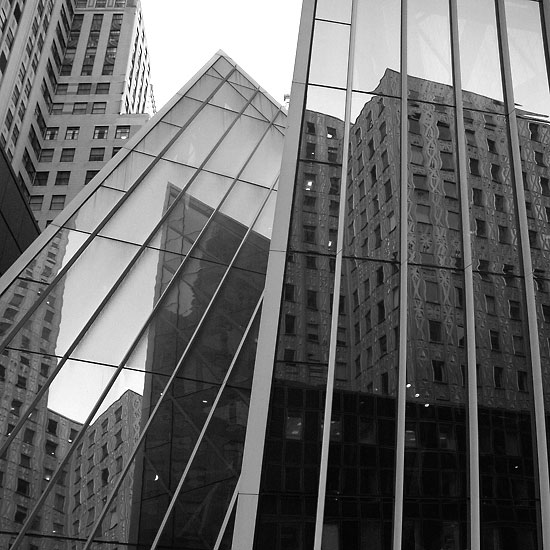
A square crop can break down a unified design into an arrangement of shapes and lines.

Automotive Shapes, 2006, photo by Fred Hatt

A beautiful three dimensional shape, compressed into two dimensions and framed in a square, becomes somehow even more abstractly sensuous.

Steel Helix, 2005, photo by Fred Hatt

This classic bit of architecture (The Enid A. Haupt Conservatory at the New York Botanical Garden in the Bronx) is designed with golden ratio proportions, but a square frame really flatters it:

White Dome, 2004, photo by Fred Hatt

This view from a Brooklyn rooftop shows the special properties of the square picture.  A wide image would be a panorama, focused on the horizon, and a tall image would emphasize the height of the vantage point.  The square equalizes the vertical and the horizontal, and thus shows height and depth in equilibrium.

Brooklyn Crepuscule, 2005, photo by Fred Hatt

In a square frame, what is centered is idealized and what is off center is dynamic.

Heaven and Earth, 2009, photo by Fred Hatt

Straight lines and organic forms complement each other in perfect tension within the square.

Diagonals, 2005, photo by Fred Hatt

Dark and light, rounded and rectangular, perpendicular and angular: Simple polarities of form spring into relief in the balanced space of the square frame.

Urban Sundown, 2006, photo by Fred Hatt

Straight lines make quadrilaterals and triangles within the square, and curved forms break the rigidity.

Street Fair Decorations, 2010, photo by Fred Hatt

The simplest contrasts reveal their full complexity in the square.

Piece of Gold, 2004, photo by Fred Hatt

The perfect regularity and abstraction of the square can be an ideal frame for the fractal chaos of natural forms.  Any other rectangle partakes of a bit of chaos itself, but a square remains rigorously neutral.

Rainy Berries, 2005, photo by Fred Hatt

The square’s geometrical balance can also highlight the gestural quality of a figure or sculpture.

Command, 2006, photo by Fred Hatt

Sculptural Hands, 2005, photo by Fred Hatt

The converging lines of perspective take on a special quality in a square frame, where verticals, horizontals, and  diagonals exist in egalitarian relationship.

Subway Perspective, 2004, photo by Fred Hatt

Fence Growth, 2007, photo by Fred Hatt

Perspective compositions are made even more interesting by the addition of curves or random angles.

Cast Iron, 2005, photo by Fred Hatt

Barriers, 2005, photo by Fred Hatt

The elements of a square picture rest in balanced relation to all their companion elements.

Flushing Meadows Globe, 2004, photo by Fred Hatt

Perfect symmetry is actually heightened by slight elements of asymmetry.   The harmonious square frame magnifies both qualities.

Church Garden, 2005, photo by Fred Hatt

Stone Yard, 2010, photo by Fred Hatt

A square is naturally divided into rectangles and other shapes, a la Mondrian.

Drawer Pull Display, 2006, photo by Fred Hatt

Eighth Avenue, 2004, photo by Fred Hatt

Leaning or angular shapes have a certain natural dynamism based on their contrast with rectilinear forms.  The square composition gives these shapes their full measure of potential energy.

Angular Structure, 2006, photo by Fred Hatt

In a square image, a living element can be a point of active concentration, seen off center in relation to a more abstract, more chaotic space, illustrating the tension inherent in the relation of the living being to the natural world.

Fountain Joy, 2006, photo by Fred Hatt

Snow Mound, 2005, photo by Fred Hatt

Wet Asphalt, 2004, photo by Fred Hatt

Plywood's Red Glare, 2004, photo by Fred Hatt

Expressions of style can be abstracted from their complex personal and cultural manifestations, to be observed in their purely formal aspects.

Mosaic, 2005, , photo by Fred Hatt

Instruments and Shoes, 2004, photo by Fred Hatt

Just as fractal mathematics shows the rational order underlying complexity, the square frame in photography puts the unbalanced world, snarled, tangled and scattered, into a context of perfect equilibrium, illuminating the logic of chaos.

Linear Arrangement in Streetlight, 2007, photo by Fred Hatt

Composition in Gray, 2004, photo by Fred Hatt

Spilt, 2006, photo by Fred Hatt

« Newer PostsOlder Posts »

Powered by WordPress

Theme Tweaker by Unreal