DRAWING LIFE by fred hatt

2011/08/12

Chaotic Landscape

Filed under: Drawing: Experimenting — Tags: , , , , , , , — fred @ 21:36


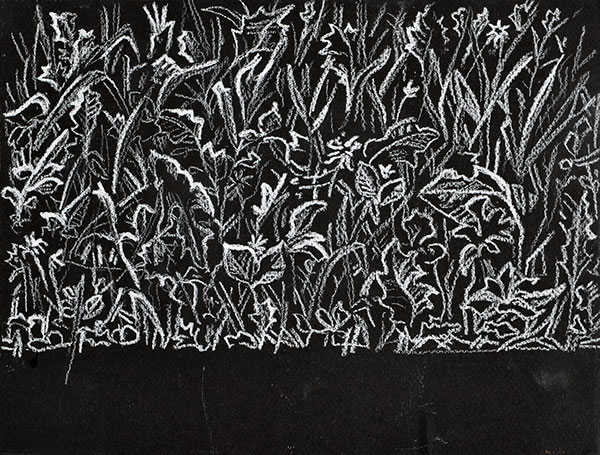
Mixed Grass, 2011, by Fred Hatt

Drawing landscapes and plants is not my strong suit.  I love wildernesses and gardens, but I feel overwhelmed trying to capture their forms in drawing or painting.  They present a bewildering chaos of detail, a vast, borderless scale, and a range of color and tone that makes my palette look paltry.  My urge to draw operates comfortably at the scale of the human body, a form and an expressive range I know intimately from inside and out.  But the body is a product of Earth, an efflorescence of organic forms that reflect evolutionary history and evoke the forms of the land and its creatures.  A hip is a hill, an ear a shell, an elbow a crooked branch.  Even if the body is my primary subject, I need to understand it as a microcosm by looking to the macrocosm.  And purely from the standpoint of practice, I can only benefit by straying outside my comfort zone, trying to draw what I am incompetent to draw.  In this post I’ll present some of my awkward stabs at landscape.  I’ll immediately make them look worse by setting them in the context of some real masters!

The sketch of my own I’ve chosen to head this post was made while looking at a field of mixed short grasses and weeds in a rural field.  I was struck by the variety of different leaf shapes all jumbled together.  What seems at first glance a tranquil and plush tapestry of green becomes on close inspection a dense jungle, and that is surely how it would appear if you could shrink to the size of an ant to make your way through it.

Below is Albrecht Dürer’s astonishingly realistic watercolor portrayal of a similar patch of sod, known as the “Great Piece of Turf”  (Go to this link to see it in a much larger size).  Botanists can clearly identify at least nine species of herbs in this drawing.  The production of this painting was an act of profound and sustained meditation on the reality of nature, made at a time when nature in art was usually idealized and symbolic, a mere setting for human and spiritual subjects.  The artist’s intensity of attention, directed at something that most would see as utterly inconsequential, has preserved a bit of nature over the centuries like a specimen in amber.  Dürer has captured the chaotic quality of wild plant life, but has somehow given it a kind of clarity that even photography couldn’t provide.  This painting sets a standard that every great naturalist illustrator can only hope to approach.

The Great Piece of Turf, 1503, by Albrecht Dürer

Even if the detail of photography rarely achieves the clarity of Dürer’s vision, by the late nineteenth century many painters had ceded this kind of hard physical detail to the new light-capturing technology and tried instead to depict the wild energy of the natural world with brushy, gestural strokes of color that give a sense of leaves fluttering in a breeze and rays of light dancing over and through shimmery water and misty air.  Claude Monet painted the same scenes over and over again, at different seasons and times of day, striving to capture the mercurial subtleties of luminosity and atmosphere.

Rainy Morning on the Seine, 1890’s (?), by Claude Monet

Charles Burchfield is a magical realist, seeing the natural world as a physical manifestation of different qualities of spiritual energy.  The forms of land and sky and plants are abstracted slightly to more closely resemble the Platonic archetypes of these forces.  The chaos is there, but it is unified within a greater spirit of pure Nature.

Dawn of Spring, 1960’s (?), by Charles E. Burchfield

I have usually avoided drawing and painting the landscape, but I’ve frequently tried to capture it with photography.  I’ve always felt especially drawn to the raw and ragged forms of uncultivated plant life.  Thick thatches of foliage are challenging subjects even for photography, as the transition from three dimensions to two reduces the bursting and branching shapes to a flat patchwork like a camouflage pattern.  Stereo photography can better portray the complexity.  If you look at the picture below (previously posted here) with red/cyan 3D glasses you’ll see what I mean.  If you look at it without glasses, it’s pure abstract field.
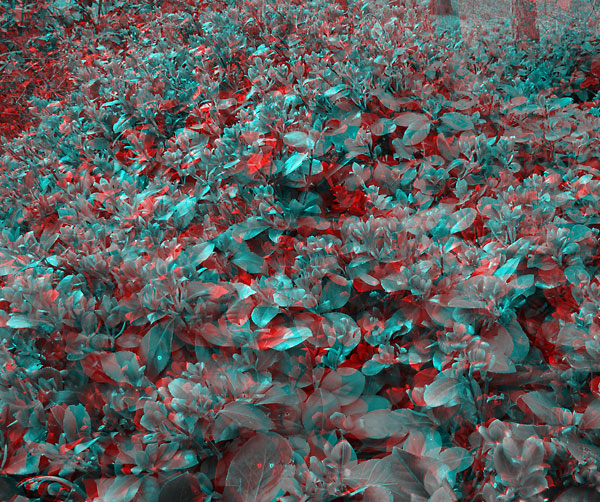
Sprouting Hedge, 2010, stereo photo by Fred Hatt

But now let’s take a look at some of my recent fumbling attempts to draw complex, chaotic plant forms.  Just today I took a sketchbook and a camera to my neighborhood park.  Here’s a snapshot of a particularly plush evergreen tree, and below it, my scribbly marker sketch, drawn from direct observation of the tree without any reference to the photo.

Evergreen, 2011, photo by Fred Hatt

Evergreen, 2011, sketch by Fred Hatt

The drawing doesn’t get much of the texture or spatial form of the tree, but it has, perhaps, something of its energy.  Another day I made a sketch of the plants growing in a window box, with these ornate curly leaves in front of a stand of long spear-like leaves.  This is a smaller subject, a closer focus, and a more careful hand with the drawing.

Leaves, 2011, by Fred Hatt

Here’s a sketch of a flowering plant with trumpet-shaped flowers (some kind of orchid?) drooping thickly around a central stalk.  (If anyone recognizes any of the species depicted in these drawings, let me know – my botanical taxonomical knowledge is practically nonexistent.)

Flowers, 2011, by Fred Hatt

Last month I spent a week teaching workshops and attending the festival at the Brushwood Folklore Center in Western New York State.  I spent some of my spare time making crayon sketches.  Here you see the fire-builders’ woodpile in the foreground, the Roundhouse (a sort of ritual structure for drum circles) and bonfire stack in the middle ground, and the trees of the forest in the background.

Roundhouse and Bonfire Stack, 2011, by Fred Hatt

The sky was clear, deep and luminous, with the great zaftig white bodies of cumulus clouds lazing across the heavens like manatees in a warm current.

Clouds, 2011, by Fred Hatt

Near my campsite was this traditional Plains Indian tepee.

Tepee, 2011, by Fred Hatt

This last Brushwood landscape was drawn a couple of years ago.  This is a clump of plants in the hollow under a big tree where the henna artists and body painters decorate people.
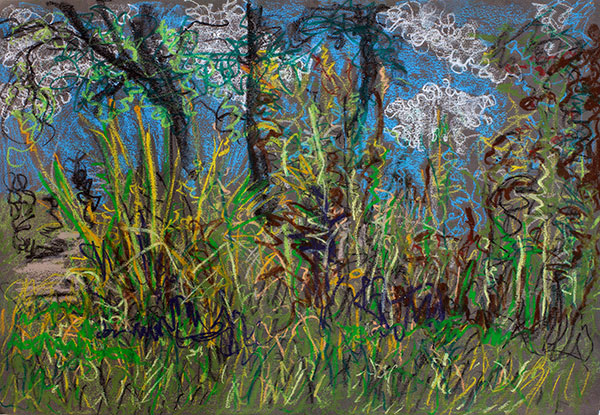
Under the Henna Tree, 2009, by Fred Hatt

I still always feel completely unequal to the task when I try to make a drawing from a landscape, but I try to open myself to the chaos and let some attenuated remnant of that vast current flow through me and into my sketch.  I may feel like a mouse trying to sing opera, but sometimes it is better to squeak than to be silent.

Drawings on black paper are 9″ x 12″, medium is aquarelle crayon.  Drawings on white paper are 11″ x 14″ or smaller, medium is brush-tip marker.  The images of pieces by other artists were found on the web; clicking on a picture links to source.

2011/08/07

Made Man

Dear readers, I’ll have another post for you here some time this week, but in the meantime check out my “guest post” on Daniel Maidman’s blog.  Daniel’s a figurative painter, of a more classical bent than me, and he’s also a stimulating writer, often considering artistic issues in the light of scientific and philosophical ideas.  I wrote a rather extensive comment on Daniel’s recent post, “The Integrated Visual Field”, going into what I’ve learned about the science of human visual perception as it pertains to observational drawing.  Daniel invited me to expand on that response, and then he combined my comments with those of Stephen Wright, another really interesting figurative artist, and made the whole thing into this guest post.  I hope some of you will appreciate being turned on to Maidman’s blog.


2011/08/02

Try, Try Again

Filed under: Figure Drawing: Practice — Tags: , , , , , , — fred @ 23:28

Marilyn 1, June, 2011, by Fred Hatt

Last week I posted about the master of the “naked portrait”, Lucian Freud, who often spent hundreds of hours over a period of many months on a single painting.  Naked portraits are also among my practices, but I lack the patience to spend so much time laboring over a single image.  I feel my best work arises more from spontaneity than from perseverance, and so I just churn ’em out and hope a few are worth saving.

I run a weekly session at New York’s Spring Studio featuring a nude “long pose” – long by sketch standards, not by oil painting standards.  My class lasts three hours and starts with a set of two-minute warm-up poses; subtracting that set and breaks, the amount of time allotted for drawing the pose amounts to two hours.

Most artists work on a single drawing or painting during the session.  So do I, sometimes, but I also frequently decide to start over again one or more times.  In this post I’ll share recent examples of multiple tries at the same pose from the same viewing angle.  I’m sharing some of my failures, work I wouldn’t normally exhibit, because of what they reveal about my process.

The sketch that opens this post shows how I begin analyzing the angles of a pose.  You can see how I use a combination of triangulation and rhythmic curves to find the tension and structural energy of the pose.  In my second attempt, below, I’m building on that analysis, but drawing closer.  I often use lines to indicate the contours between shadows and highlights.

Marilyn 2, June, 2011, by Fred Hatt

Finally, I decide that all the magnificent arches and cantilevers of this pose are distilled in Marilyn’s face, with its pointed eyebrows and lips, and the lovely taut bow of the collarbone.

Marilyn 3, June, 2011, by Fred Hatt

Christophe is a model with an acting background, and his specialty is facial expressions.  Here he gave us anguish, leaning to one side.

Christophe 1, June, 2011, by Fred Hatt

Here I spent most of the session developing the drawing above.  At some point near the end of the session I decided I’d best stop working on it. lest I overwork it and destroy its power, a mistake I still sometimes make.  So I spent the last half hour or so simplifying what  I’d learned from the previous hours of study of Christophe’s expression into a linear abstraction of emotion, below.  Even though this drawing is an afterthought, I think it’s stronger than the one I spent more time on.  I wouldn’t have been able to do something like this from the start – its simplicity only arises from the experience of prolonged looking.

Christophe 2, June, 2011, by Fred Hatt

Here’s one of my favorite models, Betty.  I think I began drawing using the yellow crayon sideways to indicate the highlights of the body, then used white and black lines to delineate details and the contours between highlight and shadow areas.  Proportions are wildly off here, with the head half the size of the torso.

Betty 1, July, 2011, by Fred Hatt

So I started again and developed this figure in relation to the elements around it.  The head may still be a little too big, but that’s my strongest distortive tendency.  The face has so much structural complexity and carries so much expressive power, it needs as much space in the drawing as it needs!

Betty 2, July, 2011, by Fred Hatt

Below is another example where I managed to come up with a representation of the model’s face, body and expression that was pretty satisfactory, overall, but a bit dull, perhaps.

Mitchell 1, July, 2011, by Fred Hatt

So I moved in on the face and tried to summarize its specificity in line.

Mitchell 2, July, 2011, by Fred Hatt

Here’s stage one of a look at Luke’s seated pose.  All the drawings in this post were made during the summer.  In the hot months, the aquarelle crayons I use are softer and lay down a thicker layer of wax than they do in the cooler months.  Once there’s a certain density of wax on the paper, revision is hopeless.

Luke 1, July, 2011, by Fred Hatt

A second attempt shows my understanding of the figure sharpening.  Here I’m using a lot of cross-contours.

Luke 2, July, 2011, by Fred Hatt

Finally, again, I move in closer.  Here the style I”m using is like carving with a chisel.  I’m trying to approximate colors by the method of optical mixing.

Luke 3, July, 2011, by Fred Hatt

The final series of drawings in this post is from this past Monday.  This was my first shot at drawing Leah, a model that has inspired several lovely paintings by Daniel Maidman.  I started out measuring the pose by head-lengths.

Leah 1, August, 2011, by Fred Hatt

In the second attempt, the head was oversized – my usual tendency.  The pose has subtly changed since the first set, with the left knee and arm covering less of the torso.  Most of the artists were clustered to the model’s right side during this pose, and probably didn’t even notice the change in the pose.  I took advantage of it to study the structure of the chest and abdomen.

Leah 2, August, 2011, by Fred Hatt

My third try at this pose finds me moving closer, to allow a more detailed treatment of the face.  Still not quite right, though.

Leah 3, August, 2011, by Fred Hatt

Here’s the final try, developed during the last third of the session.  I still haven’t really captured Leah’s face, but I’m happy with the color and the challenging dangling hand in front of the thigh.  It can be hard to really get the essence of a model in the first session of studying her or him – you get what you can, and then time’s up!

Leah 4, August, 2011, by Fred Hatt

All the drawings in this post are aquarelle crayon on paper, 19 1/2″ x 25 1/2″ (50 cm x 65 cm).  Similar previous posts showing multiple attempts at the same pose include Variations and Redrawing.

2011/04/02

Vertical Panoramas

Filed under: Photography: Framing — Tags: , , , , — fred @ 22:38

Stairs and Skylight, 2010, photo by Fred Hatt

We’ve all gotten used to the terms “landscape” and “portrait” being used to designate the orientation of a rectangular display screen, printed document, or photograph, though there’s no reason a portrait can’t be horizontal, or a landscape vertical.  I live in New York, a famously vertical city of skyscrapers, but even here most of the locals scurry around the streets like the inhabitants of Flatland, never imagining that third dimension.  In 1998 photographer Horst Hamann published a book called New York Vertical, that showed how excitingly the upward thrust of the city can be captured in a tall and narrow frame.

I believe Hamann used a 6 cm x 17 cm medium format film camera like this one (though not necessarily this brand or model).  I can’t afford one of those, so when I’ve wanted to capture a very wide or very tall view I usually just take anywhere from two to six sequential panning shots on a fairly humble digital camera, stitching them together later using computer software.  I started doing this with the Canon G1 I got back in 2001.  It came with a “stitch assist” mode that helped align such a series using the LCD viewfinder, and a program called PhotoStitch to put them together.  Today Photoshop includes a panorama merging function, and Sony has a “sweep panorama” mode where you just pan over the landscape and the camera automates the whole process.  I don’t have one of those, but I’ve had pretty good results with combining a series of photos the “old fashioned” way.

Javits Center Geometry, 2004, photo by Fred Hatt

If you’re looking at these pictures on a small screen or a short wide display you may have to scroll vertically to see the whole picture.  This is actually the most natural way to look at these pictures.  They capture a larger vertical field of view than you can take in in a glance.  They represent looking at something head-on and then tilting the head to move your view upwards, or vice versa.  When you make one of these images small enough to take in the whole thing at once, it looks very distorted.  In the shots above and below, the lower part of the picture is a straight-on view with the gaze parallel to the ground, while the upper part is seen as though the head is tilted back at a severe angle.  They represent a movement of vision, not an instant of vision.

Puck Building Fire Escape, 2005, photo by Fred Hatt

The picture below shows an audience on the sidewalk, watching one of the storefront window performances at the arts organization Chashama in 2002, with the newly constructed Condé Nast building towering overhead, 48 stories high.

Welcome to Chashama Land, 2002, photo by Fred Hatt

Sometimes the tilt of the view is not from horizontal to upward, but from horizontal to downward, as in this view of the stairs going into a Subway station at the south end of Central Park.

Subway Stairs, 2003, photo by Fred Hatt

Towers and stairways are not the only vertical presence in the city.  Trees are the great mediators between earth and sky.  Here are butoh dancers Moeno Wakamatsu and Celeste Hastings, performing in the 17th century graveyard of St. Marks Church in the Bowery, where Peter Stuyvesant is buried.

Celeste and Moeno at St Marks, 2006, photo by Fred Hatt

Reddish streetlights make a bare tree at dusk look like arteries and capillaries.

Vascular Tree, 2005, photo by Fred Hatt

Here’s a view from inside “Big Bambu” a sculptural/architectural temporary evolving installation by Mike and Doug Starn on the roof of the Metropolitan Museum of Art last year. (An outside view of this piece is the third photo from the bottom in this post.)

Bambu Interior, 2010, photo by Fred Hatt

Finally, here’s one of Manhattan’s earliest skyscrapers, the Flatiron Building, a favorite subject for photographers since the time of Stieglitz and Steichen.

Flatiron Lamppost, 2010, photo by Fred Hatt

All the photos in this post are stitched panoramas, made from multiple original shots.  See this post for a vertical panorama of the World Trade Center.

2011/02/21

Fan Brush

Fan Brushes, 2011, photo by Fred Hatt

These brushes, with their bristles splayed out in the shape of an unfurled hand fan, are used by both makeup artists and oil painters.  With makeup, they’re often used to blend powders and eyeshadows, or to gently remove fallen eye shadow from the cheeks.  Oil painters generally use them dry, flicking them crosswise across still-workable paint to obscure visible brush marks or to blend tonal transitions to perfect smoothness.  Some also use them to apply paint, especially to simulate textures like hair or grass.  Bob Ross, the happy host of the 1980’s “Joy of Painting” TV shows, was a fan-brush enthusiast, using it for many landscape effects such as trees and clouds.  I always hated his painting style, but Bob Ross probably provided my first exposure to this versatile tool.

I’m not an oil painter and am temperamentally opposed to blending.  I generally use fan brushes not to make things smoother or less brush-strokey, but to make them rougher and more brush-strokey.  I like using them with sumi ink, straight up.

Silvana Dance, 2000, by Fred Hatt

Changing the angle at which the brush contacts the paper makes a thinner or thicker mark.  Applying one edge to the paper gives a thin but bold line.  Turning the brush flat to the paper causes the bristles to spread out and lay down thin parallel strokes over the width of the brush.  These lines are particularly delicate when the brush is fairly dry.  I’ve done a lot of drawing from observations of moving dancers.  The fan brush gives a feeling of movement, and also can fill in shadow areas or create a feeling of the volume of a body with very simple, spontaneous strokes.

Des, 1999, by Fred Hatt

Ground, 2006, by Fred Hatt

Open and Coil, 2008, by Fred Hatt

Ceremony, 2006, by Fred Hatt

The fan brush works this way with any kind of ink, including colored inks.

Invoking, 2006, by Fred Hatt

It’s a very quick way to make cross-contours, giving volume to a line-drawn figure.

Crouch, 2009, by Fred Hatt

For more traditional observational drawing, the fan brush is not an easy tool to master, but I like to challenge myself sometimes.  It’s like trying to eat soup with a fork.  I’m pretty sure both of the sketches below were drawn using the fan brush only.  The edges are drawn with the corner of the brush, and the shading, hair, etc. are done with the flat.

Standing, 2008, by Fred Hatt

Ryan, 2008, by Fred Hatt

I like to use the fan brush with body paint, too.  It can quickly depict flowing textures such as flames or feathers.

Blue Heron, 2004, bodypaint and photo by Fred Hatt

The swirly parallel strokes of the fan brush suggest the energy within the body.

Blue Raynn, 2004, bodypaint and photo by Fred Hatt

Fiery Back and Hand, 2001, bodypaint and photo by Fred Hatt

Fire Heart, 2001, bodypaint and photo by Fred Hatt

That last one is a detail of the body painting featured at the top of the post “Fire in the Belly“.  Now that I’ve shown you what to look for, you’ll probably be able to spot the tell-tale stripes of the fan brush elsewhere among my body paintings and ink brush drawings, on this blog or at my portfolio site.

« Newer PostsOlder Posts »

Powered by WordPress

Theme Tweaker by Unreal