
November, my video collaboration with dancer/choreographer Jung Woong Kim, is on the program at the Frameworks Dance Film Series this Thursday night at 7:00 p.m. at Dance New Amsterdam. Click here for all the details.
November, my video collaboration with dancer/choreographer Jung Woong Kim, is on the program at the Frameworks Dance Film Series this Thursday night at 7:00 p.m. at Dance New Amsterdam. Click here for all the details.

New Leaves, 2010, stereo photo by Fred Hatt
The image above may appear a mild abstraction on a natural scene, some curling leaves fringed in red and blue. But put on a pair of old-fashioned 3-D glasses, with a red filter over the left eye and a cyan filter over the right eye, and a window opens up in your monitor, offering a view down upon a sensuous early spring plant, reaching towards you from a vivid texture of dirt and twigs.
Last year’s post, Shapes of Things, featured stereoscopic photographs I took seventeen years ago, in 1993. This year I’ve been taking new ones, now using the Canon G11 that I usually carry with me as I move about the city going to jobs and visiting friends. To take a 3D or stereo photograph, I just take one shot, then move the camera a few inches to the right and take another. I use free software called Stereo Photo Maker to align them and to convert them to various viewing formats. For these samples on the blog, I’ve chosen to use the “gray anaglyph” format, for viewing with traditional anaglyphic 3D glasses. If you don’t have a pair, you can get one for free at this site. Ask for Red/Cyan Anaglyph 3D Glasses.

Snow Tree, 2010, stereo photo by Fred Hatt
Here, a snow-covered winter tree spreads elegantly in front of an apartment building, while below a bare tree adds its complexity to an otherwise geometrical landscape. The branching patterns of trees resemble the neurons in the brain, as well as the patterns formed by electrical discharges such as lightning. Although they form much more slowly, trees express the same motion of formation as these examples of instant impulse.

Treeburst, 2010, stereo photo by Fred Hatt
Old trees can express as much character in their trunks as in their branches or leaves. This one’s had the initials of generations carved into it.

Elder Tree, 2010, stereo photo by Fred Hatt
Below is an early, tripartite stage of something that might one day fuse into something as majestically bumpy as the one above.

Trunk Trio, 2010, stereo photo by Fred Hatt
Here’s an old tree that has been hollowed by rot into a sort of vertical canoe form.

Tree Shell, 2010, stereo photo by Fred Hatt
Rolling hills and trees reaching and leaning in all directions create a dynamic spatial environment that makes the experience of walking through woods invigorating in any season.

Downhill, 2010, stereo photo by Fred Hatt

Garden, 2010, stereo photo by Fred Hatt
Here you can see the form of a hedge in early spring. Last year’s leaves are broad and flat, dark and shiny. Newer leaves, lighter and much smaller, sprout in clusters from among the old leaves.
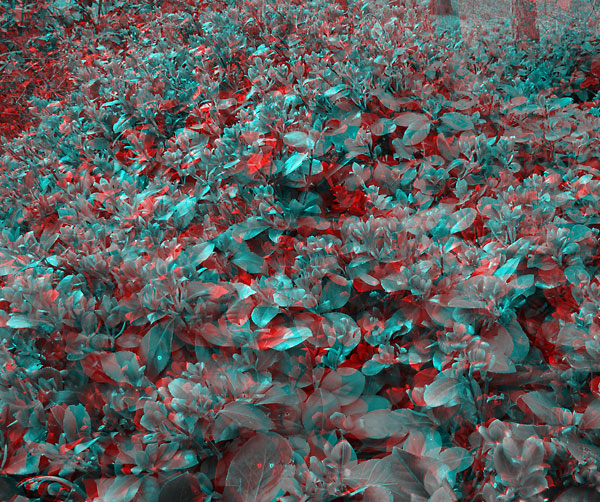
Sprouting Hedge, 2010, stereo photo by Fred Hatt
We’ll turn now to the shapes of man-made things, letting this shop window with potted plants behind a neon sign serve as a segue.

Qi Gong Tui-Na, 2010, photo by Fred Hatt
Shop windows are a natural subject for stereo photography, since we look through them into enclosed places where objects have been composed in spatial arrangement.

Pastry Shop, 2010, stereo photo by Fred Hatt

Lamp Store, 2010, stereo photo by Fred Hatt
The window below has been decorated with a huge transparent photographic image, which we look through to see a dress on display within the open space of the store.

Calvin Klein Store, 2010, stereo photo by Fred Hatt
This antique store has arranged a family of wooden manikins on a leather upholstered bench.

Manikins, 2010, stereo photo by Fred Hatt
Instead of looking through a glass window, we can look through a steel mesh gate to see the receding space of a narrow passageway.

Passageway, 2010, stereo photo by Fred Hatt
This chain-link fence slides on a track to let trucks in and out of a loading dock. The framework of the gate produces a beautiful geometric shadow.

Rolling Gate, 2010, stereo photo by Fred Hatt
This frame was put up to support multiple billboards. It’s now being a bit under-utilized.

Sign Frame, 2010, stereo photo by Fred Hatt
Here, a huge, mottled block supports a cast-iron bannister for a set of brownstone steps adorned with a ratty carpet.

Stoop Steps, 2010, stereo photo by Fred Hatt
A construction shovel is another rough form on a residential street.

Shovel, 2010, stereo photo by Fred Hatt
The rough form below reminded me of an aging roué with a young mistress.

Beauty and the Beast, 2010, stereo photo by Fred Hatt
I find that looking at 3D photographs makes me more aware of three dimensional form and texture, and the topological complexity of the landscape, aspects of the world we may often overlook.

Snowy Skyy, 2001, photo by Fred Hatt
Last weekend the Eastern U.S. had its first major snowfall of the season, immediately preceding the Winter Solstice. Around this time of year our culture ritually celebrates the White Christmas and the Winter Wonderland, Jack Frost and Frosty the Snowman, calling up nostalgic images of horse-drawn sleigh rides and cozy houses among rolling hills of pure white. The reality of snow in the city is more conflicted, both soft and harsh, beauty that rapidly becomes ugliness. In honor of the season, here are some photos from my collection, images of great New York City snowfalls of the past decade.
Streetlamps illuminate the beautiful movement of swirling snow. Because of its lightness, snow shows the complexity of whorls and eddies in the flowing air:

Streetlamp Flurry, 2003, photo by Fred Hatt

Snow at Ground Zero, 2005, photo by Fred Hatt
The first dusting adds a cool glamor to the gritty street:

Powdered Bus Lane, 2003, photo by Fred Hatt

Snow Traffic, 2001, photo by Fred Hatt
Nothing imparts mystery to our mundane environment of walls and ads like a white veil:

Snow-Masked, 2003, photo by Fred Hatt

I Love You, 2006, photo by Fred Hatt
Even when the snow is really coming down, the city is always full of rush and bustle:

Spring Snow, 2003, photo by Fred Hatt

Colors on White, 2003, photo by Fred Hatt
If it gets heavy enough, the car traffic stops and major streets become walkways, as in these pictures taken while walking down the middle of Broadway during the blizzard of 2003:

Posing in Blizzard, 2003, photo by Fred Hatt

Snowy Broadway, 2003, photo by Fred Hatt
In the photo immediately above you can see the fog-like effect, with objects in the distance fading to white. As night falls, beams of light cut and color the swirls and piles:

Snow in Headlights, 2005, photo by Fred Hatt

Blizzard Outside Deli, 2005, photo by Fred Hatt

Snowy Sidewalk, 2005, photo by Fred Hatt

Snow Shadows, 2003, photo by Fred Hatt

Snowscape, 2005, photo by Fred Hatt
Snow’s crumbly clumps cling to windows:

Snowy Windshield, 2005, photo by Fred Hatt

Snow on Skylight, 2003, photo by Fred Hatt
Like grains of sand in an oyster, parked cars are coated with smoothness until they become great white round mounds:

Buried Cars, 2006, photo by Fred Hatt

Snowdrift Car, 2006, photo by Fred Hatt
Other objects are transformed, like this concrete cherub (a popular decoration in my Italian neighborhood):

Snowcapped Cherub, 2005, photo by Fred Hatt
In the heaviest blizzards, like the one we had in 2003, snowfall penetrates even the subway system, drifting down the stairs and through the vents in the sidewalk:

Subway Stairs, 2003, photo by Fred Hatt

Subway Drift, 2003, photo by Fred Hatt
The snow seems to capture particles of diesel exhaust and other things floating in the air, and as it melts off peoples’ shoes the subway tiles get coated with an oily grunge:

Snow Pile in Subway, 2003, photo by Fred Hatt
Snowplows clearing the streets pile the snow up into huge mountains, packing in parked cars and creating pedestrian barriers that have to be scaled:

Wall of Snow, 2003, photo by Fred Hatt
Storm drains are clogged and gutters and crosswalks become lakes of dirty slush:

Slush Pallet, 2003, photo by Fred Hatt
Within a day, New York City snow is gray and filthy. Hardened chunks remain even as shoveling, plowing and relentless traffic clear the routes:

Dirty Snow, 2007, photo by Fred Hatt
The high piled-up mounds can last for weeks, even through warm weather, becoming nastier day by day. I’m sure this is what our lungs look like from breathing urban air:

Filthy Snow, 2003, photo by Fred Hatt
As the ice retreats, the salt and other residues leave sedimentary markings on the sidewalk:

Snow Residue, 2008, photo by Fred Hatt
And when the sun comes out, melting snow rains down from the buildings and construction sheds, glittering like gems in the sunlight:

Snowmelt, 2003, photo by Fred Hatt
November from Fred Hatt on Vimeo.
November is a film I made in collaboration with dancer Jung Woong Kim of U-Turn Dance Company. This is about as spontaneous as filmmaking can get. Jung Woong and I just met one day at Brooklyn’s Prospect Park, walked around looking for suitable settings, and then filmed Jung Woong’s improvisations in the moment.
Most dance video makers nowadays seem to rely heavily on editing, choreographing by assembling moments of movement. Our approach, by contrast, was to find settings that would provide a frame or field of play, keeping the camera fixed and allowing mostly uninterrupted movement to sketch the spatial potential of the topology.
There is no music, but the crunching and swishing of dry autumn leaves becomes a complex rhythmic composition. The urban aspect of the setting is expressed through the auditory environment, which includes aircraft, traffic, and distant voices.
Before the advent of high definition video, this kind of mise en scène approach required 35mm film. This video was made with a humble Canon HV20 (with wide angle adapter and external microphone), but the detail is sufficient to show texture and atmospheric depth in a long shot, which conveys a great deal about a dancer’s exploration of the possibilities of a natural space.
If your computer can handle high definition video, check out the HD version on Vimeo.
Here are three still frames from the video:

Still from "November", 2009, a video by Jung Woong Kim & Fred Hatt

Still from "November", 2009, a video by Jung Woong Kim & Fred Hatt

Still from "November", 2009, a video by Jung Woong Kim & Fred Hatt

Sidewalk Reclaimed, 2004, photo by Fred Hatt
Weeds are feral plants, the bane of gardeners and pavers. They thrive in the most inhospitable settings, taking root in the sooty dust that collects in cracks, taking over abandoned urban spaces with remarkable speed, breaking concrete and reclaiming mankind’s barrens for the kingdom of plants.

Straight and Scribbly Lines, 2004, photo by Fred Hatt

Weeds on Stairs, 2003, photo by Fred Hatt

Urban Copse, 2006, by Fred Hatt
Weeds may be glorious wildflowers or medicinal herbs, thistles, grasses or ivies. The kind that thrive in cities often seem to have forms that are ragged, jagged, scribbly, electric. They’re tough and prickly, like many urban dwellers.

Street Grass, 2008, photo by Fred Hatt

Grassburst, 2007, photo by Fred Hatt

Demolition Site, 2009, photo by Fred Hatt
In our uncertain time, everything seems to be breaking down. Industrial civilization defines prosperity only as growth, but the limits to growth are looming everywhere. Population and consumption of resources have exploded. The atmosphere is running a fever. Our food and all our technology are built on reservoirs of oil that may be running dry. Our financial system is metastatic, a cancer growing on the real economy. Our political system is sclerotic, too beholden to moneyed interests to act for the common good. Bold change will not come from our leaders, but only from our forced adaptation to catastrophes.

Greenpoint Dandelions, 2003, photo by Fred Hatt
Such times will be hard for vast monocultures, and for hothouse flowers (and I do intend those as human metaphors). Such times call for weedy spirits, for those that can find their earthly grounding even in the decaying manufactured world, and who burst with green power, determined to reassert the forces of life.

Storm Drain Greenery, 2004, photo by Fred Hatt

Cobblestone Grass, 2002, photo by Fred Hatt

Blue/Yellow/Green, 2002, photo by Fred Hatt

Backlit Weeds, 2002, photo by Fred Hatt

Vacant Lot, 2002, photo by Fred Hatt
I took all the photos in this post in New York City, over the last seven years.

Powered by WordPress