DRAWING LIFE by fred hatt

2011/04/02

Vertical Panoramas

Filed under: Photography: Framing — Tags: , , , , — fred @ 22:38

Stairs and Skylight, 2010, photo by Fred Hatt

We’ve all gotten used to the terms “landscape” and “portrait” being used to designate the orientation of a rectangular display screen, printed document, or photograph, though there’s no reason a portrait can’t be horizontal, or a landscape vertical.  I live in New York, a famously vertical city of skyscrapers, but even here most of the locals scurry around the streets like the inhabitants of Flatland, never imagining that third dimension.  In 1998 photographer Horst Hamann published a book called New York Vertical, that showed how excitingly the upward thrust of the city can be captured in a tall and narrow frame.

I believe Hamann used a 6 cm x 17 cm medium format film camera like this one (though not necessarily this brand or model).  I can’t afford one of those, so when I’ve wanted to capture a very wide or very tall view I usually just take anywhere from two to six sequential panning shots on a fairly humble digital camera, stitching them together later using computer software.  I started doing this with the Canon G1 I got back in 2001.  It came with a “stitch assist” mode that helped align such a series using the LCD viewfinder, and a program called PhotoStitch to put them together.  Today Photoshop includes a panorama merging function, and Sony has a “sweep panorama” mode where you just pan over the landscape and the camera automates the whole process.  I don’t have one of those, but I’ve had pretty good results with combining a series of photos the “old fashioned” way.

Javits Center Geometry, 2004, photo by Fred Hatt

If you’re looking at these pictures on a small screen or a short wide display you may have to scroll vertically to see the whole picture.  This is actually the most natural way to look at these pictures.  They capture a larger vertical field of view than you can take in in a glance.  They represent looking at something head-on and then tilting the head to move your view upwards, or vice versa.  When you make one of these images small enough to take in the whole thing at once, it looks very distorted.  In the shots above and below, the lower part of the picture is a straight-on view with the gaze parallel to the ground, while the upper part is seen as though the head is tilted back at a severe angle.  They represent a movement of vision, not an instant of vision.

Puck Building Fire Escape, 2005, photo by Fred Hatt

The picture below shows an audience on the sidewalk, watching one of the storefront window performances at the arts organization Chashama in 2002, with the newly constructed Condé Nast building towering overhead, 48 stories high.

Welcome to Chashama Land, 2002, photo by Fred Hatt

Sometimes the tilt of the view is not from horizontal to upward, but from horizontal to downward, as in this view of the stairs going into a Subway station at the south end of Central Park.

Subway Stairs, 2003, photo by Fred Hatt

Towers and stairways are not the only vertical presence in the city.  Trees are the great mediators between earth and sky.  Here are butoh dancers Moeno Wakamatsu and Celeste Hastings, performing in the 17th century graveyard of St. Marks Church in the Bowery, where Peter Stuyvesant is buried.

Celeste and Moeno at St Marks, 2006, photo by Fred Hatt

Reddish streetlights make a bare tree at dusk look like arteries and capillaries.

Vascular Tree, 2005, photo by Fred Hatt

Here’s a view from inside “Big Bambu” a sculptural/architectural temporary evolving installation by Mike and Doug Starn on the roof of the Metropolitan Museum of Art last year. (An outside view of this piece is the third photo from the bottom in this post.)

Bambu Interior, 2010, photo by Fred Hatt

Finally, here’s one of Manhattan’s earliest skyscrapers, the Flatiron Building, a favorite subject for photographers since the time of Stieglitz and Steichen.

Flatiron Lamppost, 2010, photo by Fred Hatt

All the photos in this post are stitched panoramas, made from multiple original shots.  See this post for a vertical panorama of the World Trade Center.

2011/03/04

Looking Back at the Gates: Central Park, 2005

Conversation, The Gates, Central Park, by Christo and Jeanne-Claude, 2005, photo #8388 by Fred Hatt

For two weeks in February, 2005, the muted winter landscape of New York’s Central Park was altered by over seven thousand orange curtained gates straddling every meandering footpath of the great park.  Detractors consistently described the nylon fabric as “shower curtains”, but the environmental installation by Christo and Jeanne-Claude was inspired by the traditional Shinto torii, gates signifying the entrance to sacred space.

Viewing the Gates in Central Park, 2005, map from the New York Times

Christo and Jeanne-Claude have been altering the landscape and the cityscape, usually with fabrics, since the 1960’s.  I first became aware of their work in the 1970’s, when I saw the Maysles brothers documentary about the creation of their Running Fence, shimmering white fabric along 25 miles of rolling hills and into the sea on the California coast.  As the film showed, the great majority of the actual work they do is administrative and organizational, negotiating with bureaucracies and property owners, a task that took twenty-five years in the case of The Gates.  The engineering is minimalist and efficient, the materials industrial.  Their work is ephemeral, installed for a limited time, and unsellable.  It appears that they fund these huge projects mainly by selling photos, prints and preparatory sketches like this one:

The Gates, Project for Central Park, New York City, 2003, collage by Christo

Christo and Jeanne-Claude’s combination of aesthetic simplicity, huge scale, and very limited duration gives the work an interesting effect.  It exists for many years as a plan, a project, only very briefly as a reality, and then in a long, lingering afterlife of memories and images.  Its design seems aimed at altering a sense of space, but it succeeds also in altering the sense of time.

Vessels, The Gates, Central Park, by Christo and Jeanne-Claude, 2005, photo #8398, by Fred Hatt

I took The Gates as an opportunity to practice my photography.  The saffron fabric seemed to capture the warmth of the sun in the gray wintry air.

Composition, The Gates, Central Park, by Christo and Jeanne-Claude, 2005, photo #8400, by Fred Hatt

The colorful rectangles contrasted with the monochrome wriggliness of bare branches and 19th Century cast iron froufrou.

Cherubs, The Gates, Central Park, by Christo and Jeanne-Claude, 2005, photo #8432, by Fred Hatt

Here the ephemeral curtains are glimpsed over the top of a boulder that has occupied its space for hundreds of millions of years.

Manhattan Schist, The Gates, Central Park, by Christo and Jeanne-Claude, 2005, photo #8449, by Fred Hatt

The Gates created another skyline for the city of skylines.

Skyline, The Gates, Central Park, by Christo and Jeanne-Claude, 2005, photo #8452, by Fred Hatt

South End, The Gates, Central Park, by Christo and Jeanne-Claude, 2005, photo #8481, by Fred Hatt

Central Park is woven with extensive curlicues of footpaths, but usually they are invisible from a distance.

Breeze, The Gates, Central Park, by Christo and Jeanne-Claude, 2005, photo #8492, by Fred Hatt

At dusk, the yellow-orange fabric took on a darker tone.

Dusk, The Gates, Central Park, by Christo and Jeanne-Claude, 2005, photo #8512, by Fred Hatt

Construction Sign, The Gates, Central Park, by Christo and Jeanne-Claude, 2005, photo #8530, by Fred Hatt

The orange color reminded many people of the orange construction equipment and safety markers seen everywhere in the city.  To some it seemed the entire park had become a construction zone.  The Gates had lots of detractors, grousing about all the hype, about how it didn’t fulfill traditional artistic values, about how it desecrated the classic landscape design of Olmsted and Vaux, about how they couldn’t enjoy the park with all the damn shower curtains and extra tourists.  I think some of these were the same folks that fire off an angry letter every time NPR mentions the existence of popular culture.  If you want to complain about the alteration of the landscape, how about the Second Avenue Subway project, which promises to keep a major commercial artery ripped up for the better part of a decade?

Bridge, The Gates, Central Park, by Christo and Jeanne-Claude, 2005, photo #8617, by Fred Hatt

Overlook, The Gates, Central Park, by Christo and Jeanne-Claude, 2005, photo #8624, by Fred Hatt

For me, The Gates provided interesting aesthetic effects, but only became truly beautiful when the snow fell.

Winter, The Gates, Central Park, by Christo and Jeanne-Claude, 2005, photo #8746, by Fred Hatt

Snow Field, The Gates, Central Park, by Christo and Jeanne-Claude, 2005, photo #8752, by Fred Hatt

Reflecttion, The Gates, Central Park, by Christo and Jeanne-Claude, 2005, photo #8764, by Fred Hatt

The Gates were emblems of warmth standing amid the ice and snow.

Frozen Lake, The Gates, Central Park, by Christo and Jeanne-Claude, 2005, photo #8899, by Fred Hatt

My friend Kayoko Nakajima, a dancer, was inspired to move among the billowing panels of color.

Kayoko's Dance, The Gates, Central Park, by Christo and Jeanne-Claude, 2005, photo #8984, by Fred Hatt

The Gates inspired many other artists and parodists, including the charming Somerville Gates.

I walked just about every part of that wonderful park during those two weeks, whenever I had some free time.

Night and Snow, The Gates, Central Park, by Christo and Jeanne-Claude, 2005, photo panorama #6,by Fred Hatt

And then it was gone, the materials recycled, the tourists gone, the pervasive orange accenting (or blight, if you prefer) vanished completely.  It was only an experience.

For my view of another giant temporary art installation in another great NYC park, click here.

2011/02/03

Finding Beauty in Filthy Snow

Nocturnal Snowscape, 2011, photo by Fred Hatt

It’s been a record-breaking season for snowfall this winter in the Northeastern United States – 56 inches (142 cm) so far in New York.  We’ve had snow every week for the past six weeks, sometimes massive dumpings.  Last week’s epic blizzard mostly spared NYC, but covered more than half of the country – check out a satellite photo, and read accounts of drivers taken by surprise and trapped for hours on Chicago’s Lake Shore Drive, a major highway at the heart of the city.  Snowfall has been heavier than usual across the northern hemisphere, and many warmer areas have experienced heavy rainfall and flash flooding.  Climate scientists tell us the increased cold weather and precipitation in the temperate latitudes is related to the collapse of a “polar vortex” that used to keep frigid air confined to the arctic regions, and this may be related to the melting of arctic sea ice and global climate change.  Of course, a freakishly snowy winter can happen at any time, due to the inherently chaotic nature of weather patterns, but it is also possible that what we are experiencing this winter will become the “new normal”.  If so, we’d better learn to appreciate it!

Of course pristine white snow in the countryside is one of nature’s magnificent spectacles, something nearly everyone finds beautiful.  Snow in the city is a more conflicted phenomenon.  It’s a barrier, a nuisance and a hazard, and it quickly becomes a magnet for all the city’s filth.  But I love observing the forces of nature in an urban setting, and snow is fascinating because it presents so many different forms and changes over a short time span.  Look how it swirls in the golden light of a sodium vapor parking lot lamp.

Snowflake Traces, 2011, photo by Fred Hatt

On a sunny morning after a heavy snowfall, parked cars are gently rolling mounds like dunes of white sand.

Snow Dune Van, 2011, photo by Fred Hatt

The contours of a pink kiddie-ride horse are softened and abstracted like an unfinished marble carving.

White Horse, 2011, photo by Fred Hatt

The bare branches of trees are etched against the background in black and white.

Snowy Branches, 2011, photo by Fred Hatt

It’s a linear feast.

Wires and Branches, 2011, photo by Fred Hatt

On my block in Brooklyn, cars were thoroughly buried, as the city snowplows piled the snow against them from the street side, while the sidewalks were cleaned with a snow blower that plastered the cars from the house side.  New York has good public transportation, so after a big snowfall many people leave their vehicles interred for many days or weeks.

Great Wall of Snow and Cars, 2011, photo by Fred Hatt

Crossing the street may involve clambering over giant mounds of snow or trudging through piles churned up by the plows.

Ahead of the Plow, 2011, photo by Fred Hatt

When some of the snow melts, many crosswalks are reached only by leaping across or wading through ankle-deep lakes of slush.

Slush to Ford, 2011, photo by Fred Hatt

There should be a word for the hybrid of snow and mud that coats the streets after the snowplows make the rounds.

Sloppy Crosswalk, 2011, photo by Fred Hatt

Kids of course love snow.  So do dogs – at least those with long enough legs to keep their bellies out of the mess.  Lots of people are inspired to play and get creative.  This is a giant snow monster, taller than a person, that I saw in Tompkins Square Park.

Tompkins Square Snow Monster, 2011, photo by Fred Hatt

Snow in the city actually makes nighttime photography easier, as long as you can keep the wet stuff off your lens.  The snow reflects all the light that the dark pavement normally absorbs, making even the darker parts of the city as bright as only Times Square would be under normal conditions.

Pour House in Winter, 2011, photo by Fred Hatt

Street lights coming from behind a mound of snow highlight the rocky texture of its edge.

Plowed In, 2011, photo by Fred Hatt

Bicycles frame the colors of the multiple light sources in circles and triangles.

Bike Rack in Snow, 2011, photo by Fred Hatt

The shadow this buried bike casts on the show is tinted green by the light of a nearby neon sign.

Buried Bike, 2011, photo by Fred Hatt

The whiteness of snow magically intensifies the effects of colored shadows and of lights of different hues falling from different directions.

Shadows on Snow, 2011, photo by Fred Hatt

Ice and the damp crystallized sheen that covers the streets reflect the colors of green and red traffic signals, against the snow illuminated by amber street lighting.

Traffic Signals Reflected on Cobblestones, 2011, photo by Fred Hatt

This pile of snow is filthy and jagged, and it’s blocking passage to the street and taking up a parking spot.  But look how it catches the colored lights around it.  It’s a glittering gem!

Neon Snow Pile, 2011, photo by Fred Hatt

When rain follows snow, the snow is covered by a glistening icy crust.

Icy Crust, 2011, photo by Fred Hatt

When there’s been a really big blizzard, certain dirty mounds survive long after most of the snow is gone.  With a core of solid ice, condensed and insulated by an outer coating of diesel scum and general street dust, these icebergs can last well into the early spring.

Tip of the Iceberg, 2011, photo by Fred Hatt

All of the photos in this post were taken in January or February of 2011.  I did a post about urban snow last year too – check it out.

2011/01/05

12 Months

Filed under: Photography: The Seasons — Tags: , , , , , — fred @ 00:50

Slick Sidewalks, January, 2010, photo by Fred Hatt

Here we take a look back at 2010 in the landscape of New York City, with one photo from each month.  I often keep a camera with me as I walk around the city, and photograph scenes and patterns and effects of the light that catch my eye, like the rainy reflections above, or the illusion of a face in a mound of plowed snow, below.

God of Dirty Snow, February, 2010, photo by Fred Hatt

Road Plate, March, 2010, photo by Fred Hatt

Metallic gray is warmed by the brown of rust or the pink of spring blossoms.

Petaled Accord, April, 2010, photo by Fred Hatt

Deepwater Demon, May, 2010, photo by Fred Hatt

Sunset Shorts, June, 2010, photo by Fred Hatt

The Summer is about relaxing outdoors.  Streetlights through leaves make an urban park at night an impressionist fantasy.

Bryant Park at Night, July, 2010, photo by Fred Hatt

Signals, August, 2010, photo by Fred Hatt

The chaos of signs, patterns and colors embodies the energy of the city.

Sign Painter, September, 2010, photo by Fred Hatt

Shadowscreen, October, 2010, photo by Fred Hatt

Autumn in New York is a long, lingering season of mild weather and gentle brightness.

S Curve, November, 2010, photo by Fred Hatt

Wall Sheen, December, 2010, photo by Fred Hatt

All of these pictures were made with a Canon G11, casual shots of scenes glimpsed as I made my quotidian peregrinations of jobs and errands in Manhattan, Brooklyn and Queens.  I have selected one photo out of all those made in each month of 2010.  Happy 2011!

2010/11/06

Magic Squares

Filed under: Photography: Framing — Tags: , , , , , — fred @ 01:30

Sunset Construction Shed, 2005, photo by Fred Hatt

A lot of writing about proportions and composition focuses on the golden ratio or phi.  Relationships based on phi appear everywhere you look in natural forms and cycles.  Artists, architects and designers frequently use the golden rectangle based on this ratio, and it’s often considered the most beautiful of all rectangles.  But it could be argued that the square is an even more harmonious quadrangular shape, and its perfect evenness has very special compositional qualities.

The 6 x 6 cm square film format became popular for magazine photography partly because square images could be cropped to either vertical or horizontal rectangles by the editor, but photographers often found that the square frame facilitated particularly bold arrangements of their subject matter.  Designers discovered the special qualities of the square frame in creating sleeves for LP records, leading to some of the most iconic graphic designs of the last century.

Here I share a selection of my images of New York City from the past decade, selected as examples of square compositions.  I don’t have a square format camera, but I find that many of my photographs are improved by cropping, and the square crop is one I frequently consider.  A criterion for choosing images for this post is that I don’t think any of these images would work as well with a vertical or horizontal frame.

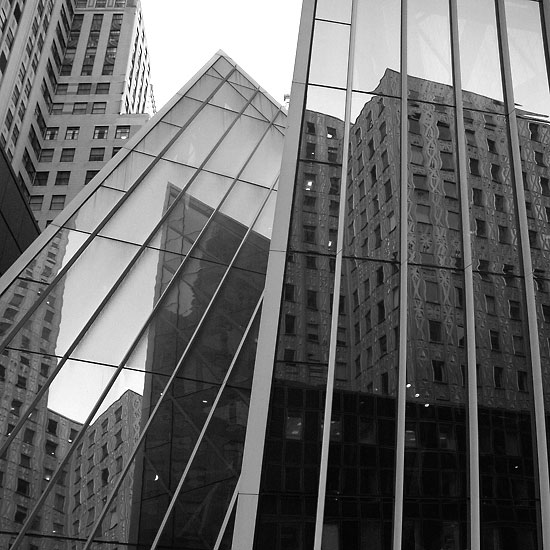
The top photo in this post is a perspective through the roughly square corridor of a construction shed.  The setting sun casts long diagonal shadows of the scaffold columns, and those diagonals are countered by the thicker shape of an inclined tree trunk.  The square frame really highlights the contrast of vertical, horizontal, and diagonal lines.  Here’s another example:

Oblique Light, 2006, photo by Fred Hatt

A square crop can break down a unified design into an arrangement of shapes and lines.

Automotive Shapes, 2006, photo by Fred Hatt

A beautiful three dimensional shape, compressed into two dimensions and framed in a square, becomes somehow even more abstractly sensuous.

Steel Helix, 2005, photo by Fred Hatt

This classic bit of architecture (The Enid A. Haupt Conservatory at the New York Botanical Garden in the Bronx) is designed with golden ratio proportions, but a square frame really flatters it:

White Dome, 2004, photo by Fred Hatt

This view from a Brooklyn rooftop shows the special properties of the square picture.  A wide image would be a panorama, focused on the horizon, and a tall image would emphasize the height of the vantage point.  The square equalizes the vertical and the horizontal, and thus shows height and depth in equilibrium.

Brooklyn Crepuscule, 2005, photo by Fred Hatt

In a square frame, what is centered is idealized and what is off center is dynamic.

Heaven and Earth, 2009, photo by Fred Hatt

Straight lines and organic forms complement each other in perfect tension within the square.

Diagonals, 2005, photo by Fred Hatt

Dark and light, rounded and rectangular, perpendicular and angular: Simple polarities of form spring into relief in the balanced space of the square frame.

Urban Sundown, 2006, photo by Fred Hatt

Straight lines make quadrilaterals and triangles within the square, and curved forms break the rigidity.

Street Fair Decorations, 2010, photo by Fred Hatt

The simplest contrasts reveal their full complexity in the square.

Piece of Gold, 2004, photo by Fred Hatt

The perfect regularity and abstraction of the square can be an ideal frame for the fractal chaos of natural forms.  Any other rectangle partakes of a bit of chaos itself, but a square remains rigorously neutral.

Rainy Berries, 2005, photo by Fred Hatt

The square’s geometrical balance can also highlight the gestural quality of a figure or sculpture.

Command, 2006, photo by Fred Hatt

Sculptural Hands, 2005, photo by Fred Hatt

The converging lines of perspective take on a special quality in a square frame, where verticals, horizontals, and  diagonals exist in egalitarian relationship.

Subway Perspective, 2004, photo by Fred Hatt

Fence Growth, 2007, photo by Fred Hatt

Perspective compositions are made even more interesting by the addition of curves or random angles.

Cast Iron, 2005, photo by Fred Hatt

Barriers, 2005, photo by Fred Hatt

The elements of a square picture rest in balanced relation to all their companion elements.

Flushing Meadows Globe, 2004, photo by Fred Hatt

Perfect symmetry is actually heightened by slight elements of asymmetry.   The harmonious square frame magnifies both qualities.

Church Garden, 2005, photo by Fred Hatt

Stone Yard, 2010, photo by Fred Hatt

A square is naturally divided into rectangles and other shapes, a la Mondrian.

Drawer Pull Display, 2006, photo by Fred Hatt

Eighth Avenue, 2004, photo by Fred Hatt

Leaning or angular shapes have a certain natural dynamism based on their contrast with rectilinear forms.  The square composition gives these shapes their full measure of potential energy.

Angular Structure, 2006, photo by Fred Hatt

In a square image, a living element can be a point of active concentration, seen off center in relation to a more abstract, more chaotic space, illustrating the tension inherent in the relation of the living being to the natural world.

Fountain Joy, 2006, photo by Fred Hatt

Snow Mound, 2005, photo by Fred Hatt

Wet Asphalt, 2004, photo by Fred Hatt

Plywood's Red Glare, 2004, photo by Fred Hatt

Expressions of style can be abstracted from their complex personal and cultural manifestations, to be observed in their purely formal aspects.

Mosaic, 2005, , photo by Fred Hatt

Instruments and Shoes, 2004, photo by Fred Hatt

Just as fractal mathematics shows the rational order underlying complexity, the square frame in photography puts the unbalanced world, snarled, tangled and scattered, into a context of perfect equilibrium, illuminating the logic of chaos.

Linear Arrangement in Streetlight, 2007, photo by Fred Hatt

Composition in Gray, 2004, photo by Fred Hatt

Spilt, 2006, photo by Fred Hatt

« Newer PostsOlder Posts »

Powered by WordPress

Theme Tweaker by Unreal