DRAWING LIFE by fred hatt

2012/03/30

Collector of Souls: Alice Neel


Nancy and Olivia, 1967, by Alice Neel

Alice Neel (1900-1984) is always described as an artist that was slow to find recognition.  It’s true, but I think it’s also true that her brilliance was of a kind that is only achieved through maturity and persistence.  Our culture likes to think that a genius is a genius, that they must be incandescent in their emergence.  If you pass 30 or 40 and you’re not a star, you should give up, pack it in, and do something useful for a change.  And maybe that makes sense if you think art is all about fresh concepts and the iconoclasm of a new generation defying the elders.  But what if you’re trying to do something very deep and subtle, and nearly impossible to master?

Alice Neel, 1944, photo by Sam Brody

I’m not saying Neel’s early work wasn’t strong, and I’m not saying her sex and her devotion to figuration in an era where the big money was on abstraction didn’t delay her acclaim.  Her early work shows the  influence of the Ashcan School of socially conscious realism, as well as of surrealism and psychological expressionism of the kind that Munch and Ensor developed.  Her paintings of the 1920’s and 1930’s are dark with lots of black paint, and heavy with romantic angst, symbolism, and working class politics.

Degenerate Madonna, 1930, by Alice Neel

Kenneth Fearing (poet, founder of Partisan Review), 1935, by Alice Neel

Those were the radical art fashions of the era.  Neel does them well, but you can see hints that the real essence of her talent lies in her intense focus on the individual human subject.  At the time, she was young, and dedicated to the romantic ideal of the rebellious and bohemian artist, which she lived fully, complete with abusive marriages, nervous breakdowns and suicide attempts.

Ballet Dancer, 1950, by Alice Neel

The Last Sickness (Alice's mother), 1953, by Alice Neel

She persuaded a diverse collection of people to sit for her – her neighbors, her bohemian artist and writer friends, children and old people, naked nudes and dressed-up dandies, the uptight and the laid-back, the pretentious and the naïve.  She found nothing more fascinating than to try to capture in paint something of what it was like to be with these people.  She said, “Like Chekhov, I am a collector of souls.”

Two Girls, Spanish Harlem, 1959, by Alice Neel

Robert Smithson (earthworks artist), 1962, by Alice Neel

Sherry Speeth (mathematician), 1964, by Alice Neel

Alice Neel painted directly from life, and directly on the canvas, without designs or preliminary studies.  She said, “I do not pose my sitters. I do not deliberate and then concoct… Before painting, when I talk to the person, they unconsciously assume their most characteristic pose, which in a way involves all their character and social standing – what the world has done to them and their retaliation.”  Doing a painting of someone was for her an interaction with that person.

Fuller Brush Man, 1965, by Alice Neel

Hartley (Alice's son), 1965, by Alice Neel
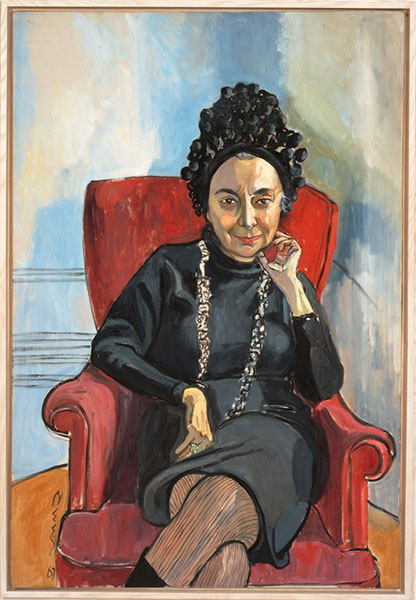
Charlotte Willard (art critic & author), 1967, by Alice Neel

The old saying is “Every painter paints himself”, and for most portrait painters this is a limitation.  It means they project something on the subject, some fantasy or ideal.  For Neel, it means she paints how she and her subject encounter each other, in the moment as they look at each other.  The directness of the look, and the directness of the act of painting, capture the uncanny aliveness that Neel’s pictures embody.

In the silent home movie above you can see some of how Neel starts painting, and how she develops the canvas.  Alice’s son Hartley shot this film as she was painting her daughter-in-law Ginny.  She starts out with a black line drawing in thinned paint, sure and direct.  There is no measuring, no roughing in.  It’s distorted and out of proportion, and that doesn’t matter at all.  As she continues to paint, areas of color are filled in here and there, seemingly haphazardly, but with a sense of painterly dynamics.

Andy Warhol (artist), 1970, by Alice Neel

Jackie Curtis (performer, Warhol superstar) and Ritta Redd, 1970, by Alice Neel

The Family (John Gruen, Jane Wilson and Julia), 1970, by Alice Neel. Gruen was a music, dance and art critic, Wilson a painter, and Julia is now director of the Keith Haring foundation.

The eyes are usually enlarged, making intense connection to the painter, and through her, to the viewer.  The hands are often oddly small yet expressive, with snaky fingers grasping the world, holding on tight or draping lazily.  Background elements are sometimes highly textural and at other times they are left as bare indications.  In the later work the use of unfinished areas is masterful.

Carmen and Judy, 1972, by Alice Neel

John Perreault (artist, poet & critic), 1972, by Alice Neel

The Soyer Brothers (Moses and Raphael, artists), 1973, by Alice Neel


Her pictures of people are distorted in proportion, but they are not distorted by idealism or sentimentality, nor by judgment or an agenda.  They are open, clear-eyed, compassionate, and realistic.  The probing engagement is the same whether the subject is a child or a power broker.  Some of her pictures could almost be caricatures, except that they are made with an openness to her subject that is foreign to caricature.

Isabel Bishop (artist), 1974, by Alice Neel

Margaret Evans Pregnant, 1978, by Alice Neel

Geoffrey Hendricks (Fluxus artist) and Brian, 1978, by Alice Neel

The riveting quality of Neel’s paintings convinces me that there is no greater subject for a painter than the individual human being, and that symbolism and theory and “statements” are nothing  but obstacles to true seeing.  Why do so few serious artists in our day attempt it?  The portrait is considered a fusty genre, suitable for sentimentalists and satirists.  It doesn’t challenge the status quo as the contemporary artist is expected to do.  It has no intellectual component.  But perhaps all that is just to rationalize avoiding a challenge that is extremely difficult to pull off, a challenge that engages not just the mind but the whole being of the artist.

Self Portrait, 1980, by Alice Neel

Alice Neel never stopped believing in herself, even as the institutional art world ignored her.  She had to wait for her moment of fame, which finally came with the rise of the feminist movement.  They came looking for the great neglected female artists, and for an approach to art that countered the macho culture of abstract expressionism and pop art.  Neel’s deeply embodied, personally engaged work, with its pregnant women and babies, its frank and unheroic male nudes, fit the bill.  She bristled a bit at being assigned the role of feminist art icon, but she reveled in her late-life fame.

Alice Neel, 1970's, photographer unknown

The illustrations here really don’t do justice to the original paintings.  They lose the subtleties of the color and the sense of scale, which in the later work tends to be half life size or bigger.  Last week I was thrilled to be able to look at some original Alice Neel oils in an exhibit at the Michael Rosenfeld Gallery on 57th Street in Manhattan.  It’s a three person show with pioneering African American artists Benny Andrews and Bob Thompson, whose work is also very much worth looking at, and it’s up for just another week, through April 7, 2012.  The asking price for all the Neels is about half a million dollars each.  I think even when she was 50 years old and living in poverty, Alice Neel knew her work was that valuable.

Check out this brief clip on Neel from ART/New York.  One of the art critics that’s interviewed is John Perreault, whose nude portrait by Neel is included in this post.

If you’re interested in learning more about Alice Neel, I recommend the excellent documentary on her made by her Grandson, Andrew Neel.

All the images here were found on the web, and clicking on the images links back to the site where I found them.

2012/03/11

A Trio of Birthdays

Still from the film “2001: A Space Odyssey”, 1968, directed by Stanley Kubrick

1. This week, on March 15, Drawing Life turns three years old.

2. Minerva Durham’s Spring Studio, New York’s busy basement of figure drawing and one of the forges of my creative life, is celebrating its twentieth anniversary this month.

3. On the 12th, my brother Frank Hatt is celebrating another one of those decade birthdays.

Please indulge me as I share a few images and video clips to trumpet this triumvirate of things that matter to me.  (Note to email subscribers: embedded video and audio clips don’t work on the email versions of posts, so you’ll need to click the links or visit the blog on the web to see the things I’m talking about.)

Honestly, each of these three anniversaries merits its own post.  I’ll blame my jamming them together on cosmic conjunction.

Let’s start with Frank.  Long-time readers of Drawing Life may recall seeing some videos I made that featured Frank: “Subway Sax“, “The Silo“, and “Glossolalia + Katharsis“, all from twenty or more years ago.  Well, Frank’s still around, and still plays a sweet alto saxophone.  In January of this year, we filmed some of his improvisations on an animal farm/petting zoo in the Catskills – thanks to my great friend Alex for taking us to this beautiful place.

“Sax Stream” – saxophone solo by Frank Hatt, video by Fred Hatt

Frank has long been fascinated with “extended vocal techniques” such as overtone singing and vocalizing on the inbreath, both of which you’ll see in the clip below, as well as toy instruments and noisemakers.  Frank’s approach is playful, often frenetic, sometimes downright wacky.  Here his voice blends with those of chickens, geese, ducks, turkeys, and emus.

“Down on the Farm” – vocals and noisemakers by Frank Hatt, video by Fred Hatt

Maybe the best moment we got where Frank really seems to be vocally interacting with the birds is this brief improvisation on sax mouthpiece, without the rest of the instrument.  This one is presented as an audio-only file, as the visuals didn’t add much.

FrankHatt_mouth-piece128

In the 1990’s I was mostly known for body painting, and Minerva thought body painting would be an effective way to demonstrate anatomy, so I shared a few pointers on materials and techniques, and Minerva took off with it.  Here she is painting the muscular system on the renowned dancer, model, and choreographer Arthur Aviles, a former dancer in the Bill T. Jones company and one of the founders of the Bronx Academy of Arts and Dance (BAAD).

Minerva Durham paints muscles on Arthur Aviles at Spring Studio, 1998, photo by Fred Hatt

Spring Studio also hosts art exhibitions, and I had a show there in 1998.  At the opening I did a couple of body art performances, including a blacklight body painting performance with Sue Doe, with whom I’d developed a nightclub act that we were then presenting regularly at the Blue Angel Cabaret.  Here’s a condensed version of that performance.

Art Underground from Fred Hatt on Vimeo.

This month, the walls of Spring Studio are filled with hundreds of drawings and paintings made in the studio by the many artists that pursue their practice there.  I love Spring Studio’s annual anniversary exhibitions, which reveal the incredible diversity of styles and approaches that flourish in such an environment.  The work of seasoned professional artists is hung cheek-by-jowl with the work of beginners, and somehow the juxtaposition makes both look better!  This kind of show also highlights the talents of Spring Studio’s great models, especially when you notice multiple artists’ interpretations of the same pose.

Next Sunday, March 18, starting at 6:30, Spring Studio will host an anniversary party with performances.  Here are the details:

Andrew Bolotowsky, flute,  and Mary Hurlbut, voice, Leon Axel’s compositions for flute and voice, 6:30 pm

We will paint muscles on Arthur Aviles, 7:00 with a backdrop of Andrew Bolotowsky’s flute, then Aviles will dance.

Dance, 8:00 pm: Kuan, Leticia and Esteban, Jason Durivou, Linda Diamond, Raj Kapoor, Nepali folk tune with Sherry Onna, and Anna Schrage painting a canvas to music played by Godfrey Daniel. Open MikeElizabeth Hellman, Flo Reines,  Nina Kovolenko, George Spencer, Susie Amato, Trevor Todd, Others. 

I’ll note that Kuan’s dance will be based on some of the poses she’s developed for modeling at Spring Studio, and that she’s using my drawings of her as choreographic source material, so I’m excited to see that.  You’ll notice too that Minerva is still painting on Arthur, and Arthur’s an incredible performer, not to be missed.  So if you’re in NYC next weekend, it would be a pretty interesting time to check out the studio!

[Late addition to this post, now that Spring Studio’s 20th Anniversary Party is past – a video I shot of Kuan’s dance based on her poses from Spring Studio:]

All right, so now I’ve gone on and on and bombarded you with pictures and videos and information about Frank Hatt and Spring Studio, and this post is also serving as Drawing Life‘s anniversary post.  In the first and second year anniversary posts, I highlighted the top articles, the ones that got the most page views.  This time, I’d like to thank my most regular commenters.  I know from the site stats that quite a few people alight upon these pages every day, but most probably don’t read much of what I write.  I’m sure there are some who read these posts regularly, but don’t comment.  There are also those who comment only by email or on Facebook.  I appreciate all of that, but I have a special affection for those who follow Drawing Life and join in the conversation with thoughtful responses, right here on the site.  Thank you, star commenters!

Jennifer, from the UK, a devoted student of figurative art

Andrew, author of the highly recommended “Art Model’s Handbook”

Jim in Alaska, always has great observations or reminiscences

Claudia (Museworthy blogger and star model)

Daniel Maidman (fellow blogger and master painter)

David Finkelstein (experimental filmmaker and performer)

I love you all, and the less frequent commenters as well.  Feedback is good, and when my writing threatens to dissolve into pompous monologue, you save it by making it a conversation!

2012/02/29

Golden Hour and Blue Hour

Filed under: Photography: Light — Tags: , , , , , , — fred @ 01:14

Sunset and Twilight, 2006, photos by Fred Hatt

Photographers and Cinematographers sometimes use the term “magic hour” to refer to times of day when natural daylight takes on special qualities that beautify nearly any setting and imbue it with drama and grandeur.  Unfortunately the phrase is used inconsistently to refer to times just before or just after sunup or sundown.  I prefer the terms “golden hour” for those times when the sun is just above the horizon, and “blue hour” for the time of twilight, when the sun is below the horizon but the sky carries a hint of its glow.  Of course, “hour” is also imprecise, as the duration of the times of magical light depends on season and latitude.  The tropics may have warm weather all year round, but there the setting of the sun is abrupt.  In St. Petersburg or in Patagonia, on the other hand, the  sky can be numinously luminous all day long.

At the golden hour, the sun comes nearly sideways through the atmosphere, passing through significantly more air than when it comes from overhead.  This softens and diffuses the light, and absorbs many of the short (blue) wavelengths, giving it a warm golden or reddish tone.  The landscape is illuminated laterally, with raking shadows revealing the texture of surfaces and things.

Autumn Sundown, 2004, photo by Fred Hatt

Side lighting is particularly flattering to human subjects.  In stage lighting, illumination from the sides is usual for dance, as it emphasizes the shapes of the body.  The warm tone of late afternoon or early morning light has its own glamorizing effect, reducing harshness and making blemishes and wrinkles less visible.  The softer light doesn’t make people squint as harsh midday light does, nor does it cast dark shadows under their eyebrows and noses.

Photographer, 2010, photo by Fred Hatt

When the light comes from behind through translucent things like leaves, grass, or hair, those objects glow with transmitted light, overpowering the ordinary reflected light by which we see opaque things.

Roebling Tea Room, 2010, photo by Fred Hatt

When low in the sky, the sun casts shadows laterally, sometimes outlining the shapes of trees and people and things upright on walls, rather than beneath them on the ground or floor.

Studio Window, 2003, photo by Fred Hatt

Direct lateral sunlight exposes textural contours in a reddish light, while the overhead blue light diffused through the sky provides a second, softer source of light.  At a particular time these two light sources, red from the side and blue from overhead, may be almost perfectly balanced.

White Brick, 2007, photo by Fred Hatt

A golden glint and long shadows turn the plainest structures into glittering metallic facets.

Gilt Edge, 2006, photo by Fred Hatt

Buildings are shadowed by other buildings, and the red glow of the setting or rising sun selectively ignites the gridlike structures.

Tinged Red, 2001, photo by Fred Hatt

Just as the sun drops below the horizon, the level of daylight comes into balance with the level of artificial lights.  Buildings are illuminated both from without and from within.

Foggy Evening, 2005, photo by Fred Hatt

At certain times, from certain angles of view, reflected light is more powerful than any direct light, outlining softly illuminated subjects against a sharp antipodal sheen.

Shiny Paint, 2006, photo by Fred Hatt

Once the sun drops below the horizon, the sky retains a diffuse ultramarine glow for some time before darkness completely overtakes the celestial vault.  Artificial lights are now dominant, but the twilight glow pervades the shadows.  Now it is is the blue hour.

Blue & White, 2008, photo by Fred Hatt

The remaining light in the sky gives every unlit thing a blue glow, while interiors and places with artificial lighting shine in warmer tones.

Pay Phones, 2004, photo by Fred Hatt

The sky is blue, sodium vapor streetlamps are reddish, incandescent bulbs yellowish, fluorescent lights greenish.

Manhattan Bridge Anchorage, 2009, photo by Fred Hatt

The photo below is taken while there was a twilight blue glow in the sky.  Fifteen minutes later, and the women would have been silhouettes against the artificially lit background.

Smoothies - Salads, 2012, photo by Fred Hatt

Wet streets reflect the sky, so the blue glow comes from below as well as above.

Rain & Steam, 2004, photo by Fred Hatt

As night descends, the overarching dome of light that is the sky gives way to the many separate sources of light that rule the urban night – headlights, streetlights, working lights, signal lights, display lights.

Roadway Composition, 2003, photo by Fred Hatt

When the level of the long wavelength street lighting matches the level of the short wavelength twilight sky, red runs through blue like rivulets of blood in icy water.

Red Feather, 2006, photo by Fred Hatt

Pomona Fountain, 2010, photo by Fred Hatt

Through reflection, the golden light of incandescence penetrates the deep blue of the gloaming.

Chelsea Blue, 2011, photo by Fred Hatt

Golden Estuary, 2009, photo by Fred Hatt

The last phase of twilight is an indigo glow that barely rises above black, a memory of light, a faint resonance, a lingering echo.

Park Road, 2004, photo by Fred Hatt

Central Park at Dark, 2005, photo by Fred Hatt

2012/02/12

Dancing/Drawing Performance

Kayoko Nakajima and Carly Czach, dancing Contact Improvisation, 2012, photo by Fred Hatt

On Saturday, February 18, I was drawing as part of this performance by one of my longtime collaborators, Kayoko Nakajima.  Kayoko is a dancer and a deep student of the anatomy of movement.  Here are all the details:

 “ARt Seeds to ARt Sprouts Project 2012”

Concept: Kayoko Nakajima

Improvisational/Contact Improvisational Dance: Kayoko Nakajima, Carly Czach
Improvising Drawing: Fred Hatt, Michael Imlay,Ivana Basic, Jennifer Giuglianotti
Costume: Aya Shibaraha
Video: Charles Dennis
February 18, Sat. 2012
7:30pm
Cumbe: Center for African and Diaspora Dance
558 Fulton Street, 2nd Floor (near Flatbush Ave.)
Brooklyn, NY 11217
This performance was a part of NYFA Bootstrap Festival 2012 A Celebration of Movement and Interdisciplinary Art
featuring Nicola Iervasi, Artistic Director, Mare Nostrum Elements, Kayoko Nakajima with Carly Czach, and Clark Jackson.

2011/11/22

Abstraction by Shadows

Filed under: Photography: Light — Tags: , , , , , — fred @ 00:12

Texture in Gray and Tan, 2010, photo by Fred Hatt

I don’t usually think of my urban landscape photos as Fine Art Photography.  They’re just visual impressions, casually collected by technological means.  Unless it’s a job, I rarely go out specifically to make photographs.  If I’m going to the kind of event I think will attract a lot of shutterbugs, I’ll deliberately leave my camera at home.  But when I’m going about my business around town, provided I’m not too rushed or carrying too much other stuff, I often carry a camera with me.  Looking for pictures in the world around me is an exercise in seeing the world abstractly.  I like patterns and geometry, randomness (chaos) and design (order), elemental and optical phenomena.

Sometimes the patterns of shadows and light, when framed in the viewfinder, look like abstract expressionist paintings, especially when organic scatterings come together with rectilinear structures, as in the above image of mottled tree shadows falling across subtle bands of colored stucco and concrete.  In the picture below, the mottled pattern is light reflected from the windows of another building, a towering projection of fire in the middle of a monolithic shadow.

Light Within Shadow, 2010, photo by Fred Hatt

Decorative ironwork makes the stark necessity of security an occasion for creative design, and the visual layering of the black iron and the dark shadows in afternoon sunlight make a complex tessellation.

Cracquelure, 2006, photo by Fred Hatt

At night, multiple light sources, of different colors, come from different directions, creating subtle patterns.

Stair Shadows, 2011, photo by Fred Hatt

Here, the sun shines through windows of beveled glass onto a tile floor perhaps inspired by Piet Mondrian.

Sunlight Through Leaded Glass, 2011, photo by Fred Hatt

A geometrical arrangement in red, beige, and dark gray frames an adumbral totem of modernity.

Cobra, 2007, photo by Fred Hatt

Another signpost is the figure on a ground of stippled gold and teal.

Park and Adelphi, 2005, photo by Fred Hatt

In a shadowy corridor, a beam of light shining through a skylight gives this brass number a soft aura.

Three, 2006, photo by Fred Hatt

In early morning sunlight, shadows and reflections from chrome architectural fixtures play like wild luminous graffiti across this stodgy corporate structure.

Plaza, 2004, photo by Fred Hatt

I think of this one as a study in polyrhythms, as the different repeating intervals of light and dark, thick and thin, angled and perpendicular, come together.

Interval Variations, 2005, photo by Fred Hatt

This composition of perspective and piebald is held together by the patch of bright orange netting in the corner.

Under a Scaffold, 2011, photo by Fred Hatt

Here, shadows of trees cast directly by the sun overlap shadows cast by the sun bouncing off of greenish glass, a vision worthy of a great abstract colorist like Joan Mitchell.

Shadows in Green and Gray, 2009, photo by Fred Hatt

Two lamps cast cones of light like sentries guarding this Romanesque arch.

Lamps and Arch, 2010, photo by Fred Hatt

This porch light in the late day sun projects a robotic face on the wall.

Daytime Nightlight, 2010, photo by Fred Hatt

Someone tried to relieve the ennui-producing rigidity of this building façade by putting the vinyl siding on at a 45 degree angle, but the venous shadows of bare trees are what finally do the trick.

Winter Composition, 2006, photo by Fred Hatt

Don’t rectangles and organic branching patterns complement each other wonderfully?

Storefront, 2011, photo by Fred Hatt

In this nighttime shot, the shadow of a cluster of signs and the crosswalk markings add their jagged geometry to a well-worn street corner.

Bold Stripes, 2008, photo by Fred Hatt

On this wall beneath an iron grating, two white lights and one yellow one create a network of stripes over the masonry.

White and Yellow Light, 2010, photo by Fred Hatt

Light reflecting from (I think)  a bowl of water in the sun throws this ghost on an old tin ceiling, with a bit of a rainbow forming about the lower left edge.

Refractive Projection, 2004, photo by Fred Hatt

The cable installers never seem much concerned about neatness, and the angled sun turns their tangle into an art brut scrawl.

Coaxial Cluster, 2010, photo by Fred Hatt

The columns in this neoclassical temple are cast concrete, but sunlight and bare trees give them the veined patterns of Carrara marble.

Fluted Columns, 2010, photo by Fred Hatt

Here the crepuscular rays of a car’s headlights cross the sidewalk slabs from one angle, while the elongated shadow of a bicycle, cast by a sodium-vapor streetlight, cross at another angle.

Crossing Light and Dark, 2011, photo by Fred Hatt

Here the shadows of decorative ironwork dance across the treads and risers of a New York brownstone stoop.

Filigreed Steps, 2008, photo by Fred Hatt

White stripes, orange splotches, dark windows, a looming presence.

Night House, 2010, photo by Fred Hatt

A tree’s narrow leaves make the shadows on this security gate, but it looks like the work of a berserk calligrapher.  The sky blue and pink paint on the wall are the colors of baby announcements, but what kind of world are they being born into?

Shadow Gate, 2010, photo by Fred Hatt

The shadow of an ornate carved wooden cross at a Lithuanian church breaks as it falls across a stepped wall.

Segmented Cross, 2010, photo by Fred Hatt

When multiple light sources of different colors cast shadows of a single object, the colors neutralize in the bright areas but intensify in the shadows, especially where light of only one color falls.

Tinted Lines, 2011, photo by Fred Hatt

The city is designed and constructed of plane surfaces, but without the organic forms of trees and people in motion, it would be nothing.

Sidewalk Shadows, 2011, photo by Fred Hatt


« Newer PostsOlder Posts »

Powered by WordPress

Theme Tweaker by Unreal