DRAWING LIFE by fred hatt

2011/01/24

Quick Pose as Dance

Chuck 20101018a (crayon), by Fred Hatt


I fill up a sketchbook every couple of months with the quick (one minute to five minute) poses from the life drawing sessions I attend regularly.  I almost never exhibit or sell these pieces.  The sketchbook is a practice space.  I try different media, experiment with things like varying the scale or drawing shadows as contours, and I really don’t worry that some of the drawings fall flat or even crash and burn.  Sometimes I use a big sketchbook and sometimes a smaller one.  In the fall of 2010, I filled up two 18″ x 24″ (45.7 x 61 cm) spiral-bound sketch pads.  More recently, I’ve been using a smaller sketchbook, but when I looked back at the bigger ones I felt the fact that I could get multiple figures on a single page conveyed a sense of movement, of one pose flowing into the next, much more effectively than the smaller sketchbooks, where most of the poses are isolated one to a page.

In this post I’ll share some of those fall 2010 sketchbook pages.  Rather than discussing them individually, I’ll give the images in random order, with my thoughts interspersed.  Most of the words relate to the whole set of sketches, not just those directly above or below.

Adam 20101106c, by Fred Hatt


For me, a drawing can reproduce the form and structure of the body, the light and shadow, space and weight, with precision, and that can be beautiful.  But if a drawing captures the feeling of living energy or movement, now that’s exciting.  So I like to view a series of quick poses as a kind of dance performance.

Kuan 20100906q, by Fred Hatt


Most, maybe all, of the sketches in this post are from two-minute poses.  In a typical quick pose set, a model will perform ten two-minute poses of their own choosing.  Usually the monitor or supervisor of the session will call “Change,” at two minute intervals.  It’s like a dance, but instead of being performed in flowing movement, it’s composed of a series of held positions.

MichaelR 20101002b, by Fred Hatt


Many of the models are dancers or actors.  Others are visual artists themselves, or writers, musicians, athletes, bodyworkers, yogis.  Some of them have a deeper working knowledge of anatomy than do most of the figurative artists drawing them.

Betty 20100927c, by Fred Hatt


Some models want to express emotion, others want to show energy, to reveal structure, or to explore grounding and focus.

MichaelH 20100911b, by Fred Hatt


I don’t just look at the pose.  I watch the transitions even more intently.  In the way the model moves from one pose to the next you can see where in the body the energy is concentrated, where there is a push or a pull into the next pose.  The contours that express that impulse or that tension are the lines that make the drawing dynamic.

Maho 20100122b, by Fred Hatt


At the two drawing venues I attend regularly, Spring Studio and Figureworks Gallery, we’re fortunate to have a great variety of models, ranging in age from 18 to 90 or so, and in body type from emaciated to corpulent.  Our models also vary greatly in their personality and their approach to the job of modeling.

Kyle 20101115d, by Fred Hatt


I look for the characteristics that make each model unique.  This means focusing on specific curves and angles.  Some teachers of drawing urge an approach that simplifies and abstracts the body structures, but too much abstraction makes all the figures generic.  It’s much more interesting to be as specific as possible.

Jiri 20101122c, by Fred Hatt


Each model has particular qualities.  The model above has long, angular limbs and a face that reaches forward with intensity.  The one below has an elegant torso that is all parabolic curves, with a beautiful bowlike collarbone.

Vassilea 20101206b, by Fred Hatt


In The Natural Way to Draw, Kimon Nicolaides teaches a method of learning figure drawing that starts from two seemingly opposite exercises – scribbly, spontaneous “gesture” drawing, and slow, painstaking “contour” drawing.  When you get more practiced, you begin to understand that every contour has a gestural expressive aspect, and every gestural marking has its own contour, so these extremes meet and merge.

Shizu 20100918b, by Fred Hatt


I often let the figures spill off the edges of the page.  The sketches can look more dynamic that way, and it is often more interesting to capture more detail in the most dynamic part of the pose than to spend that time dotting the i’s and crossing the t’s, so to speak.  But the direction of the head, and of the hands and feet, can be an important part of what makes the pose expressive.

Chuck 20101018c (crayon), by Fred Hatt


Some models like to act out scenes or perform actions, either everyday ones or dramatic ones.

Adam 20101106d, by Fred Hatt


Some models come out of one pose completely and then go into a completely different next pose, while others treat the transition from one pose to the next as a flow, perhaps keeping part of the body anchored while another part changes direction.

Ellen 20101129b (pen), by Fred Hatt


Some models are students of the history of figurative art, and derive their poses from what they’ve seen in the work of Caravaggio, Rubens, or Rodin.

Yisroel 20101011b, by Fred Hatt


Some models take casual poses, varying attitudes or presentations of the balanced body.

Carmen 20101030d (ink brush), by Fred Hatt


Other models like to use quick poses to explore their limits of stretching or balancing, taking poses that are highly challenging to hold even for one or two minutes.

Elizabeth 20100920a, by Fred Hatt


Poses that twist or reach into open space tend to untwist or droop a bit, even in just a minute or two.  Many of the classic poses involve bracing one part of the body against another or against a wall or support, to ensure stability.

Shizu 20101113a, by Fred Hatt


Most models have a repertory of poses that they use frequently.  Most have a consistent style or feeling that is maintained through a whole set of long poses.  When the feeling or type of pose changes radically from one to the next, a multi-pose page looks less like a record of the flow of movement, and more like a scene with more than one character.

Sue 20101025c, by Fred Hatt


A set of quick poses usually reveals more of the particular character of a model than a long pose does.  It’s not possible for a model to really push limits or put intense energy into a long pose.  Quick poses are a performance, a gift of energy to the artist.  I always feel that I must give total focus and intensity to this exercise.  Like most of the good things in life, a quick pose must be savored in the moment, because it can’t last long!

Ellen 20101129c (pen), by Fred Hatt


All of these sketchbook pages are 18″ x 24″, and all were made between September and December of 2010.  All are done in pencil unless otherwise noted.

2010/12/09

Forces in Black and White

Biomass, 2010, by Fred Hatt

Drawing with ink and brush is more like ice skating than it is like walking.  The lack of friction frees the movement to express the bliss of bodily momentum, making great looping explorations of space.  Smaller strokes can zigzag or oscillate.  If you think of the large flowing lines as low frequencies and the small vibrating ones as high frequencies, there’s a kind of musical sense of harmony and timbre going on in these ink brush drawings.

Equus, 2010, by Fred Hatt

Because of my regular practice of life drawing, all the lines I make have the curves of organic forms and the energy of living movement.

Leaping, 2010, by Fred Hatt

Sometimes Asian calligraphy shows this kind of loose, dashing, impulsive stroke.  The drawing above is inspired by looking at people dancing.  The simple brush strokes suggest figures but communicate their energy while only suggesting their form.  The drawing below uses the same simplified strokes but is drawn more slowly and composed more consciously.  Here you can make out many figures and fragments of figures.  Some of the brush strokes may belong to more than one figure.

Community, 2010, by Fred Hatt

Combining the musical abstract approach and the calligraphic figurative approach produces more ambiguous images.  I often like to keep the figurative elements of the drawing from getting too specific.  Something that can be read in more than one way is more evocative.

Leda, 2010, by Fred Hatt

Every vertebrate is a snake at its core.  Sometimes in movement we can experience a hint of that slippery freedom.

Sinuosity, 2010, by Fred Hatt

Smooth and constant motion is inertia, the same as stillness.  We experience movement only through changes in direction or through acceleration or deceleration.  As in every aspect of experience, change is fundamental.

Breast Momentum, 2010, by Fred Hatt

All of these ink drawings were made at GreenSpace in Queens, New York, during their Cross Pollination events, open sessions where the studio is made available for free improvised music, dance and art.  The drawings are infused with the energy of the music I’m hearing or the moving bodies I’m watching, or from my own movement, as I tend to alternate dancing and drawing.  The movment is too quick to allow for the kind of figure drawing I practice regularly in timed sessions with models, so these drawings usually go more abstract.

Black Sun, 2010, by Fred Hatt

The energy flows in from the music and dance, and manifests in the movement of the hand and brush.  Another factor, one that becomes increasingly dominant as the page becomes filled with marks, is an intuitive sense of composition, a feel for dynamic asymmetrical balance in the plane of the drawing, balance of light and heavy, simple and complex.

Irrigation, 2010, by Fred Hatt

The elemental forces of the world are constantly moving and changing.  We move to be a part of the process, and we draw to trace its fleeting passage in a lasting form.  Cycles within cycles, changes upon changes, make a world, a life, a body of work.

Sky God, 2010, by Fred Hatt

All of these drawings are ink on paper, 18″ x 24″.  Other drawings from the Cross Pollination sessions can be seen in these posts:  1, 2, 3, 4, 5.

2010/08/04

3D or Not 3D

Still from “Convergence”, 2010, video by Fred Hatt

I love stereoscopic or 3D photography for the way it turns a picture into a window.  I’ve posted some of my 3D photographs on this blog (here and here), converted from side-by-side pairs to the anaglyphic process, which can be viewed with cheap old-fashioned red/cyan 3D glasses (available free from this site).  I noticed that the more abstract shots were quite beautiful as anaglyphs without the 3D glasses.  This led me to imagine ways of making simple and abstract anaglyphic 3D images that could be appreciated either with or without the glasses.  One form of simplified image that has long fascinated me is the shadow, and I’ve done several shadowplay performances, including this one.  I’ve also noticed that two colored lights will produce overlapping colored shadows.  So it occurred to me that if the light source for a shadowplay performance were not a single white light, but side by side lights, one red and one cyan, the shadows would appear as 3D if viewed with red/cyan 3D glasses.

Stereo photography has been around almost as long as regular photography.  The stereoscopic 3D effect occurs because each eye sees from a slightly different angle, and the brain uses the difference between these views to perceive depth or distance.  3D photography or cinema uses various techniques to show separate views to each eye, creating the illusion of depth.  If you see a 3D movie at your local multiplex nowadays, the views are separated through the use of polarizing filters.  The anaglyphic technique is an older way of separating the views using colored filters.  In the shadowplay video I’ve made here, the slight offset between the two adjacent colored lights casting the shadows differs in exactly the same way that the views between your two eyes differ, and when the video is viewed with red/cyan glasses the shadows take on an illusory but very convincing depth.

Still from “Convergence”, 2010, video by Fred Hatt

But of course my intention here was to create something that would be equally, if differently, beautiful when viewed without glasses.  Seen in that way, the shadows are fringed in red and blue, and the lighter areas are in various shades of pink, purple and violet.

The title “Convergence” refers to the coming together of contrasting principles: red and blue, light and shadow, male and female, giving and receiving, and also to the convergence of the eyes that is the basis of the 3D effect. The film portrays the fertile moment, the magical conjunction of opposites.

Still from “Convergence”, 2010, video by Fred Hatt

This film was produced simply and quickly, shot in one day in the studio at CRS, where I had my most recent art exhibit.  The performers are dancers Aya Shibahara and Masanori Asahara.  I was assisted in the production by Ignacio Valero, Yuko Takebe, Lili White and Alex Kahan.  The music is derived from music played at a ritual body painting performance I did at the Didge Dome at Brushwood Folklore Center back in 2002.  Drummer Daveed Korup got a bunch of percussionists, didgeridoo players, and others to play for that performance, and I sampled and remixed sound from a rather low-fidelity video made at that performance.

Stereoscopic or 3D cinema has been a passing fad several times over the past 50 years, and it’s currently enjoying its greatest possibility ever.  It’s a natural for computer-generated animation, which uses 3D graphics anyway, and James Cameron’s Avatar featured the most technically advanced form of 3D ever seen in mainstream commercial cinema.  I also recently had the opportunity to watch one of the FIFA World Cup games on ESPN 3D.  Unfortunately, most live action films now being released in 3D are really in fake 3D, a computer simulation applied after the fact to a movie shot in 2D, and I suspect the current 3D craze will be, once again, a passing fad.

So here I present my own very simple, very low-budget version of 3D cinema, that can be viewed equally well with or without the 3D effect:  “Convergence”.

convergence from Fred Hatt on Vimeo.

2010/07/29

Fires of Brushwood

Filed under: Photography: Elemental Forces — Tags: , , , , — fred @ 14:49

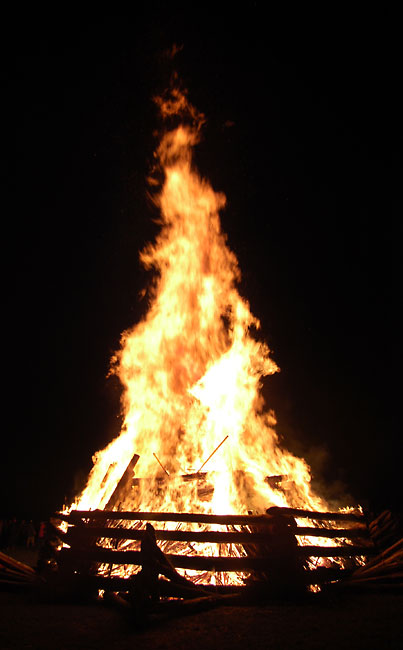
Cone of Fire, 2004, photo by Fred Hatt

I’ve just returned from a week of teaching and body painting at SummerFest, the new festival of the creative spirit at the Brushwood Folklore Center in Sherman, New York.  For many years, Brushwood has hosted Sirius Rising, Starwood (now moved to Wisteria in Ohio), and other festivals, and it’s become fertile ground for a community of artists and musicians, pagans and faeries, free spirits and freedom seekers.  I’ve been going out there since 1999, and it is one of my essential places.  I’ve previously posted some of my body art from Brushwood here, here, here and here.

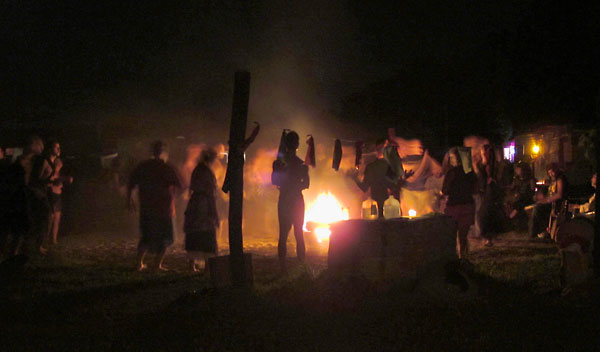
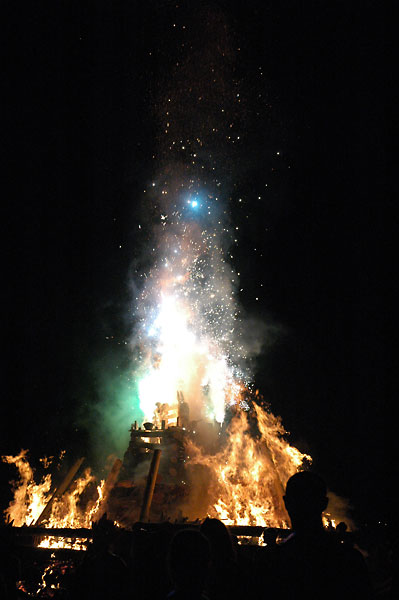
The night life at Brushwood revolves around fires.  Every night there are several small fires with drum circles, didgeridoos, trance music, rituals or dancing.  The final night of every festival features a huge bonfire like the one pictured at the top of this post.  The fire shown below was the scene of quiet drumming with complex middle eastern rhythms.

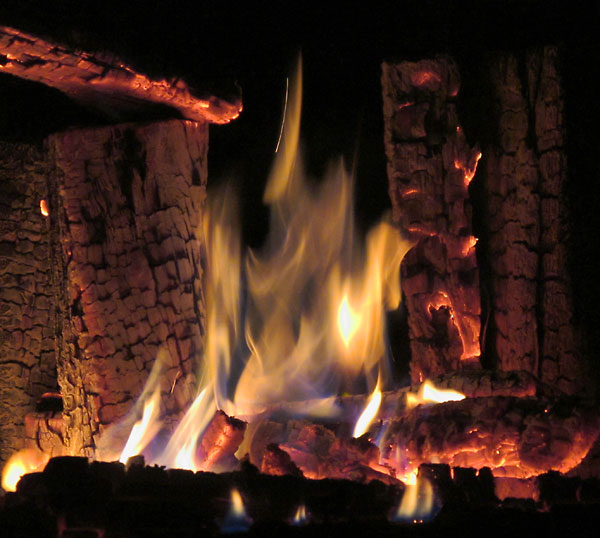
Drummers' Fire, 2010, photo by Fred Hatt

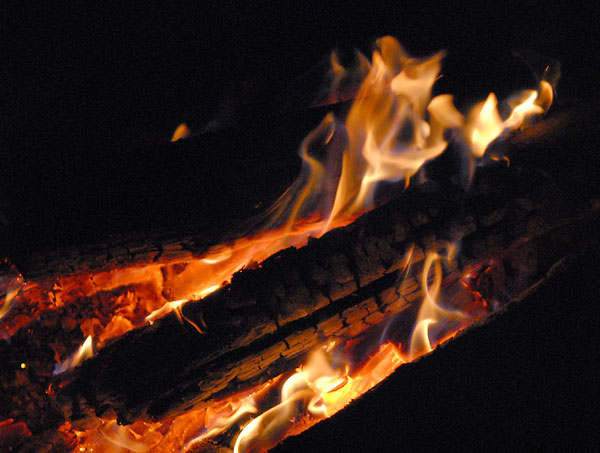
I can go into a quiet reverie watching the slinky, dashing movement of flames.  Fire is a difficult subject for photography, as its essence is in its movement.  A long exposure blurs the flame into smooth streaks of light.  A short exposure captures some of the remarkable fleeting shapes that appear in the flames, but often makes the fire seem smaller than it appears to the eye.

Curtain of Fire, 2010, photo by Fred Hatt

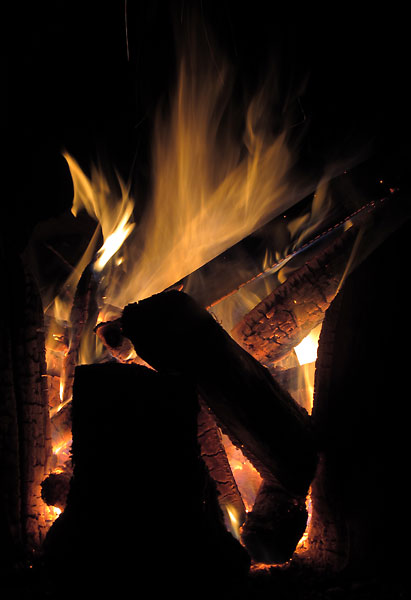
Even the small campfires at Brushwood are meticulously constructed and tended with quiet vigilance by Brushwood’s legendary guild of fire tenders.  Young men and women learn the craft and safety techniques from elders with years of experience, and graduated apprentices proudly sport the emblem of their status, red suspenders worn hanging down.

Architecture of Fire, 2010, photo by Fred Hatt

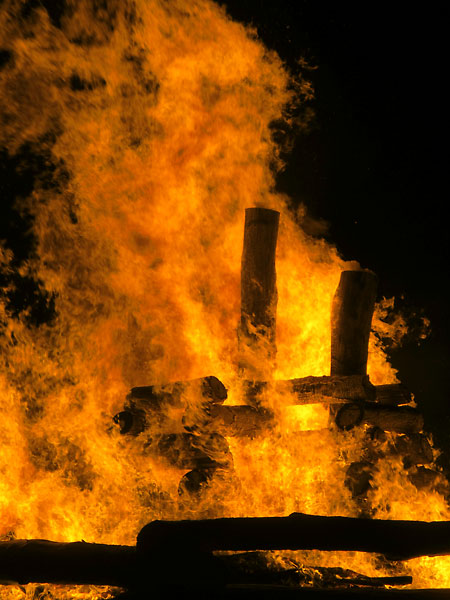
The way the wood is stacked and structured channels and focuses the energy being released from the wood.  The fluid forms of flame cling to, lick over, and leap from the wood that feeds them.

Energy Released, 2009, photo by Fred Hatt

Licking Flames, 2009, photo by Fred Hatt

Sometimes the shapes of the flames spark my imagination with pictures of dancing figures, faces, leaping horses, diving raptors and crashing waves.

Dancing Flame, 2009, photo by Fred Hatt

Feminine Flame, 2009, photo by Fred Hatt

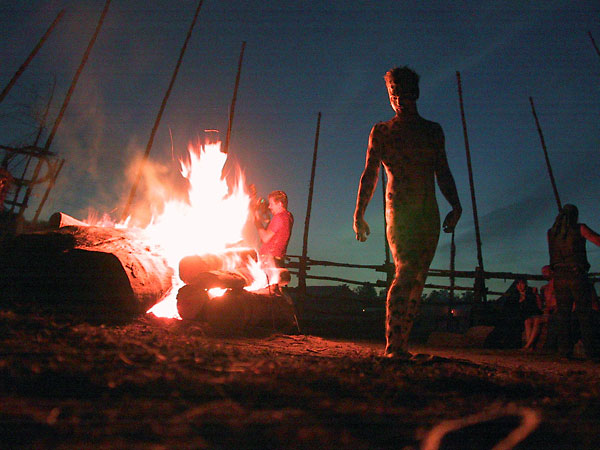
Here a man decorated in a leopard pattern by body painter Vann Godfrey draws dancing energy from the flames in the drum circle enclosure called the Roundhouse.

Leopard Man, 2001, photo by Fred Hatt

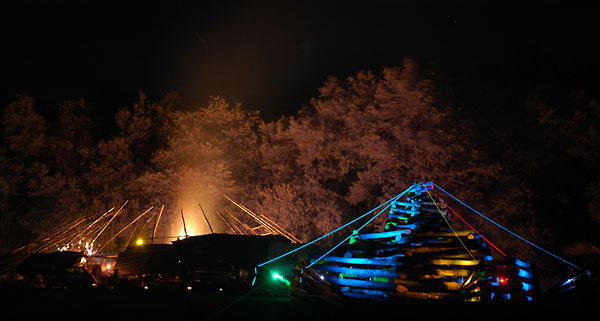
During a festival week, while nightly fires burn in the roundhouse for all-night drumming and dancing, a large bonfire stack is constructed in an open field.  Here you can see the roundhouse in the background, and the bonfire stack in the foreground.

Roundhouse and Bonfire Stack, 2004, photo by Fred Hatt

Ignition, 2004, photo by Fred Hatt

This is the bonfire from the Starwood Festival of 2004, one of the biggest fires I ever saw at Brushwood, as it is first ignited.
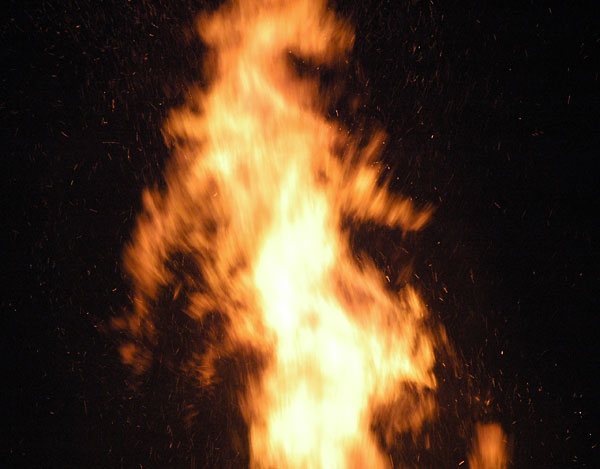
Growing Fire, 2004, photo by Fred Hatt

Sometimes the bonfires also contain fireworks.

Gold and Diamonds, 2004, photo by Fred Hatt

Pyrotechnic Tower, 2004, photo by Fred Hatt

The final night bonfires bring together the whole Brushwood community in a mass celebration.

Summerfest Bonfire, 2010, photo by Fred Hatt

Bonfire Revelers, 2004, photo by Fred Hatt

Fire Watchers, 2010, photo by Fred Hatt

Below, a friend’s fiery red hair is illuminated by the flames as she watches the bonfire.

Firetress, 2002, photo by Fred Hatt

People dance or run in a circle around the towering conflagration.

Bonfire Dance, 2004, photo by Fred Hatt

Runners, 2010, photo by Fred Hatt

Golden Frolic, 2001, photo by Fred Hatt

The really big fires show different patterns compared to the small fires.  The densely packed red-hot embers have blue flames dancing over their surface.

Blue Embers, 2004, photo by Fred Hatt

The sheer concentration of uprushing energy produces a whirlwind of flame.  If it’s raining, you won’t get rained on if you stay near the fire, as it blows the raindrops back up into the sky.

God of Fire, 2004, photo by Fred Hatt

Above the fire, glowing particles swirl and sometimes surge upward in fountains of light.

Flying Embers, 2010, photo by Fred Hatt

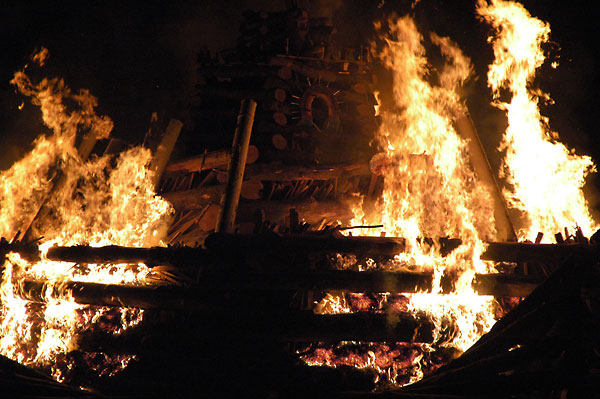
The final set of pictures in this post were taken at this year’s SummerFest bonfire.  All are fast camera exposures to capture the momentary shapes seen in the inferno, and exposed darkly enough to show the variations of brightness in the fire.

Engulfed, 2010, photo by Fred Hatt

Torrent, 2010, photo by Fred Hatt

Silhouette, 2010, photo by Fred Hatt

Curly Horn, 2010, photo by Fred Hatt

Dancers with Lights, 2010, photo by Fred Hatt

Fire Dance, 2010, photo by Fred Hatt

This incredible uprushing of fiery energy on Saturday evening was followed, on Sunday morning, by an incredible downrushing of lake-effect rain that caused flash flooding in all the low-lying areas of the camp – a perfect elemental balancing act!

2010/07/18

Movement Multiples

Space Between (Anna), c. 1998, by Fred Hatt

In the late 1990’s, an important focus of my drawing practice was capturing the energy of moving figures through expressive line.  This week’s post is a selection of drawings from 1997 through 1999.  All of these feature multiple renderings of the same pose in different positions.  It was my attempt to introduce the dimension of time into the two-dimensional world of the sketch.

Nested (Ignacio), c.1998, by Fred Hatt

In the drawing above, the transition of the figure from upright to fetal forms a natural nested composition, with different colored lines used to keep the phases of the movement separate.  The drawing below is more like a stroboscopic sequence moving across the frame, reminiscent of this kind of photograph I remembered seeing as a kid.
Stage Cross (Arthur), c. 1998, by Fred Hatt

Here’s a beautifully simple study of the movement of the spine:

Spinal Movement (Francisca), c. 1998, by Fred Hatt

In drawing from a model in motion, it is often impossible to capture the entire figure.  The composition below arises from the bony contours of ribs and arms, shoulderblades and collarbones:

Bony (Francisco), c. 1998, by Fred Hatt

A model who is an expressive dancer can convey feeling even in quick movement sketches:

Emotion (Anna), c. 1998, by Fred Hatt

Here are two figures, with two phases each:

Turns (Heather), c. 1998, by Fred Hatt

Here, the arm of the forward bending figure becomes the leg of the standing figure:

Unfolding (Caitlin), c. 1998, by Fred Hatt

Ink drawing with a brush has the spontaneity of dance:

Motion 4, c. 1998, by Fred Hatt

Here, the soft colors seem to be separating from the hard colors:

Stepping Out of Oneself (Miha), c. 1998, by Fred Hatt

There are five fragmentary figures here, two drawn softly, in white, using the edge of the crayon, and three drawn crisply, in dark blue, using the point.  The differing techniques make the white and the blue drawings appear to be on different planes:

Circularity (Corinna), c. 1998, by Fred Hatt

The cool softness above is contrasted by the hot energy below:

Lunge (Claudia), c. 1998, by Fred Hatt

At times, the overlapping lines of the figures cease being figures and become abstract patterns:

Grass (Anna), c. 1998, by Fred Hatt

In drawing from moving models, I often focused on one part of the body.  Here, it is the movement of the legs:

Legwork (Joe), c. 1998, by Fred Hatt

The simplicity of the ink drawing below makes it possible to see many forms, not just figures, suggested in the flowing brushstrokes.

Motion 3, c. 1998, by Fred Hatt

When the models movements suggest power and vigor, those qualities come through in the drawing:

Explode (Toby), c. 1998, by Fred Hatt

A softer style of movement makes a softer drawing:

Shimmy (Nyonnoweh), c. 1998, by Fred Hatt

The model for the next two drawings was a dancer whose movements all seemed to flow from a supple spine:

Spinal Flexure (Donna), c. 1998, by Fred Hatt

Leap & Turn (Donna), c. 1998, by Fred Hatt

In the one below, the model must have been holding the poses for at least a minute, as there are relatively complete figures, kept mostly separated on the page:

Angst (Joe), c. 1998, by Fred Hatt

Here two phases of the model’s changing states find expression in the drawing.  The face, like a placid moon, looks down upon the thrusting figures below it:

Serene Vigor (Julie), c. 1998, by Fred Hatt

I believe the drawing below arose from a model moving very slowly.  As the upper body gradually changed position, I kept sketching the contours.  In this case slow movement produced a sketch with a lot of energy:

Twist and Reach (Lea), c. 1998, by Fred Hatt

Many of these drawings look like they should be painted on the walls of a cave.  They have the roughness and vitality of stone age painting.

Stone (Claudia), c. 1998, by Fred Hatt

All of these drawings were done between the years, 1997 and 1999, mostly at the movement drawing sessions I used to run at Spring Studio in New York.  The color drawings are done with aquarelle crayons and sometimes ink, and are about 18″ x 24″.  Some of the ink drawings here may be as small as 10″ x 10″.  The digital images used in this post were made in the same era as the drawings, by photographing the drawings on 35mm film and scanning the prints, so they’re not quite up to the artwork photography standards I try to maintain today.

Note:  The “Claudia” that is credited as the model in two of the drawings in this post is not the same Claudia that many of my readers know as the blogger of Museworthy.

My portfolio site from this era is still online, and features a selection of movement drawings.

This week I’ll be teaching workshops and doing body painting and other fun things at the Brushwood Folklore Center in Sherman, NY.  I won’t have access to a computer, so forgive me if I don’t reply to your comments right away, or if the next post takes a little more than a week to appear here.

« Newer PostsOlder Posts »

Powered by WordPress

Theme Tweaker by Unreal