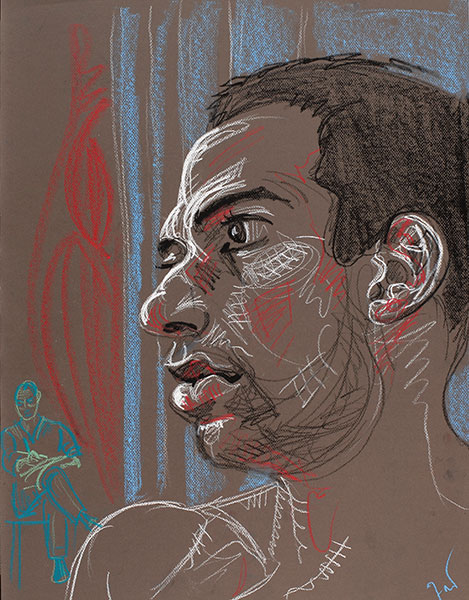
DRAWING LIFE by fred hatt

2011/08/12

Chaotic Landscape

Filed under: Drawing: Experimenting — Tags: , , , , , , , — fred @ 21:36


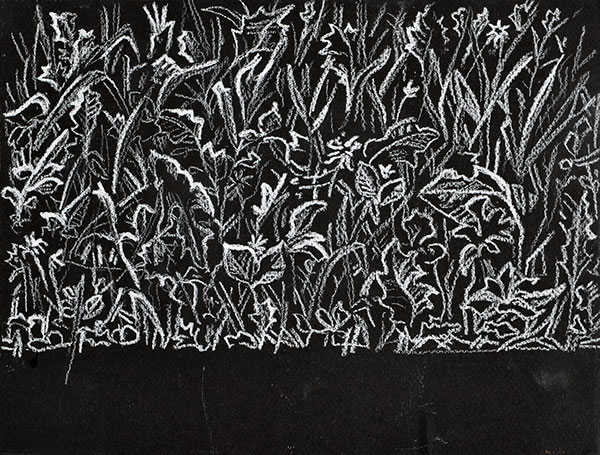
Mixed Grass, 2011, by Fred Hatt

Drawing landscapes and plants is not my strong suit.  I love wildernesses and gardens, but I feel overwhelmed trying to capture their forms in drawing or painting.  They present a bewildering chaos of detail, a vast, borderless scale, and a range of color and tone that makes my palette look paltry.  My urge to draw operates comfortably at the scale of the human body, a form and an expressive range I know intimately from inside and out.  But the body is a product of Earth, an efflorescence of organic forms that reflect evolutionary history and evoke the forms of the land and its creatures.  A hip is a hill, an ear a shell, an elbow a crooked branch.  Even if the body is my primary subject, I need to understand it as a microcosm by looking to the macrocosm.  And purely from the standpoint of practice, I can only benefit by straying outside my comfort zone, trying to draw what I am incompetent to draw.  In this post I’ll present some of my awkward stabs at landscape.  I’ll immediately make them look worse by setting them in the context of some real masters!

The sketch of my own I’ve chosen to head this post was made while looking at a field of mixed short grasses and weeds in a rural field.  I was struck by the variety of different leaf shapes all jumbled together.  What seems at first glance a tranquil and plush tapestry of green becomes on close inspection a dense jungle, and that is surely how it would appear if you could shrink to the size of an ant to make your way through it.

Below is Albrecht Dürer’s astonishingly realistic watercolor portrayal of a similar patch of sod, known as the “Great Piece of Turf”  (Go to this link to see it in a much larger size).  Botanists can clearly identify at least nine species of herbs in this drawing.  The production of this painting was an act of profound and sustained meditation on the reality of nature, made at a time when nature in art was usually idealized and symbolic, a mere setting for human and spiritual subjects.  The artist’s intensity of attention, directed at something that most would see as utterly inconsequential, has preserved a bit of nature over the centuries like a specimen in amber.  Dürer has captured the chaotic quality of wild plant life, but has somehow given it a kind of clarity that even photography couldn’t provide.  This painting sets a standard that every great naturalist illustrator can only hope to approach.

The Great Piece of Turf, 1503, by Albrecht Dürer

Even if the detail of photography rarely achieves the clarity of Dürer’s vision, by the late nineteenth century many painters had ceded this kind of hard physical detail to the new light-capturing technology and tried instead to depict the wild energy of the natural world with brushy, gestural strokes of color that give a sense of leaves fluttering in a breeze and rays of light dancing over and through shimmery water and misty air.  Claude Monet painted the same scenes over and over again, at different seasons and times of day, striving to capture the mercurial subtleties of luminosity and atmosphere.

Rainy Morning on the Seine, 1890’s (?), by Claude Monet

Charles Burchfield is a magical realist, seeing the natural world as a physical manifestation of different qualities of spiritual energy.  The forms of land and sky and plants are abstracted slightly to more closely resemble the Platonic archetypes of these forces.  The chaos is there, but it is unified within a greater spirit of pure Nature.

Dawn of Spring, 1960’s (?), by Charles E. Burchfield

I have usually avoided drawing and painting the landscape, but I’ve frequently tried to capture it with photography.  I’ve always felt especially drawn to the raw and ragged forms of uncultivated plant life.  Thick thatches of foliage are challenging subjects even for photography, as the transition from three dimensions to two reduces the bursting and branching shapes to a flat patchwork like a camouflage pattern.  Stereo photography can better portray the complexity.  If you look at the picture below (previously posted here) with red/cyan 3D glasses you’ll see what I mean.  If you look at it without glasses, it’s pure abstract field.
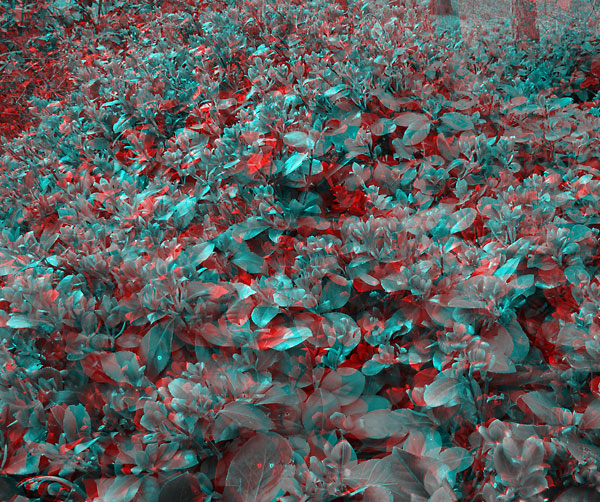
Sprouting Hedge, 2010, stereo photo by Fred Hatt

But now let’s take a look at some of my recent fumbling attempts to draw complex, chaotic plant forms.  Just today I took a sketchbook and a camera to my neighborhood park.  Here’s a snapshot of a particularly plush evergreen tree, and below it, my scribbly marker sketch, drawn from direct observation of the tree without any reference to the photo.

Evergreen, 2011, photo by Fred Hatt

Evergreen, 2011, sketch by Fred Hatt

The drawing doesn’t get much of the texture or spatial form of the tree, but it has, perhaps, something of its energy.  Another day I made a sketch of the plants growing in a window box, with these ornate curly leaves in front of a stand of long spear-like leaves.  This is a smaller subject, a closer focus, and a more careful hand with the drawing.

Leaves, 2011, by Fred Hatt

Here’s a sketch of a flowering plant with trumpet-shaped flowers (some kind of orchid?) drooping thickly around a central stalk.  (If anyone recognizes any of the species depicted in these drawings, let me know – my botanical taxonomical knowledge is practically nonexistent.)

Flowers, 2011, by Fred Hatt

Last month I spent a week teaching workshops and attending the festival at the Brushwood Folklore Center in Western New York State.  I spent some of my spare time making crayon sketches.  Here you see the fire-builders’ woodpile in the foreground, the Roundhouse (a sort of ritual structure for drum circles) and bonfire stack in the middle ground, and the trees of the forest in the background.

Roundhouse and Bonfire Stack, 2011, by Fred Hatt

The sky was clear, deep and luminous, with the great zaftig white bodies of cumulus clouds lazing across the heavens like manatees in a warm current.

Clouds, 2011, by Fred Hatt

Near my campsite was this traditional Plains Indian tepee.

Tepee, 2011, by Fred Hatt

This last Brushwood landscape was drawn a couple of years ago.  This is a clump of plants in the hollow under a big tree where the henna artists and body painters decorate people.
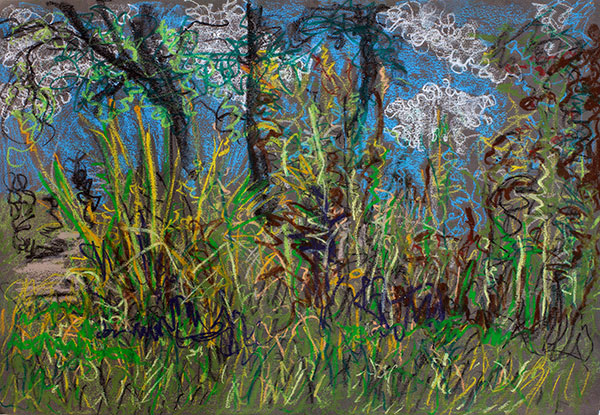
Under the Henna Tree, 2009, by Fred Hatt

I still always feel completely unequal to the task when I try to make a drawing from a landscape, but I try to open myself to the chaos and let some attenuated remnant of that vast current flow through me and into my sketch.  I may feel like a mouse trying to sing opera, but sometimes it is better to squeak than to be silent.

Drawings on black paper are 9″ x 12″, medium is aquarelle crayon.  Drawings on white paper are 11″ x 14″ or smaller, medium is brush-tip marker.  The images of pieces by other artists were found on the web; clicking on a picture links to source.

2011/08/02

Try, Try Again

Filed under: Figure Drawing: Practice — Tags: , , , , , , — fred @ 23:28

Marilyn 1, June, 2011, by Fred Hatt

Last week I posted about the master of the “naked portrait”, Lucian Freud, who often spent hundreds of hours over a period of many months on a single painting.  Naked portraits are also among my practices, but I lack the patience to spend so much time laboring over a single image.  I feel my best work arises more from spontaneity than from perseverance, and so I just churn ’em out and hope a few are worth saving.

I run a weekly session at New York’s Spring Studio featuring a nude “long pose” – long by sketch standards, not by oil painting standards.  My class lasts three hours and starts with a set of two-minute warm-up poses; subtracting that set and breaks, the amount of time allotted for drawing the pose amounts to two hours.

Most artists work on a single drawing or painting during the session.  So do I, sometimes, but I also frequently decide to start over again one or more times.  In this post I’ll share recent examples of multiple tries at the same pose from the same viewing angle.  I’m sharing some of my failures, work I wouldn’t normally exhibit, because of what they reveal about my process.

The sketch that opens this post shows how I begin analyzing the angles of a pose.  You can see how I use a combination of triangulation and rhythmic curves to find the tension and structural energy of the pose.  In my second attempt, below, I’m building on that analysis, but drawing closer.  I often use lines to indicate the contours between shadows and highlights.

Marilyn 2, June, 2011, by Fred Hatt

Finally, I decide that all the magnificent arches and cantilevers of this pose are distilled in Marilyn’s face, with its pointed eyebrows and lips, and the lovely taut bow of the collarbone.

Marilyn 3, June, 2011, by Fred Hatt

Christophe is a model with an acting background, and his specialty is facial expressions.  Here he gave us anguish, leaning to one side.

Christophe 1, June, 2011, by Fred Hatt

Here I spent most of the session developing the drawing above.  At some point near the end of the session I decided I’d best stop working on it. lest I overwork it and destroy its power, a mistake I still sometimes make.  So I spent the last half hour or so simplifying what  I’d learned from the previous hours of study of Christophe’s expression into a linear abstraction of emotion, below.  Even though this drawing is an afterthought, I think it’s stronger than the one I spent more time on.  I wouldn’t have been able to do something like this from the start – its simplicity only arises from the experience of prolonged looking.

Christophe 2, June, 2011, by Fred Hatt

Here’s one of my favorite models, Betty.  I think I began drawing using the yellow crayon sideways to indicate the highlights of the body, then used white and black lines to delineate details and the contours between highlight and shadow areas.  Proportions are wildly off here, with the head half the size of the torso.

Betty 1, July, 2011, by Fred Hatt

So I started again and developed this figure in relation to the elements around it.  The head may still be a little too big, but that’s my strongest distortive tendency.  The face has so much structural complexity and carries so much expressive power, it needs as much space in the drawing as it needs!

Betty 2, July, 2011, by Fred Hatt

Below is another example where I managed to come up with a representation of the model’s face, body and expression that was pretty satisfactory, overall, but a bit dull, perhaps.

Mitchell 1, July, 2011, by Fred Hatt

So I moved in on the face and tried to summarize its specificity in line.

Mitchell 2, July, 2011, by Fred Hatt

Here’s stage one of a look at Luke’s seated pose.  All the drawings in this post were made during the summer.  In the hot months, the aquarelle crayons I use are softer and lay down a thicker layer of wax than they do in the cooler months.  Once there’s a certain density of wax on the paper, revision is hopeless.

Luke 1, July, 2011, by Fred Hatt

A second attempt shows my understanding of the figure sharpening.  Here I’m using a lot of cross-contours.

Luke 2, July, 2011, by Fred Hatt

Finally, again, I move in closer.  Here the style I”m using is like carving with a chisel.  I’m trying to approximate colors by the method of optical mixing.

Luke 3, July, 2011, by Fred Hatt

The final series of drawings in this post is from this past Monday.  This was my first shot at drawing Leah, a model that has inspired several lovely paintings by Daniel Maidman.  I started out measuring the pose by head-lengths.

Leah 1, August, 2011, by Fred Hatt

In the second attempt, the head was oversized – my usual tendency.  The pose has subtly changed since the first set, with the left knee and arm covering less of the torso.  Most of the artists were clustered to the model’s right side during this pose, and probably didn’t even notice the change in the pose.  I took advantage of it to study the structure of the chest and abdomen.

Leah 2, August, 2011, by Fred Hatt

My third try at this pose finds me moving closer, to allow a more detailed treatment of the face.  Still not quite right, though.

Leah 3, August, 2011, by Fred Hatt

Here’s the final try, developed during the last third of the session.  I still haven’t really captured Leah’s face, but I’m happy with the color and the challenging dangling hand in front of the thigh.  It can be hard to really get the essence of a model in the first session of studying her or him – you get what you can, and then time’s up!

Leah 4, August, 2011, by Fred Hatt

All the drawings in this post are aquarelle crayon on paper, 19 1/2″ x 25 1/2″ (50 cm x 65 cm).  Similar previous posts showing multiple attempts at the same pose include Variations and Redrawing.

2011/07/19

Dramatis Personæ

Bow, 2011, by Fred Hatt

Actor and writer Susan Merson invited me to make sketches at some of the sessions of New York Theatre Intensives, a six-week play development workshop and training program associated with New York’s Ensemble Studio Theatre.  Susan likes to get visual artists to respond in their own medium to the creative process of the actors, directors and writers.  The work is shared with the participants and may be used on the organization’s website and/or public presentations.

I attended two sessions there.  The first one was an acting workshop led by Janet Zarish.  I sat at the side of the room and sketched in white crayon on a 9″ x 12″ black pad.  The class began with warm-up exercises, including spine rolls, the game of tag, and slow-motion tag.  Since I’ve done a lot of movement drawing, this part of the class was a natural for me.

Tag, 2011, by Fred Hatt

Following the movement exercises, the acting students stood listening to the instructor.  Their postures show their energetic engagement.

Listen, 2011, by Fred Hatt

Next, various pairs of acting students performed their versions of little playlets.  The acting duos had been given a page or two of bare dialog, and they had to invent a context and back story and work it up into a scene.  They’d play the scene two or three times, with coaching and notes from the acting instructor.  I tried to make simplified personality sketches, essentially caricatures, of the actors playing their parts.  Fleeting expressions and attitudes are hard to catch in a drawing from life!

Copier, 2011, by Fred Hatt

In most of these, I tried to get more than one expression or position for at least one of the characters.  Without knowing the content of the scenes, you can see these as multiple-figure compositions.  Some kind of narrative content is implied in the drawings, but they’re highly ambiguous.  I don’t think anyone could guess much about the actors’ scenes from these sketches, but maybe the sketches could be imagination stimuli.  For instance, I could see the central figures in the one below as a couple’s public composure, while the faces on the edges represent hidden attitudes.

AA Meeting, 2011, by Fred Hatt

This exercise only increased my admiration for the great theatrical illustrator Al Hirschfeld, who spent eight decades at Broadway openings, sketching in a theater seat, and stylizing his impressions of the actors as elegant ink drawings that appeared alongside reviews in the New York Times.  Drawing actors in action is not easy, and I feel my attempts were pretty rough.

Afterlife, 2011, by Fred Hatt

The three sketches above are based on three acting duos’ interpretations of the same playlet, an encounter between two characters with diverging views of their relationship.  I’ve titled the sketches after context choices made by the actors.

The next three sketches are three different interpretations of a second playlet.  This one centers around one character trying to collect a long-overdue debt from the other character.  It was fascinating to observe how different choices and different actors’ personæ completely changed the feeling of the scene.

Hot Dog Park, 2011, by Fred Hatt

Naked Under Hoodie, 2011, by Fred Hatt

The actress below conveyed a particularly vivid sense of awkward nervousness toward her impassive debtor.

Wordvomit, 2011, by Fred Hatt

The acting class instructor, Janet Zarish, threw a lot of ideas at the actors, offering suggestions and modifications aimed at sharpening the characters and punching up the drama.  I was struck by her many crisp, incisive gestures.  I think they reflect her focus on performative clarity.

Instructor, 2011, by Fred Hatt

I sat in on another New York Theatre Intensives session, and will get to those sketches later in this post, but first, a sketch theater entr’acte.  American Independence Day, the fourth of July, fell between the two NYTI classes I attended.  Spring Studio, where I supervise one of the regular figure drawing sessions, hosted a July 4 special with models costumed as historical American characters, including a Revolutionary War era soldier, Buffalo Bill, Harriet Tubman, Pocahontas and Betsy Ross.  These sketches are in marker or pencil on white paper, 18″ x 24″, and all are based on poses held between two minutes and ten minutes.

American History Figures, 2011, by Fred Hatt

Noble Faces, 2011, by Fred Hatt

The models for this session were all what I would describe as character models.  Like character actors, they have distinctive faces, body types and ways of moving and looking that would stimulate the narrative imagination even without the costumes and props.  It’s impossible to draw these models in a generic way, because all of them are so distinctive.

Caretaker, 2011, by Fred Hatt

Small and Tall, 2011, by Fred Hatt

Barricade, 2011, by Fred Hatt

Later that week I went to a “rep class” session, led by Rod Menzies, at New York Theatre Intensives.  The actors did readings of new scenes by playwrights Crystal Skillman and Jason Holtham, with the playwrights present.  I believe part of the function of the session was for the writers to see how their work in progress was understood by the actors, and how it worked in front of an audience.  These drawings are 18″ x 24″ on white paper, in crayon and/or ink and brush.  Here’s the scene in the studio, with the instructor and playwright sitting at the left.

Studio Reading, 2011, by Fred Hatt

Crystal Skillman’s scene was for two actors, and a little longer than the playlets from the acting class, which gave me a better opportunity to study the actors.  The experience was a bit like what I imagine a courtroom artist does.

A Look, 2011, by Fred Hatt

Here’s my impression of the discussion, with the class instructor and the playwright at the left, and some of the students in discussion at the right.  They really did overlap like that, from my viewing position.  I chose to make them transparent.

Watching and Discussing, 2011, by Fred Hatt

Although the actors sitting to read stayed more still than they did in the acting class, where they had memorized their lines, it’s still hard to draw a reading, because the actors have their heads and eyes down at their scripts much of the time, and their facial expressions and energetic engagements with one another tend to be fleeting.  This remained so even after instructor Rod Menzies urged the actors to engage with each other even at the cost of missing lines in the scripts.

Cold Reading, 2011, by Fred Hatt

Model U. N., 2011, by Fred Hatt

Jason Holtham’s scene was about high school students at a Model United Nations simulation conference.  All the characters were named after the nations they were representing in the conference, which allowed the scene to be read on two levels.

Playwright, 2011, by Fred Hatt

I switched to ink and brush for a few sketches.  The brushed ink line is more expressive than the crayon line, but also much more difficult to control.

Characters, 2011, by Fred Hatt

The directions of eyes and eyebrows, and the set of the mouth, are the most immediately readable indicators of emotion and relational role, at least among those that can be captured in a quick sketch that lacks the sound of the voice, the movement of the body, and the narrative developments of the script.

Reactions, 2011, by Fred Hatt

For me, the experience of sketching at these theater classes drew on my long-term practice of drawing from movement.  I’m used to sketching from dance, with the attention given to large physical movement.  The actors didn’t move so much – most of the interesting changes going on were subtle facial cues.  In drawing faces, I’m accustomed to doing portraits, where I can take my time to study the structure and character of a face.  Trying to apply the quick-response, gestural interpretation of movement to facial expressions was a challenge I definitely haven’t yet mastered, but I love to keep finding fresh challenges!

I’d be interested to hear from actors or other participants in the classes about what you see in my sketches, and whether they reveal anything to you that you might not get by looking at a still photo or video of the classes.  Please feel free to comment here, and I’ll respond.  (Comments from first-time commenters are held for moderation, so may take a day or so to appear on the blog.)


2011/06/03

Choices

Filed under: Figure Drawing: Practice — Tags: , , , , , — fred @ 11:08

Opposite Sides, 2011, by Fred Hatt

Life drawing as a practice involves a tension between habit and novelty.  Everyone I know who attends open figure drawing sessions has their favorite places to set up, their usual distance and scale, their familiar materials and techniques.  Anything unfamiliar, even a model you aren’t used to, is likely to make the quality of your work suffer.  Naturally, most artists are happy when they’re drawing or painting fluently, and unhappy when they’re struggling and stumbling, and they find that cleaving to habitual ways helps a lot.  This is as true for me as it is for any artist.

On the other hand, constantly working a well-worn rut will never get you anywhere new.  It’s exercise, but not the kind of exercise that builds strength or expands capacity.  It’s boring, and often the artwork that comes out of it is well-controlled but boring.  I believe most artists are far too sensitive to doing bad or awkward work, and far too insensitive to the hazards of the rut.

Boredom is a regular aspect of life drawing sessions.  Even when you love drawing and love looking at naked bodies, and often feel excitement and flow in your work, there are times when you’re looking at the same model in the same pose you’ve seen a hundred times, when your angle of view obscures the most dynamic part of the pose, or when your energy level flags.

My strategy is to introduce controlled variations, to break one part of the set of habits at a time.  I might try changing my scale of drawing, moving away from my habitual spot, or focusing on a particular aspect of the pose or scene that’s different from my usual approach.  When the model takes the pose, I’ll often make a choice at that moment:  Which element of my work should depart from the norm?

The drawing at the top of the post is from the Monday morning long pose class I supervise at Spring Studio.  After a set of quick poses for warm-up, the model takes a single pose for the rest of the session.  Subtracting the breaks, we have about two hours of drawing time for the long pose.  I’m quick, so my greatest hazard is to overwork drawings, a mistake I still find myself making sometimes.

Kuan, the model for the above drawing, has a beautifully toned and well-defined body.  She took a sideways seated pose, looking towards the center of the room.  I took the opportunity to go to the left side of the room and study her back.  But I thought I’d be likely to overwork just the back, so I used half the sheet of paper, saving the other half for a study of the same pose from the opposite side of the room.  Besides going beyond the one-sided view to which two-dimensional artists usually confine themselves, this turned out to be a fascinating study in proportional and structural relationships.

Absence, 2011, by Fred Hatt

The 20-minute drawing above was done at Figureworks, where the models pose in an archway between two rooms.  I was at an angle where this reclining pose was highly foreshortened and partially blocked by the edge of the arch on the left.  I could have moved to a different spot, to see an unobstructed view, or a more straight-on angle.  Instead, I chose to let the left edge of the paper be the edge of the arch, centering the composition on the empty part of the blanket on which the model was lying.

Floor Cloth, 2010, by Fred Hatt

In this reclining pose, I also focused on the floor and the blanket, leaving the body as a silhouette with some cross-contour shading.  Here the shape formed by the body is defined by its negative space.  The folds of the fabric even help give a sense of the weight and solidity of the body.

Framing, 2010, by Fred Hatt

Here’s another pose defined largely by coloring in the negative spaces.  The colors used for walls, floor and fabric have nothing to do with the actual hues of the scene.  They’re chosen to enhance the form of the pose.  I particularly like the diamond-shaped space between the arms, chest and thigh, that takes on the appearance of a tetrahedron with yellow and green faces.

Contour, 2010, by Fred Hatt

Here’s another archway pose, with the model turned away from me and the edge on the right blocked.  I started drawing in red, just the front contour of the body from shoulder to knee, but then I decided I wanted to include the foot and the hair, so I flipped the paper upside down and drew again, at a smaller scale, on the opposite side of the page.  I left the upside-down red contour, making an interesting river of negative space between the two views of the pose.

Right Triangles, 2011, by Fred Hatt

Side views of the body are particularly challenging, especially when none of the landmark features are visible.  Here my attention was captured by the squareness of the seated pose and the angularity of the model’s face.  The colored areas in the background are pure invention, to emphasize this contrast between right angles and diagonals.

Cluster of Fingers, 2011, by Fred Hatt

Here is yet another seated pose, viewed from the side.  I could find no dynamism in the pose or composition, and couldn’t see the model’s face, but the hands were clasped together in a way that was highly complex, and I was close enough to see them pretty well, so I took the opportunity to practice hands, widely considered the most difficult part of the body to capture in drawing.

Nazarene, 2011, by Fred Hatt

Like complicated hand positions, the face at an unusual angle is very challenging to draw, so I try to practice it when the opportunity arises.  These attempts often turn out with distortions, and this drawing does have certain distortions, but I think it succeeds in capturing a sense of aliveness, not only through the facial expression, but also through the angles and composition.

Sketcher and Poser, 2011, by Fred Hatt

This portrait from a Figureworks life drawing session needed one more element, so I included a sketch of Randall, Firgureworks’ proprietor, with his sketchbook on the other side of the room.  I made him much smaller in relation to the main figure than he actually appeared from my angle of view, which makes the main figure appear to be seen from very close.  This is the same effect you get with a photo taken from close to the subject with a wide-angle lens, with the perspective differences between foreground and background exaggerated.

Facing Light, 2011, by Fred Hatt

Here’s a back view with the shape of the figure highlighted by the window she’s facing and the light from the window reflecting off the polished hardwood floor.  Sometimes a very simple treatment of the background greatly enhances the sense of real presence of a figure by creating a space for it to occupy.

In a Room, 2011, by Fred Hatt

Here’s a more complex variation on the same idea.  The space is simplified into areas of differing value and color, just enough to make the figure a solid reality in a world of air and light.

Many of these poses could have been boring drawings had I not made choices to do something different from my habitual approach.  These experiments aren’t always successful – in fact they increase my chances of making terrible, embarrassing drawings.  But without the unusual choices, the results might have been competent but rather dull.

All the drawings in this post are aquarelle crayon on paper, approximately 18″ x 24″.

2011/05/15

Dimensions

Three Worlds, 1955, lithograph by M. C. Escher

Recently, a cluster of unrelated events have turned my thoughts to the visual perception of space.  To be honest, it’s always been a preoccupation.  For several months I’ve been using the Escher print pictured above as my computer desktop image.  It’s an elegant depiction of the world of the surface, a higher world that is seen mirrored in the surface, and a third world that is glimpsed in the depths.  This can be taken as a simple image of the beauty of transparency and reflection, or it can be related to the cosmology that is common to shamanic cultures worldwide, where the world of our everyday experience exists between and influenced by both an upper realm of celestial patterns and an underworld of earthly spirits.  Our prehistoric and ancient ancestors have left us evidence of their engagement with the upper world through their sophisticated models of the movements of heavenly bodies, and of their journeying in the lower world through caves populated with powerfully rendered animal spirits.

I’ve always been fascinated by paleolithic art, and have posted about it previously, so of course when I heard that Werner Herzog had made a documentary film about the Chauvet Cave, the oldest painted cave yet discovered, I knew this was a film I had to see.  Here’s a publicity still of the director posing with an archaeologist who appears in the film dressed in an ice age fur suit and plays a reconstruction of a 35,000 year-old vulture-bone flute (sound file at the link).

Film director Werner Herzog, cinematographer Peter Zeitlinger, and archaeologist Wulf Hein on location for the 2011 documentary Cave of Forgotten Dreams

You’ll notice that Herzog’s cinematographer, in the background, is holding a camera that has two side-by-side lenses.  That’s a 3D or stereoscopic camera.  We perceive depth partly through the way our brains process the input from two eyes offset from each other by a few inches, and 3D photography, which has been around nearly since the invention of photography, simulates depth perception by showing each of our eyes a slightly different view of the scene.

(I’ve also had a long interest in stereoscopic photography, and have posted some of my own 3D images in the posts “Shapes of Things” and “Depth Perception“, and even a 3D video in “3D or not 3D“.)

I’m not particularly fond of the current 3D digital projection processes –  there are several variants, all of which I find rob the cinematic image of much of its brightness and color, and are generally distracting and tiring to the eyes.  (Not to mention that a lot of films these days are shot normally, and then turned into fake, simulated 3D, which can look really terrible.)  But in Herzog’s film, Cave of Forgotten Dreams, the technique is effective in giving us the feeling of what it’s like to be inside the cave, and of how the artwork is integrated into the organic bulges and hollows of the limestone walls.  It’s the closest most of us will get to being able to be inside a real paleolithic painted cave.

One effect of seeing a 3D film is that it can make you more conscious of depth perception in everyday life.  But here’s something different and odd.  I went with a friend to take a look at this new sculpture, Echo, by Spanish artist Jaume Plensa, that’s been installed through August 14, 2011, in Madison Square Park in Manhattan.  It’s a 44-foot (13.4 meter) tall head of a child, with eyes closed and a tranquil expression.  My friend said she couldn’t escape the illusion, when seeing the statue from a distance, that it was flat, like a cutout, and I had the same experience.  Seen from up close, it’s clearly three-dimensional, but from a distance it has an eerie, unreal quality.  It is surely an uncanny object.

Echo, 2011 sculpture by Jaume Plensa, Madison Square Park, New York City, 2011 photo by Fred Hatt

It appears that the scale of the vertical dimension is approximately double the scale of the horizontal dimensions.  Plensa uses 3D computer modeling to create his works, and here he has started from a realistic form, elongating it and softening the edges of the features.  The surface of the sculpture is cast in polyester resin and coated with white marble dust.  The reflective, almost translucent-looking whiteness, the simplicity of the forms and the serene blankness of the expression, the monumental size, and the lack of a pedestal all help to make Echo look like an eerie vision.  I believe the illusion of flatness is caused by the elongated scale.  We’re used to seeing huge flat pictures on billboards, and often from angles that distort the images in ways similar to the distortion of Echo.  When we see a huge face distorted, our minds assume that we are seeing a flat image from an oblique angle.  We are so habituated to seeing things that way that it is difficult to overcome the illusion even when we know what we are looking at.

Another eerie white object that appears flat even though we know it is round is the moon.  I came across this photo recently on the fantastic Nasa Astronomy Picture of the Day site, a bottomless fountain of beauty on the web.  If you look at this picture with cheap red-cyan 3D glasses (available free here), the moon looms out at you like the sphere it is.  Of course the moon is far too distant for the normal parallax separation of our eyes to reveal its shape through stereoscopic vision.  The picture here is constructed from shots of the moon taken two months apart.  The natural wobble, or “libration” of the moon provides two angles of view, producing a 3D image that could never be seen in reality.

3D Full Moon, 2007, red/cyan anaglyph by Laurent Laveder

Yet another recent stimulus to my thinking about the visual perception of space and depth was Daniel Maidman’s recent post about approaches to pictorial space in painting.  I urge you to click the link and go through the well-chosen example images – click on the small pictures to embiggen them.  You’ll learn a lot about the subject by reading through Daniel’s entertaining overview, and if you’re a visual artist of any kind yourself, you’ll probably also find it highly stimulative of creative ideas.  Daniel’s blog is really worth following.  He’s as good a writer as he is a painter, easy to read, funny, and thought-provoking.

Model with Unfinished Self-Portrait, date unknown, by David Hockney (featured in Daniel Maidman’s blog post “Egyptian Space”

A lot of what I learned about pictorial space I learned by studying photography.  In photography one of the biggest factors affecting the way space is presented is the choice of lens – a shorter focal length, or wide-angle lens, gives a very different effect than a longer focal length, or telephoto, lens.  Here’s a street sign photographed with a wide-angle lens.  A wide angle lens literally takes in a very broad cone of vision.  For an object to appear large in the frame, it needs to be seen from very close, while the wide field of view includes a generous swath of background.  Perspectival angling of lines is emphasized, and the apparent distance between background and foreground is exaggerated.

Sign Back, 2006, photo by Fred Hatt

A slightly longer focal length lens allows us to fill the frame with a similar-sized object from a greater distance.  Here the cone of vision is narrower, and thus the amount of background we see is limited and the perspective appears compressed, with the background seemingly right behind the subject.  Many professional photographers tend to favor long lenses, because they isolate the subject from all the distracting stuff around it.  Long lenses also make it easier to throw the background out of focus, which enhances the isolating effect.

Angled Planes, 2010, photo by Fred Hatt

A wide lens lets you see a whole tall building from right across the street, or to get a feeling of space within a tight interior.  Any angle that’s not straight-on will show perspectival diminution.  Translating the view below to a drawing would require three-point perspective, with vanishing points to the left, right and above the frame.

Church and Tower, 2009, photo by Fred Hatt

A long lens keeps straight lines straight, but tends to flatten the space of objects seen from a distance, as in this view looking towards the Manhattan Municipal Building from Canal Street.

Downtown Cluster, 2005, photo by Fred Hatt

Finally we get to some figure drawing.  Aside from perspective effects, which you can sometimes observe in seeing the body from a foreshortened angle, there are several ways to convey three-dimensionality in a drawing.  I generally try to make my shading and coloring lines follow the surface contours of the subject.  These lines are called cross-contours, and they’re a very effective way to create the illusion of solidity.

Rounded Back, 2011, by Fred Hatt

Lighting effects also help to show the spatial form of a subject.  Just as the differing angles of the two eyes create the stereoscopic effect, different colors or qualities of light coming from more than one angle can give solidity to a two-dimensional depiction.

Night Back, 2011, by Fred Hatt

In the drawing below, perspective, cross-contours, lighting, and negative space are all combined to give a sense of the model as a solid presence occupying space.

Smoke, 2010, by Fred Hatt

This is probably one of the most wide-ranging posts I’ve ever done, but I hope it hangs together around the concept of spatial perception.

All the images that are not my own link back to their sources on the web if you click on the pictures.

« Newer PostsOlder Posts »

Powered by WordPress

Theme Tweaker by Unreal