DRAWING LIFE by fred hatt

2012/03/30

Collector of Souls: Alice Neel


Nancy and Olivia, 1967, by Alice Neel

Alice Neel (1900-1984) is always described as an artist that was slow to find recognition.  It’s true, but I think it’s also true that her brilliance was of a kind that is only achieved through maturity and persistence.  Our culture likes to think that a genius is a genius, that they must be incandescent in their emergence.  If you pass 30 or 40 and you’re not a star, you should give up, pack it in, and do something useful for a change.  And maybe that makes sense if you think art is all about fresh concepts and the iconoclasm of a new generation defying the elders.  But what if you’re trying to do something very deep and subtle, and nearly impossible to master?

Alice Neel, 1944, photo by Sam Brody

I’m not saying Neel’s early work wasn’t strong, and I’m not saying her sex and her devotion to figuration in an era where the big money was on abstraction didn’t delay her acclaim.  Her early work shows the  influence of the Ashcan School of socially conscious realism, as well as of surrealism and psychological expressionism of the kind that Munch and Ensor developed.  Her paintings of the 1920’s and 1930’s are dark with lots of black paint, and heavy with romantic angst, symbolism, and working class politics.

Degenerate Madonna, 1930, by Alice Neel

Kenneth Fearing (poet, founder of Partisan Review), 1935, by Alice Neel

Those were the radical art fashions of the era.  Neel does them well, but you can see hints that the real essence of her talent lies in her intense focus on the individual human subject.  At the time, she was young, and dedicated to the romantic ideal of the rebellious and bohemian artist, which she lived fully, complete with abusive marriages, nervous breakdowns and suicide attempts.

Ballet Dancer, 1950, by Alice Neel

The Last Sickness (Alice's mother), 1953, by Alice Neel

She persuaded a diverse collection of people to sit for her – her neighbors, her bohemian artist and writer friends, children and old people, naked nudes and dressed-up dandies, the uptight and the laid-back, the pretentious and the naïve.  She found nothing more fascinating than to try to capture in paint something of what it was like to be with these people.  She said, “Like Chekhov, I am a collector of souls.”

Two Girls, Spanish Harlem, 1959, by Alice Neel

Robert Smithson (earthworks artist), 1962, by Alice Neel

Sherry Speeth (mathematician), 1964, by Alice Neel

Alice Neel painted directly from life, and directly on the canvas, without designs or preliminary studies.  She said, “I do not pose my sitters. I do not deliberate and then concoct… Before painting, when I talk to the person, they unconsciously assume their most characteristic pose, which in a way involves all their character and social standing – what the world has done to them and their retaliation.”  Doing a painting of someone was for her an interaction with that person.

Fuller Brush Man, 1965, by Alice Neel

Hartley (Alice's son), 1965, by Alice Neel
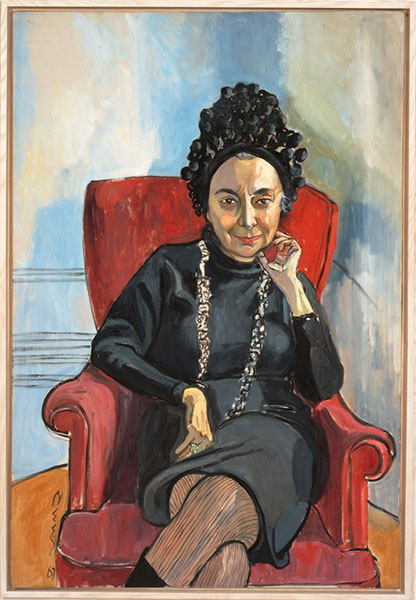
Charlotte Willard (art critic & author), 1967, by Alice Neel

The old saying is “Every painter paints himself”, and for most portrait painters this is a limitation.  It means they project something on the subject, some fantasy or ideal.  For Neel, it means she paints how she and her subject encounter each other, in the moment as they look at each other.  The directness of the look, and the directness of the act of painting, capture the uncanny aliveness that Neel’s pictures embody.

In the silent home movie above you can see some of how Neel starts painting, and how she develops the canvas.  Alice’s son Hartley shot this film as she was painting her daughter-in-law Ginny.  She starts out with a black line drawing in thinned paint, sure and direct.  There is no measuring, no roughing in.  It’s distorted and out of proportion, and that doesn’t matter at all.  As she continues to paint, areas of color are filled in here and there, seemingly haphazardly, but with a sense of painterly dynamics.

Andy Warhol (artist), 1970, by Alice Neel

Jackie Curtis (performer, Warhol superstar) and Ritta Redd, 1970, by Alice Neel

The Family (John Gruen, Jane Wilson and Julia), 1970, by Alice Neel. Gruen was a music, dance and art critic, Wilson a painter, and Julia is now director of the Keith Haring foundation.

The eyes are usually enlarged, making intense connection to the painter, and through her, to the viewer.  The hands are often oddly small yet expressive, with snaky fingers grasping the world, holding on tight or draping lazily.  Background elements are sometimes highly textural and at other times they are left as bare indications.  In the later work the use of unfinished areas is masterful.

Carmen and Judy, 1972, by Alice Neel

John Perreault (artist, poet & critic), 1972, by Alice Neel

The Soyer Brothers (Moses and Raphael, artists), 1973, by Alice Neel


Her pictures of people are distorted in proportion, but they are not distorted by idealism or sentimentality, nor by judgment or an agenda.  They are open, clear-eyed, compassionate, and realistic.  The probing engagement is the same whether the subject is a child or a power broker.  Some of her pictures could almost be caricatures, except that they are made with an openness to her subject that is foreign to caricature.

Isabel Bishop (artist), 1974, by Alice Neel

Margaret Evans Pregnant, 1978, by Alice Neel

Geoffrey Hendricks (Fluxus artist) and Brian, 1978, by Alice Neel

The riveting quality of Neel’s paintings convinces me that there is no greater subject for a painter than the individual human being, and that symbolism and theory and “statements” are nothing  but obstacles to true seeing.  Why do so few serious artists in our day attempt it?  The portrait is considered a fusty genre, suitable for sentimentalists and satirists.  It doesn’t challenge the status quo as the contemporary artist is expected to do.  It has no intellectual component.  But perhaps all that is just to rationalize avoiding a challenge that is extremely difficult to pull off, a challenge that engages not just the mind but the whole being of the artist.

Self Portrait, 1980, by Alice Neel

Alice Neel never stopped believing in herself, even as the institutional art world ignored her.  She had to wait for her moment of fame, which finally came with the rise of the feminist movement.  They came looking for the great neglected female artists, and for an approach to art that countered the macho culture of abstract expressionism and pop art.  Neel’s deeply embodied, personally engaged work, with its pregnant women and babies, its frank and unheroic male nudes, fit the bill.  She bristled a bit at being assigned the role of feminist art icon, but she reveled in her late-life fame.

Alice Neel, 1970's, photographer unknown

The illustrations here really don’t do justice to the original paintings.  They lose the subtleties of the color and the sense of scale, which in the later work tends to be half life size or bigger.  Last week I was thrilled to be able to look at some original Alice Neel oils in an exhibit at the Michael Rosenfeld Gallery on 57th Street in Manhattan.  It’s a three person show with pioneering African American artists Benny Andrews and Bob Thompson, whose work is also very much worth looking at, and it’s up for just another week, through April 7, 2012.  The asking price for all the Neels is about half a million dollars each.  I think even when she was 50 years old and living in poverty, Alice Neel knew her work was that valuable.

Check out this brief clip on Neel from ART/New York.  One of the art critics that’s interviewed is John Perreault, whose nude portrait by Neel is included in this post.

If you’re interested in learning more about Alice Neel, I recommend the excellent documentary on her made by her Grandson, Andrew Neel.

All the images here were found on the web, and clicking on the images links back to the site where I found them.

2012/03/20

Givens and Options

Shoulderblade Contact, 2012, by Fred Hatt

In an open life drawing session, the givens are simple:  There is a live nude model, who will take a pose and hold still for a designated period of time.  Using the materials of visual art, we must draw what we can from the model during the interval allowed.  Over a series of sessions, we can expect to see a great variety of models, and if we want to, we can try out many different materials and techniques, but for a given class, we take the model we get and use the materials we’ve brought.  If it’s a big class, we will probably have little or no say about the poses, and may not be able to move from the viewing position we have taken up in advance.  But in the moment the model takes the pose and the timer begins counting down, we still have many options, and must make choices instinctively or deliberately.

How shall we scale the figure?  Do we want to include the whole figure, or just part?  Do we focus our energies on trying to capture a likeness, or a feeling of structure, or what?  Do we isolate the figure, or include background elements?  What details should we include, and what can we omit?  Do we start with light and shadows, or with contours?  Shall we try to keep our hand as loose as possible, or as precise as possible?  These choices face us, in a way limited by our skill, even in a one- or two-minute pose.  If the pose is twenty minutes, or three hours, the options proliferate!  In an instructed class, the teacher may make many of these choices for us, but in an open practice session they are up to us, and the richness of the practice is greatly enhanced by not always making the same choices.

That’s a general observation, the sort of thing I’m always harping on, and would perhaps be best illustrated by work from over the years, specifically selected to highlight the various choices involved.  But what I have to share with you now is a few of my recent watercolor paintings and crayon drawings of the figure.  I’ve arranged them to bring out similarities and differences, and the theme of choices will perhaps provide a lens with which to view them.

Slim, 2012, by Fred Hatt

The first three illustrations are all 10- or 20-minute watercolor sketches of figures with crossed arms.  All of these have a loose, casual feel, but the scribbly strokes are anchored by contour lines that are carefully drawn.  The first two are standing poses, with the faces roughly indicated, and framed to include most of the body but not the feet.  The one below is a seated pose, framed closer, with more attention to the facial expression and the hands.

Arms Folded, 2012, by Fred Hatt

Lines of color on the face give a sense of color and shading, but also convey some quality of emotion or energy.  Below I’ve used a similar approach in a longer drawing – I think this one was about an hour.  I had started out sketching a full figure, but as I went on with it I found that what really interested me about this model was her face, and I couldn’t get the details of the face in a full-figure painting.

Thinking Back, 2012, by Fred Hatt

Including the chest as well as the face allows me to get plenty of expressive detail but also show something of how the head is carried upon the body.  In the watercolor sketches above and below, I’m using two of my favorite pigments, cadmium red and ultramarine blue.  The red shows where the blood flows near the surface, and the blue shows where the light is absorbed.

Relief, 2012, by Fred Hatt

In the long-pose watercolor portrait below, I tried optical color mixing to give a sense of flesh tones.  By cross-hatching using fan brushes with cadmium red and green oxide, with some lamp black and phthalocyanine turquoise, I’m trying to get the glow of life.  Adding bluer tones to the background also emphasizes the warmth of the figure.

Chuck, 2012, by Fred Hatt

The portrait below is drawn with white and reddish-brown aquarelle crayon on warm gray paper, with the darks filled in with black watercolor.  A wet brush was used to blend some of the white aquarelle crayon.

A.Z., 2012, by Fred Hatt

The model below, Julie,  has an inner happiness and confidence that I can’t help but express in my drawings of her.  Plump females may get no respect in the media culture, but they’re very popular as figure drawing models, because their rounded forms are beautiful on paper, and they’re a lot easier to draw than wiry, angular models.  Something about this pose just makes me want to dance, and I had to get the whole figure on the paper, from head to feet, in this 20-minute watercolor sketch.

Coquette, 2012, by Fred Hatt

The body leans to one side, and that violation of balance makes a still pose seem active.  In the long pose watercolor below, I chose to develop rectangular elements in the background to contrast the inclined body.

Piet, 2012, by Fred Hatt

Every Monday morning at Spring Studio I am the monitor for the 3-hour long pose session.  We do a set of 2-minute warm-up poses and then, subtracting the breaks, we have about two hours to study a single pose.  Once in a while, we have two models at once.  Two models isn’t just twice the work, it multiplies the geometrical relationships of elements and reveals every feature of the face and body by contrast to a very different face and body.  The intensity of observation required usually sends me into a more realist mode than I might otherwise pursue.

Two Women, 2012, by Fred Hatt

The realist mode of painting is obsessive, and when I really get into it, every detail of texture or color becomes achingly beautiful – even the way cellulite refracts light.

Center of Power, 2012, by Fred Hatt

Sometimes in a session you get an angle on a pose that, on first glance, doesn’t seem to offer much.  A back view, flat lighting, not much visible anatomical detail – not much to work with, right?  No, this is an opportunity to notice subtleties, and to find how simple details – the arrangement of the fingers, the way a scarf is tied around the head – can make the boring pose dynamic.

Back with Headscarf, 2012, by Fred Hatt

Here’s another example of a pose that at first seemed a bad viewpoint.  But look at how the angular joints stack up!  Look at how the light pulls everything up and to the right, while the shadows and the black hair give the figure gravity.

Listening, 2012, by Fred Hatt

Contrast the skinny body above with the corpulent body below.  The range of variation of the human form is a wondrous thing to contemplate.

An artist working with a model in his or her own studio would be unlikely to choose either of these sideways/backwards views of a pose, but in a class or an open session you get what you get, and what do you know, this is a great angle to reveal the energy of the body!

Column, 2012, by Fred Hatt

When I work with a model in my own studio, I can do experiments with angles and lighting that wouldn’t work in a class or open session.  The next two figures were drawn (in aquarelle crayon) by looking through a mirror set on the floor with the model standing above.  This gives a foreshortened view with a standing pose.  In this way, I’m looking up by looking down, while drawing on the floor.  The figure in the mirror is seen upside-down, and these drawings were made that way, with the head at the bottom of the page.  One of the pleasures of the foreshortened view of the figure is unusual juxtapositions of body parts.  Notice below how one elbow aligns with the head, and another with the cleft between buttock and thigh.  That’s something you will never see with the normal straight-on view of a standing pose.

Atlas 2, 2012, by Fred Hatt

My inspiration for these figures was ceiling frescoes, which often show cherubs and mythological characters as though one is looking up at bodies floating in the sky.  The figure towering above has a godlike quality.  This is how adults are seen by babies!

Atlas 1, 2012, by Fred Hatt

This pose was done lying face down on the floor, but it naturally conveys the feel of flying.  I was sorry to lose that left hand, but just couldn’t shrink the figure down enough to fit the entire thing on the page!

Soar, 2012, by Fred Hatt

Here’s a reclining foreshortened view from the head end of the body, with the light coming from behind.  This is a sketch painted with white gouache on black paper.  I love unusual, foreshortened views of the body.  In drawing them, I find it very helpful to think of the eyes as organs of touch from a distance.  The fingertips that are touching this body are rays of light, and it is that touch that the eyes receive and translate into drawing.

Morning Light, 2012, by Fred Hatt

All the pieces in this post are around 18″ x 24″, in watercolor, sometimes with white gouache, and/or in aquarelle crayon on paper.

EVENT THIS WEEKEND:

On Saturday, at Soundance Studio in Brooklyn, I’m showing an experimental video I made last year with dancer Kristin Hatleberg.  Kristin improvised movement at Ringing Rocks Park in Eastern Pennsylvania, a unique landscape with boulders that ring like steel when struck.  Filmmaker Yuko Takebe and I both shot video of Kristin in this environment, and then each of us made our own edits of the combined footage.  It’s fascinating to see how two different sensibilities transform the same raw material.  We’ll be showing both versions of the Ringing Rocks video at an event also featuring other video and live dance work at Soundance Studio in Williamsburg, Broooklyn, this Saturday.  Here are details:

    • Saturday
    • 8:00pm
  • 281 N. 7th Street in Williamsburg, Brooklyn
  • Free Admission! Reservation required!
    2 Excerpts From Generations: A Dance and Film Collaboration Conceived and Directed by Janet Aisawa with choreography by Emily Winkler-Morey and Judith Grodowitz
    Ringing Rocks Remember: Companion Films by Yuko Takebe and Fred Hatt, with dancer Kristin Hatleberg
    Additional Videos by Vanessa Paige & Dalienne Majors’ Video of Sarah Skaggs’ 9/11

2012/03/11

A Trio of Birthdays

Still from the film “2001: A Space Odyssey”, 1968, directed by Stanley Kubrick

1. This week, on March 15, Drawing Life turns three years old.

2. Minerva Durham’s Spring Studio, New York’s busy basement of figure drawing and one of the forges of my creative life, is celebrating its twentieth anniversary this month.

3. On the 12th, my brother Frank Hatt is celebrating another one of those decade birthdays.

Please indulge me as I share a few images and video clips to trumpet this triumvirate of things that matter to me.  (Note to email subscribers: embedded video and audio clips don’t work on the email versions of posts, so you’ll need to click the links or visit the blog on the web to see the things I’m talking about.)

Honestly, each of these three anniversaries merits its own post.  I’ll blame my jamming them together on cosmic conjunction.

Let’s start with Frank.  Long-time readers of Drawing Life may recall seeing some videos I made that featured Frank: “Subway Sax“, “The Silo“, and “Glossolalia + Katharsis“, all from twenty or more years ago.  Well, Frank’s still around, and still plays a sweet alto saxophone.  In January of this year, we filmed some of his improvisations on an animal farm/petting zoo in the Catskills – thanks to my great friend Alex for taking us to this beautiful place.

“Sax Stream” – saxophone solo by Frank Hatt, video by Fred Hatt

Frank has long been fascinated with “extended vocal techniques” such as overtone singing and vocalizing on the inbreath, both of which you’ll see in the clip below, as well as toy instruments and noisemakers.  Frank’s approach is playful, often frenetic, sometimes downright wacky.  Here his voice blends with those of chickens, geese, ducks, turkeys, and emus.

“Down on the Farm” – vocals and noisemakers by Frank Hatt, video by Fred Hatt

Maybe the best moment we got where Frank really seems to be vocally interacting with the birds is this brief improvisation on sax mouthpiece, without the rest of the instrument.  This one is presented as an audio-only file, as the visuals didn’t add much.

FrankHatt_mouth-piece128

In the 1990’s I was mostly known for body painting, and Minerva thought body painting would be an effective way to demonstrate anatomy, so I shared a few pointers on materials and techniques, and Minerva took off with it.  Here she is painting the muscular system on the renowned dancer, model, and choreographer Arthur Aviles, a former dancer in the Bill T. Jones company and one of the founders of the Bronx Academy of Arts and Dance (BAAD).

Minerva Durham paints muscles on Arthur Aviles at Spring Studio, 1998, photo by Fred Hatt

Spring Studio also hosts art exhibitions, and I had a show there in 1998.  At the opening I did a couple of body art performances, including a blacklight body painting performance with Sue Doe, with whom I’d developed a nightclub act that we were then presenting regularly at the Blue Angel Cabaret.  Here’s a condensed version of that performance.

Art Underground from Fred Hatt on Vimeo.

This month, the walls of Spring Studio are filled with hundreds of drawings and paintings made in the studio by the many artists that pursue their practice there.  I love Spring Studio’s annual anniversary exhibitions, which reveal the incredible diversity of styles and approaches that flourish in such an environment.  The work of seasoned professional artists is hung cheek-by-jowl with the work of beginners, and somehow the juxtaposition makes both look better!  This kind of show also highlights the talents of Spring Studio’s great models, especially when you notice multiple artists’ interpretations of the same pose.

Next Sunday, March 18, starting at 6:30, Spring Studio will host an anniversary party with performances.  Here are the details:

Andrew Bolotowsky, flute,  and Mary Hurlbut, voice, Leon Axel’s compositions for flute and voice, 6:30 pm

We will paint muscles on Arthur Aviles, 7:00 with a backdrop of Andrew Bolotowsky’s flute, then Aviles will dance.

Dance, 8:00 pm: Kuan, Leticia and Esteban, Jason Durivou, Linda Diamond, Raj Kapoor, Nepali folk tune with Sherry Onna, and Anna Schrage painting a canvas to music played by Godfrey Daniel. Open MikeElizabeth Hellman, Flo Reines,  Nina Kovolenko, George Spencer, Susie Amato, Trevor Todd, Others. 

I’ll note that Kuan’s dance will be based on some of the poses she’s developed for modeling at Spring Studio, and that she’s using my drawings of her as choreographic source material, so I’m excited to see that.  You’ll notice too that Minerva is still painting on Arthur, and Arthur’s an incredible performer, not to be missed.  So if you’re in NYC next weekend, it would be a pretty interesting time to check out the studio!

[Late addition to this post, now that Spring Studio’s 20th Anniversary Party is past – a video I shot of Kuan’s dance based on her poses from Spring Studio:]

All right, so now I’ve gone on and on and bombarded you with pictures and videos and information about Frank Hatt and Spring Studio, and this post is also serving as Drawing Life‘s anniversary post.  In the first and second year anniversary posts, I highlighted the top articles, the ones that got the most page views.  This time, I’d like to thank my most regular commenters.  I know from the site stats that quite a few people alight upon these pages every day, but most probably don’t read much of what I write.  I’m sure there are some who read these posts regularly, but don’t comment.  There are also those who comment only by email or on Facebook.  I appreciate all of that, but I have a special affection for those who follow Drawing Life and join in the conversation with thoughtful responses, right here on the site.  Thank you, star commenters!

Jennifer, from the UK, a devoted student of figurative art

Andrew, author of the highly recommended “Art Model’s Handbook”

Jim in Alaska, always has great observations or reminiscences

Claudia (Museworthy blogger and star model)

Daniel Maidman (fellow blogger and master painter)

David Finkelstein (experimental filmmaker and performer)

I love you all, and the less frequent commenters as well.  Feedback is good, and when my writing threatens to dissolve into pompous monologue, you save it by making it a conversation!

2012/03/06

In the Flow

Art Seeds performance drawing #4,  30 seconds, 2012, by Fred Hatt

A drawing or painting is an object, an arrangement of marks on a surface, inert and mute.  So what do we mean when we speak of a picture having dynamism or tension, energy or lyricism?  There could be multiple factors.  Movement may be pictorially implied.  Shapes and colors may be arranged in ways that suggest rhythmic repetition or create tensions of weight or light that, like certain chords in music, predict a resolving change.

For me, the most direct path to capturing energy in pictorial visual art is simply to approach drawing or painting as an art of movement.  The brush strokes or pencil marks are tracings of the movement of the artist’s hand.  The hand dances what the eyes see or what the spirit feels.  Movement is the most direct way of expressing grace or violence, serenity or frolic.  A drawing doesn’t move, but it is a product of movement.  The kinetics of its making affect the quality of its marks in a way that viewers can feel.

Direct gestural expression is something drawing and painting have that still photography generally lacks.  For me, that’s a compelling reason to focus on that aspect of art, in this age glutted with mechanically reproduced images.

A longstanding exercise for me is sketching dancers as they move.  It’s one of those things that’s almost impossible to do, like getting a sweet sound out of a violin, and for that reason a great thing to practice, practice, practice.  In this post I’ll share a few recent examples of the rough and spontaneous results of this pursuit.

The thirty-second ink-brush drawing that heads this post was made during a recent performance organized by my friend the dancer Kayoko Nakajima.  She and Carly Czach performed improvised dance in timed intervals, interspersed with similarly timed intervals in which several artists made drawings in response to the movement they’d just witnessed.  Kayoko’s blog for the project shows the resulting drawings of four artists (including me), and the following video by Charles Dennis shows excerpts from the performance, so you can get an idea what the dance was like and how the audiences watched the drawing as well as the dance.

The form of dance that Carly and Kayoko are doing here is called Contact Improvisation.  Notice how the dancers pull or push each other.  Each dancer is feeling her weight in dynamic relation to the other.  The principles of Contact Improv are closely related to the martial art Aikido.  One dancer may push into the other, and the other may respond by redirecting a straight move into a curved one.  One may feel the other’s weight and roll under or push upward.  There’s a constant give-and-take, a shifting flow in which every movement is a transformation of the movement that feeds into it.  Although my drawing hand is dancing solo, not pushing against another hand, I try to capture this feeling of each movement of the brush arising out of the preceding movement.

Art Seeds performance drawing #6, 8 minutes, 2012, by Fred Hatt

In this performance, periods of drawing alternated with periods of dancing, so the drawings are not made during direct observation of the movement.  Thus they capture a memory of motion, not a response in the moment.  The figurative elements in the drawing above also reflect memories rather than direct perceptions.  The brush flows following the aftertaste of a spinal curve, and that curve shifts into the helical analogue of a remembered rotation.

Kayoko’s post features several drawings each by Felipe Galindo, Ivana Basic, Michael Imlay, and myself.  It’s interesting to compare the different ways each of us instinctively channeled the dance into our drawings.  Felipe, an illustrator, focuses on relationships and indicates the directions of movement with arrows and arcs.  In Ivana‘s drawings, the contours of bodies merge with the contours of looping movement, and the bodies don’t just contact, but merge and interpenetrate.  Michael takes the sinuous quality of the dance and projects it imaginatively in biomorphic shapes and suggestions of musical structure.

The night before Kayoko’s performance, I got myself warmed up for it at Cross Pollination, an occasional event at Green Space Studio in Queens where artists draw, dancers move, and musicians play in a freeform interactive space.  These drawings are made in direct observation of dancers, not by memory, though the movement is generally quick enough that once an impression travels from eye to hand to paper it’s a memory anyway.  The next two watercolor sketches are from Cross Pollination.

Tensegrity, 2012, by Fred Hatt

Expressing energy with brush or pencil is not so much about putting the maximum amount of energy into the effort.  In a recent life drawing class I noticed one of the artists scratching away madly, his face screwed up with tension.  But when I looked at his drawing it was scribbly and diffuse.  It expressed something of the physical effort of the artist, but nothing of the quality or presence of the model.  The key to capturing that more subtle energy is the clear focus of the artist’s movement in the work.  It’s like the difference between the flailing of a drunkard and the efficient punch of a martial artist.  The first may expend more raw frenzy, but it’s the second that will knock you out.

Stances of Rest, 2012, by Fred Hatt

I try to be immersed in the experience of perceiving the bodies, feeling the flow of movement and of form.  The way a muscle curls around from the shoulder blade to the top of the arm bone is not so different, when you follow it smoothly, from the way one person reaches out and draws another into an embrace.  Because my brush is moving in a state of grace, I experience everything as a unified current.  It’s obvious that movement is something that flows, but when my mind and hand are dancing, I understand that form is also something that flows.

I try to bring that kind of perception to my practice of life drawing.  The body is a dynamic structure, not a static one.  Every part exists in a relationship of tension or balance with other parts of the body and of its environment.  When the drawing brush freely explores how one part connects with another through movement, the drawings capture some of the sense of the life force that we perceive in a living being.

Chuck, eight quick poses, grid of four watercolor sketches, 2012, by Fred Hatt

Chuck, above, and Kuan, below, are models that give their all in the quick (1-2 minute) poses.  Chuck is an artist whose own paintings show a wonderful sense of movement, sometimes soaring, sometimes tangled.  Kuan is a dancer and choreographer.  She moves with great clarity and takes still poses that look like frozen instants of explosive action.  Their quick poses are wondrous things to see.  But they are so fleeting!  Only by following the flow of the form with the movement of my brush can I capture some impression of the energy they share with us.

Kuan, sixteen quick poses, grid of watercolor sketches, 2012, by Fred Hatt

Powered by WordPress

Theme Tweaker by Unreal