DRAWING LIFE by fred hatt

2011/06/24

Tripartite Being

Filed under: Art and Philosophy — Tags: , , , , — fred @ 18:07

"The Sea is the Body, the two Fishes are Soul and Spirit", engraving from The Book of Lambspring, by Nicholas Barnaud Delphinas, 1599, illustrator unknown

The Sages will tell you
That two fishes are in our sea
Without any flesh or bones.
Let them be cooked in their own water;
Then they also will become a vast sea,
The vastness of which no man can describe.
Moreover, the Sages say
That the two fishes are only one, not two;
They are two, and nevertheless they are one,
Body, Spirit, and Soul.
Now, I tell you most truly,
Cook these three together,
That there may be a very large sea

This is from the first plate of the 1599 publication The Book of Lambspring.  The excerpt from the text is translated by Arthur Edward Waite.  In Europe in the 16th and 17th centuries alchemical craft and the Hermetic philosophy were expressed in “emblem books”, which consisted of series of often surreal images and baffling texts full of mythological and religious allusions, in which the language of chemical operations and that of spiritual transformation are inseparably alloyed.

The alchemical style comes from a pre-scientific era, when the study of Nature was called “natural philosophy”, and principles were described analogically rather than analytically.  The modern scientific method, with quantification and controlled variables and testable hypotheses, was just beginning to be developed.  It would soon prove far more efficacious than the old analogies, but the transition was not instantaneous.  Sir Isaac Newton, one of the most important figures in the development of analytical science, was also an alchemist and wrote extensively in the alchemical mode.

Three-headed monster in an alchemical flask, from "Splendor Solis", 1582, by Salomon Trismosin

Alchemical writings are deliberately confusing, to protect “secret knowledge”, which could include trade secrets of craftsmen as well as heretical philosophy.  I suspect the emblem books were intended to be used as teaching tools within an oral tradition.  Some of the weird images are not so far from the kind of thought-illustrations, such as Schrödinger’s cat, used by present-day scientists.

Nowadays we mostly lack the initiates who can explain alchemical writings and illustrations to us, but I’ve had a long fascination with these old riddling texts and strange pictures.  They emerge from deep study of the nature of material and spiritual transformations, and they retain the power to stimulate imagination and insight.  C. G. Jung adapted alchemical concepts to the methods of depth psychology, and alchemy has informed the work of many modern and contemporary artists, such as Anselm Kiefer.  After all, creative work cannot be reduced to a purely analytical approach, and thinking about it still takes place largely through analogy.

Resurrexit, 1973, by Anselm Kiefer

Let’s return from that tangent to the Book of Lambspring.  Its images are simpler and its way of speaking more direct than the typical alchemical style.  It consists of a series of animal images and an odd parable of a son reborn after being devoured by his own father.  It all seems to be based around the central idea of Hermeticism, that everything is in reality one thing, and that a process of separating and recombining can reveal this fundamental unity of the all.  (The entire text and illustrations are available here, it’s easy to read the whole thing in one sitting.)

The first division the book makes, and to which it returns again and again, is of our own being into three parts:  body, spirit, and soul.  The body is clear enough.  It is our physical being, our material aspect.  Mind and matter is a distinction that makes sense to us and that we still use today.

But what is the distinction being made between spirit and soul?  Let’s look at the words.  Spirit means breath, as in the root of respiration, inspiration, expiration and aspiration.  Most of the ancient languages describe spirit as breath.  In Greek the word for spirit is pneuma, in Hebrew ruach, in Arabic ruh. All of these words mean breath.   The concept is similar to the Chinese qi and the Sanskrit prana.  The salient characteristic of breath is that it is a current that moves through us but is not of us.  To live we must continuously take air in, and let it go.  It represents a vital force that flows through everything.  When we die, the breath stops moving through us, but it does not stop moving through the world.  It is energy and movement, universal and eternal.

The soul is anima in Latin, the root of animal and animated.  In Greek it’s psyche.  It’s nephesh in Hebrew and nafs in Arabic.  It is the self, the essence of a being.  It is personality, character, individuality.  It is the part of us that experiences the highs and lows of the human condition, and that relates to others through compassion.  Unlike the spirit, the soul is bound to the body.

Returning to our more modern distinction between mind and matter, then, is mind soul or spirit?  It is both.  The flow of experiences and sensations, the experience of time, the constant current of ideas and thoughts with which our intellects engage, are spirit.  All of these things exist independently of the individual, yet our lives consist of their constant coming and going.  Our particular tastes, our individual responses to experiences, the character we build through our struggles with the world, our memories and our achievements, are soul.  (Others may understand these terms differently; this is the distinction that speaks most clearly to me.)

But this is an art blog.  What does all this mysticism have to do with art?  For me, it informs my way of seeing things.  It’s an attempt to see multiple levels of reality together.  Since I’ve built my own creative process around figurative drawing, let’s see how this tripartite view of being would apply to drawing.

For me, a drawing of a living being must have body, spirit, and soul.  If it is missing any one of these aspects, it is an incomplete depiction.  There is nothing wrong with an incomplete depiction, of course.  Here are some lovely examples of such one-faceted images.

An anatomical illustration shows the structure of the body.

Torso, from "Livre du Pourtraiture" by Jehan Cousin, 1608

A gesture sketch depicts the energy of the body.

Gesture drawing by Bill Shelley, 2009

A caricature focuses on the individuality.

Frank Sinatra, by Al Hirschfeld, date unknown

I usually strive to get all three aspects, and to get them unified.  To me there is a magic that happens when all three of these aspects of the human can be seen harmoniously portrayed in a drawing.

Aimi, 2009, by Fred Hatt

I think a similar criterion could apply to other artforms.  A playwright, for instance, might try to convey the physical reality of a setting, the action of outside forces upon characters, and the individuality of their responses.

Remember the point of Lambspring is that these three aspects are really one.  Making the divisions reveals to us the underlying unity.

We can see similar three-part divisions in the Christian holy trinity, in the Ayurvedic gunas (sattva, rajas, and tamas), in the shamanic three worlds, and so on.  They’re all really arbitrary divisions of a continuum.

One particular continuum, the color spectrum, was divided into seven parts by Newton, into six by Goethe, into five by Munsell, and into four by Hering’s opponent process theory.  But the division by three has been most useful for practical methods of industrial color reproduction.  Three legs are just enough to make a stool stable, three dimensions just enough to give us space.  The number three has the power of simplicity and the beginnings of complexity.

Color wheels based on the divisions of Newton, Goethe, Munsell, and Hering, from left to right respectively

Dividing the whole helps us to move within its dimensions, to explore its facets and work with its qualities, and finally to restore its oneness.

All the illustrations in this post that are not my own work were found on the web, and clicking on the pictures links back to where I found them.

2011/06/13

Urban Typography

Filed under: Photography: Signs and Displays — Tags: , , , , , — fred @ 23:23


Unsh, 2006, photo by Fred Hatt

Language is meant to flow like water.  It conveys meaning through cadence and syntax, tone and undertone.  It is the river in which our minds swim and spawn and take the bait.  Fragment and blow it up and find the weirdness in it, as you would find the odd creatures in a drop of river water seen under a microscope.

Ampersand, 2005, photo by Fred Hatt

The English language is littered with mismatched characters and syllables and ideas, a jumbled rummage sale.

Hair, 2007, photo by Fred Hatt

Words on signs aren’t just signifiers, they’re physical objects that poke out, catch the light, rust, run in the rain.

Tunod Niwt, 2006, photo by Fred Hatt

Alphanumeric characters are wrought of our fundamental elements of form.  They become abstracted by accident, or by design.

Peace, 2004, photo by Fred Hatt

All these pictures are from New York.  The city’s characteristic graphic mode is uppercase bold, and as long as a sign communicates no one has time to polish the raggedy edges.

Iquo, 2006, photo by Fred Hatt

Heavy fonts in all caps speak with chesty syncopation.

Clear, 2003, photo by Fred Hatt

Script fonts sing.  Big and bold script fonts are Broadway belters, pitching the tune to the cheap seats.

Grace, 2005, photo by Fred Hatt

“Mosaic” is thought to be from the same root as “museum” and “muse”, but spelled the same way the word also means “having to do with Moses”, the Hebrew liberator and lawgiver.  Words in mosaic form look old and authoritative, even when they’re new.

OthS, 2006, photo by Fred Hatt

Words as signs cast shadows and coexist with all the manifestations of Nature.

Shops, 2006, photo by Fred Hatt

Big words are styled to give aesthetic force to what they signify, to convey qualities like whimsy, modernity, or sobriety.

Authority, 2005, photo by Fred Hatt

Many big signs these days are overly familiar corporate branding and generic marketing, but you still see a lot of high-spirited 20th century design.

S Broiled S, 2004, photo by Fred Hatt

Like the babble of voices in a crowd, words on display can get lost in the layers and dissolve into multicolored noise.

Og & Cat Fo, 2010, photo by Fred Hatt

Sometimes I see hidden messages in segments of words.

Land Rot, 2005, photo by Fred Hatt

Some words shake their booties like shameless drunks.

Rub Righteous, 2007, photo by Fred Hatt

Others proudly proclaim their dullness and conformity.

Building Mart, 2004, photo by Fred Hatt

Basking on glass, a word is projected on the underlying soft fabric.

Stones, 2006, photo by Fred Hatt

Choose me!  I am exotic in a fun and happy way.

Opt, 2006, photo by Fred Hatt

I dare to be illegible but dashing, an arabesque in gridland.

Villency, 2005, photo by Fred Hatt

We have everything you could want, and all of it is all lit up.

Neon Menu, 2004, photo by Fred Hatt

In all the jumble and agita of the hard world, we offer you light and color and atmosphere.

Light, 2010, photo by Fred Hatt

Curvy swooping lines that sell a fantasy of elegant luxury contrast or merge with the jagged overlay of winter survivors.

Trump Palace, 2009, photo by Fred Hatt

Rustic and quirky means wholesome and real.

Organic, 2010, photo by Fred Hatt

That’s in contrast to the traditional corporate style, respectable intimidation.

Time War, 2010, photo by Fred Hatt

Neon words are spelled with bent tubes of glass holding luminous gas, little labyrinths of light.

Monum, 2006, photo by Fred Hatt

Stone words are the traditions that stand through the centuries, defying the ephemeral.

Crucified Again, 2005, photo by Fred Hatt

Shiny metal is the dazzle of the technological era.

All, 2004, photo by Fred Hatt

A word can be like a vine, florid and tentacular.

Primary, 2006, photo by Fred Hatt

Another word embodies the neatness and assertive simplicity of the modern style, even amid a jungle of decor.

Optic, 2006, photo by Fred Hatt

Fun can be manufactured on an industrial scale.

Thrills Whee, 2009, photo by Fred Hatt

Silliness and idiosyncracy can be picked up in a shop.

Parties, 2001, by Fred Hatt

We can make you think of the most intimate sensory experiences while you navigate the canyon of towers.

Smell, 2001, photo by Fred Hatt

When you come to a corner, hang a 90 and keep on trucking.

Groc Ery, 2010, photo by Fred Hatt

Pop art is all about abstracting icons and remixing ideas in the field of commerce.

Vote, 2004, photo by Fred Hatt

It takes some patina to fulfill the classical style.

Hand, 2005, photo by Fred Hatt

When the power is turned off, the word means its opposite.

Open, 2005, photo by Fred Hatt

Letters condensed to be readable from one angle look like broken stairsteps when seen from another angle.

School, 2005, photo by Fred Hatt

In our time we are not ashamed of our desires.  They are the meaning of our lives!

Urge, 2007, photo by Fred Hatt

It is all about getting and getting more and more.

Receiving, 2007, photo by Fred Hatt

Even when it is all eroding out from under us, we shall consume.

Fresh Donuts, 2010, photo by Fred Hatt

The only alternative to satiating our desires is lashing out in our anger!

Rage, 2003, photo by Fred Hatt


2011/06/03

Choices

Filed under: Figure Drawing: Practice — Tags: , , , , , — fred @ 11:08

Opposite Sides, 2011, by Fred Hatt

Life drawing as a practice involves a tension between habit and novelty.  Everyone I know who attends open figure drawing sessions has their favorite places to set up, their usual distance and scale, their familiar materials and techniques.  Anything unfamiliar, even a model you aren’t used to, is likely to make the quality of your work suffer.  Naturally, most artists are happy when they’re drawing or painting fluently, and unhappy when they’re struggling and stumbling, and they find that cleaving to habitual ways helps a lot.  This is as true for me as it is for any artist.

On the other hand, constantly working a well-worn rut will never get you anywhere new.  It’s exercise, but not the kind of exercise that builds strength or expands capacity.  It’s boring, and often the artwork that comes out of it is well-controlled but boring.  I believe most artists are far too sensitive to doing bad or awkward work, and far too insensitive to the hazards of the rut.

Boredom is a regular aspect of life drawing sessions.  Even when you love drawing and love looking at naked bodies, and often feel excitement and flow in your work, there are times when you’re looking at the same model in the same pose you’ve seen a hundred times, when your angle of view obscures the most dynamic part of the pose, or when your energy level flags.

My strategy is to introduce controlled variations, to break one part of the set of habits at a time.  I might try changing my scale of drawing, moving away from my habitual spot, or focusing on a particular aspect of the pose or scene that’s different from my usual approach.  When the model takes the pose, I’ll often make a choice at that moment:  Which element of my work should depart from the norm?

The drawing at the top of the post is from the Monday morning long pose class I supervise at Spring Studio.  After a set of quick poses for warm-up, the model takes a single pose for the rest of the session.  Subtracting the breaks, we have about two hours of drawing time for the long pose.  I’m quick, so my greatest hazard is to overwork drawings, a mistake I still find myself making sometimes.

Kuan, the model for the above drawing, has a beautifully toned and well-defined body.  She took a sideways seated pose, looking towards the center of the room.  I took the opportunity to go to the left side of the room and study her back.  But I thought I’d be likely to overwork just the back, so I used half the sheet of paper, saving the other half for a study of the same pose from the opposite side of the room.  Besides going beyond the one-sided view to which two-dimensional artists usually confine themselves, this turned out to be a fascinating study in proportional and structural relationships.

Absence, 2011, by Fred Hatt

The 20-minute drawing above was done at Figureworks, where the models pose in an archway between two rooms.  I was at an angle where this reclining pose was highly foreshortened and partially blocked by the edge of the arch on the left.  I could have moved to a different spot, to see an unobstructed view, or a more straight-on angle.  Instead, I chose to let the left edge of the paper be the edge of the arch, centering the composition on the empty part of the blanket on which the model was lying.

Floor Cloth, 2010, by Fred Hatt

In this reclining pose, I also focused on the floor and the blanket, leaving the body as a silhouette with some cross-contour shading.  Here the shape formed by the body is defined by its negative space.  The folds of the fabric even help give a sense of the weight and solidity of the body.

Framing, 2010, by Fred Hatt

Here’s another pose defined largely by coloring in the negative spaces.  The colors used for walls, floor and fabric have nothing to do with the actual hues of the scene.  They’re chosen to enhance the form of the pose.  I particularly like the diamond-shaped space between the arms, chest and thigh, that takes on the appearance of a tetrahedron with yellow and green faces.

Contour, 2010, by Fred Hatt

Here’s another archway pose, with the model turned away from me and the edge on the right blocked.  I started drawing in red, just the front contour of the body from shoulder to knee, but then I decided I wanted to include the foot and the hair, so I flipped the paper upside down and drew again, at a smaller scale, on the opposite side of the page.  I left the upside-down red contour, making an interesting river of negative space between the two views of the pose.

Right Triangles, 2011, by Fred Hatt

Side views of the body are particularly challenging, especially when none of the landmark features are visible.  Here my attention was captured by the squareness of the seated pose and the angularity of the model’s face.  The colored areas in the background are pure invention, to emphasize this contrast between right angles and diagonals.

Cluster of Fingers, 2011, by Fred Hatt

Here is yet another seated pose, viewed from the side.  I could find no dynamism in the pose or composition, and couldn’t see the model’s face, but the hands were clasped together in a way that was highly complex, and I was close enough to see them pretty well, so I took the opportunity to practice hands, widely considered the most difficult part of the body to capture in drawing.

Nazarene, 2011, by Fred Hatt

Like complicated hand positions, the face at an unusual angle is very challenging to draw, so I try to practice it when the opportunity arises.  These attempts often turn out with distortions, and this drawing does have certain distortions, but I think it succeeds in capturing a sense of aliveness, not only through the facial expression, but also through the angles and composition.

Sketcher and Poser, 2011, by Fred Hatt

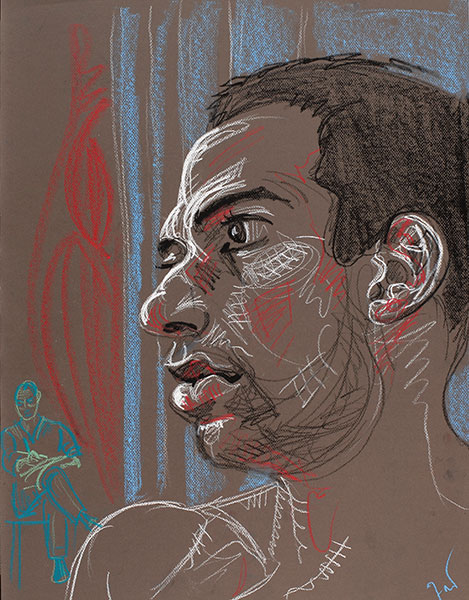
This portrait from a Figureworks life drawing session needed one more element, so I included a sketch of Randall, Firgureworks’ proprietor, with his sketchbook on the other side of the room.  I made him much smaller in relation to the main figure than he actually appeared from my angle of view, which makes the main figure appear to be seen from very close.  This is the same effect you get with a photo taken from close to the subject with a wide-angle lens, with the perspective differences between foreground and background exaggerated.

Facing Light, 2011, by Fred Hatt

Here’s a back view with the shape of the figure highlighted by the window she’s facing and the light from the window reflecting off the polished hardwood floor.  Sometimes a very simple treatment of the background greatly enhances the sense of real presence of a figure by creating a space for it to occupy.

In a Room, 2011, by Fred Hatt

Here’s a more complex variation on the same idea.  The space is simplified into areas of differing value and color, just enough to make the figure a solid reality in a world of air and light.

Many of these poses could have been boring drawings had I not made choices to do something different from my habitual approach.  These experiments aren’t always successful – in fact they increase my chances of making terrible, embarrassing drawings.  But without the unusual choices, the results might have been competent but rather dull.

All the drawings in this post are aquarelle crayon on paper, approximately 18″ x 24″.

Powered by WordPress

Theme Tweaker by Unreal