DRAWING LIFE by fred hatt

2010/07/29

Fires of Brushwood

Filed under: Photography: Elemental Forces — Tags: , , , , — fred @ 14:49

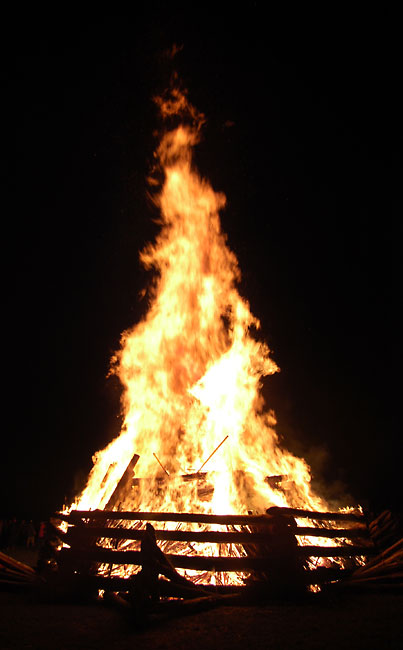
Cone of Fire, 2004, photo by Fred Hatt

I’ve just returned from a week of teaching and body painting at SummerFest, the new festival of the creative spirit at the Brushwood Folklore Center in Sherman, New York.  For many years, Brushwood has hosted Sirius Rising, Starwood (now moved to Wisteria in Ohio), and other festivals, and it’s become fertile ground for a community of artists and musicians, pagans and faeries, free spirits and freedom seekers.  I’ve been going out there since 1999, and it is one of my essential places.  I’ve previously posted some of my body art from Brushwood here, here, here and here.

The night life at Brushwood revolves around fires.  Every night there are several small fires with drum circles, didgeridoos, trance music, rituals or dancing.  The final night of every festival features a huge bonfire like the one pictured at the top of this post.  The fire shown below was the scene of quiet drumming with complex middle eastern rhythms.
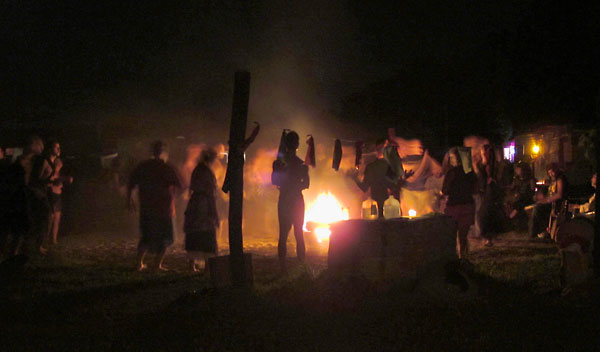
Drummers' Fire, 2010, photo by Fred Hatt

I can go into a quiet reverie watching the slinky, dashing movement of flames.  Fire is a difficult subject for photography, as its essence is in its movement.  A long exposure blurs the flame into smooth streaks of light.  A short exposure captures some of the remarkable fleeting shapes that appear in the flames, but often makes the fire seem smaller than it appears to the eye.
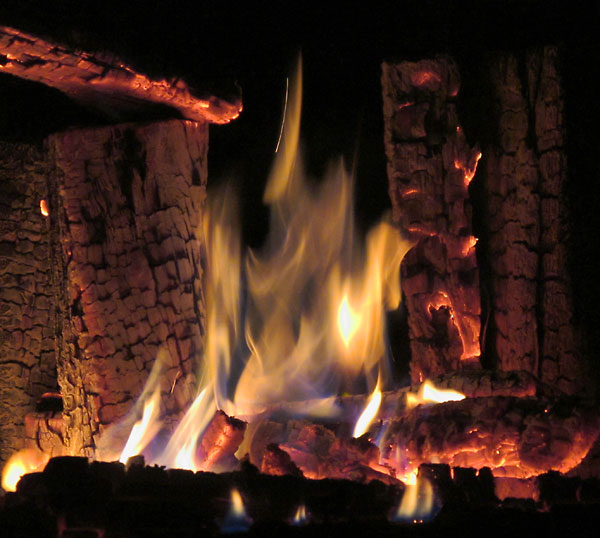
Curtain of Fire, 2010, photo by Fred Hatt

Even the small campfires at Brushwood are meticulously constructed and tended with quiet vigilance by Brushwood’s legendary guild of fire tenders.  Young men and women learn the craft and safety techniques from elders with years of experience, and graduated apprentices proudly sport the emblem of their status, red suspenders worn hanging down.
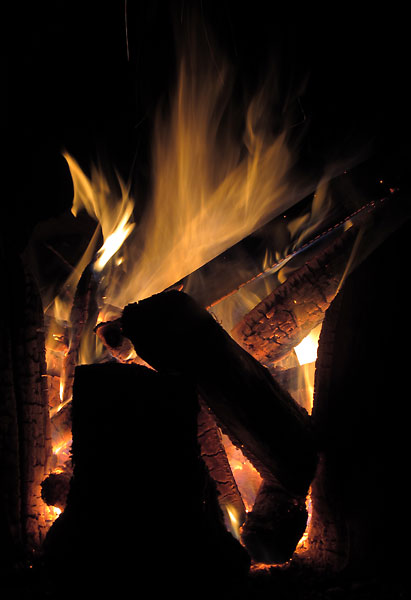
Architecture of Fire, 2010, photo by Fred Hatt

The way the wood is stacked and structured channels and focuses the energy being released from the wood.  The fluid forms of flame cling to, lick over, and leap from the wood that feeds them.
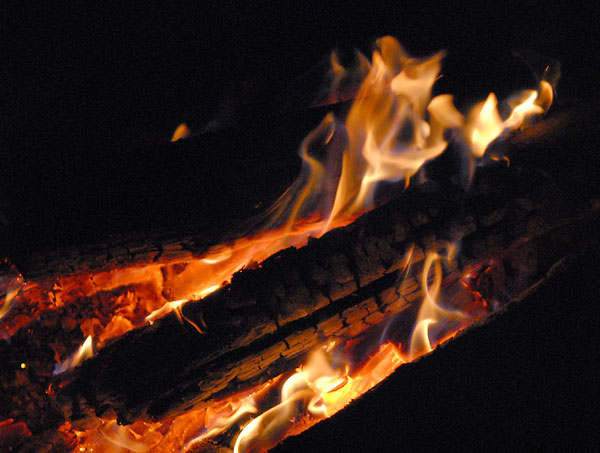
Energy Released, 2009, photo by Fred Hatt

Licking Flames, 2009, photo by Fred Hatt

Sometimes the shapes of the flames spark my imagination with pictures of dancing figures, faces, leaping horses, diving raptors and crashing waves.

Dancing Flame, 2009, photo by Fred Hatt

Feminine Flame, 2009, photo by Fred Hatt

Here a man decorated in a leopard pattern by body painter Vann Godfrey draws dancing energy from the flames in the drum circle enclosure called the Roundhouse.
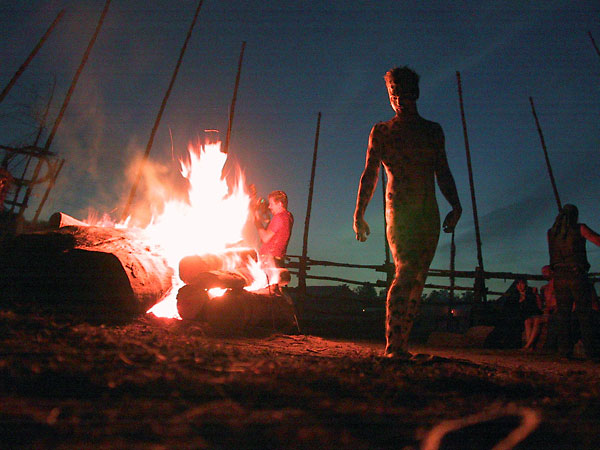
Leopard Man, 2001, photo by Fred Hatt

During a festival week, while nightly fires burn in the roundhouse for all-night drumming and dancing, a large bonfire stack is constructed in an open field.  Here you can see the roundhouse in the background, and the bonfire stack in the foreground.
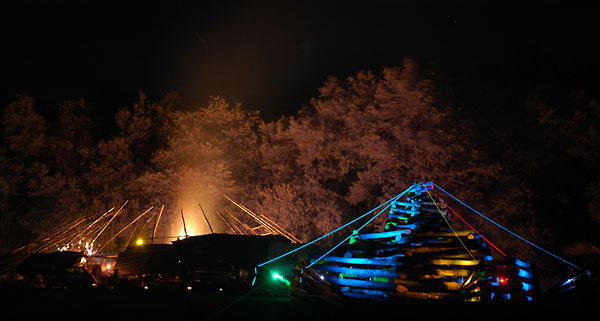
Roundhouse and Bonfire Stack, 2004, photo by Fred Hatt

Ignition, 2004, photo by Fred Hatt

This is the bonfire from the Starwood Festival of 2004, one of the biggest fires I ever saw at Brushwood, as it is first ignited.
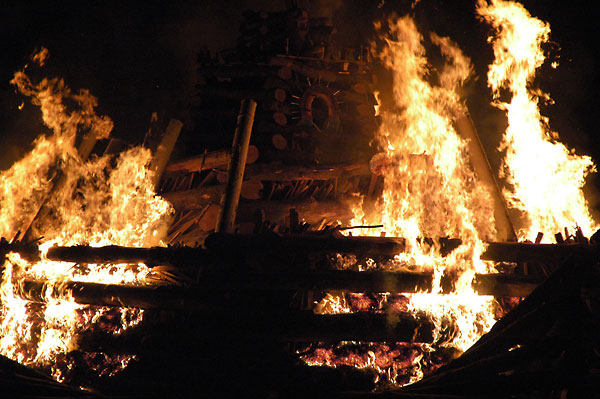
Growing Fire, 2004, photo by Fred Hatt

Sometimes the bonfires also contain fireworks.

Gold and Diamonds, 2004, photo by Fred Hatt
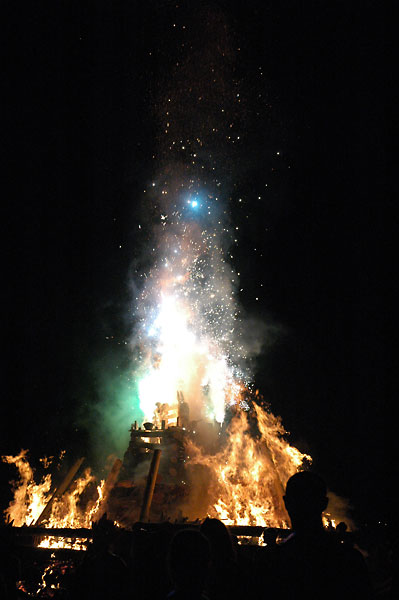
Pyrotechnic Tower, 2004, photo by Fred Hatt

The final night bonfires bring together the whole Brushwood community in a mass celebration.

Summerfest Bonfire, 2010, photo by Fred Hatt

Bonfire Revelers, 2004, photo by Fred Hatt

Fire Watchers, 2010, photo by Fred Hatt

Below, a friend’s fiery red hair is illuminated by the flames as she watches the bonfire.

Firetress, 2002, photo by Fred Hatt

People dance or run in a circle around the towering conflagration.

Bonfire Dance, 2004, photo by Fred Hatt

Runners, 2010, photo by Fred Hatt

Golden Frolic, 2001, photo by Fred Hatt

The really big fires show different patterns compared to the small fires.  The densely packed red-hot embers have blue flames dancing over their surface.

Blue Embers, 2004, photo by Fred Hatt

The sheer concentration of uprushing energy produces a whirlwind of flame.  If it’s raining, you won’t get rained on if you stay near the fire, as it blows the raindrops back up into the sky.
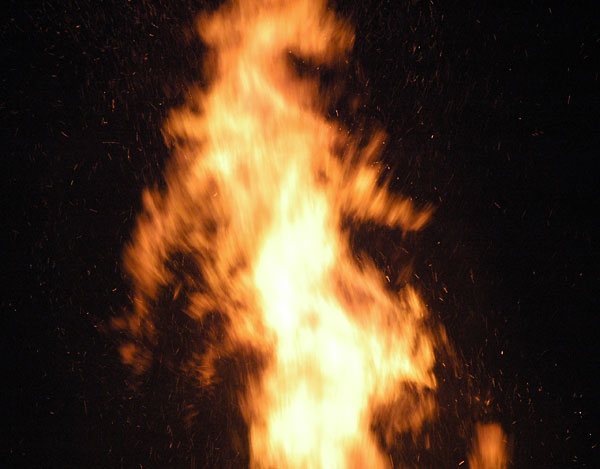
God of Fire, 2004, photo by Fred Hatt

Above the fire, glowing particles swirl and sometimes surge upward in fountains of light.

Flying Embers, 2010, photo by Fred Hatt

The final set of pictures in this post were taken at this year’s SummerFest bonfire.  All are fast camera exposures to capture the momentary shapes seen in the inferno, and exposed darkly enough to show the variations of brightness in the fire.
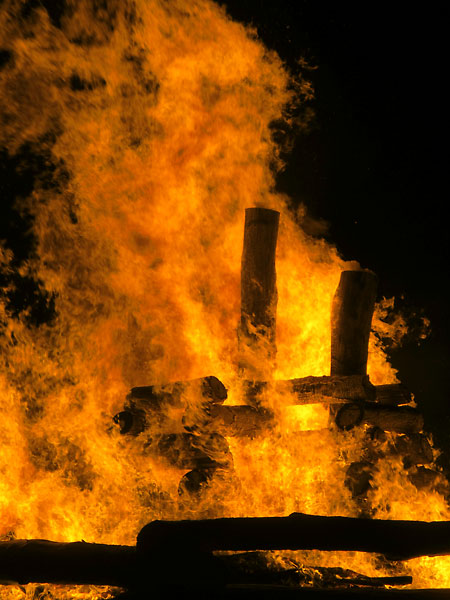
Engulfed, 2010, photo by Fred Hatt

Torrent, 2010, photo by Fred Hatt

Silhouette, 2010, photo by Fred Hatt

Curly Horn, 2010, photo by Fred Hatt

Dancers with Lights, 2010, photo by Fred Hatt

Fire Dance, 2010, photo by Fred Hatt

This incredible uprushing of fiery energy on Saturday evening was followed, on Sunday morning, by an incredible downrushing of lake-effect rain that caused flash flooding in all the low-lying areas of the camp – a perfect elemental balancing act!

2010/07/18

Movement Multiples

Space Between (Anna), c. 1998, by Fred Hatt

In the late 1990’s, an important focus of my drawing practice was capturing the energy of moving figures through expressive line.  This week’s post is a selection of drawings from 1997 through 1999.  All of these feature multiple renderings of the same pose in different positions.  It was my attempt to introduce the dimension of time into the two-dimensional world of the sketch.

Nested (Ignacio), c.1998, by Fred Hatt

In the drawing above, the transition of the figure from upright to fetal forms a natural nested composition, with different colored lines used to keep the phases of the movement separate.  The drawing below is more like a stroboscopic sequence moving across the frame, reminiscent of this kind of photograph I remembered seeing as a kid.

Stage Cross (Arthur), c. 1998, by Fred Hatt

Here’s a beautifully simple study of the movement of the spine:

Spinal Movement (Francisca), c. 1998, by Fred Hatt

In drawing from a model in motion, it is often impossible to capture the entire figure.  The composition below arises from the bony contours of ribs and arms, shoulderblades and collarbones:

Bony (Francisco), c. 1998, by Fred Hatt

A model who is an expressive dancer can convey feeling even in quick movement sketches:

Emotion (Anna), c. 1998, by Fred Hatt

Here are two figures, with two phases each:

Turns (Heather), c. 1998, by Fred Hatt

Here, the arm of the forward bending figure becomes the leg of the standing figure:

Unfolding (Caitlin), c. 1998, by Fred Hatt

Ink drawing with a brush has the spontaneity of dance:

Motion 4, c. 1998, by Fred Hatt

Here, the soft colors seem to be separating from the hard colors:

Stepping Out of Oneself (Miha), c. 1998, by Fred Hatt

There are five fragmentary figures here, two drawn softly, in white, using the edge of the crayon, and three drawn crisply, in dark blue, using the point.  The differing techniques make the white and the blue drawings appear to be on different planes:

Circularity (Corinna), c. 1998, by Fred Hatt

The cool softness above is contrasted by the hot energy below:

Lunge (Claudia), c. 1998, by Fred Hatt

At times, the overlapping lines of the figures cease being figures and become abstract patterns:

Grass (Anna), c. 1998, by Fred Hatt

In drawing from moving models, I often focused on one part of the body.  Here, it is the movement of the legs:

Legwork (Joe), c. 1998, by Fred Hatt

The simplicity of the ink drawing below makes it possible to see many forms, not just figures, suggested in the flowing brushstrokes.

Motion 3, c. 1998, by Fred Hatt

When the models movements suggest power and vigor, those qualities come through in the drawing:

Explode (Toby), c. 1998, by Fred Hatt

A softer style of movement makes a softer drawing:

Shimmy (Nyonnoweh), c. 1998, by Fred Hatt

The model for the next two drawings was a dancer whose movements all seemed to flow from a supple spine:

Spinal Flexure (Donna), c. 1998, by Fred Hatt

Leap & Turn (Donna), c. 1998, by Fred Hatt

In the one below, the model must have been holding the poses for at least a minute, as there are relatively complete figures, kept mostly separated on the page:

Angst (Joe), c. 1998, by Fred Hatt

Here two phases of the model’s changing states find expression in the drawing.  The face, like a placid moon, looks down upon the thrusting figures below it:

Serene Vigor (Julie), c. 1998, by Fred Hatt

I believe the drawing below arose from a model moving very slowly.  As the upper body gradually changed position, I kept sketching the contours.  In this case slow movement produced a sketch with a lot of energy:

Twist and Reach (Lea), c. 1998, by Fred Hatt

Many of these drawings look like they should be painted on the walls of a cave.  They have the roughness and vitality of stone age painting.

Stone (Claudia), c. 1998, by Fred Hatt

All of these drawings were done between the years, 1997 and 1999, mostly at the movement drawing sessions I used to run at Spring Studio in New York.  The color drawings are done with aquarelle crayons and sometimes ink, and are about 18″ x 24″.  Some of the ink drawings here may be as small as 10″ x 10″.  The digital images used in this post were made in the same era as the drawings, by photographing the drawings on 35mm film and scanning the prints, so they’re not quite up to the artwork photography standards I try to maintain today.

Note:  The “Claudia” that is credited as the model in two of the drawings in this post is not the same Claudia that many of my readers know as the blogger of Museworthy.

My portfolio site from this era is still online, and features a selection of movement drawings.

This week I’ll be teaching workshops and doing body painting and other fun things at the Brushwood Folklore Center in Sherman, NY.  I won’t have access to a computer, so forgive me if I don’t reply to your comments right away, or if the next post takes a little more than a week to appear here.

2010/07/10

Burchfield’s Force Fields

Autumnal Fantasy, 1916-1944, by Charles E. Burchfield

Charles E. Burchfield’s landscape paintings swarm with spirits.  His wild and hairy visions of the alive world are currently on view at the Whitney Museum of American Art, in an exhibit titled Heat Waves in a Swamp.  I knew a little of Burchfield before, mostly through reproductions, but seeing this show, brilliantly curated by sculptor Robert Gober, was like discovering a cache of glittering gems hidden in an old tree stump.

Burchfield grew up in Salem, Ohio and lived most of his life in Gardenville, a rural suburb of Buffalo, New York.  His talent was recognized at a fairly early age, but he had no interest in living in a big city or being part of a movement or scene.  He painted to please himself, and sold paintings to support his wife and five kids.  His life story and his words reveal him as an unassuming and unpretentious man, but so thoroughly an artist that he couldn’t stop thinking as an artist for a moment.  One room of the Whitney show is filled with hundreds of abstract biomorphic doodles that he made while talking on the phone or playing card games with his wife.  Besides doodling he also kept journals throughout his life.  A particular pleasure of the exhibit is that nearly every painting is accompanied by Burchfield’s own eloquent description or reminiscence of its creation.

Charles E. Burchfield painting in his studio in Gardenville, N.Y., 1966, photo by William Doran, Burchfield Penney Art Center

While he did oil paintings and some mixed media, the bulk of Burchfield’s work is done in the medium of “dry brush” watercolor and gouache.  Traditional watercolor technique involves using thin washes of color on absorbent wet paper, and often tries for luminous, saturated colors and a loose, spontaneous style.  Burchfield’s technique is quite different, heavily worked by watercolorist standards, and his colors are often subtle and earthy.  His work achieves a feeling of light not by a light touch, but by a fiery intensity of movement.

His work divides neatly into three periods: the first begins in his breakthrough year of 1917, when he was in his mid-20’s.  He devised a system of visual motifs that embodied different moods and energies, called “conventions for abstract thoughts“.  These forms remind me of the “thought forms” described by Theosophists Annie Besant and C. W. Leadbeater in a 1901 book as shapes of thoughts visualized through clairvoyant synesthesia, though I do not know whether Burchfield was influenced by Theosophical ideas.  In painting from nature Burchfield saw manifestations of these abstractions, and his paintings of this period seem to depict organic forms through drawn lines whose movement expresses their underlying forces.  Those forces sometimes seem dark, ominous, prickly, overwhelming, or explosive, but always beautiful.  The chaos that is there is fertile and creative.

The Insect Chorus, 1917, by Charles E. Burchfield

Burchfield’s description of the image above reads, “It is late Sunday afternoon in August.  A child stands alone in the garden listening to the metallic sounds of insects.  They are all his world, so, to his mind, all things become saturated with their presence – Crickets lurk in the depths of the grass, the shadows of the trees conceal fantastic creatures, and the boy looks with fear at the black interior of the arbor, not knowing what terrible thing might be there.”

In his middle period Burchfield turned to a kind of American regionalism or social realism, often depicting industrial scenes or working-class settings.  The paintings of this period have a great sense of light and space.  The example below has a deep perspective reminiscent of Breughel, with a whole town visible in the far distance.

End of the Day, 1938, by Charles E. Burchfield

Burchfield’s description:  “At the end of a day of hard labor the workmen plod wearily uphill in the eerie twilight of winter, and it seems to the superficial eye that they have little to come home to in those stark, unpainted houses, but, like the houses, they persist and will not give in; and so they attain a rugged dignity that compels our admiration.”

Sun and Rocks, 1918-1950, by Charles E. Burchfield

Burchfield’s late period begins in 1943, when he was fifty.  He had spent decades developing his craft, but felt that his work was “rather prosaic” compared with his youthful, magical approach.  He went back to early works that were not quite successful, but that had the seeds of great ideas he now had the maturity to accomplish.  He attached extra paper around these early paintings, extending them into bold compositions in monumental scale.  The late period expansions were as much as five or six times larger than the early paintings that form their cores.

While many of the middle-period works in the show are oil paintings on loan from major museums, all the late work is watercolor on paper, which can’t be kept on permanent display due to watercolor’s vulnerability to fading, and most of them are from the collection of the Burchfield Penney Art Center in Buffalo, where the artist’s personal archives reside.  I assume this means most of this late work was not sold in Burchfield’s lifetime.  Perhaps in his later years he had achieved enough recognition, his children were grown, and he felt the freedom to paint for himself, for the sheer joy he clearly felt in it.

The Four Seasons, 1949-1960, by Charles E. Burchfield

Though Burchfield was a protestant, his late work expresses a pure pagan spirituality, in which clouds and rain, trees and insects, are living beings in a web of sacred life.  In one painting, the space between trees, through which the bright distant landscape is seen, becomes a golden dancing figure.  Another seems to show, as curator Robert Gober says, “the point of view of a man lying in a field of dandelions on a sleepless night”.  The late works are overwhelming in their size, their magical light and space, and their thorny, buzzing detail.  The reproductions here don’t even begin to do them justice.

Heat Waves in a Swamp:  The Paintings of Charles Burchfield is curated by Robert Gober.  It was first exhibited at the Hammer Museum in Los Angeles and at the Burchfield Penney Art Center in Buffalo, before moving to the Whitney Museum of American Art in New York City, where it will remain on view until October 17, 2010.

All illustrations for this post were found on the web.  Clicking on the pictures links to their source pages, which are great places to find more images and information on Burchfield and Heat Waves in a Swamp.

2010/07/03

Old Glory in New York

Filed under: Photography: Signs and Displays — Tags: , , , , — fred @ 22:20

Fragmented Flag, 2003, photo by Fred Hatt

For the Fourth of July, I offer a selection of images of the Stars and Stripes, as displayed in my home city of New York.

Many artists have explored the aesthetic possibilities of the U.S. flag, most famously Jasper Johns. It has a strong graphic presence that makes it stand out in nearly any setting.  The bold colors and stripes assert themselves through distortions that would render most patterns unintelligible, as in the images above and below.

Auto Reflection, 2002, photo by Fred Hatt

Here a flag in a window is seen through the reflection of another flag hanging from a building across the street.  There are additional small flag stickers in the reflected windows.  Even the stripes of the blinds and the fields of colors made by the reflected building and sky seem to echo the visual elements of the flag.

Flag in Flag, 2001, photo by Fred Hatt

Below, a gentle breeze is enough to make ripples in the water standing in the gutter, but just barely moves the flag hanging from the side of a building.

Gutter Reflection, 2004, photo by Fred HattFlag on Rusty Car, 2001, photo by Fred Hatt

I had been casually photographing things seen on the street for many years, but in 2001 I got my first digital camera, a Canon G1, and began carrying it with me nearly all the time, dramatically increasing my photographic output.  That was the year of the September 11 attack, of course, and suddenly flags were everywhere in the city, as expressions of solidarity and defiance.  When photographing in the city it became nearly impossible not to photograph flags.  At that time, it was common to see unusually large flags attached to cars:

Flag on Rusty Car, 2001, photo by Fred Hatt

The explosion in the number of flags displayed in New York City lasted for quite a few years.

Construction Shed Flag, 2003, photo by Fred Hatt

In a way, the proliferation of flags showed that people felt called to respond to a terrible new reality, but didn’t know how.  This kind of symbolism was all we had.  Often, religious and national symbols are used in response to our sense of powerlessness in the face of death and history.

Headstone, 2003, photo by Fred Hatt

The Union battle flag below, a veteran of the War Between the States, is on display at Grant’s Tomb in Manhattan:

Civil War Battle Flag, 2005, photo by Fred Hatt

Outside the Tomb, there are columns that translate the stars and stripes into sculptural form:

Flag Column, 2005, photo by Fred Hatt

Another flag in columnar form is this display on the outside of the NASDAQ MarketSite building in Times Square, a building completely covered in video billboard.

Nasdaq Flag, 2005, photo by Fred Hatt

In the years following September 11, 2001, many businesses in the city displayed flags or incorporated them into their commercial displays.  Here’s the window of a Brooklyn store that sells walkers, trusses, neck braces, and the like:

Medical Supplies Flag, 2003, photo by Fred Hatt

A psychic reader’s window displays symbols of power:  crystals, wizards, angels, and the flag:

Psychic's Display, 2003, photo by Fred Hatt

Screaming Mimi’s is a long-time vintage clothing store in Manhattan, made famous in the 1980’s by pop singer Cyndi Lauper.  In the zeroes they got on the patriotic bandwagon too.

Screaming Mimi's Red White & Blue, 2002, photo by Fred Hatt

Here, the U.S. flag adorns an inflatable sledgehammer, perhaps a metaphor for the American Empire’s ineffective military might and bubble economics.   Or maybe it’s just a cute toy.

Inflated Toys, 2004, photo by Fred Hatt

The following picture is not from Abu Ghraib, but from a Manhattan bondage club, duly expressing its patriotic sentiments in the wake of 9/11.

Bondage Club, 2001, photo by Fred Hatt

I live in an Italian neighborhood in Brooklyn, where the flag of the Mother Country is often displayed alongside that of the Land of Opportunity.

Italian America, 2004, photo by Fred Hatt

Country first, hamburgers second:

United States of White Castle, 2006, phot by Fred Hatt

Here the slanting winter sun gives a glow to a row of international flags and the exhaust from Manhattan’s famous network of underground steam pipes.

Flags and Steam, 2004, photo by Fred Hatt

A lot of people put up flags and forget about them, letting the elements fade and tear them.

Weathered Flag, 2003, photo by Fred Hatt

On this flag sticker, the stripes have completely faded away, replaced by a beautiful network of cracks like one would see on a dessicated lake bed.

God Bless America, 2003, photo by Fred Hatt

Another faded sticker, another inane yellow smiley:

United We Stand, 2003, photo by Fred Hatt

The wind has whipped this flag to ribbons:

Stars and Ribbons, 2007, photo by Fred Hatt

And this flag flies in a fortified industrial wasteland:

Flag and Razor Wire, 2005, photo by Fred Hatt

This is getting too depressing.  Flags blowing in the wind, even if they are ripped up, can make beautiful patterns of thrilling color:

Tattered Flag, 2003, photo by Fred Hatt

Flags often make interesting wriggly shapes when viewed from almost directly underneath:

Soft and Hard, 2003, photo by Fred Hatt

Convulsing Stripes, 2003, photo by Fred Hatt

Billowing Flag, 2006, photo by Fred Hatt

And flags clustered together send the color moving in all directions:

Flag Cluster, 2008, photo by Fred Hatt

Patriotic Neighborhood, 2006, photo by Fred Hatt

Here, a building shrouded for renovation work still displays its flag in golden crepuscular light:

Sunset Flag, 2005, photo by Fred Hatt

As a complement to this post, you may want to check out my earlier post, “9/11:  Signs in the Aftermath“, which shows many flags and other kinds of displays that sprouted in New York City in response to the catastrophe of September 11, 2001.

Powered by WordPress

Theme Tweaker by Unreal