DRAWING LIFE by fred hatt

2010/09/17

Skylines

Filed under: Photography: Structure — Tags: , , — fred @ 09:14

Twilight Manhattan, 2006, photo by Fred Hatt

You have to get a little outside of it to get good views of Manhattan’s famous skyline.  The view above is from a Tribeca highrise apartment balcony.  The one below is from across the East River in Brooklyn.

Dead End, 2006, photo by Fred Hatt

Atop a bridge you’re both high and outside, as in this view from the approach to the Queensboro Bridge.

Bridge Approach, 2003, photo by Fred Hatt

You can get a good view from under a bridge too.  Here the framing structure is the Manhattan Bridge.  The lighted arc of cables further back is the Brooklyn Bridge.

Framing Bridge, 2005, photo by Fred Hatt

You can have this view from your apartment, if you are a billionaire.

Central Park View, 2004, photo by Fred Hatt

The skyline is such an iconic way of seeing New York that even an image of disaster takes the form of a skyline.  This is a photomural, inside a building in lower Manhattan, of the smoldering pile of the World Trade Center following the 9/11 attack.

9/11 Mural, 2003, photo by Fred Hatt

New Yorkers, used to the familiar outline of the Twin Towers, felt there was a hole in the skyline.  Every year around the anniversary, beams of light rise in place of the missing towers.

Converging Beams, 2003, photo by Fred Hatt

Another type of memorial that creates a skyline is the gathering of gravestones in a cemetery.  Here, the buildings of midtown Manhattan in the background blend in with the stone slabs and columns of Queens’ Calvary Cemetery in the foreground.

Cemetery Skyline, 2004, photo by Fred Hatt

Taking a closer view of the contours where the buildings of Manhattan touch the sky, wooden water towers are a distinctive feature of the lower-rise portions of the city.

Water Tower Rooftops, 2007, photo by Fred Hatt

The sky silhouette seen in the outer boroughs of New York often includes church spires, clotheslines, and satellite dishes.

Laundry and Spires, 2006, photo by Fred Hatt

Sometimes you can see a skyline by looking downward.

Reflected Towers, 2006, photo by Fred Hatt

The mirrored skyline lends a certain quality of serenity to this view of an industrial wasteland.

Newtown Creek Skyline, 2005, photo by Fred Hatt

Contrasting shapes meet the sky here where a Frank Gehry-designed office building in white glass rises next to the High Line, an elevated freight track converted into a park.

Gehry & High Line Construction, 2009, photo by Fred Hatt

Another translucent white glass building, the Enid A. Haupt Conservatory at the New York Botanical Garden, nearly blends in to the overcast sky, in the view below.  Not every skyline contour is hard and toothy.

Conservatory, 2004, photo by Fred Hatt

Fog can also create a soft-edged effect.

Citibank in Fog, 2004, photo by Fred Hatt

In the view below, only the Empire State Building is tall enough to be seen above the trees of McCarren Park in Brooklyn, shining through the evening mist.

Ghostly Empire State, 2003, photo by Fred Hatt

A ruined waterfront warehouse in the sunset has a skyline of crumbling grandeur.

Burned Warehouse, 2006, photo by Fred Hatt

The warehouse’s eroded contours contrast with the thrusty ones of this neo-gothic structure, Grace Church.

Gothic Silhouette, 2007, photo by Fred Hatt

These 19th century east side townhouses have chimneys like crooked fingers.

Chimneys, 2005, photo by Fred Hatt

We tend not to notice the sky contours of signs and street lamps, as they blend in to general visual clutter, but the shapes can be fantastic abstract sculpture.

Billboard & Streetlamp, 2007, photo by Fred Hatt

The gleaming towers of architects must share the skyline with the ragged juttings of infrastructure.

Tower, Poles, Wires, 2003, photo by Fred Hatt

The combinations of all these elements can become glorious geometries of chaos.

Crossing Lines, 2005, photo by Fred Hatt

Here, a particular angle of view brings together building, statue, lamp and tree for a composition that crackles and twists.

Central Park South, 2010, photo by Fred Hatt

In buildings the supporting framework is decorously concealed, but bridges nakedly display their engineering.  Here, the towers of the Queensboro Bridge and the Roosevelt Island tramway stand side by side.

Tramway, 2004, photo by Fred Hatt

New York’s first great bridge was the Brooklyn Bridge, a masterpiece of engineering and still the most beautiful of Manhattan’s bridges with its delicate cabling.

Bridge Cabling, 2009, photo by Fred Hatt

The roof of the Metropolitan Museum currently hosts this gigantic birds-nest-like structure, the architectural sculpture “Big Bambu” by the Starn brothers.

Big Bambu, 2010, photo by Fred Hatt

Birds use the cables and spars over the Manhattan streets as bleachers to spectate on the human beehive, and their bodies become part of the skyline.

Pigeon Perch, 2005, photo by Fred Hatt

In the outer boroughs, people toss their old sneakers onto the wires.  This one was unusually generously festooned.

Shoes on Wire, 2009, photo by Fred Hatt

2010/07/03

Old Glory in New York

Filed under: Photography: Signs and Displays — Tags: , , , , — fred @ 22:20

Fragmented Flag, 2003, photo by Fred Hatt

For the Fourth of July, I offer a selection of images of the Stars and Stripes, as displayed in my home city of New York.

Many artists have explored the aesthetic possibilities of the U.S. flag, most famously Jasper Johns. It has a strong graphic presence that makes it stand out in nearly any setting.  The bold colors and stripes assert themselves through distortions that would render most patterns unintelligible, as in the images above and below.

Auto Reflection, 2002, photo by Fred Hatt

Here a flag in a window is seen through the reflection of another flag hanging from a building across the street.  There are additional small flag stickers in the reflected windows.  Even the stripes of the blinds and the fields of colors made by the reflected building and sky seem to echo the visual elements of the flag.

Flag in Flag, 2001, photo by Fred Hatt

Below, a gentle breeze is enough to make ripples in the water standing in the gutter, but just barely moves the flag hanging from the side of a building.

Gutter Reflection, 2004, photo by Fred HattFlag on Rusty Car, 2001, photo by Fred Hatt

I had been casually photographing things seen on the street for many years, but in 2001 I got my first digital camera, a Canon G1, and began carrying it with me nearly all the time, dramatically increasing my photographic output.  That was the year of the September 11 attack, of course, and suddenly flags were everywhere in the city, as expressions of solidarity and defiance.  When photographing in the city it became nearly impossible not to photograph flags.  At that time, it was common to see unusually large flags attached to cars:

Flag on Rusty Car, 2001, photo by Fred Hatt

The explosion in the number of flags displayed in New York City lasted for quite a few years.

Construction Shed Flag, 2003, photo by Fred Hatt

In a way, the proliferation of flags showed that people felt called to respond to a terrible new reality, but didn’t know how.  This kind of symbolism was all we had.  Often, religious and national symbols are used in response to our sense of powerlessness in the face of death and history.

Headstone, 2003, photo by Fred Hatt

The Union battle flag below, a veteran of the War Between the States, is on display at Grant’s Tomb in Manhattan:

Civil War Battle Flag, 2005, photo by Fred Hatt

Outside the Tomb, there are columns that translate the stars and stripes into sculptural form:

Flag Column, 2005, photo by Fred Hatt

Another flag in columnar form is this display on the outside of the NASDAQ MarketSite building in Times Square, a building completely covered in video billboard.

Nasdaq Flag, 2005, photo by Fred Hatt

In the years following September 11, 2001, many businesses in the city displayed flags or incorporated them into their commercial displays.  Here’s the window of a Brooklyn store that sells walkers, trusses, neck braces, and the like:

Medical Supplies Flag, 2003, photo by Fred Hatt

A psychic reader’s window displays symbols of power:  crystals, wizards, angels, and the flag:

Psychic's Display, 2003, photo by Fred Hatt

Screaming Mimi’s is a long-time vintage clothing store in Manhattan, made famous in the 1980’s by pop singer Cyndi Lauper.  In the zeroes they got on the patriotic bandwagon too.

Screaming Mimi's Red White & Blue, 2002, photo by Fred Hatt

Here, the U.S. flag adorns an inflatable sledgehammer, perhaps a metaphor for the American Empire’s ineffective military might and bubble economics.   Or maybe it’s just a cute toy.

Inflated Toys, 2004, photo by Fred Hatt

The following picture is not from Abu Ghraib, but from a Manhattan bondage club, duly expressing its patriotic sentiments in the wake of 9/11.

Bondage Club, 2001, photo by Fred Hatt

I live in an Italian neighborhood in Brooklyn, where the flag of the Mother Country is often displayed alongside that of the Land of Opportunity.

Italian America, 2004, photo by Fred Hatt

Country first, hamburgers second:

United States of White Castle, 2006, phot by Fred Hatt

Here the slanting winter sun gives a glow to a row of international flags and the exhaust from Manhattan’s famous network of underground steam pipes.

Flags and Steam, 2004, photo by Fred Hatt

A lot of people put up flags and forget about them, letting the elements fade and tear them.

Weathered Flag, 2003, photo by Fred Hatt

On this flag sticker, the stripes have completely faded away, replaced by a beautiful network of cracks like one would see on a dessicated lake bed.

God Bless America, 2003, photo by Fred Hatt
Another faded sticker, another inane yellow smiley:

United We Stand, 2003, photo by Fred Hatt

The wind has whipped this flag to ribbons:

Stars and Ribbons, 2007, photo by Fred Hatt

And this flag flies in a fortified industrial wasteland:

Flag and Razor Wire, 2005, photo by Fred Hatt

This is getting too depressing.  Flags blowing in the wind, even if they are ripped up, can make beautiful patterns of thrilling color:

Tattered Flag, 2003, photo by Fred Hatt

Flags often make interesting wriggly shapes when viewed from almost directly underneath:

Soft and Hard, 2003, photo by Fred Hatt

Convulsing Stripes, 2003, photo by Fred Hatt

Billowing Flag, 2006, photo by Fred Hatt

And flags clustered together send the color moving in all directions:

Flag Cluster, 2008, photo by Fred Hatt

Patriotic Neighborhood, 2006, photo by Fred Hatt

Here, a building shrouded for renovation work still displays its flag in golden crepuscular light:

Sunset Flag, 2005, photo by Fred Hatt

As a complement to this post, you may want to check out my earlier post, “9/11:  Signs in the Aftermath“, which shows many flags and other kinds of displays that sprouted in New York City in response to the catastrophe of September 11, 2001.

2010/05/21

Depth Perception

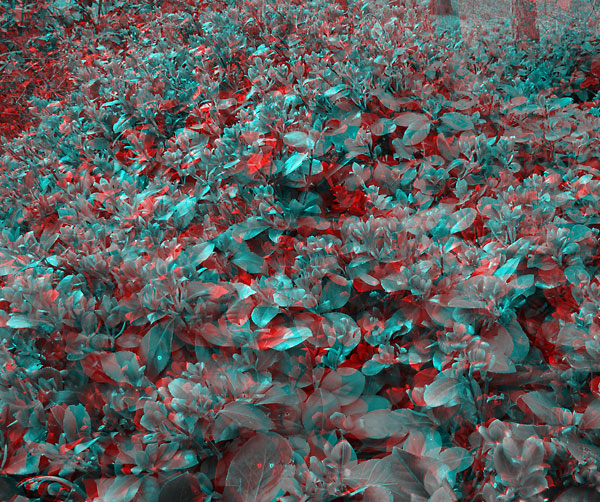
New Leaves, 2010, stereo photo by Fred Hatt

The image above may appear a mild abstraction on a natural scene, some curling leaves fringed in red and blue.  But put on a pair of old-fashioned 3-D glasses, with a red filter over the left eye and a cyan filter over the right eye, and a window opens up in your monitor, offering a view down upon a sensuous early spring plant, reaching towards you from a vivid texture of dirt and twigs.

Last year’s post, Shapes of Things, featured stereoscopic photographs I took seventeen years ago, in 1993.  This year I’ve been taking new ones, now using the Canon G11 that I usually carry with me as I move about the city going to jobs and visiting friends.  To take a 3D or stereo photograph, I just take one shot, then move the camera a few inches to the right and take another.  I use free software called Stereo Photo Maker to align them and to convert them to various viewing formats.  For these samples on the blog, I’ve chosen to use the “gray anaglyph” format, for viewing with traditional anaglyphic 3D glasses.  If you don’t have a pair, you can get one for free at this site.  Ask for Red/Cyan Anaglyph 3D Glasses.

Snow Tree, 2010, stereo photo by Fred Hatt

Here, a snow-covered winter tree spreads elegantly in front of an apartment building, while below a bare tree adds its complexity to an otherwise geometrical landscape.  The branching patterns of trees resemble the neurons in the brain, as well as the patterns formed by electrical discharges such as lightning.  Although they form much more slowly, trees express the same motion of formation as these examples of instant impulse.

Treeburst, 2010, stereo photo by Fred Hatt

Old trees can express as much character in their trunks as in their branches or leaves.  This one’s had  the initials of generations carved into it.

Elder Tree, 2010, stereo photo by Fred Hatt

Below is an early, tripartite stage of something that might one day fuse into something as majestically bumpy as the one above.

Trunk Trio, 2010, stereo photo by Fred Hatt

Here’s an old tree that has been hollowed by rot into a sort of vertical canoe form.

Tree Shell, 2010, stereo photo by Fred Hatt

Rolling hills and trees reaching and leaning in all directions create a dynamic spatial environment that makes the experience of walking through woods invigorating in any season.

Downhill, 2010, stereo photo by Fred Hatt

Garden, 2010, stereo photo by Fred Hatt

Here you can see the form of a hedge in early spring.  Last year’s leaves are broad and flat, dark and shiny.  Newer leaves, lighter and much smaller, sprout in clusters from among the old leaves.

Sprouting Hedge, 2010, stereo photo by Fred Hatt

We’ll turn now to the shapes of man-made things, letting this shop window with potted plants behind a neon sign serve as a segue.

Qi Gong Tui-Na, 2010, photo by Fred Hatt

Shop windows are a natural subject for stereo photography, since we look through them into enclosed places where objects have been composed in spatial arrangement.

Pastry Shop, 2010, stereo photo by Fred Hatt

Lamp Store, 2010, stereo photo by Fred Hatt

The window below has been decorated with a huge transparent photographic image, which we look through to see a dress on display within the open space of the store.

Calvin Klein Store, 2010, stereo photo by Fred Hatt

This antique store has arranged a family of wooden manikins on a leather upholstered bench.

Manikins, 2010, stereo photo by Fred Hatt

Instead of looking through a glass window, we can look through a steel mesh gate to see the receding space of a narrow passageway.

Passageway, 2010, stereo photo by Fred Hatt

This chain-link fence slides on a track to let trucks in and out of a loading dock.  The framework of the gate produces a beautiful geometric shadow.

Rolling Gate, 2010, stereo photo by Fred Hatt

This frame was put up to support multiple billboards.  It’s now being a bit under-utilized.

Sign Frame, 2010, stereo photo by Fred Hatt

Here, a huge, mottled block supports a cast-iron bannister for a set of brownstone steps adorned with a ratty carpet.

Stoop Steps, 2010, stereo photo by Fred Hatt

A construction shovel is another rough form on a residential street.

Shovel, 2010, stereo photo by Fred Hatt

The rough form below reminded me of an aging roué with a young mistress.

Beauty and the Beast, 2010, stereo photo by Fred Hatt

I find that looking at 3D photographs makes me more aware of three dimensional form and texture, and the topological complexity of the landscape, aspects of the world we may often overlook.

2010/04/30

Urban Patterns and Juxtapositions

Filed under: Photography: Structure — Tags: , , , — fred @ 15:23

Chair Shadow, 2010, photo by Fred Hatt

I like to keep a small camera with me when I’m out and about in the city.  I rarely go anywhere for the specific purpose of photography unless it’s a paying job, but I find having the camera with me helps me to look at the world around me with a more engaged eye.  My personality is neither aggressive enough nor gregarious enough to shoot pictures of strangers in public.  Instead, I look for striking or unusual compositions made by the juxtapositions of shapes and colors and textures, effects of light and shadow, objects and displays, and ever-changing natural and man-made phenomena.  This post consists entirely of shots taken since the beginning of this year with my inconspicuous Canon G11.

The shot above was taken while sitting with a friend in a little outdoor cafe in Central Park on a late spring afternoon.  I was struck by the complex cluster of lines made by the table and chair legs, the elongated chair shadow stretching across the irregular stone slab floor, and my friend’s shoe to one side.  I believe the thicker, inverted Y-shaped shadow is that of a large tree.

Many of the most interesting patterns are seen only by looking at the ground, as above, or to the sky, as in the image below.  This is another composition of angles and lines, at the corner of Bogart and Grattan Streets in Bushwick, Brooklyn.

Bogart and Grattan, 2010, photo by Fred Hatt

New York City is packed with tall buildings from different eras, creating many different kinds of juxtapositions of shapes and styles depending on your angle of view.  Zooming to the longer position of the lens flattens the perspective, emphasizing the density of the forms.  The view below is looking north from Union Square.

Looking North from Union Square, 2010, photo by Fred Hatt

And this one is looking south from Columbus Circle.  These show a striking difference in style between the two ends of Manhattan’s dense midtown cluster.

Looking South from Columbus Circle, 2010, photo by Fred Hatt

Over on the West Side, near Lincoln Tunnel and the Port Authority Bus Terminal, there is, for some reason, an unusually high concentration of pigeons.

Midtown Pigeons, 2010, photo by Fred Hatt

And here’s a view looking towards the far East Side of Manhattan, from Long Island City, Queens, with the Queensboro or 59th Street Bridge rising over the streets.  The textures in this picture are fascinating, though I’m afraid it loses something in this small size.

Queensboro Bridge, 2010, photo by Fred Hatt

Looking up at buildings in the city, a frequently-seen motif is something tall towering above something broad.  The Lever House, a classic of the 1950’s International Style, deliberately invokes this juxtaposition.

Lever House, 2010, photo by Fred Hatt

More often, it’s an accident of separate buildings seen from a particular angle.

Bloomingdales at Dusk, 2010, photo by Fred Hatt

Perfectly contrasting the glossy elegance of Lever House is this orange-shrouded construction site rising behind a blank billboard.

NYC Law, 2010, photo by Fred Hatt

Blankness can give a building a massive feel even when it is surrounded by much larger buildings.

Roosevelt Post Office, 2010, photo by Fred Hatt

Curved shapes give a much softer impression.

Terraces and Tower Top, 2010, photo by Fred Hatt

I find something oddly inviting about rounded interior spaces.  The best known of those in New York City is of course the Guggenheim Museum, but here’s an oval plaza in a newer building near Bloomingdales on the East Side.

Oval Plaza, 2010, photo by Fred Hatt

A few blocks away from that is found this spiral staircase at the Fifth Avenue Apple Store.

Apple Store Stairs, 2010, photo by Fred Hatt

Compare that to this old style cast iron and tile spiral staircase in a courthouse on the West Side.

Spiral Stairwell, 2010, photo by Fred Hatt

The black vertical bars above contrast with the silvery horizontal bars found in these Subway turnstiles below.

Egg Slicer Turnstiles, 2010, photo by Fred Hatt

There are lots of dense grids in the urban environment.  They’re so commonplace we often don’t notice them.  Colored lights can bring them out of the background noise.

Construction Shed Scaffold, 2010, photo by Fred Hatt

This is a roll-down store security gate, over a window with neon signs.

Neon Security Gate, 2010, photo by Fred Hatt

Colored lights can be used to break up and add movement to a monolithic surface.

Cascade of Colored Light, 2010, photo by Fred Hatt

Even a subtle use of colored lights, like these filtered fluorescents in a parking garage, can make an otherwise forbidding space more appealing.

Parking Garage, 2010, photo by Fred Hatt

I’m fascinated by patchwork patterns, where rectangles and other shapes of different tones and hues are clustered with some kind of irregularity.

Pastel Rectangles and Vendor Cart, 2010, photo by Fred Hatt

Sometimes these patchworks are an accident of angle of view.

Gate in Red Wall, 2010, photo by Fred Hatt

Here the weathered red panels are contrasted with the plain gray ones and the mysterious half face on plywood.

The Ghost of Ralph Nader, 2010, photo by Fred Hatt

Graffiti often becomes an element of patterns in the city.

Blue Anarchy & Red Square, 2010, photo by Fred Hatt

I live in Williamsburg, Brooklyn, where much of the culture is driven by the hipster sense of irony.  I don’t know if this Williamsburg window is deliberately or accidentally ironic.

Antidepressant, 2010, photo by Fred Hatt

The patchwork effect we’ve been looking at can be generated by distorted reflections in grids of glass windows.

New Reflects Old, 2010, photo by Fred Hatt

The effects of light and shadow, especially in the early morning and late afternoon, can transform mundane structures into wonderful visual arrangements.

Security Gate Shadows, 2010, photo by Fred Hatt

This store window display is a perfectly nice example of the clean tropical aesthetic, but the late afternoon sun casts shadows that transform it into a joyous abstract painting.

Window Display in Sunlight, 2010, photo by Fred Hatt

Keep your eyes open – visual pleasures are abundant and free to enjoy!

2010/03/15

Top Ten Countdown

Back Study #1: Convex, 2009, by Fred Hatt

Today, March 15, 2010, this blog turns one year old.  (Above, the first illustration from the first post, “Variations”.)

I have long shared my work with others largely through underground, alternative, and community-based venues.  In many ways, the blog has been my ideal gallery – virtually cost-free, accessible to all both near and far, open 24 hours, a place where I can share the full range of my work, my process, and my passions, without concern for whether anyone will buy, or whether a dealer thinks I’m diluting my brand.

I have long tended to put all my energy into producing work, rarely finding the time to edit and present that work, much less to sell myself or promote my career.  Feeling the need to post something here once a week or thereabouts has been a much-needed self-imposed deadline for me!

I thank those of you that post comments.  A sense of dialog sustains me.  It’s also been gratifying to pick up some fans in far-flung places, where they would have been unlikely to encounter my work in an exhibit.

In reverse order, here’s a listing of the top ten posts from the first year of Drawing Life.  These are the posts that have gotten the most hits, continuing to attract readers after they’re no longer on the front page of the blog, with a sample image and quote from each.  The titles link back to the original posts.

10:  Opening the Closed Pose

“The human body is as expressive when it is turned inward as when it is expansive or active.  The guarded nature of the crouch or fetal position shows vulnerability in a different way than the open pose.  The upper and lower parts of the body are drawn together, and the energy pattern becomes circular rather than vertical.”

Hanging Head, 2009, by Fred Hatt

9:  Shapes of Things

This post featured stereoscopic photographs, presented as anaglyphs, to be viewed with red/cyan 3D glasses.

“The compositional dynamics of a flat photograph are simple, their impact immediate and graphic.  A stereo image is more complex.  Looking at it, we feel we are looking through a window, perhaps into a world that has been miniaturized and frozen in time.  The eyes caress the forms or penetrate the space of the image.  Enjoy these images, then go out and revel in the spatial complexity of the world.”

Framework, 1993, photo by Fred Hatt

8:  Fire in the Belly

“Body painting is an ancient art of transformation, to make the warrior more terrible, the young mate more enticing, or the shaman more of a dream creature.  I have used it as a medium of discovery, exploring the landscape of the body and finding the forces that lie beneath the surface.  In the type of body art shown here, there is never any preconceived design.  As the paintbrush follows the natural curves of the body, it becomes a kind of divining rod, finding the quality of energetic pools and flows and manifesting them in visible form.”

Botanic, 2001, bodypaint and photo by Fred Hatt

7:  Painting with Light

“I first started experimenting with light painting in photography of models in 1990 or thereabouts . . . I was interested in the process because it bridged the gap between photography and painting or drawing.  As in painting, the image is created by manual gestures over a finite period of time, but instead of making pigment marks on paper or canvas, one makes light marks, through a lens, on a photograph.”

Smoke, 1996, photo by Fred Hatt

6:  Negative Space

“Clearly seeing negative space is about shifting the focus from presence to absence.  Finding the figure by looking at the negative space is one of the many artistic applications of the Hermetic principle  ‘As above, so below’ or ‘As within, so without’.  All reality exists on the cusp between interior and exterior, between past and future, or between any polarity you care to examine.  To draw is to surf on the points of contact.”

Stanley Folded, 2008, by Fred Hatt

5:  Anatomical Flux

This post featured drawings made at an artists’ sketch night event at “Bodies: The Exhibition”, a show of polymerized anatomical specimens.

“My favorite room in the exhibit is the one where blood vessels have been preserved and all the other tissues stripped away.  These figures look like my most manic scribbly drawings multiplied and exploded into three dimensions.  The arteries branch out treelike, the veins meander vinelike, and the capillaries are fuzzy like moss.  This quick sketch comes nowhere near the actual complexity of the specimen.”

Torse Vessels, 2009, by Fred Hatt

4:  The Spirit of Weeds

“In our uncertain time, everything seems to be breaking down.  Industrial civilization defines prosperity only as growth, but the limits to growth are looming everywhere . . . Such times will be hard for vast monocultures, and for hothouse flowers (and I do intend those as human metaphors).  Such times call for weedy spirits, for those that can find their earthly grounding even in the decaying manufactured world, and who burst with green power, determined to reassert the forces of life.”

Blue/Yellow/Green, 2002, photo by Fred Hatt

3:  Meanings of the Nude

“The image of the nude reminds us that we are our bodies, that sexuality and appetites and mortality are our very nature, and that the beauty of our animality cannot be separated from the beauty of our spirituality.”

Gustav Vigeland, figure from Vigeland Park, Oslo, c. 1930, photo by Simon Davey

2:  Pregnant Pose

“The roundness of the pregnant form is quite unlike the roundness of obesity.  The skin of the swelling belly and breasts is drum-tight.  The entire body is surging with life-force and all the muscles are toned.”

Fertile Structure, 2001, bodypaint and photo by Fred Hatt

And finally – drum roll, please – the number one post, the one that went viral on StumbleUpon and got twice as many hits as any other individual post of Drawing Life in the past year:

1:  Visual Cacophony

“New York City is like the rainforest, dense with competing and coexisting lifeforms . . . This kind of visual excess has an energizing effect on me, like wild music that’s dissonant yet exuberant.”

Doll Window, 2004, photo by Fred Hatt

Thanks to you, my readers, especially to the commenters, and stay tuned – I’m just getting started!

« Newer PostsOlder Posts »

Powered by WordPress

Theme Tweaker by Unreal