DRAWING LIFE by fred hatt

2013/03/27

Exploring Together

Still from "Rocks Remember", 2011, video edited by Yuko Takebe

Still from “Rocks Remember”, 2011, video edited by Yuko Takebe

I’m interested in the moving body and movement in nature, and I’m always trying to capture the spirit of motion in my drawings, but of course I love actual moving pictures too. I like to make simple, non-narrative films, often working with dancers. A couple of years ago I suggested to my friend, dancer Kristin Hatleberg that if she would like to do some kind of dance film, I’d be up for it. She mentioned a curious landscape she wanted to explore, Ringing Rocks State Park, in Pennsylvania.

Still from "Ringing Rocks", 2011, video edited by Fred Hatt

Still from “Ringing Rocks”, 2011, video edited by Fred Hatt

Ringing Rocks Park has a large field of boulders that ring like metal bells when struck with a hammer or with another stone. These boulders are called “lithophonic” or “sonorous rocks”. Geologists believe the tones emitted by these stones are the result of “internal elastic stresses”, but the science isn’t settled. It’s a mysterious and enchanting phenomenon.

Still from "Rocks Remember", 2011, video edited by Yuko Takebe

Still from “Rocks Remember”, 2011, video edited by Yuko Takebe

So one day Kristin rented a Zipcar and we took a day trip to Bucks County, Pennsylvania. With us were Kristin’s friend Jim Smith, a composer and music producer, and my friend Yuko Takebe, a talented dance filmmaker who’d just gotten a new HD camcorder and was eager to put it to use. I had my camera with me too.

Still from "Ringing Rocks", 2011, video edited by Fred Hatt

Still from “Ringing Rocks”, 2011, video edited by Fred Hatt

We had almost no plan about how to film at this site, aside from the idea that Jim was going to go around and hammer on the rocks and record sounds, and Kristin was going to dance in the environment, and Yuko and I were going to film Kristin and the landscape. None of us had ever been to Ringing Rocks before, so we didn’t know exactly what we’d encounter. Together we would explore and collect images and sounds, and then we would see what we could make of them. It was a fairly egalitarian collaboration, and the whole process would be a journey without a map.

Still from "Rocks Remember", 2011, video edited by Yuko Takebe

Still from “Rocks Remember”, 2011, video edited by Yuko Takebe

There was a large clearing covered with big jagged boulders, a forested area, and a small ravine with a waterfall. It was a late autumn day so our daylight hours would be limited, and the angle of the sun would change quickly through the afternoon.

Still from "Ringing Rocks", 2011, video edited by Fred Hatt

Still from “Ringing Rocks”, 2011, video edited by Fred Hatt

Dancing on a jumble of sharp and irregular rocks is nothing like dancing in a studio with open space and a nice smooth hardwood floor. In fact, it’s a bit dangerous. I’m not sure if Kristin imagined doing balletic leaps from stone to stone, but when she actually started moving in the boulder field, she found herself hugging the rocks, rolling over them and in and out of the crevices. It looked a little like contact improvisation with very heavy, very hard dance partners.  Kristin took the same grounded, tactile approach to other elements of the landscape as well.

Still from "Rocks Remember", 2011, video edited by Yuko Takebe

Still from “Rocks Remember”, 2011, video edited by Yuko Takebe

Since there was no script and almost no plan, we all just sort of went about doing our own explorations in whatever way felt appropriate in the moment. Jim rang the rocks until he got the birds to join in the symphony. Yuko and I looked for aesthetically pleasing compositions and dynamic camera angles. Kristin climbed and stroked and became one with the earth.

Still from "Ringing Rocks", 2011, video edited by Fred Hatt

Still from “Ringing Rocks”, 2011, video edited by Fred Hatt

We decided that Yuko and I would share all our footage and sound recordings, but each of us would edit our own version of the material. When I started editing, I found it really challenging. It felt like a random collection of shots that just wouldn’t gel. There was no clear beginning, middle, or end, no unifying design, no choreographic continuity. The color and visual quality of the images from the two cameras was way different, and there were lots of technical problems such as sun glare and noisy tourists who were also at the park that day on the sound track. The rapidly changing light meant a shot made at 2:00 would never match with one made at 3:00.

Still from "Rocks Remember", 2011, video edited by Yuko Takebe

Still from “Rocks Remember”, 2011, video edited by Yuko Takebe

For my first edit, I decided to use just two parts of our footage, the waterfall scene and the field of boulders. I decided to convert everything to black and white, both to eliminate the color differences between the two cameras and to make Kristin, who was dressed in tones of pink and purple, blend in more with the textures of stone and earth. I pulled out what I thought were the best bits of movement and labeled them according to whether the movement was up or down or rotating or whatever, and then basically assembled those movements into an illusion of continuity. It sort of worked, but it had a monotonous rhythm, and after test-screening it for Kristin and my filmmaker friend David Finkelstein, I ended up making it more fragmented and spare, maybe more about the landscape and less about the dance. For my version of the piece, Jim Smith structured some of the sound recordings from the site into a simple composition.

I think my final version captures something beautiful about experiencing oneself as part of the earth by direct contact with it. Human beings are of the earth just as much as are stones or trees, and we should feel it in our bones and in our skin.

A video piece is something different than the experience by which its source material came to be.  In the end it becomes something in itself, something that is experienced as a moving image, by people who have no knowledge of its making. My struggle to structure this material into a piece helped me to find a new sense of how to assemble moving images, and after editing this piece I found I was finally able to complete several other video pieces I had shot that had lingered unfinished for years.

Still from "Ringing Rocks", 2011, video edited by Fred Hatt

Still from “Ringing Rocks”, 2011, video edited by Fred Hatt

I don’t know too much about how Yuko approached the task of editing. Her basic impulse is more narrative and less formal than mine, and she has a knack for making good use of “flaws” like camera shake and lens flare. Her version is in color,and I feel it gives more of a sense of Kristin as a person interacting with the landscape, where mine seems more like some kind of elemental ritual.

Still from "Rocks Remember", 2011, video edited by Yuko Takebe

Still from “Rocks Remember”, 2011, video edited by Yuko Takebe

Here’s what Kristin wrote about the experience:

When Fred asked what I’d like to collaborate on, I thought here’s a rare opportunity to distill a moment. What if every element of this lasting capsule, this film, results completely from its environment? I chose Ringing Rocks State Park because of how literally it could yield all the elements. Our agreement was to focus fully on the park itself, and for me the rocks were a solidity into which I could melt away. I set out to evaporate over them, roll like an ocean wave across their challenging formations. What a metaphorical parallel this act was to dealing with life. I used all my strength to simply be, there.

For me our experience at the Ringing Rocks State Park was a meditative experience, and I think that spills over into the intent of each of the resulting films. It was meditation that arose from necessity, for the sake of harmonious survival. While we were in the park, I was not there to recreate or mimic anything. Instead, my focus was to listen to all the textures. I dove into my senses and I tried to absorb every texture of the place until the most dominant ones seeped back out of me. Because I was approaching it through absorption, I was meditating and accepting. Accepting the jagged contours into my flesh as I rolled over them, softening the harshness of the landscape by joining a wave of air and riding its current over the topography. When each element has its autonomy, it is simpler to find harmony.

All I am doing in my actions is revealing what was revealed to me, simply by being there: there, hanging off the top of that rock upside down; there, perched between three trunks of a tree without a limb on which to sit; there, hearing the beautiful water while feeling the cold, smooth stone slide away from under me. The films that resulted therefore do not give me any answers or pose questions to me. They simply reveal contours, light, textures. Watching them, I can momentarily breathe again a cleaner air.

Still from "Ringing Rocks", 2011, video edited by Fred Hatt

Still from “Ringing Rocks”, 2011, video edited by Fred Hatt

Yuko said this about the experience:

I had never known stone that resonates like a bell until Kristin took me to Ringing Rocks Park. The high-pitched tone, but involving the profound sound as hit by a hammer, brought me to feel time immemorial. Kristin danced as if she were swimming, freely and slowly, between big rough rocks. Her movement looked like just a spirit of the rocks to me. The rock has immanent memories since the earth has existed, and its sound tells us the history of our life. The water flows and wind blows on the surface of the rocks. The beautiful golden strings are spun by a spider and gnats are flying between rocks. That moment fulfilled by stillness and serenity only appeared in an early evening glow. I wanted to capture the eternal flow of time and the spiritual harmony between the perpetuity of nature and a mortal life through Kristin’s dance and my lenses.

So now I have told you my story. My collaborators have offered their beautiful perspectives on this joint exploration of the land in movement and film. There is nothing left but for you to watch the two films, first, “Rocks Remember”, Yuko’s edit, and then “Ringing Rocks”, my version.

Rocks Remember from Yuko Takebe on Vimeo.

Ringing Rocks from Fred Hatt on Vimeo.

Both of these films will be projected outdoors as part of the SB-ADaPT Festival of Dance and Physical Theater in Santa Barbara, California, this summer. I’ll add the dates and more info here when I have it. 
2013/03/12

Rough and Refined Versions


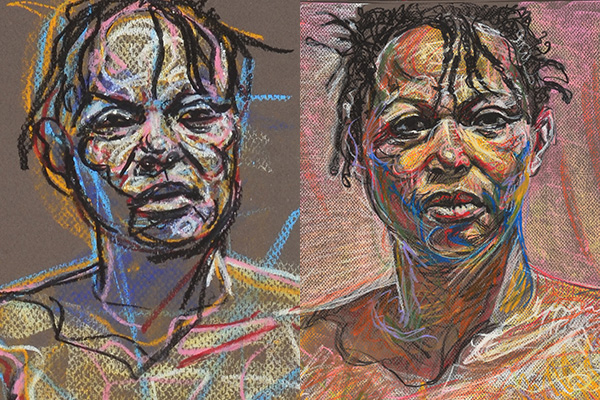
Sh About to Rise, 2013, by Fred Hatt, details of sketch and final version side-by-side

Sh About to Rise, 2013, by Fred Hatt, details of sketch and final version side-by-side

The first post of Drawing Life was published on March 15, 2009, so the fourth blogaversary is upon us. I want to thank my readers, those that have been following since the start and those that have recently discovered the blog, those that subscribe by email and those that just check it out a few times a year. I just can’t help producing a constant flow of images – it’s my nature – but looking at the site stats and seeing how many people look in on what I post here, and especially receiving comments, motivates me to keep sharing with you through this forum. I invite you, dear reader, to tell me what you’d like to see more of here, questions you’ve wanted to ask me, or topics you think I should address. Please comment.

Some readers are mainly interested in figure drawing and art technique, some are interested in body art, others respond most strongly to the photographic visual essays, and still others to the art-historical surveys. For me, it’s all of a piece, all about my approach to visual art as a practice of self-development – a journey I have chosen as the central journey of my life, an effort to transform perception and a quest for mastery in an open-ended craft.

I long ago discovered that I needed a core practice, a strong trellis upon which to cultivate my twisty vines. For me, that core practice is figure drawing. It provides me with an ideal combination of discipline and inspiration, self-measurement and freedom to explore. Looking back over the last six months of posts on Drawing Life I noticed it’s been a long time since I just posted an update on my recent figure drawing work, and I’ve built up quite an archive of unposted work in the past year – enough to explore various themes in separate posts.

In my figure drawing practice I attend two regular weekly sessions, one of which (at Figureworks) consists of poses two minutes to twenty minutes in length, and the other of which (at Spring Studio) includes a single longer pose. Total drawing time on that pose, subtracting breaks, amounts to about two hours. It’s enough time to do a fairly refined drawing, though I approach it differently at different times, sometimes focusing on capturing a likeness, sometimes looking at subtleties of color or shading, sometimes studying the relationship of the face to the body or of the model to the surroundings, or any combination of these things. Sometimes I get off to a solid start and keep working on one sheet of paper for the whole duration of the pose. Other times I do a sketch and then start over again for one reason or another. This post is a collection of recent pairs of rough, sketchy versions and more finished versions of the same poses. It’s a way of looking into my process.  For each pair, my commentary will be inserted between the sketchy and polished versions.

Ch Diagonal, sketch version, 2012, by Fred Hatt

Ch Diagonal, sketch version, 2012, by Fred Hatt

Often I start out studying the whole figure and then decide to focus on a cropped view. This pose has a strong diagonal through-line, from right foot to head, with the model’s left limbs acting as right-angled buttresses.  After doing the sketch above, I decided I wanted to work larger to get more detail in the face, realizing that the diagonal tilt of the body worked in the composition without having to go all the way down to the right foot. In this case, the sketch was weak, but doing it helped to sharpen my perception for the more developed drawing.

Ch Diagonal, final version, 2012, by Fred Hatt

Ch Diagonal, final version, 2012, by Fred Hatt

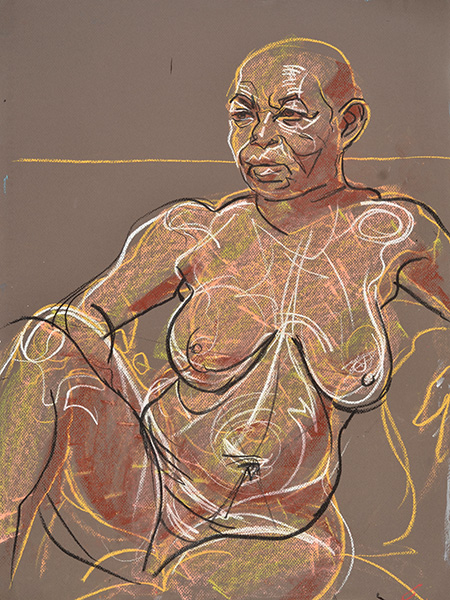
Sage, sketch version, 2012, by Fred Hatt

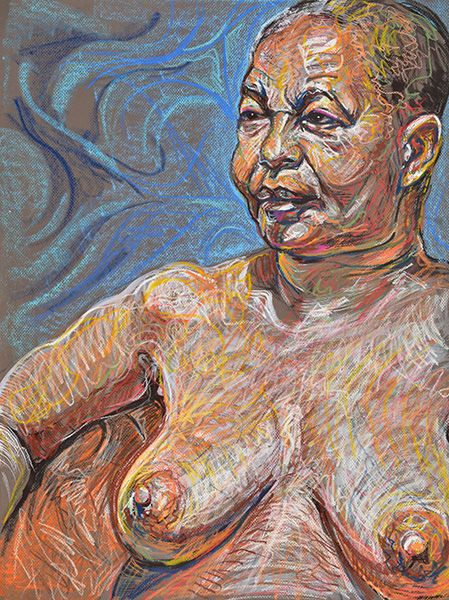
Here I felt the initial sketch was, in its rough form, a superb realization of my way of analyzing the figure, using curved lines to trace continuities of form, light, and body energy.  Further developing the drawing above would have obscured the white energy lines, destroying a drawing that is simple and intense. In this case I stopped, not because the sketch was weak or flawed, but because it was excellent in its undeveloped form. I went on to do the study below, applying most of my attention to the model’s face as an image of strong character and lived experience. I’m glad I stopped and saved the above version as a separate drawing, because it shows the robust, vibrant energy of the model’s abdomen, something that the second drawing omits.

Sage, final version, 2012, by Fred Hatt

Sage, final version, 2012, by Fred Hatt

B with Mannequins, sketch version, 2012, by Fred Hatt

B with Mannequins, sketch version, 2012, by Fred Hatt

This is a wonderful model I’ve drawn many times before. For this pose, she set up an array of background elements and I decided to place her in this spatial context, with the blocks and boxes, hanging fabrics, and tattooed mannequin parts around her. In my initial sketch, above, I tried to get everything in the frame.  Later, I decided to develop the drawing with the model more centered, omitting details on the left. But there’s something almost Matissean about the stripped-down, off-center composition of the rough sketch.

B with Mannequins, final version, 2012, by Fred Hatt

B with Mannequins, final version, 2012, by Fred Hatt

M with Stockings, sketch version, 2013, by Fred Hatt

M with Stockings, sketch version, 2013, by Fred Hatt

This model, a fine artist in her own right, has the artist’s sense of what will make an interesting pose. She came up with this Schiele-esque pose, angular, fascinatingly awkward, casual and odd, with one stocking on and one hanging from the hands. This kind of pose is complicated and not easy to draw. I studied it in the above sketch for several layers of light and dark forms, angles and curves and cut facets, before attempting the realistic/impressionistic monochrome rendering, below.

M with Stockings, final version, 2013, by Fred Hatt

M with Stockings, final version, 2013, by Fred Hatt

Cl Physique, sketch version, 2012, by Fred Hatt

Cl Physique, sketch version, 2012, by Fred Hatt

This model is a bodybuilder with incredibly defined muscles, and drawing him is an anatomical study. My initial sketch was an attempt to understand the pose, but I was craving more detail in the face and torso, and decided to develop the drawing in a vertical frame rather than the horizontal one with which I’d begun. This was a session I had to leave early because of a work obligation, so the second drawing here is less refined than some of the others in this post.

Cl Physique, final version, 2012, by Fred Hatt

Cl Physique, final version, 2012, by Fred Hatt

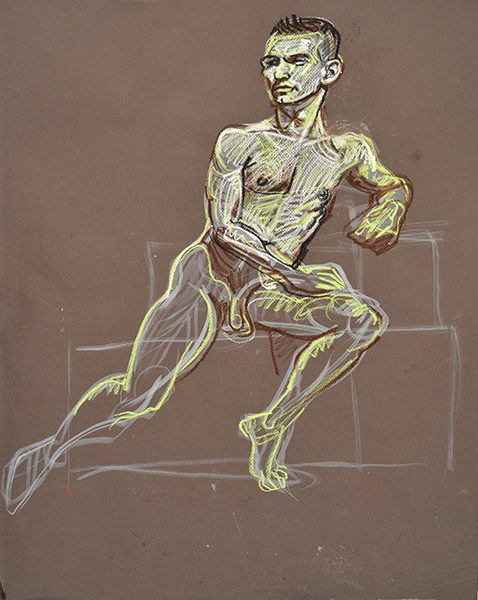
Sh About to Rise, sketch version, 2013, by Fred Hatt

Sh About to Rise, sketch version, 2013, by Fred Hatt

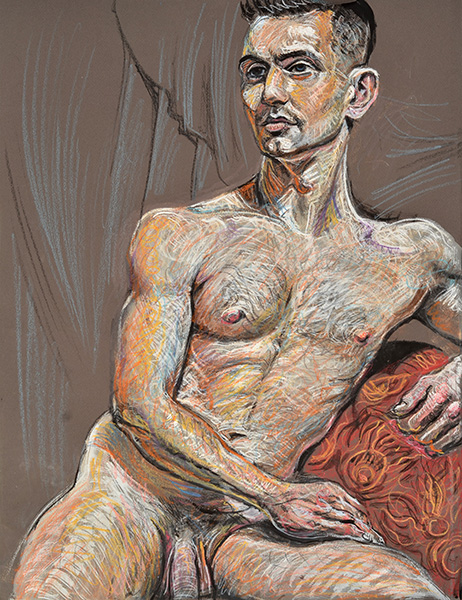
Here’s another one where the sketch was too good to ruin by developing it, and I felt the model’s face needed more space to show its character. These two drawings need to be seen together. The sketch above shows the character of the body, and the sketch below shows more detail in the character of the face. There’s a limit to the paper size that can be used n the context of the crowded group session. Sometimes I wish I could draw everything in life size.

Sh About to Rise, final version, 2013, by Fred Hatt

Sh About to Rise, final version, 2013, by Fred Hatt

Reclining K from Head End, sketch version, 2013, by Fred Hatt

Reclining K from Head End, sketch version, 2013, by Fred Hatt

This pair is done in my studio, not in the Monday morning long-pose session at Spring Studio, as are all the other examples in this post. Recently I’ve had an opportunity to work with the same model almost weekly in my own studio. I expect there will eventually be a post here about this experience. In my own studio I can work with dramatic lighting that is not practical in the group setting of Spring Studio, and can work directly with the model to refine the poses. After doing the rough crayon and gouache sketch above, the pose was modified to paint the foreshortened view below.

Reclining K from Head End, final version, 2013, by Fred Hatt

Reclining K from Head End, final version, 2013, by Fred Hatt

All of the original drawings shown in this post are roughly 19″ x 25″ (48 c 64 cm). Some are drawn with Caran d’Ache aqruarelle crayons alone, and some are painted in gouache, combined with the crayons.

2013/03/08

Opening with Projections

Filed under: My Events: Exhibitions — Tags: , , , — fred @ 09:06
Hostess, 2013, by Yuliya Lanina

Hostess, 2012, by Yuliya Lanina

This Saturday evening, March 9, 2013, my long-time friend Yuliya Lanina has a solo show opening at Figureworks gallery in Williamsburg, Brooklyn, in conjunction with Williamsburg After Hours‘ annual Armory Show weekend event.  I’ll be projecting video onto the sidewalk in front of the gallery, one animated piece by Yuliya and a video of my own in rotation.  The reception runs from 7-10 – please come see us.  Here’s the full info:

Yuliya Lanina
Honky-tonk Belles
March 9 – April 21, 2013
Reception: Saturday, March 9th from 7-10PM  *SPECIAL EVENT – SEE BELOW
at
FIGUREWORKS
fine art of the human form
168 North 6th St. (1 block from Bedford Avenue “L” train)
Williamsburg, Brooklyn, NY 11211
 hours: Saturday and Sunday from 1-6PM

Yuliya Lanina is a Russian-born American multimedia artist who splits her time between New York City and Austin, Texas. Having shown at Figureworks for many years, this solo exhibition highlights her most recent series of paintings and will also showcase her latest animatronic sculpture. This body of work portrays alternate realities that fuse fantasy, femininity, and humor.

Employing fanciful imagery from plants, animals and humans, Lanina’s characters simultaneously elicit feelings of uneasiness and empathy. Mostly female in gender, they are made of parts that are not supposed to go together and are derived from the artist’s own projections of nonsensical events and consequences. Painted on a stark white background, the primary isolated figure is accompanied by small winged creatures and quirky floral personas – all gesturing to get her attention. These unusual compositions celebrate feminine power and its connection to the mysterious, the beautiful, and the sensual.  Lanina’s largest canvases are now introducing some intricately tattooed appendages that personalize and provide greater insight into these mysterious beings.

Lanina draws from many sources to create these characters. Though she often taps into Greek mythology with the half-human and half-animal demigods, she also relies on her personal roots with Russian fairy tales, which are filled with fantastic beings deeply rooted in paganism, mysticism, and symbolism. Her creatures and their stories move freely between logical and illogical, realistic and illusory, predictable and surprising, representing life that can only be lived, but never understood.

Bringing these two dimensional characters to life, Lanina has collaborated with Theodore Johnson (technical direction) and Yevgeniy Sharlat (musical score) to create “Honky-tonk Belles”, a festive, animatronic sculpture with characters from her paintings frolicking to an original soundtrack.

Figureworks is located at 168 N. 6th St., Williamsburg, Brooklyn, NY 11211, one block from the Bedford Avenue “L” train. The gallery is open to the public Saturday and Sunday from 1-6 PM and is dedicated to exhibiting contemporary and 20th century fine art of the human form.

For more information please email harris@figureworks.com, call the gallery at 718-486-7021 or visit us online at www.figureworks.com

* THIS RECEPTION COINCIDES WITH A SPECIAL WILLIAMSBURG EVENT:

Williamsburg After Hours

7 pm to 10 pm
Sat March 9th

Powered by WordPress

Theme Tweaker by Unreal