DRAWING LIFE by fred hatt

2010/08/26

Synapse Opens September 2

Filed under: My Events: Exhibitions — Tags: , , , , — fred @ 22:47

Hand stencils, Santa Cruz Cueva Manos, Argentina, circa 7370 BCE (postcard image for "Synapse" exhibition)

SYNAPSE, a group exhibition curated by Anthony Troncale

2/20 Gallery

220 West 16th Street

New York, NY 10011

212-807-8348

September 2 – 16,  2010.

Opening reception: Thurs., Sept. 2, 6:00 – 9:00pm

rsvp:  atroncale@yahoo.com

Artists included in the exhibition:

Dan Leo

David Schafer

Eric Olson

Marilyn McLaren

Michelle Beshaw

Josh Gura

Anthony Troncale

Bill Eldred, Jr.

Fred Hatt

Yuri Lev

If you’re in town come and meet me and Anthony and the other artists in the show.  Here’s one of two pieces I’m showing in Synapse:

Creature, 2010, by Fred Hatt

2010/08/24

The Landscape in Motion

Filed under: Video: Natural Phenomena — Tags: , , — fred @ 07:54

August from Fred Hatt on Vimeo.

Click on the video to watch in HD on Vimeo.

I spent last week visiting my brother in Western Massachusetts.  He lives in a rural area surrounded by forests and wetlands.  I was struck by the sound environment there.  Far from highways and flight paths, it was clean of the technological noises that are constant in my usual urban setting, but it was hardly quiet.  With my eyes closed I could hear the densely woven tapestry of sound surrounding me in omnidirectional space:  crickets and cicadas, birds and bees and frogs, and the constant burbling of a stream, shallow from the late summer drought.

Still from "August", 2010, video by Fred Hatt

I wanted to take a sample of this sound to bring with me to the city.  The only audio recording device I had with me was a small camcorder with a reasonably good microphone, but no tripod.  So I set the camcorder down on various flat rocks and let it run for two or three minutes each in a variety of locations.  In the bright sunlight I could hardly see what kind of images I was recording.

When I had the chance to play back my recordings, I was struck by the images I had captured, almost without thinking of it.  The view of the natural environment was intimate, up close and from ground level, a frog’s eye view.  Every scene was filled with motion, the constant fluctuation of wind, light, water, and life in all its forms.  It was a beautiful portrait of teeming Gaia in late summer, simultaneously harmonious and chaotic, serene and tempestuous.

Still from "August", 2010, video by Fred Hatt

The five minute edit presented here is a landscape picture in sound and motion.  There are no characters, no events, no ideas.  This absolutely minimal way of using video highlights its richness as a medium for capturing the texture and energy of the natural world, a little love letter to Mother Earth in the technology of our time.  Watch it in HD, and with headphones if possible.

For another of my experiments in minimalist video, depicting a different setting and season, see “November”.

2010/08/13

Profile View

Filed under: Figure Drawing: Portraits — Tags: , , , , — fred @ 14:50

Kika Eyes Closed, 2002, by Fred Hatt

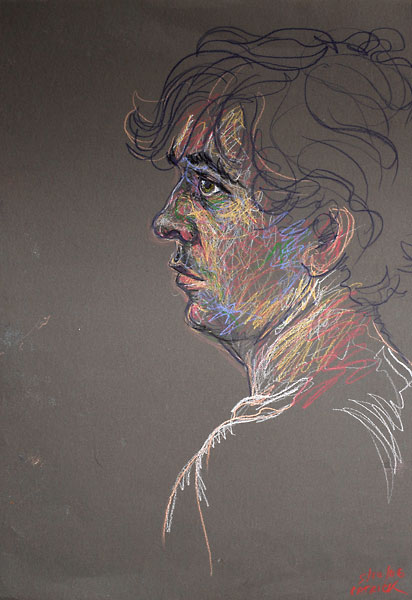
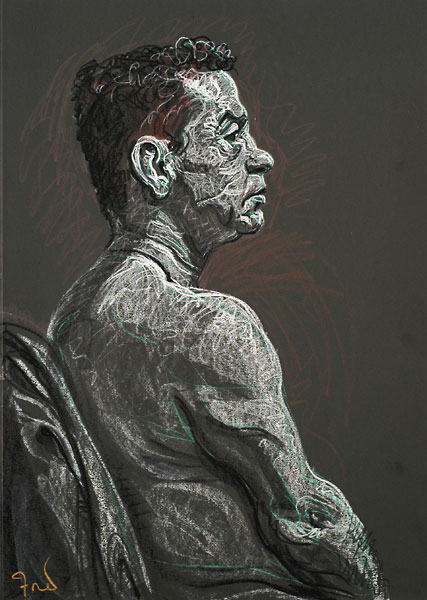
The profile or side view of the face has been a standard for coin portraits since ancient times, probably because it remains recognizable even when worn smooth.  The contour of the front of the face, and of the head and neck, conveys the individuality of the subject even when it lacks such significant interior details as eyes and ears.

A couple of decades ago, the side view of the face would probably have been the first meaning of the word “profile” to come to mind for most people.  Now the word is more likely to evoke a Facebook profile, a company profile, “racial profiling” or some such more informational expression of identity.  Facebook profiles include profile pictures, of course, but hardly anyone uses a side view.  It’s just not the way people see themselves.  But the side view can be a distinctive and highly expressive aspect of the human face.  In this post I’ve gathered together a variety of my own drawings of faces in the profile view.

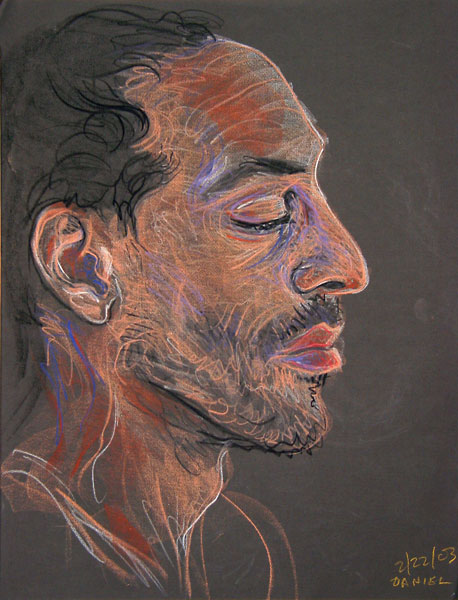
Daniel Eyes Closed, 2003, by Fred Hatt

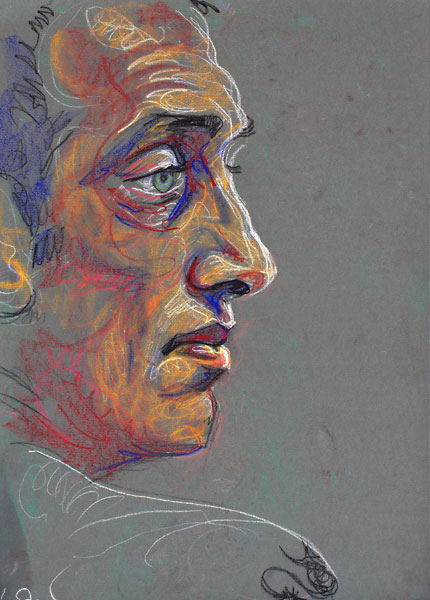
The subject of the drawing above has bold, prominent features, but his energy is turned inward as though in meditation.  The one below has a similar facial contour, but the pale eye and the shadows and wrinkles around it, give it a completely different expression.

Scott, 2008, by Fred Hatt

In the drawing below, the primary light source is behind the subject, making the facial contour both a bright line and an indicator of the more complex three dimensional structure of the face.

Che, 2002, by Fred Hatt

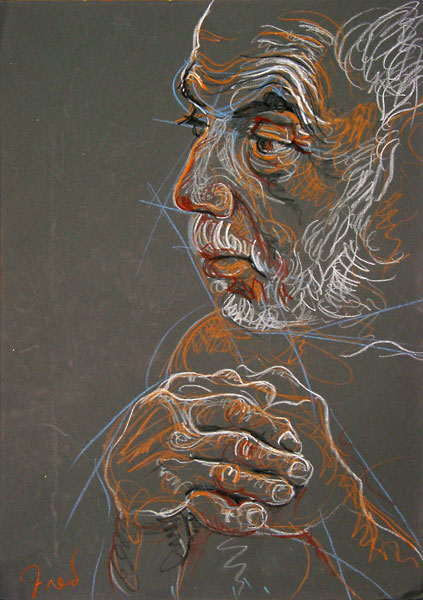
Below, the internal contours of hair and beard and brow wrinkles add a lot to the feeling of the personality of the subject.  As in the sketch above, you can see part of the eyelid of the hidden side of the face, which gives a clearer direction to the gaze.

John, 2002, by Fred Hatt

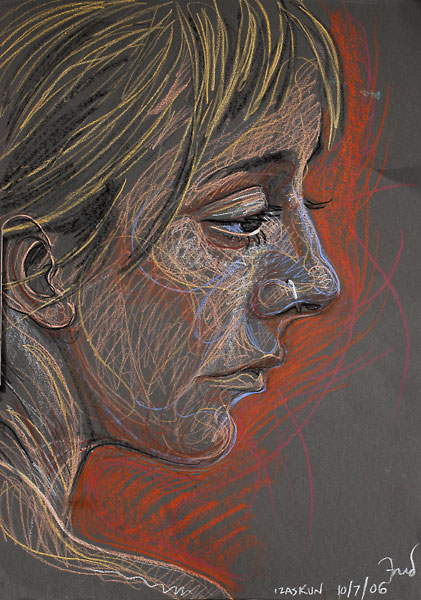
The angles of nose, jaw and brow help to define the individuality of the face.  The eyelids and the usually shadowed area where brow, eyelid and nose meet are also significant forms.

Izaskun, 2006, by Fred Hatt

Alley, 2009, by Fred Hatt

The way a person arranges, or does not arrange, their hair, and the way the neck carries the head atop the body, are other distinctive aspects of the body that convey personality, and that can be observed in most of these examples.

Patrick, 2006, by Fred Hatt

The arrangement of the neck and jaw in particular can give a profile a more sensitive or a more aggressive appearance.

Vinnie, 2009, by Fred Hatt

In the side view of the face, the ear is a central element.  The human ear is a wonderful convoluted shape, with considerable variation in size and overall shape among individuals.

Tram, 2008, by Fred Hatt

Hair can alter or emphasize the shapes of the head, as in the jutting beard above or the haircut below that reinforces the rectangularity of the model’s head.

Robert, 2004, by Fred Hatt

Marilyn, 2010, by Fred Hatt

Sometimes the neck and collarbone and shoulders are nearly as expressive as the face.  When I am drawing I often feel that I am exploring a landscape of hills and valleys, ridges and chasms.

Tanya, 2005, by Fred Hatt

Rios, 2010, by Fred Hatt

On a hairless head, the face and the skull are unified.  Hair often frames the face and disguises the shape of the rest of the skull.  This can make the face look larger or smaller in relation to the head.

Theresa, 2010, by Fred Hatt

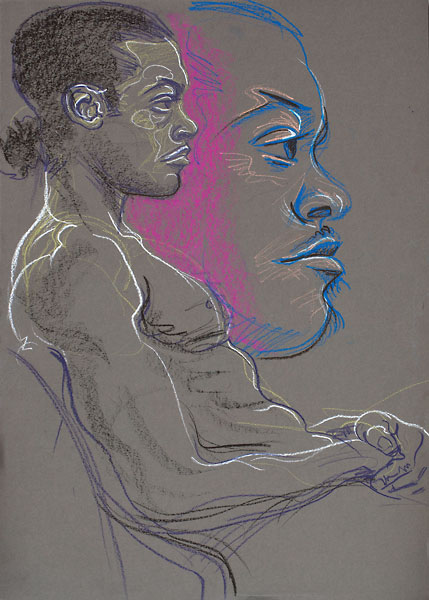
In the drawing below, I knew I hadn’t captured the contour of the face accurately in the full upper body sketch.  Projecting the face in a larger size made it easier to capture this model’s distinctive profile.

Corey Two Profiles, 2009, by Fred Hatt

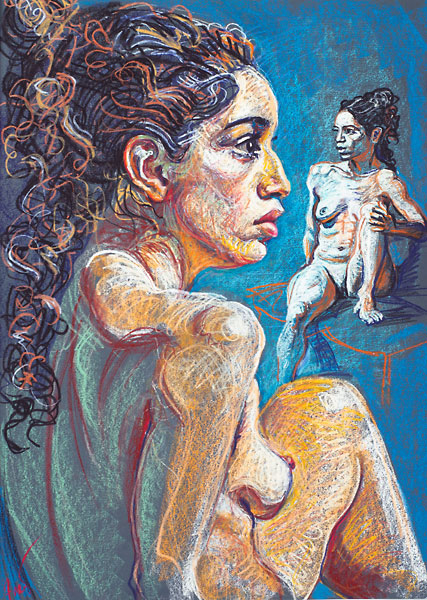
In the drawing below, I did the face large, and the full body smaller, from the opposite side.

Ivanhova Two Views, 2010, by Fred Hatt

And in my final example, two models posing together show very different facial structures.  The female figure in the foreground has prominent cheekbones, shallow eye sockets, and a relatively flat nose.  The male figure behind her has a prominent brow ridge and a more pointed nose.  Both models are sitting back, resting on the elbows.  The female settles her head into the shoulders, while the male’s head is slightly more lifted.  In drawing from life, capturing a likeness relies very much on observing the subtle differences that make each person physically unique.

Sasho & Tin, 2010, by Fred Hatt

The drawings in this post are in the range of 18″ x 24″ to 20″ x 27″, drawn in aquarelle crayon on paper.  Most of these were done during life drawing sessions at Spring Studio or Figureworks Gallery.  Some other side view portraits are among those in this earlier post.

2010/08/04

3D or Not 3D

Still from “Convergence”, 2010, video by Fred Hatt

I love stereoscopic or 3D photography for the way it turns a picture into a window.  I’ve posted some of my 3D photographs on this blog (here and here), converted from side-by-side pairs to the anaglyphic process, which can be viewed with cheap old-fashioned red/cyan 3D glasses (available free from this site).  I noticed that the more abstract shots were quite beautiful as anaglyphs without the 3D glasses.  This led me to imagine ways of making simple and abstract anaglyphic 3D images that could be appreciated either with or without the glasses.  One form of simplified image that has long fascinated me is the shadow, and I’ve done several shadowplay performances, including this one.  I’ve also noticed that two colored lights will produce overlapping colored shadows.  So it occurred to me that if the light source for a shadowplay performance were not a single white light, but side by side lights, one red and one cyan, the shadows would appear as 3D if viewed with red/cyan 3D glasses.

Stereo photography has been around almost as long as regular photography.  The stereoscopic 3D effect occurs because each eye sees from a slightly different angle, and the brain uses the difference between these views to perceive depth or distance.  3D photography or cinema uses various techniques to show separate views to each eye, creating the illusion of depth.  If you see a 3D movie at your local multiplex nowadays, the views are separated through the use of polarizing filters.  The anaglyphic technique is an older way of separating the views using colored filters.  In the shadowplay video I’ve made here, the slight offset between the two adjacent colored lights casting the shadows differs in exactly the same way that the views between your two eyes differ, and when the video is viewed with red/cyan glasses the shadows take on an illusory but very convincing depth.

Still from “Convergence”, 2010, video by Fred Hatt

But of course my intention here was to create something that would be equally, if differently, beautiful when viewed without glasses.  Seen in that way, the shadows are fringed in red and blue, and the lighter areas are in various shades of pink, purple and violet.

The title “Convergence” refers to the coming together of contrasting principles: red and blue, light and shadow, male and female, giving and receiving, and also to the convergence of the eyes that is the basis of the 3D effect. The film portrays the fertile moment, the magical conjunction of opposites.

Still from “Convergence”, 2010, video by Fred Hatt

This film was produced simply and quickly, shot in one day in the studio at CRS, where I had my most recent art exhibit.  The performers are dancers Aya Shibahara and Masanori Asahara.  I was assisted in the production by Ignacio Valero, Yuko Takebe, Lili White and Alex Kahan.  The music is derived from music played at a ritual body painting performance I did at the Didge Dome at Brushwood Folklore Center back in 2002.  Drummer Daveed Korup got a bunch of percussionists, didgeridoo players, and others to play for that performance, and I sampled and remixed sound from a rather low-fidelity video made at that performance.

Stereoscopic or 3D cinema has been a passing fad several times over the past 50 years, and it’s currently enjoying its greatest possibility ever.  It’s a natural for computer-generated animation, which uses 3D graphics anyway, and James Cameron’s Avatar featured the most technically advanced form of 3D ever seen in mainstream commercial cinema.  I also recently had the opportunity to watch one of the FIFA World Cup games on ESPN 3D.  Unfortunately, most live action films now being released in 3D are really in fake 3D, a computer simulation applied after the fact to a movie shot in 2D, and I suspect the current 3D craze will be, once again, a passing fad.

So here I present my own very simple, very low-budget version of 3D cinema, that can be viewed equally well with or without the 3D effect:  “Convergence”.

convergence from Fred Hatt on Vimeo.

Powered by WordPress

Theme Tweaker by Unreal