
Headlights at Dusk, 2014, photo by Fred Hatt
You’ve probably heard of the GoPro Hero, the tiny high definition video camera designed for extreme sports. It can be clamped to a helmet, a surfboard, a bicycle, or a racing car to show the sedentary and screen-bound what their more daredevilish brethren and sistren see while risking their lives careening down mountainsides or surfing pipelines. In 2012, when Felix Baumgartner skydove out of a capsule 24 miles above earth, he was wearing five of these little cameras. One of my favorite GoPro videos was taken with the camera strapped to the back of an eagle soaring in the Alps.
Now I’m no extreme sportsman. I feel ill leaning over a third floor balcony and trip over carpet runners while walking at a normal pace. But I was intrigued with the possibilities of the GoPro to get shots from unusual vantage points and to capture subjective views, and since I work as a freelance videographer and photographer it seemed like a good idea to add an additional camera to the bag, especially one that costs a tenth of what my main camcorder cost and is smaller than one of its batteries. I’ve been experimenting with it for a few months now, and have gotten some interesting shots. One thing I didn’t expect to do with the GoPro was to use it as a still camera, but under the right conditions it takes remarkably good stills with its extremely wide-angle built-in lens. All the pictures in this post were taken in recent months with the GoPro Hero 3+. All of these were taken as stills, not frames from video footage.

Fountain Plaza, 2014, photo by Fred Hatt
Every camera lens has a field of view that can be described as a conical space extending out from the lens. What is usually considered a “normal” lens takes in an angle of view of about 45 degrees. A telephoto lens, the kind sports photographers use to get tight shots from a distance, might have an angle of view of twelve degrees or even much less. The GoPro lens angle of view is nearly 150 degrees, meaning it gets almost everything that is in front of it. If it’s clamped to the front of your surfboard looking up at you it can take in your whole height and also a majestic view of the waves swelling and curling around you. You can take a picture of a person from inches away, and that wide cone of view places that person in the context of a panoramic landscape extending all around him or her.
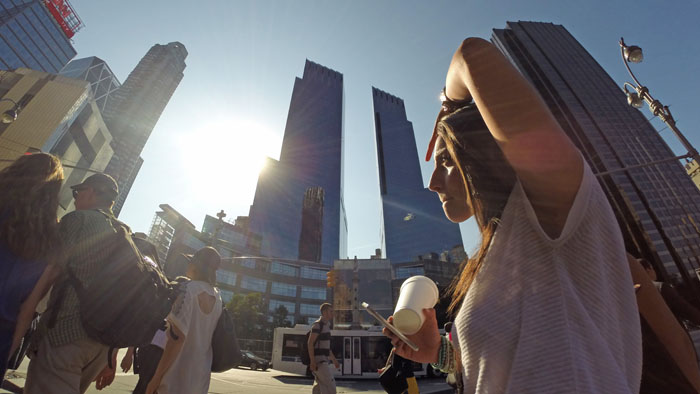
Columbus Circle, 2014, photo by Fred Hatt
If you’ve followed my urban landscape photography on Drawing Life you’ve noticed that I rarely take pictures of strangers. I’m not quite aggressive enough to shoot right at people without permission, and usually not quite socially dauntless enough to chat them up and get their consent. I found that the GoPro is so small – about half the size of a deck of playing cards – that I could just carry it around in one hand and no one even noticed it, even if I was taking their picture from inches away from them.

Rainy Day, 2013, photo by Fred Hatt
The ultra-wide view is good at capturing two spaces next to each other, an interior and an exterior space, or an opening from one space to another.

Stairs, 2014, photo by Fred Hatt
It dramatically emphasizes the converging lines of perspective.

Deli Flowers, 2014, photo by Fred Hatt
The default capture settings produce images that are highly contrasty and colorful. I changed the settings to soften contrast, since these wide views often include areas that are shady and areas that are sunlit in the same frame.
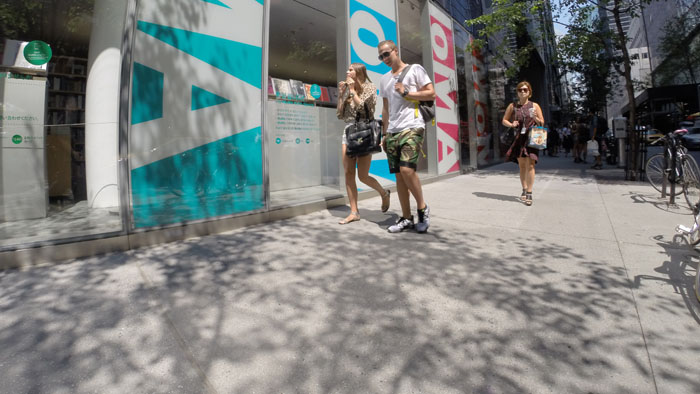
Mottled Shadows, 2014, photo by Fred Hatt
Many of these street views were shot while walking, holding the camera at hip level and not even pausing my stride. In bright daylight the shutter speed is fast enough that the images are sharp, but even overcast daylight makes the camera take a longer exposure that will often show motion blurring in these conditions.

Shades, 2014, photo by Fred Hatt
In the wide angle view, perspective affects everything. Vertical shapes loom and converge toward the sky, while the horizon line veers like the deck of a sailboat listing in the wind.

Manhattan Couple, 2014, photo by Fred Hatt
The image below shows the Henry Moore sculpture and reflecting pool at Lincoln Center, seen in another post on this blog in this very different shot (Comparing the shot at the link with the one below is an excellent illustration to contrast the different qualities of the wide angle lens and the narrow-angle telephoto lens). The exaggerated perspective of the GoPro makes it look like the sculpture is far, far away, across a great body of water.
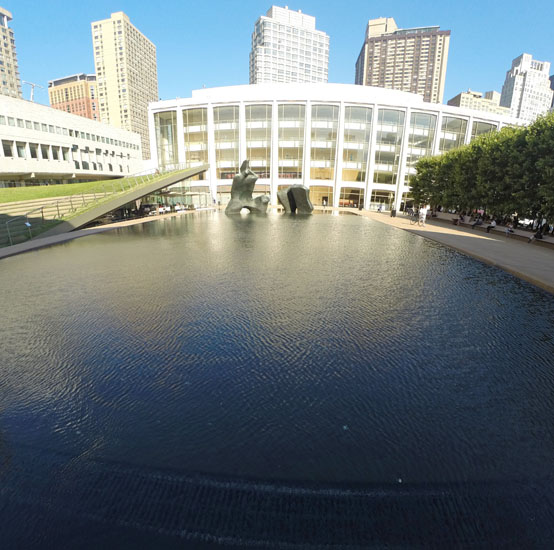
Reflecting Pool, 2014, photo by Fred Hatt
Here’s the skyline of lower Manhattan seen from the ferry to Governors Island.

Ferry, 2014, photo by Fred Hatt
Here’s a street vendor selling matted magazine covers. The shot, taken from a distance of maybe one meter, shows the vendor, all three sides of his display, and the underside of his colorful dual parasols.

Vendor, 2014, photo by Fred Hatt
A house interior shows an entire hallway seen through a door, with doors on either side and at the end, and a stairway on the right.

Hallway, 2014, photo by Fred Hatt
These food carts are seen in the context of the street, the sidewalk, the surrounding buildings, and the pedestrians.

Street Food, 2014, photo by Fred Hatt
Only such a wide view really captures the feeling of being in a supermarket aisle between great walls of food.
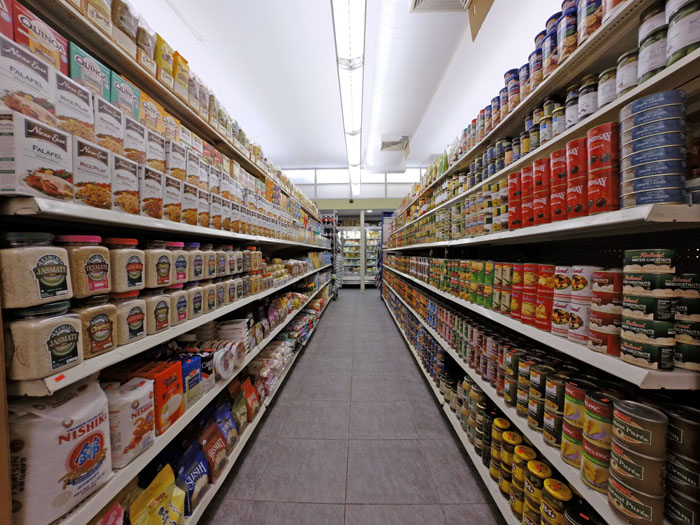
Aisle, 2014, photo by Fred Hatt
One night I returned home to find my street with a great trench dug in it, and an SUV-sized boulder there on the right – did that come out from under the street?

Street Construction, 2014, photo by Fred Hatt
And this was the truck they brought in to haul off that boulder.

Wide Load, 2014, photo by Fred Hatt
The wide view shows the buildings surrounding the people. A vertical city expresses the aspirations of a vertical species.

Red Skirt, 2014, photo by Fred Hatt
An organization called the Sculptors Guild has a gallery in a huge old house on Governors Island. The rooms themselves are sculptural spaces.

Sculpture Show, 2014, photo by Fred Hatt
The wide view captures something of the sensation of being inside a space or being within surroundings.
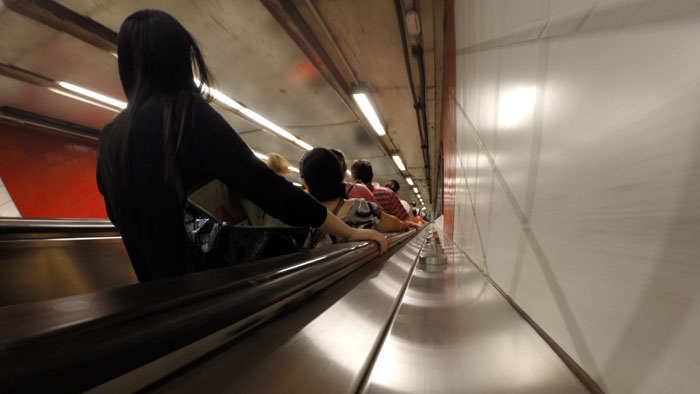
Subway Escalator, 2014, photo by Fred Hatt
Professional photographers these days tend to favor the narrow-angled telephoto lens, that isolates its subject and blurs the background. It eliminates distractions and distortions, and often has a glamorizing quality. The wide angle view has the opposite effect – emphasizing the distortions of perspective, seeing everything sharp both near and far, subjects not set apart but set within a whole scene.

Pretzels, 2014, photo by Fred Hatt
The narrow view is about objects. the wide view is about space.
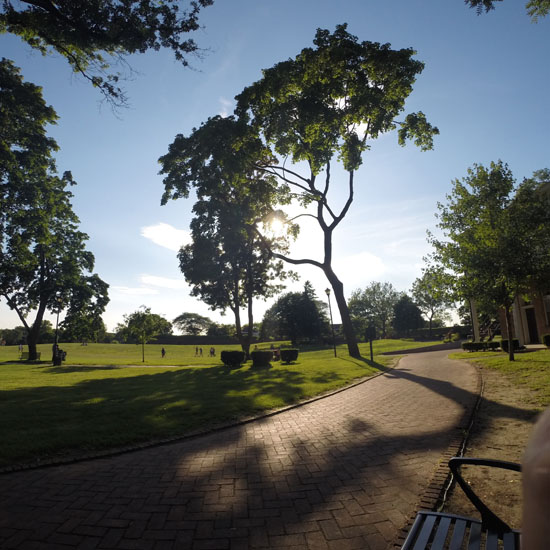
Backlit Tree, 2014, photo by Fred Hatt
The wide view is dynamic and expansive.

Photographer, 2014, photo by Fred Hatt
The practice of photography is a way of learning how to see the world. Different techniques, different approaches, and different lenses are different ways of seeing. Shooting with a wide angle lens makes me feel spaciousness. It is a curative for the feeling of being hemmed in by the density of the city.

Street Lines, 2014, photo by Fred Hatt
We put ourselves in enclosures to move around in the world – private cars and public cars. The wide lens makes these interiors seem not like tight boxes, but like environments.

Self Portrait Driving, 2014, photo by Fred Hatt

Subway Interior, 2014, photo by Fred Hatt
In a more open vehicle we feel ourselves moving among the motile masses and the massive monoliths of Manhattan.
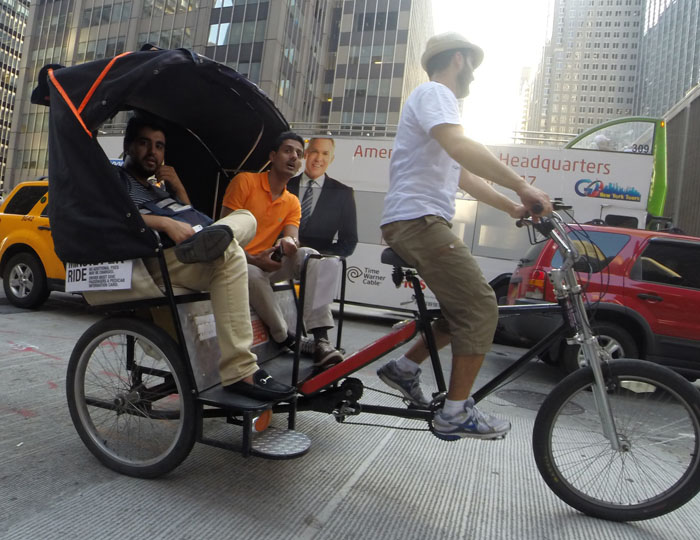
Rickshaw, 2014, photo by Fred Hatt
There’s a foreground – individual people right around us. There’s a middle ground – the constant traffic that circulates in the city like blood. And there’s a background – blocks of buildings and the grid of gaps between them that channel all that hurly-burly.

Crosswalk, 2014, photo by Fred Hatt
Life is movement in space. Open your view wide to take it in.

Limo Driver, 2014, photo by Fred Hatt


