DRAWING LIFE by fred hatt

2013/07/26

Surface Tension

Curled Back, 2013, by Fred Hatt

Curled Back, 2013, by Fred Hatt

On the scale of galaxies and bodies, the universe embodies the elegant equations of Einstein and Newton, but at the subatomic scale, it’s all quantum weirdness, a foamy chaos of particles popping in and out of existence. Processes of evolution have generated the great panoply of Gaian life, but to the individual creature it’s just an ongoing struggle to survive and thrive. A human life viewed in retrospect by a biographer can have the structural inevitability of an epic novel, but that same life lived day-by-day may be experienced as a jumble of more-or-less random encounters and issues.

I aspire to reflect this dichotomy of scale in my drawings: on the big scale, elegant form, while on the small scale, chaos. From a distance, I would like my drawings to appear realistic, even classical, while a closer approach reveals an underlying turbulence of colors and markings. I avoid blending and smoothing, as I feel the energy of the marks captures something of the living energy of my subjects. Vivid hues blend in the eye to give the impression of subtly variegated tones.

Curled Back (detail), 2013, by Fred Hatt

Curled Back (detail), 2013, by Fred Hatt

This scribbly way of rendering values and volumes takes some time, but a relatively limited ten- or twenty-minute sketch shows it in its roughest and perhaps clearest form. When I am working this way, I generally try to do so right from the start of sketching, not to draw in a more formal way and then add a layer of chaos as a veneer. The drawing holds together because it’s craziness all the way down.

Sketch in Primaries, 2013, by Fred Hatt

Sketch in Primaries, 2013, by Fred Hatt

Rough Torso, 2013, by Fred Hatt

Rough Torso, 2013, by Fred Hatt

In the early stages of drawing, value (lightness/darkness) is the most important consideration in choosing a color to draw with, while hue is a secondary concern. As the drawing develops and the values from shadow to highlight becomes well established, the relative lightness of additional marks has a diminished effect, and color becomes the primary reason to choose one crayon over another.

Seated Side, 2013, by Fred Hatt

Seated Side, 2013, by Fred Hatt

Seated Back, 2013, by Fred Hatt

The following drawings are mostly longer, more developed pieces made using this technique of building a larger order out of small passages of chaos.

Curly Hair, 2013, by Fred Hatt

Curly Hair, 2013, by Fred Hatt

Human skin is never a flat surface color that can be matched the way a decorator might mix pigments to replicate a paint swatch. Skin is translucent, exhibiting properties of specular reflection and subsurface light scattering. Its coloration comes not only from melanin and other pigments inside the skin, but from the colors of blood and muscle and connective tissue showing through it. It has constant subtle variations. Figurative artists have all sorts of esoteric methods and theories for capturing skin tones. The one that works best for me is additive color mixing with scribbly strokes.

Poet, 2013, by Fred Hatt

Poet, 2013, by Fred Hatt

Green Blue Purple, 2013, by Fred Hatt

Green Blue Purple, 2013, by Fred Hatt

The great magic of figurative art is to capture the sense of aliveness of the subject. By expressing energy in the vigorous markings at the smaller scale of the drawing, I hope to convey the feeling that this person I am showing you is alive, is full of breath and blood and might potentially move or speak at any moment. I put as much of my own energy as possible into the work of drawing, and I want to preserve the record of that kinetic energy in the markings that compose the image.

Sculptor, 2013, by Fred Hatt

Sculptor, 2013, by Fred Hatt 

Body Artist, 2013, by Fred Hatt

Body Artist, 2013, by Fred Hatt

The model expresses her or his energy through the body, the pose and expression. The process of seeing and drawing is necessarily a process of abstraction, as this living being is translated into perceptions of angles and curves, contours and volumes. The magic of capturing aliveness depends on not letting the subtler aspects of the subject get lost in that translation. I try to achieve it by approaching everything as energy. Life is energy, the body is energy, perception is energy, mark-making is energy, a completed drawing is energy.  Energy is the aspect that unifies every stage of the process.

Ballerina, 2013, by Fred Hatt

If, while drawing, even one thing you see or do is dead, the drawing dies. All of it, every object, every mark, every thought, every moment, is alive. In this way, the drawing is full of life.

Rodinesque, 2013, by Fred Hatt

Rodinesque, 2013, by Fred Hatt

All of these drawings are roughly 19 1/2? x 25 1/2? (50 cm x 65 cm), aquarelle crayon on gray or black paper. “Curled Back” is done in a combination of aquarelle crayon and gouache.
2013/07/05

Night Light

Filed under: Photography: Light — Tags: , , , , , — fred @ 23:09
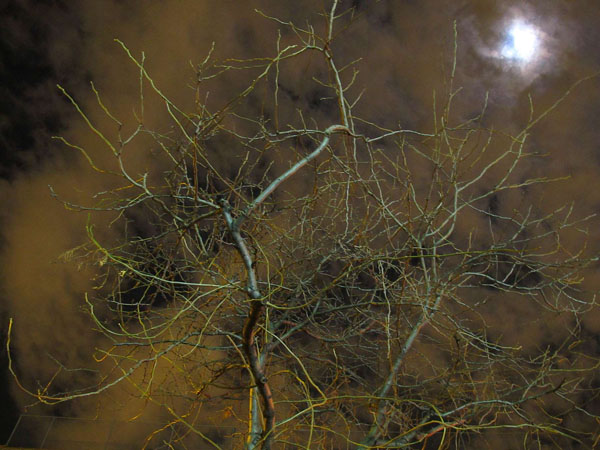
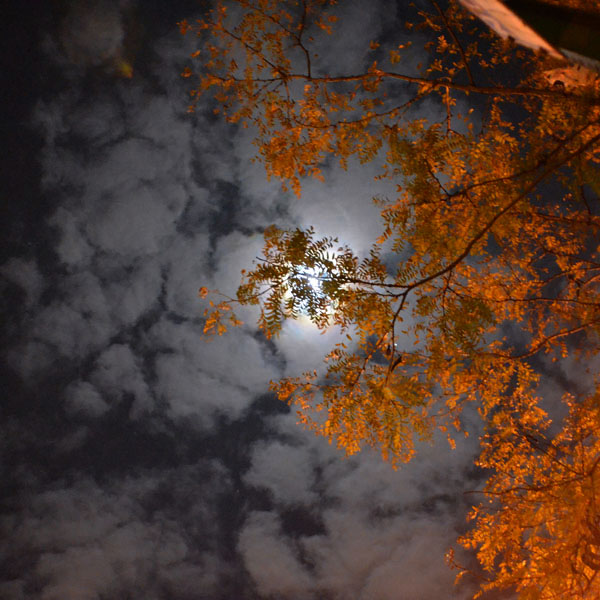
Tree and Moon, 2011, photo by Fred Hatt

Tree and Moon, 2011, photo by Fred Hatt

This is a post about the beautiful effects of artificial light photographed outdoors at night in New York City, one of the kinds of visual essays I’ve often featured on Drawing Life. It has nothing to do with the art I’m working on now. In recent months, I’ve been busier than ever with paid work as a projectionist, photographer, and videographer, and I’ve been using the improved cashflow to keep myself busier than ever with drawing and filmmaking. I’ve been doing consistent experimental figure drawing work in my studio with a few wonderful model-collaborators, pursuing fresh developments in the practice – but I’m not ready to show this work yet. Nowadays people tend to share every new thing in their lives immediately on Facebook or Twitter, but I think there’s something to be said about the old approach of laboring in obscurity and then going public with something fully-formed. I also have new video projects in the works, also not ready to share. In the meantime, I’ll keep the blog going with the kinds of posts you’ve come to expect, with new posts a little less frequent than they have been in the past. The new work will come out when it’s done.

So for now, please join me on an urban nocturne. Let’s go for a night drive.

Self Portrait Driving, 2012, photo by Fred Hatt

Self Portrait Driving, 2012, photo by Fred Hatt

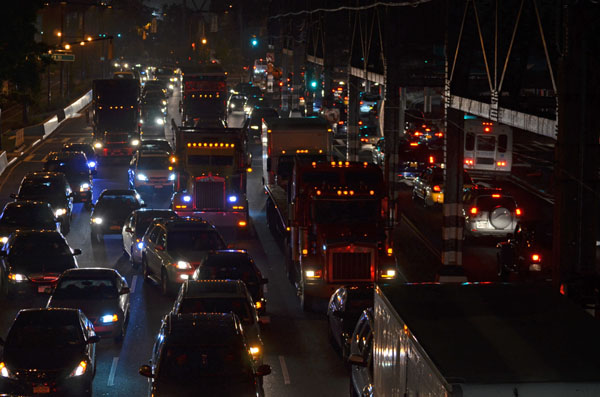
The Sun, when it’s up,  is such an alpha dog that all other lights are wheezing three-legged omega chihuahuas at best. But at night there are billions of light sources, and all of them coexist in a Milky Way of rough equality.

Expressway Lights, 2013, photo by Fred Hatt

Expressway Lights, 2013, photo by Fred Hatt

All these little lights make their own pools and shadows, vie with each other and merge with each other. If the Sun is God, all the little lights are like God’s creatures, tiny emanations or embers of the Great Fire, mobile and competitive, transient and ephemeral.

Queensboro Bridge Onramp, 2012, photo by Fred Hatt

Queensboro Bridge Onramp, 2012, photo by Fred Hatt

The beams of night shine in a world of swirling particles.

Headlights in Snow, 2013, photo by Fred Hatt

Headlights in Snow, 2013, photo by Fred Hatt

Taxi and Bikes, 2012, photo by Fred Hatt

Taxi and Bikes, 2012, photo by Fred Hatt

Daylight is objective in its distance. Daylight shadows are orthographic projections – every beam of light that forms them comes from the same direction. Shadows formed by artificial lights at night have perspective – they expand with distance from the source of light.

Leaning Meter, 2013, photo by Fred Hatt

Leaning Meter, 2013, photo by Fred Hatt

Light sources at night often strike surfaces at oblique angles that reveal texture.

Blue and White, 2012, photo by Fred Hatt

Blue and White, 2012, photo by Fred Hatt

Brick Wall, 2012, photo by Fred Hatt

Brick Wall, 2012, photo by Fred Hatt

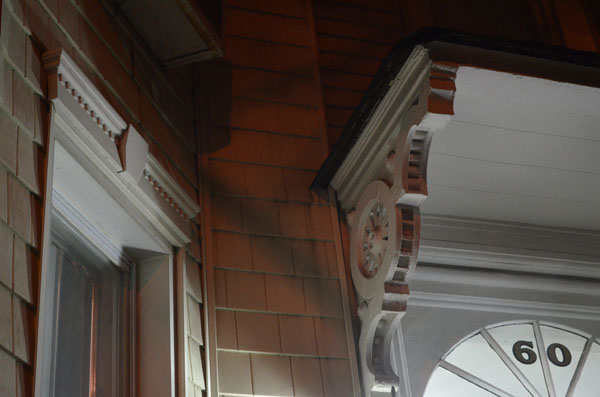
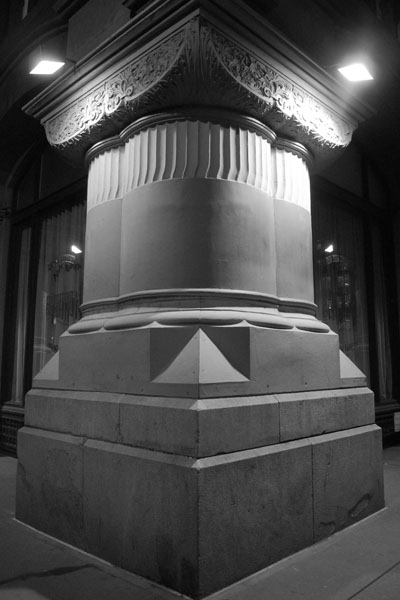
Nearby light sources sometimes impart a looming quality to architectural forms that would look stolid and stodgy in sunlight.

Architectural Elements, 2013, photo by Fred Hatt

Architectural Elements, 2013, photo by Fred Hatt

Squat Column, 2011, photo by Fred Hatt

Squat Column, 2011, photo by Fred Hatt

Neo-Romanesque, 2012, photo by Fred Hatt

Neo-Romanesque, 2012, photo by Fred Hatt

Church Door, 2010, photo by Fred Hatt

Church Door, 2010, photo by Fred Hatt

Escalator, 2013, photo by Fred Hatt

Escalator, 2013, photo by Fred Hatt

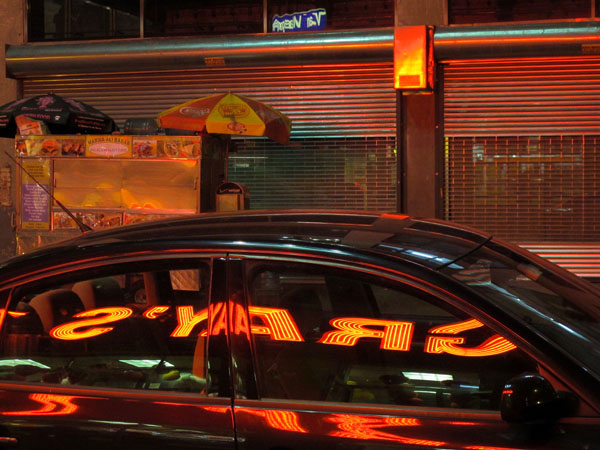
At night, reflective surfaces make beautiful landscapes out of the multitude of little light sources, and light shining out of interior spaces gives simple boxes a magical aura.

Reflections on Metal, 2013, photo by Fred Hatt

Reflections on Metal, 2013, photo by Fred Hatt

Food Cart, 2011, photo by Fred Hatt

Food Cart, 2011, photo by Fred Hatt

Taco Cart, 2012, photo by Fred Hatt

Taco Cart, 2012, photo by Fred Hatt

Cylindrical Windows, 2012, photo by Fred Hatt

Cylindrical Windows, 2012, photo by Fred Hatt

Plaza Fountain, 2010, photo by Fred Hatt

Plaza Fountain, 2010, photo by Fred Hatt

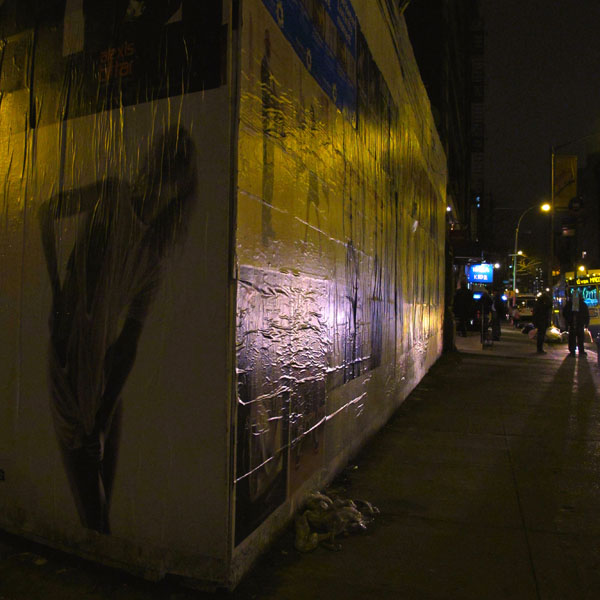
The sheen of reflective surfaces overcomes the surface details that might dominate our perception in the flat light of day.

Shiny Posters, 2010, photo by Fred Hatt

Shiny Posters, 2010, photo by Fred Hatt

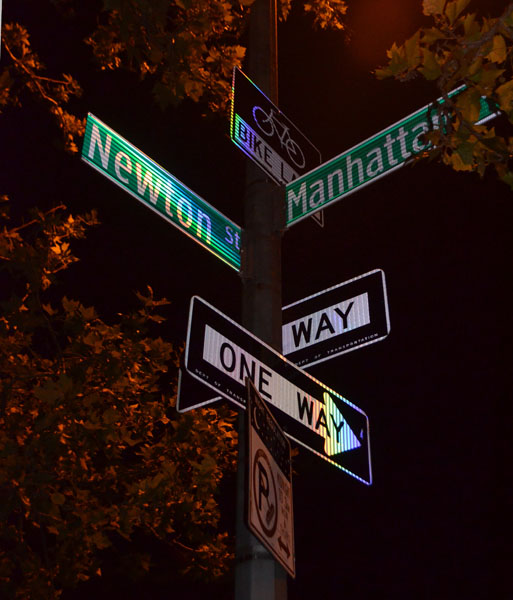
Retroreflective Signs, 2012Tree Shadow, 2010, photo by Fred Hatt

Retroreflective Signs, 2012Tree Shadow, 2010, photo by Fred Hatt

Burning Bush, 2013, photo by Fred Hatt

Burning Bush, 2013, photo by Fred Hatt

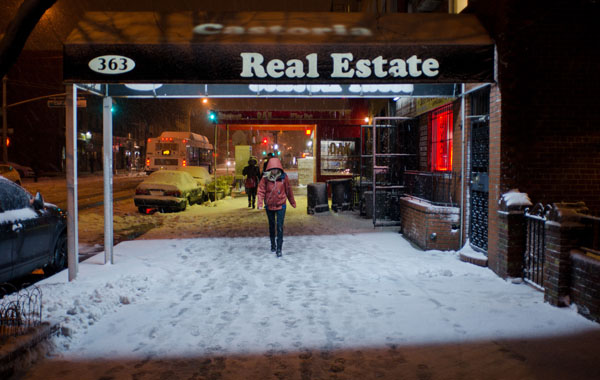
In the daytime, buildings are external structures, but at night they turn inside out, light revealing the life within.

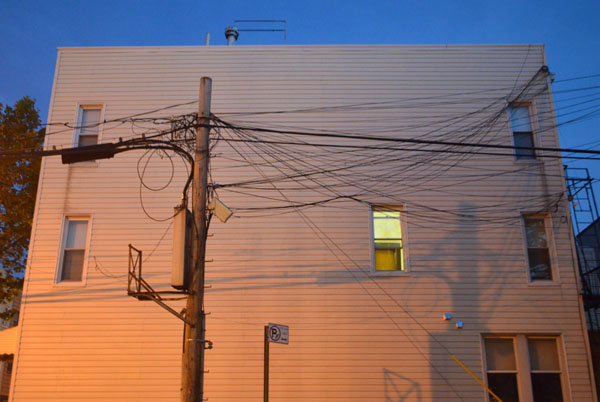
Pole and Wires, 2012, photo by Fred Hatt

Pole and Wires, 2012, photo by Fred Hatt

Metro, 2012, photo by Fred Hatt

Metro, 2012, photo by Fred Hatt

Office Building, 2012, photo by Fred Hatt

Office Building, 2012, photo by Fred Hatt

A city comes alive at night when light makes the insides of buildings more prominent than their outside forms.

Guitar Shop, 2013, photo by Fred Hatt

Guitar Shop, 2013, photo by Fred Hatt

Cheesesteaks, 2013, photo by Fred Hatt

Cheesesteaks, 2013, photo by Fred Hatt

Square of Light, 2013, photo by Fred Hatt

Square of Light, 2013, photo by Fred Hatt

A sufficiently long-exposure photograph of a landscape taken under moonlight looks barely different from one taken under sunlight. Artificial light, though, comes from various different directions and has many different colors. A long exposure taken at night under multiple artificial light sources is a kind of light painting.

Garden at Night, 2010, photo by Fred Hatt

Garden at Night, 2010, photo by Fred Hatt

Vacant Lot at Night, 2013, photo by Fred Hatt

Vacant Lot at Night, 2013, photo by Fred Hatt

Winter's Moon, 2010, photo by Fred Hatt

Winter’s Moon, 2010, photo by Fred Hatt

Polish Crests, 2012, photo by Fred Hatt

Polish Crests, 2012, photo by Fred Hatt

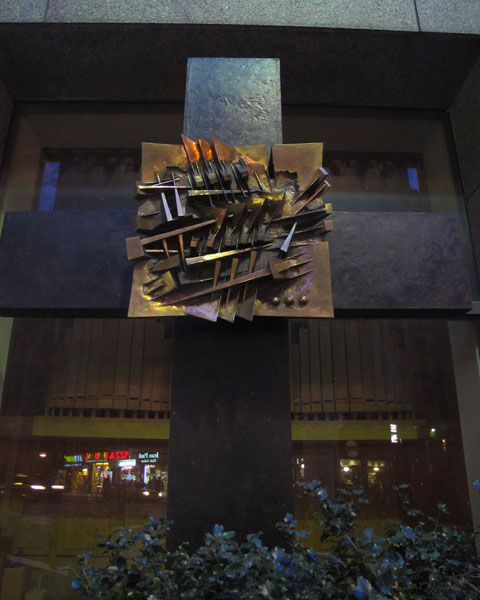
Abstract Cross, 2012, photo by Fred Hatt

Abstract Cross, 2012, photo by Fred Hatt

Colored lights, in the form of neon signs and tinted bulbs, make the night psychedelic.

Primary Hues, 2013, photo by Fred Hatt

Primary Hues, 2013, photo by Fred Hatt

Kellogg's Diner, 2013, photo by Fred Hatt

Kellogg’s Diner, 2013, photo by Fred Hatt

Red Neon, 2010, photo by Fred Hatt

Red Neon, 2010, photo by Fred Hatt

Christmas Lights, 2010, photo by Fred Hatt

Christmas Lights, 2010, photo by Fred Hatt

In the daytime, a hole in the ground is a black void, but at night, lit-up interiors and exteriors coexist and interpenetrate. A thousand tiny lights equalize space.

Restaurant Basement, 2013, photo by Fred Hatt

Restaurant Basement, 2013, photo by Fred Hatt

Powered by WordPress

Theme Tweaker by Unreal