DRAWING LIFE by fred hatt

2012/11/21

Fluidity

Filed under: Photography: Elemental Forces — Tags: , , , , , — fred @ 23:48

Liquid Topology, 2007, photo by Fred Hatt

Here in the States we’re celebrating Thanksgiving, a time to honor family, food and fellowship, and to contemplate gratitude.  Superstorm Sandy recently reminded those of us who live on America’s Mid-Atlantic coast of the destructive potential of water, but as I think of what I have to be grateful for, I am thinking of the water of life, the cyclical element that falls and flows, permeates and dissolves, irrigates and cleanses, rises and expands.  Water is the blood of the living Earth.  We New Yorkers are lucky to have plenty of rain that keeps our vegetation lush.  We have a great water system with remarkably clean tap water from upstate reservoirs.  In recent decades sewage treatment has made our coastal waters much cleaner than they used to be.  We need to love and protect our precious water!

My most basic artistic motivation is just to revel in the beauty that is all around us, and to share my perceptions with others, “Look, isn’t this amazing?”  I’m sure the sophisticates of the Art World find it as silly as the raptures of the “double rainbow” guy, but this way of looking at the world is not sentimental or delusional.   The world is a complex phenomenon of interacting forces, and the harmonies and tensions that emerge therefrom are myriad.  Aesthetic experience is fundamental to insight in science, philosophy, and the arts.

I’ve made a couple of posts of my photographs of fire (here and here), and one of my commenters, Heart_in_Water, suggested I do a post on water, the dynamic flow that complements fire in the ancient conception of elemental forces.  Herewith, a collection of my water shots.

People are instinctively attracted to water, seek it out and gather in its cooling presence.  Here’s a scene I came upon in Brooklyn’s Prospect Park, looking down from the top of a stream and waterfall.  A painter had set up an easel to make a study of the landscape, and a family took turns posing on the rocks and taking pictures of each other with their phones.  In the background you can see my friend Peter bending over to take off his shoes, compelled to dance in the stream.

Painter and Photographers, Prospect Park, 2011, photo by Fred Hatt

Even water in a city gutter can provide a glimpse of visual magic.  This standing water becomes a gap opening into a looking-glass city beneath the streets.

View of the Undercity, 2001, photo by Fred Hatt

The mirrorlike quality of still water is often used architecturally for this quality of opening up space.  Henry Moore’s monumental abstract bronze at Lincoln Center expands to twice its size in a reflecting pool.

Reclining Figure, 1965 sculpture by Henry Moore at Lincoln Center, 2012 photo by Fred Hatt

Emerald Mirror, Prospect Park, 2011, photo by Fred Hatt

Even still water moves on its surface.  The bronze angel does not move, but the reflected angel quivers in the wind like the leaves of a tree.

Angel of the Turbulent Surface (Angel of the Waters, 1868 sculpture by Emma Stebbins, at Bethesda Fountain, Central Park), 2008 photo by Fred Hatt

Macy’s in a Puddle, 2001, photo by Fred Hatt

Taxi’s Wake, 2005, photo by Fred Hatt

At night, reflected light does its shimmery shimmy on the surface of water.

Gold Under the Bridge, 2009, photo by Fred Hatt

Water on a Tar Roof, 2006, photo by Fred Hatt

The multiple image below shows the computer-controlled dancing water jets at the Brooklyn Museum, created by WET Design.  You can read this set from the bottom up:  the lowest image shows the initial burst of the water jets, the second picture shows them shooting high, and the higher images show the columns of water aloft as gravity begins to pull the droplets apart and back to earth.

Brooklyn Museum Fountain, 2006, photos by Fred Hatt

These fountains, with their unpredictable changing patterns, induce states of calm bliss in some who watch them, and screaming excitement in the children.

Fountain Joy, 2006, photo by Fred Hatt

The city is full of more traditional fountains, all of which celebrate the thrilling movements and sounds of water flying through the air and splashing down on itself.

City Hall Park Fountain, 2005, photo by Fred Hatt

Ring of Rain, Ring of Flowers, 2010, photo by Fred Hatt

Fragmenting Sprays, 2012, photo by Fred Hatt

As with fire, the shutter speed makes all the difference in photographing moving water.  A fast shutter speed freezes the water as clusters of individual droplets, while a slower shutter speed allows the movement to blur into streaks.  Sometimes a still photo of water looks like a sinuous sculpture in glass.

Belt of Water, 2005, photo by Fred Hatt

Fountain Dome, 2004, photo by Fred Hatt

Stairway Cascade, 2003, photo by Fred Hatt

Liquid Chandelier, 2012, photo by Fred Hatt

Dancing Waters, 2012, photo by Fred Hatt

Moving water has a prismatic quality – literally in the case of rainbows created by light shining through mists of droplets.  (Click this link for a good explanation of rainbows, moonbows, sundogs, and other variations on the phenomenon.)

Rainbow in Falling water, 2012, photo by Fred Hatt

Water refracts and reflects the light and object colors in its surroundings.  Water reflections weave together the colors of the environment without muddying the hues.

Wet Windshield, 2003, photo by Fred Hatt

Low Sun on the River, 2001, photo by Fred Hatt

The texture of the water’s surface varies according to the movement of the water itself and of the air moving over it.  The surface of rapidly moving water is dense with perturbation, while stiller water warps light in a more rubbery, tremulous fashion.

Rushing Stream, 2012, photo by Fred Hatt

Rain on Pond, 2012, photo by Fred Hatt

Fluidity, 2012, photo by Fred Hatt

White Splash on Green, 2012, photo by Fred Hatt

I’ve never been able to get good photos of the ocean or surf on the beach.  For me, those pictures never quite capture the immensity and power of the breathing sea.  Smaller bodies of water, ponds and streams and fountains and puddles, share with me and my camera a vision of Nature as master painter.

Water’s Edge, 2004, photo by Fred Hatt

Ducks’ Domain, 2010, photo by Fred Hatt

This Summer one of my favorite and often-visited bodies of water, the Prospect Park Lake in Brooklyn, was almost completely overtaken by invasive ferns and algae.  Apparently our extremely mild last winter played a part in this opaque bloom.  Water is vulnerable!

Carpet of Algae, 2012, photo by Fred Hatt

We are creatures of the Watery Planet.  Let us celebrate, respect, and protect the water of life.

Reflecting Pool, 2010, photo by Fred Hatt


2012/11/09

White & Black on Gray

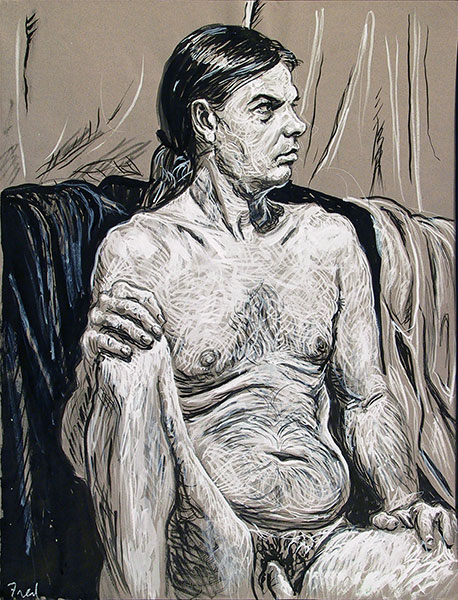
Ben, 2012, gouache by Fred Hatt

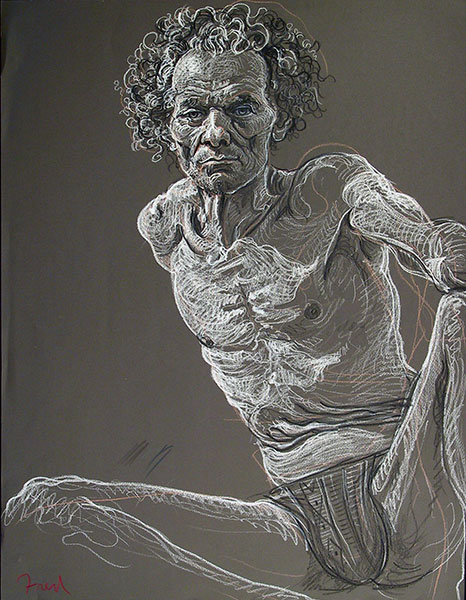
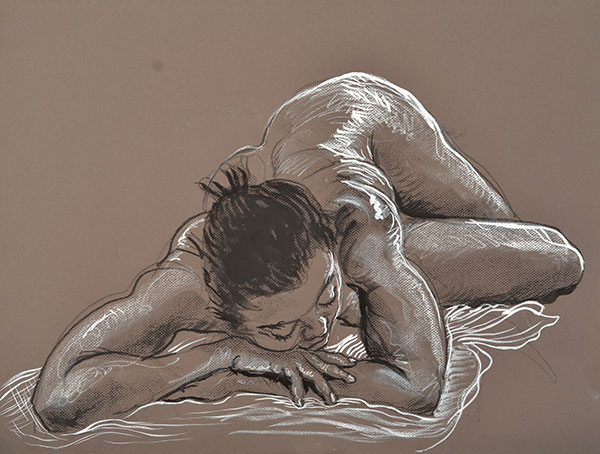
It’s a classic drawing technique used by figurative masters like Albrecht Dürer and Pierre-Paul Prud’hon (see beautiful examples by both artists at the links) – work on a gray or mid-toned paper or ground, draw highlights in white and shadows in black, and you efficiently produce a full range of values.  If you work on white paper, on the other hand, you are starting from one extreme and have to construct the whole scale going in one direction, which turns out to be difficult and time consuming.  Most of the values we see in a real-life scene are closer to middle gray than they are to pure white or black.  Starting from a gray ground isn’t just a more efficient way to draw, it’s a more subtle way to observe.  You see the variations in relation to the average, noticing the brightest highlights and the darkest shadows, then looking for areas that are a bit lighter or a bit darker than their surroundings.

When I first started attending life drawing sessions as a regular practice, back in the mid-1990’s, I quickly realized that speed is of the essence in both observing and marking.  The timer is always running, and the model can only hold the pose for a limited time, and the more interesting is the pose, the more limited is the time.  So I want to draw as much as I can as quickly as possible, and the gray paper technique is amazingly swift.  In this post I’ll share a variety of my figure drawings and paintings using variations of this technique in its monochrome mode, with observations that may be of interest if you draw or paint or are interested in the process of observational art.  Some aspects of my technique may be more evident in the absence of color.

Reclining Male, 1995, Conté crayon by Fred Hatt

It doesn’t really matter what order you do things in.  Sometimes I start with contour lines, then add some shading, then pick up the highlights. If the highlights are lightened, the gray ground can represent a basic shadow.

Man and Shadow, 1996, Conté crayon by Fred Hatt

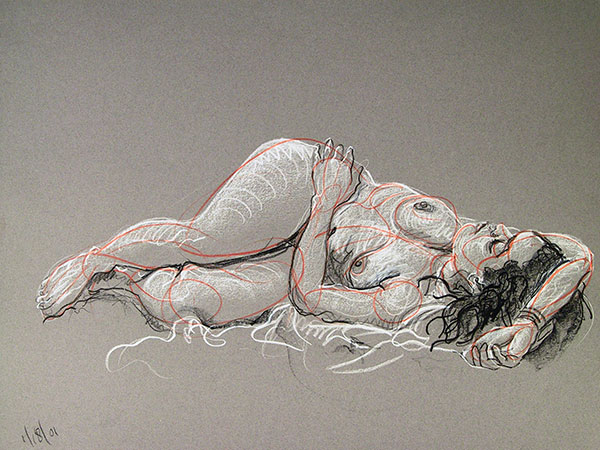
Sometimes I do a rough sketch with a colored crayon to figure out the overall structure, then use white to capture where the light falls on the subject, and black to deepen the crevices and the darkest part of the shadowy areas.

Reclining Curves, 1997, aquarelle crayon by Fred Hatt

I tend to prefer media like inks and crayons that don’t really blend, rather than ones like oil paint that blend easily.  The strokes of the pen or brush capture the energy of the process, and I don’t want those strokes to be lost in the smear of smoothness.  I try to make all the marks follow the three-dimensional contours as though they are moving over the surface of the subject.

Rudy, 1997, ink and gouache by Fred Hatt

It is light and shadow that make an image jump off the page.  The artist works out the structure of the image as it is projected onto a flat surface, but when light and shadow are added, the sketch is elevated to an illusion.

Head and Torso, 1998, aquarelle crayon by Fred Hatt

I often use color for the structural analysis phase of the sketch, working loosely, feeling proportion by the rhythmic progression of curves and the angular relationships of masses.  Then light and shade are added to make it all look solid.

Analysis of Reclining Figure, 2001, aquarelle crayon by Fred Hatt

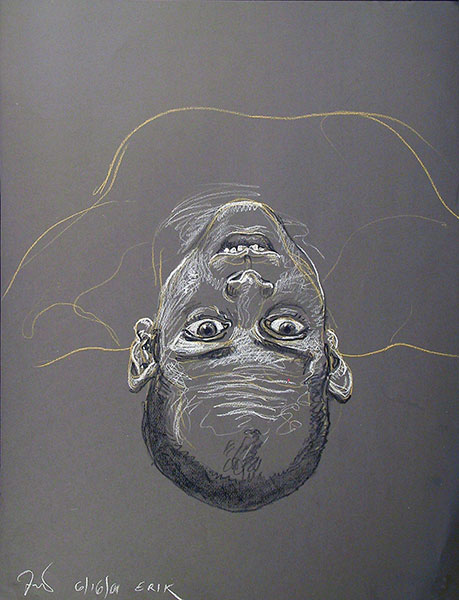
Light adds the third dimension to an image because it adds another directional aspect.  A line drawing of contours as seen from the observer’s angle is just shapes on a flat surface.  When we add light and shadow, we add another point of view.  The light illuminates certain surfaces and not others because it is coming from an angle different from the observer’s line of sight.  The paper plane, the sight line, and the light line are dimensions of pictorial seeing, just as the X, Y, and Z axis are the mathematical dimensions defining a three-dimensional space or form.

Erik Inverted, 2001, aquarelle crayon by Fred Hatt

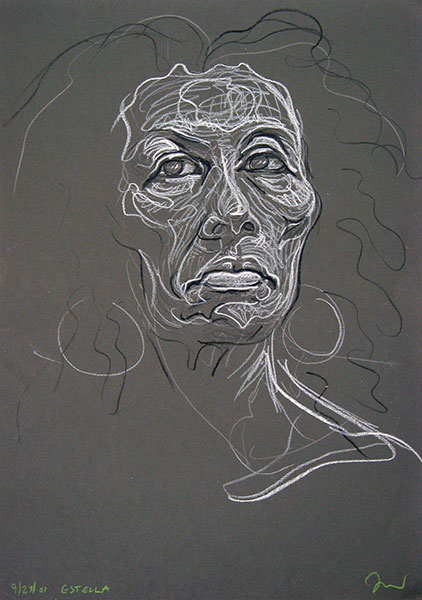
For me, the highlight areas usually reveal more form than the shadowy areas.  Sometimes I just dance all over the highlighted surfaces with white lines, staying very loose but always following the form.

Estella, 2001, aquarelle crayon by Fred Hatt

I try to keep my hand movement as free as possible, but the observations guiding them as clear and precise as possible.

George, 2001, aquarelle crayon by Fred Hatt

I am focused on light and shadow and form, but I want to let character and the quality of aliveness emerge from the process.

Arnold, 2002, aquarelle crayon by Fred Hatt

Hand on Thigh, 2002, aquarelle crayon by Fred Hatt

The human form is a complex arrangement of tension and impulse, layers of hard and soft and wiry and fluid.  There will always be much more there than you can capture with your eye and hand, but if you really go at it like a mad scientist you might get some of the feel of it in your sketch.

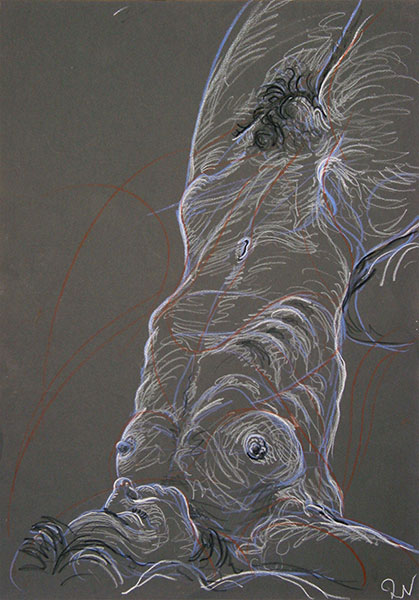
Inverted Torso, 2002, aquarelle crayon by Fred Hatt

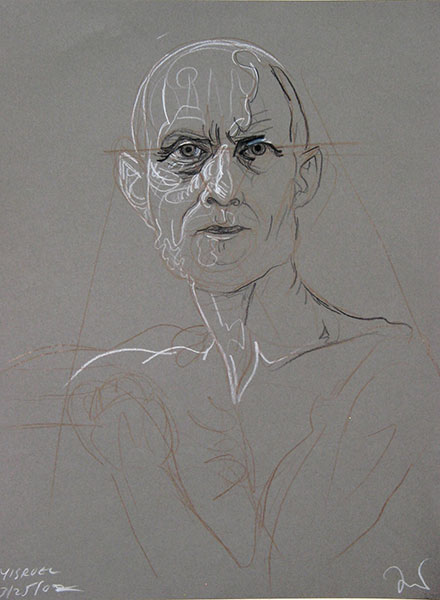
While the highlights reveal more of the subtle shapes of the surfaces, the dark lines define the most salient edges, the deep grooves, the biometric landmarks.

Yisroel, 2002, aquarelle crayon by Fred Hatt

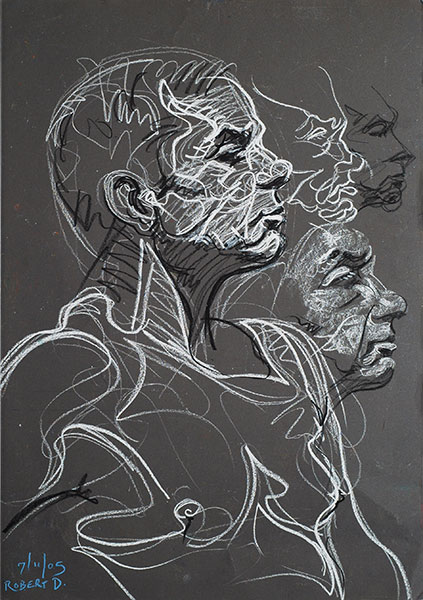
Sometimes I separate these aspects and repeat them, doing highlights or shadows now as lines, now as cloudy forms.

Studies of Robert, 2005, aquarelle crayon by Fred Hatt

Like color, the perception of values of light and dark is relativistic – every value is seen as lighter or darker in relation to its surroundings.  Starting with a gray ground allows us to draw relativistically, looking at every area in comparison to its surrounding average.  We let the gray ground be that local average, and use white and black to mark the local differences.

Andrew, 2006, aquarelle crayon by Fred Hatt

Much of my work is colorful, but if you ask me to name my favorite color, it will have to be gray.  Gray is the magical middle way, the point of balance, the axis, the mutable mean.  Holding the center maximizes freedom of movement.

Betty, 2010, aquarelle crayon by Fred Hatt

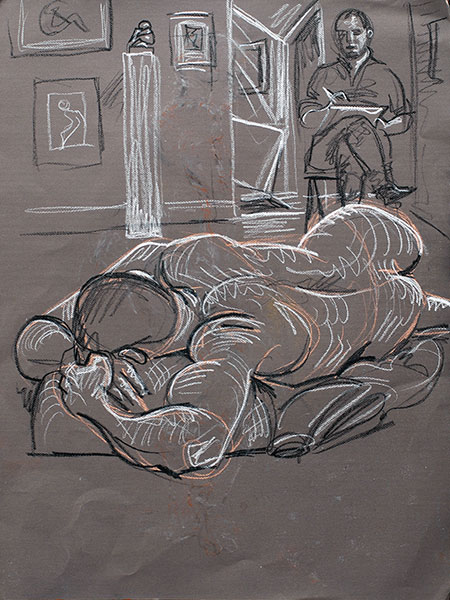
Light defines some aspects of a scene, and darkness defines other aspects.  Gray is the neutral ground, the zero that defines both positive and negative.

Model and Artist, 2010, aquarelle crayon by Fred Hatt

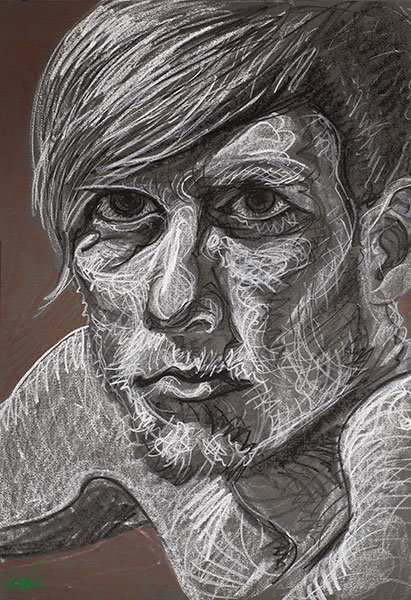
For many years I drew mostly with aquarelle crayons.  In the past year I’ve been experimenting more with gouache and watercolor paints, and sometimes combining these media with the crayons.  Rather than blending the paint, I tend to use fan brushes and cross-hatching techniques to add black to white, white to black, or either to gray.

Ben (detail), 2012, gouache by Fred Hatt

Above is a detail of the portrait that heads this post, a portrait drawn in about two hours in the session I supervise at Spring Studio.  Below is a larger-than-life scale portrait sketch made in a twenty minute pose in one of the figure drawing sessions at Figureworks Gallery in Brooklyn.  The technique is essentially the same, but the level of complexity is different.

Tinuola Profile, 2012, gouache by Fred Hatt

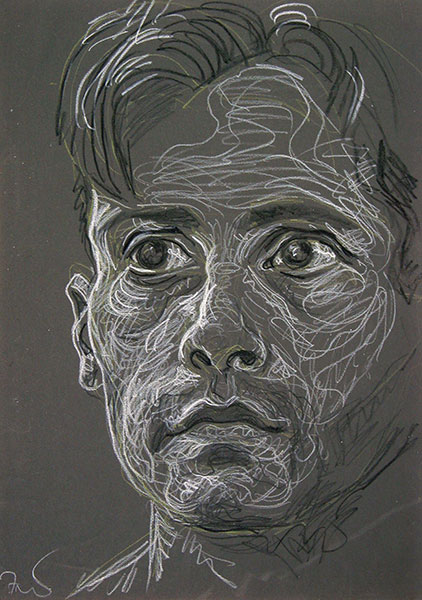
To translate light into line, I see light as a touch that strokes the figure, and I follow those strokes with my crayons and brushes.  White lines define the bright edges, and dark lines define the dark edges.  Scribbly strokes of white and black follow the subtler variations of tone.

Seated Back, 2012, gouache and aquarelle crayon by Fred Hatt

Here’s an attempt at a portrait of Claudia, the Museworthy blogger, from a session this past week at Spring Studio.  Claudia writes about art and life with a strong, engaging voice, shares a wide variety of great work, and gives a perspective on figurative art from the other side of the easel.

Claudia, 2012, gouache and aquarelle crayon by Fred Hatt

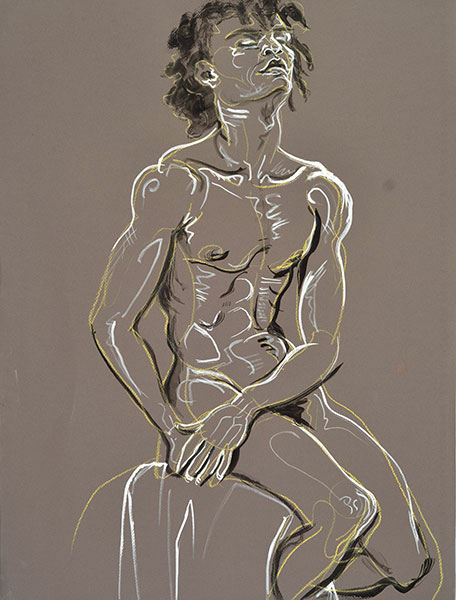
Sometimes I try to simplify lit areas into simple brush gestures with white paint.  The dark lines tend to define simpler, more straightforward contours anyway.  Reducing highlighted areas to white gestures brings dark and light into beautiful equilibrium.

Strength at Rest, 2012, gouache and aquarelle crayon by Fred Hatt

Part of the artistic prestige of sculpture and of traditional black-and-white silver halide photography comes from how discarding color can reveal the formal essence of an image.  This is Fly, an art model and artist of the “Peops” series of biographical portraits.

Fly, 2012, gouache and aquarelle crayon by Fred Hatt

Simplicity and formal clarity, and a highly efficient approach to observing and rendering.  White and black on gray.

Right Triangles, 2012, gouache and aquarelle crayon by Fred Hatt

All of the original drawings pictured in this post are in the range of 18″ x 24″ (46 x 61 cm) to 20″ x 28″ (50 x 70 cm).

Powered by WordPress

Theme Tweaker by Unreal