Attraction, Healing Hands series, 2010, by Fred Hatt
The Center for Remembering and Sharing, or CRS, is an organization devoted to supporting and teaching healing arts and creative arts. Their studios near Union Square in Manhattan host dance and yoga classes, bodywork sessions, film screenings, performances (music, dance and theater), and meditation and energy healing circles. I got involved with CRS several years ago because their excellent performing arts program, directed by Christopher Pelham, is one of a handful of organizations (along with Cave and the Japan Society) regularly presenting butoh dance, the experimental Japanese performance art that grows out of the work of Tatsumi Hijikata and Kazuo Ohno. I first studied butoh in 1992 (in a workshop at La MaMa Experimental Theatre with Yoko Ashikawa), and have performed and collaborated with many butoh artists since then. On several occasions I was involved in events at CRS, as a performer, video or light artist, or performance videographer. Through those events I got to know Chris Pelham and CRS’s founder Yasuko Kasaki, and in 2010 they invited me to exhibit my artwork at CRS. Last year I blogged about it as an upcoming show and posted a transcript of the interview Yasuko conducted with me at the opening. In this post I’ll share all the drawings I made specifically for the CRS show, and talk a little about my experience making them.

Healing Circle 1, 2010, by Fred Hatt
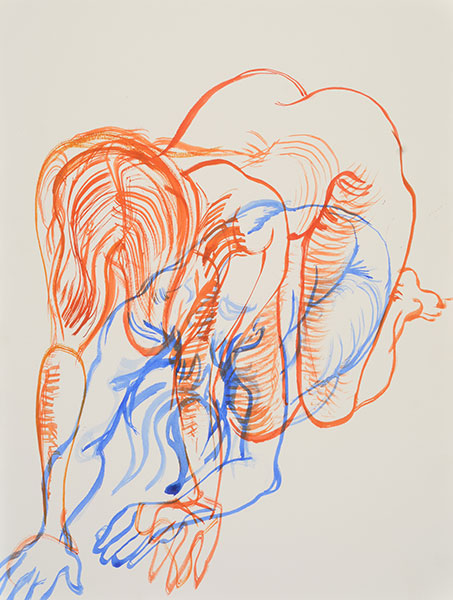
Aside from the creative arts programs, CRS is a center for spiritual healing. Practitioners use visualizations, focused breathing, and meditative mental states to channel and direct energy, much as yogis or martial artists do. I thought this would be an interesting subject to approach as an artist, so I observed and sketched at some of the healing circles at CRS. These large ink-brush drawings are based on rough sketches I made on-site.

Healing Circle 2, 2010, by Fred Hatt
It’s been a while since I attended these sessions, and some of the sessions were conducted in Japanese, which I don’t understand, so my memory could be wrong in some details, but I think all the healing sessions began with guided and silent meditation. I believe there was some private speaking between each healer and his or her receiver. The person receiving healing would sit meditating in a chair, while the healer would move around them, not touching them, but directing the hands towards various parts of the person’s body as though beaming heat waves at them. Often the healer would raise one hand towards the sky, connecting to universal energy or Holy Spirit, and face the other hand towards the receiver.

Healing Circle 3, 2010, by Fred Hatt
At other times, a healer would move their hands several inches above the receiver’s body, as though smoothing fabric or combing hair in the air around the receiver. In this drawing, instead of depicting the healers, I drew the paths of the movements of their hands around the receivers, giving, perhaps, an impression of the patterns of energy the healers perceive or conceive surrounding the body.

Healing Circle 4, 2010, by Fred Hatt
If you know my portraits and figure drawings, you’ll know that I often show “energy lines” or “auras” like this, in work that has nothing to do with spiritual healing. People sometimes ask me if I can perceive energy, if I really see all the colors I put into my drawings. I’ll try to answer those questions in this post, the remainder of which is illustrated with my drawings of the hands of various CRS healing practitioners, sketched from life as they sat in meditation.

Blessing, Healing Hands series, 2010, by Fred Hatt
I have no sixth sense. Like anyone else, my eyes perceive only light, and it is through seeing patterns of light that I can discern physical forms and movements. Through many years of practice in observational drawing, I have trained myself to look with sustained attention, and to notice very subtle variations in form and color. Through the practice of photography and filmmaking, I have learned a lot about how light works.

Connection, Healing Hands series, 2010, by Fred Hatt
Science tells us that solid matter is essentially an illusion, that all the diverse substances and objects in the world are just different arrangements of the same fundamental stuff, essentially patterns of energy. The fundamental particles and forces that make up a blade of grass are the same as those that make a blade of steel, and fire and water are different patterns, not different elements. We living creatures grow out of chemicals forged in stars, and every breath we breathe contains atoms that have been part of countless other things and beings.

Focus, Healing Hands series, 2010, by Fred Hatt
Our perception has evolved to show us a world of solid matter and separate objects. For basic animal functioning, it’s a highly effective way of understanding what is around us, but it is an illusion. I have made it a project of my life to try to train myself to see through that illusion, to make the unified field of reality not just an intellectual understanding, but a lived experience. It seemed to me that our default mode of interpreting sensory input is the most powerful impediment to getting the deeper reality of what we know, and that a practice of honing perception might be a fruitful path. My visual art practices are about learning to see the world in a way that I believe is truer than the default way, and about communicating that vision to others. To put it simply, I try to perceive physical things, especially the human form, as patterns of energy, rather than as objects.

Heart, Healing Hands series, 2010, by Fred Hatt
Perhaps some people really can perceive invisible energies directly through the eyes. Synesthesia is a well-known phenomenon in which sensory pathways get crossed, so that a synesthete might perceive particular musical notes as having colors, for example. There are many variations of synesthesia, and perhaps seeing auras is a synesthetic phenomenon. Alternatively, it could be a matter of intuition heightened by imagination – that’s what some who claim to teach clairvoyance seem to be describing. I don’t know, because I don’t perceive that way, though intuitive imagination is a fundamental aspect of art, mine as much as anyone else’s, and you can see that in these examples especially in the backgrounds, which are essentially imaginative developments around the form of the hands (more on backgrounds later).

Insight, Healing Hands series, 2010, by Fred Hatt
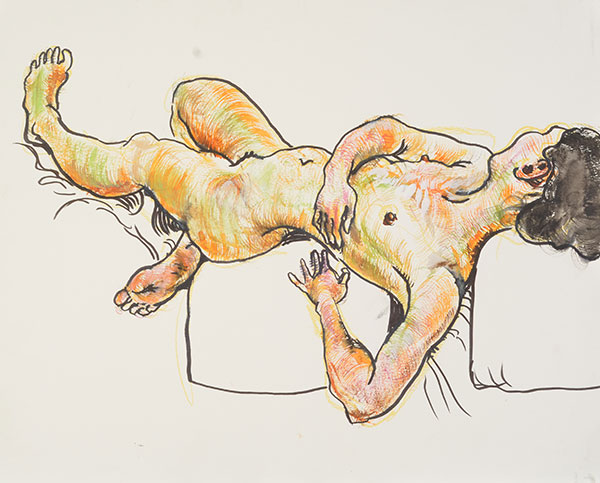
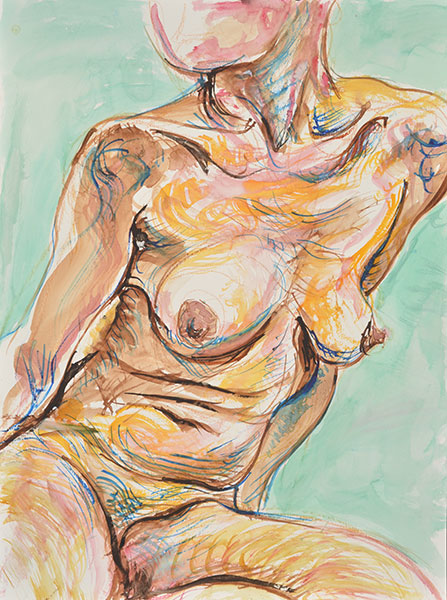
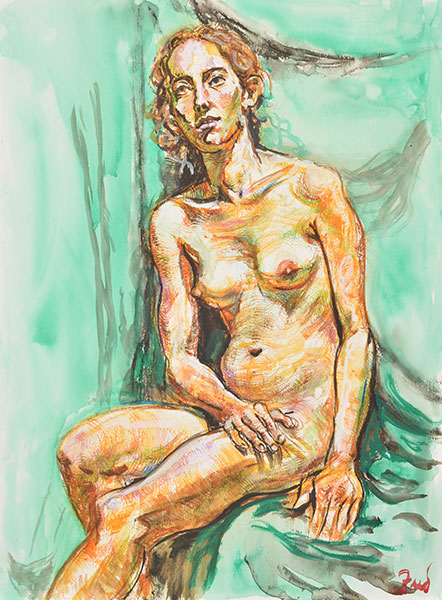
Instead, my practice is to try to link the actual mark-making as closely as possible to the act of perceiving. Ideally, every saccadic glance should be a stroke of the crayon or brush or whatever. Every mark should move as though it is flowing over the surface it is describing. The curves and rhythms of the movements of my drawing hand should reflect the patterns of organic growth that create the forms of the body, or whatever else I am drawing. My aim is to work in the most direct and dynamic way possible, and in that way to achieve an image in which flow IS form.

Light, Healing Hands series, 2010, by Fred Hatt
This approach can be steered more toward classical realism, by working to make contours and gradations as accurate as possible to what I see, or it can be steered more toward expressionism, by allowing the marks to be freer and looser – by letting the hand dance on the paper. It’s like the musical distinction between playing it straight and swinging. Generally the looser style creates a more immediate impression of energy in the viewer of the drawing. I find that accuracy of proportion is rather unimportant – if the lines have the flow of life, the drawing has life.

Receiving, Healing Hands series, 2010, by Fred Hatt
The colors are just exaggerated from what I see. In the drawing below, for example, I could see in looking at these hands that the knuckles were slightly more reddish than the rest of the skin, and the area around the veins slightly more bluish. Color perception is highly relativistic anyway – our way of perceiving color is to compare adjacent areas to see how different they are. In drawing, I often exaggerate these differences. If I’m going for the more realistic style, I work at neutralizing the extreme colors by layering them with opposing colors, and the end product can look fairly convincing, when the colors combine in the eye. If I’m being more expressionistic, I like to keep the more extreme color contrasts.

Rest, Healing Hands series, 2010, by Fred Hatt
In these drawings, the backgrounds are fanciful abstractions. Sometimes elements of the real background come into it. In the drawing above, the river of color underneath the hands contains some forms derived from the wrinkles in the pants of the model, whose hands were resting on her thighs. More often in these drawings, the backgrounds are made by echoing and extending curves in the subject, making a pattern that derives from the hands but also tries to express something of the intuitive feeling I get from the individual who is posing for me. This aspect of these drawings really is the imaginative projection I discussed above, but it takes place strictly on the paper – it’s not something I could see without drawing.

Strength, Healing Hands series, 2010, by Fred Hatt
I suppose it could be objected that my practice of working as closely as possible to direct perception of the subject, while treating the pictorial background as a projected abstraction, remains a form of separating objects, and therefore does not achieve the vision of unity I described as my ideal. Alas, my practice doesn’t quite meet my goal. It’s just the best I’ve been able to do so far in depicting the body as a pattern of energy, and it’s still a work in progress.

Warmth, Healing Hands series, 2010, by Fred Hatt
The “Healing Circle” ink brush drawings are 22.25″ x 30″ (56.5 cm x 76.2 cm). The “Healing Hands” aquarelle crayon drawings are 18.4″ x 24.5″ (46.7 cm x 62.2 cm).